
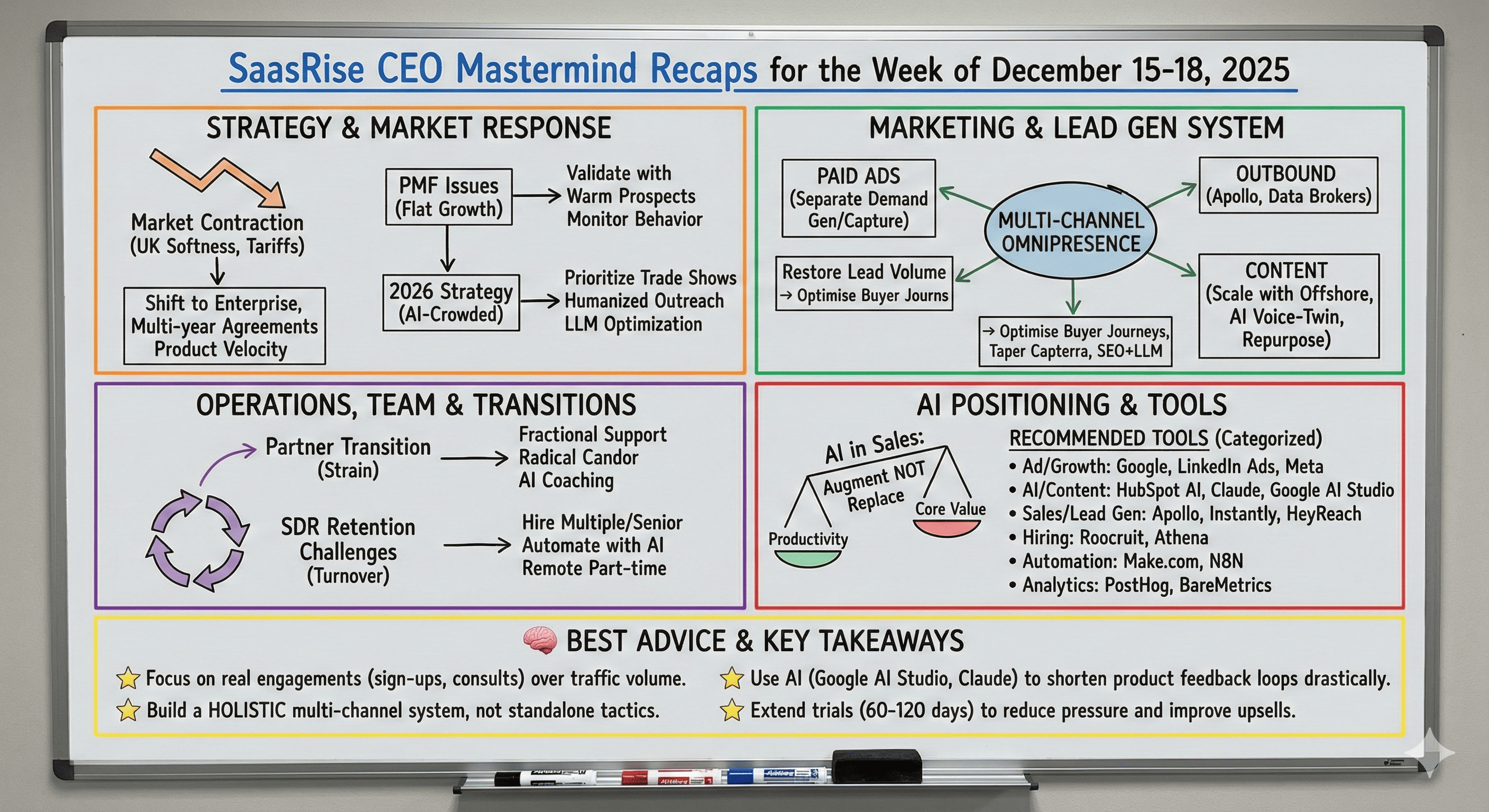
SaasRise CEO Mastermind Recaps for the Week of December 15-18, 2025
This week’s SaasRise masterminds covered market slowdowns, shifting buyer behavior, AI’s impact on sales conversations, building reliable marketing systems, hiring challenges, and managing churn. The discussions centered on today’s environment and how teams are adapting to keep growth moving.

These sessions continue weekly — offering a space for SaaS operators to learn, collaborate, and implement strategies that drive measurable growth.
Here were the topics discussed this week in the SaaS CEO and Founder Mastermind:
📉 Navigating Market Contraction
Challenges:
UK market softness, tariff-driven demand drops, 50–60% pipeline decline, customer bankruptcies, and high churn were threatening revenue predictability.
Recommendations:
Shift toward enterprise customers, increase product velocity for expansions, migrate accounts to multi-year agreements, and make decisive leadership changes when current systems stall growth.
🔍 Distinguishing Product-Market Fit Issues
Challenges:
Flat growth where new sales barely offset churn, unclear whether the issue is product quality or economic conditions, and demoralized teams.
Recommendations:
Study competitors, monitor changing buyer behavior, talk to warm prospects to validate value, and recognize AI-driven uncertainty affecting enterprise purchasing cycles.
🤖 Positioning AI in Enterprise Sales
Challenges:
Buyers questioning whether AI will replace entire software categories, procurement hesitating on long-term commitments, and certain industries rejecting AI features outright.
Recommendations:
Position AI as productivity-enhancing, keep AI optional for sensitive markets, emphasize core product value, and show how AI augments—not replaces—existing workflows.
🎯 Setting 2026 Strategy in an AI-Crowded Marketplace
Challenges:
Standing out when every vendor claims AI leadership, unclear which channels will produce growth, and underutilized product features by users.
Recommendations:
Prioritize trade shows for differentiation, invest in thought leadership, optimize for LLM visibility, focus on upsells/cross-sells, lean into humanized outreach, and use in-app messaging to drive feature adoption.
🧲 LinkedIn Marketing & Attribution
Challenges:
High CPMs, weak direct-response performance, and difficulty attributing revenue to LinkedIn efforts.
Recommendations:
Separate demand-gen from demand-capture metrics, use inexpensive Thought Leader Ads, boost customer posts, deploy Message Ads for cheap direct response, automate connection workflows, and publish both LinkedIn and email newsletters.
📝 Scaling Content Output with Small Teams
Challenges:
Limited in-house bandwidth, inability to maintain consistent publishing cadence, and high agency fees.
Recommendations:
Hire offshore content marketers, turn webinar transcripts into weekly blog posts, use AI voice-twin tools to scale content, and anchor content creation around customer interviews for authenticity.
🔁 Building a Holistic Multi-Channel Marketing System
Challenges:
Underperforming channels (LinkedIn, cold email, agencies), lack of qualified leads, and dependence on disconnected standalone tactics.
Recommendations:
Adopt a unified system: combine paid ads, outbound, content, and retargeting to create omnipresence. Use Apollo and data brokers for ABM data sourcing. Optimize for LLM crawling while maintaining SEO and paid ads.
🤝 Navigating Partner Transitions
Challenges:
A business partner stepping back created operational strain, loss of focus, and hesitancy to delegate responsibilities.
Recommendations:
Use fractional integrators, fractional marketing support, practice radical candor in discussions, and seek coaching or AI assistance to frame tough conversations while protecting the relationship.
⚙️ Restoring Lead Volume & Reducing Dependency
Challenges:
SQLs dropped by 50%, Capterra CAC reaching $50–60K per customer, and rising costs across Google, LinkedIn, and marketplaces.
Recommendations:
Return to prior successful marketing mixes, separate marketing and sales roles, use SDRs or automation to filter leads, taper dependence on Capterra, optimize buyer journeys, invest in SEO+LLM, and improve product UX and retention.
👥 Managing SDR Retention
Challenges:
High SDR turnover, year-long ramp-ups lost when SDRs leave, and difficulty sustaining junior sales roles that AI increasingly augments.
Recommendations:
Hire multiple SDRs instead of one, lean toward senior hires who can automate processes with AI, use remote SDRs for part-time capacity, accept turnover as normal, and prioritize scalable, repeatable SDR workflows.
⚙️ Recommended Tools
Advertising & Growth Tools
- Google Ads
- LinkedIn Thought Leader Ads
- LinkedIn Message Ads
- Meta Ads
- HockeyStack (LinkedIn attribution)
AI & Content Tools
- Pressmaster
- HubSpot AI Content Tools
- ChatGPT
- Claude
- Google AI Studio
- Gemini (Nano Banana Pro)
- Delphi.AI
- Typefully
Outbound, Sales & Lead Gen Tools
- HeyReach
- Kakio
- Instantly
- Apollo
- GetKen (Christian)
- Clay
- ZoomInfo
Hiring & Talent Tools
- Roocruit
- Athena
- Wing Assistant
Review, Engagement & Marketplace Tools
- Brevo (email/newsletter platform)
- Trustpilot
- Capterra
- Software Advice
- G2
- GetApp
- PartnerStack
- Impact.com
- Rewardful
Automation & Workflow Tools
- Make.com
- N8N
Analytics & Churn Tools
- BareMetrics
- PostHog
- Intercom + FIN agent
- Surecart
Localization & Translation Tools
- Weglot
- Google Translate
Team & Engagement Tools
- Kahoot
- Zoom backgrounds
Productivity Tools
- Walking Pad (treadmill desk)
🧠 Best Advice from the Calls
- Focus on driving prospects to sign up, book consultations, or engage in real conversations. These interactions attract more serious buyers, reveal what the audience truly cares about, and improve conversion quality far more effectively than increasing traffic volume alone.
- The most valuable advice was about holistic marketing strategy: Don't rely on single "magic bullet" channels or standalone tactics. Instead, build a comprehensive, multi-channel marketing system that creates omnipresence with your target market.This includes combining paid ads, outbound email, content marketing, and brand awareness efforts to generate qualified leads consistently. Success comes from the system working together, not from one individual strategy.
- The most emphasized tools were Google AI Studio and Claude for dramatically shortening product development feedback loops from months to hours.
- On Managing Churn: Extend trial periods from 14 days to 60–120 days to reduce pressure, improve engagement and create more opportunities for upsells.