
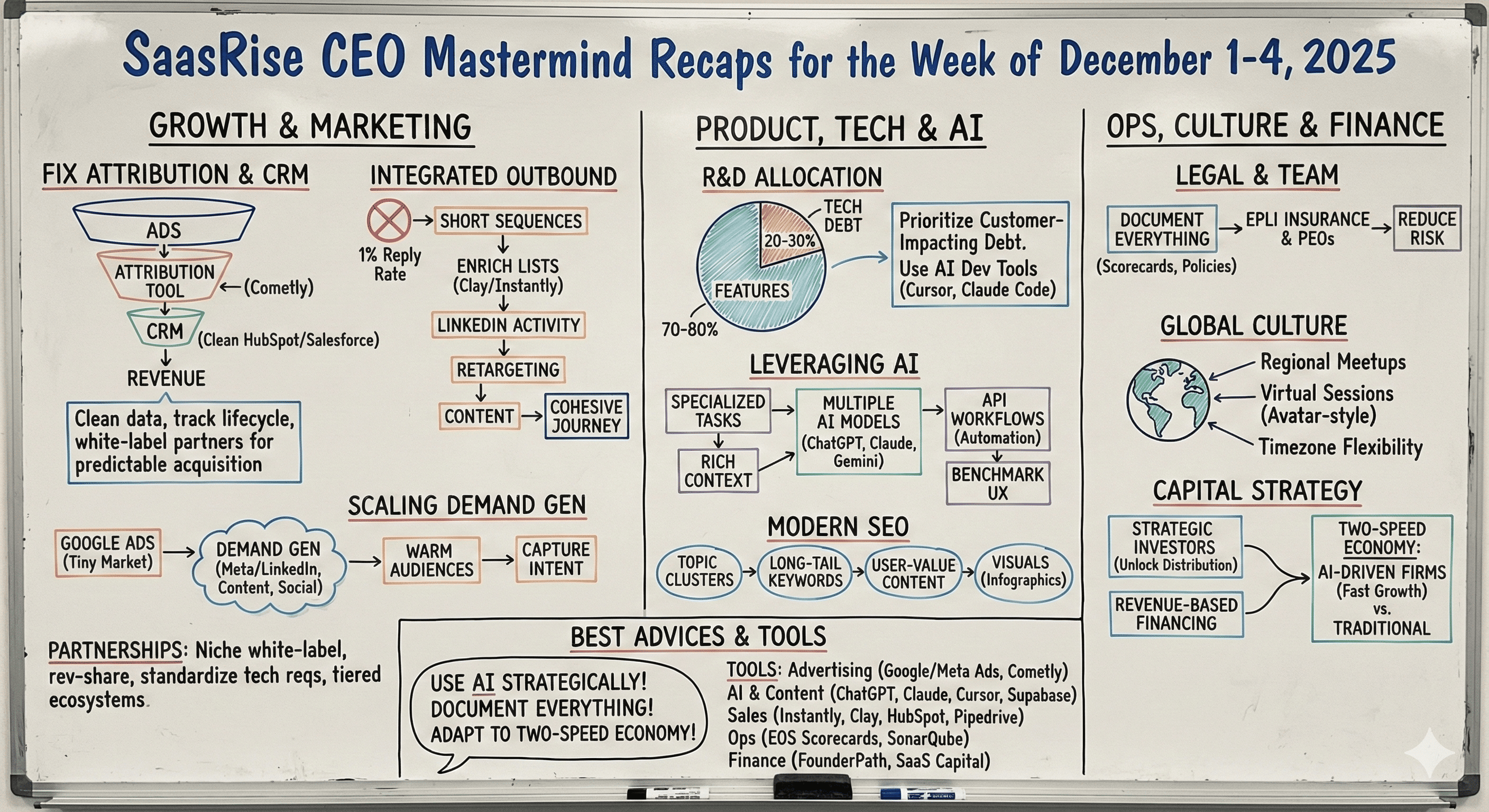
SaasRise CEO Mastermind Recaps for the Week of December 1-4, 2025
This week’s SaasRise masterminds focused on the practical systems founders are using to grow more efficiently. Members discussed fixing attribution, improving cold outbound, and moving beyond Google Ads by building real demand through content and partnerships. They also compared approaches for managing team performance, balancing technical debt with new features, and using AI to accelerate work across the company.

These sessions continue weekly — offering a space for SaaS operators to learn, collaborate, and implement strategies that drive measurable growth.
Here were the topics discussed this week in the SaaS CEO and Founder Mastermind:
📊 Fixing Attribution & CRM Visibility Across the Funnel
Challenges:
Messy HubSpot setups, unclear attribution paths, poor tracking from ads to revenue, and unreliable CRM partner integrations made it difficult to understand true pipeline sources.
Recommendations:
Clean up CRM connections, use attribution tools, audit ad settings, and track lifecycle stages. Build simple, scalable CRM or white-label partnerships for predictable acquisition.
✉️ Improving Cold Email Results & Building an Integrated Outbound System
Challenges:
Cold outreach reply rates were low (~1%), sequences were too long, and outbound worked in isolation instead of supporting ecosystem-level marketing.
Recommendations:
Shorten sequences, enrich lists better, and integrate cold email with retargeting, content, social proof, and LinkedIn activity for cohesive multi-touch journeys.
🔥 Scaling Demand Generation Beyond Google Ads
Challenges:
Over-reliance on Google Ads meant teams only captured the tiny portion of the market already in buying mode, resulting in shrinking lead quality.
Recommendations:
Invest in long-term demand generation—content, testimonials, social campaigns, and nurturing. Use Meta/LinkedIn to warm up audiences before capturing intent.
🤝 Strengthening Partnership & White-Label Strategies
Challenges:
Low-LTV customers and limited direct acquisition reach made partnerships essential. Many CRMs failed to deliver volume or required heavy integration work.
Recommendations:
Pursue niche CRM white-labeling, implement simple rev-share models, standardize technical requirements, and build tiered partner ecosystems for scalability.
⚖️ Managing Team Performance & Reducing Legal Exposure
Challenges:
Fear of wrongful-termination lawsuits and lack of structured performance documentation created risk around removing underperformers.
Recommendations:
Document everything, use scorecards, apply policies consistently, secure EPLI insurance, and leverage PEOs for legal and HR protection.
🧱 Allocating R&D Capacity Between Technical Debt & Feature Development
Challenges:
Legacy code slowed teams down, but over-focusing on tech debt stalled growth. Founders struggled with balancing innovation and stability.
Recommendations:
Adopt a 70–80% features / 20–30% tech debt split, prioritizing customer-impacting debt. Use AI dev tools to accelerate UI/UX modernization and refactoring.
🤖 Leveraging AI to Multiply Output Across the Entire Company
Challenges:
Teams lacked a structured approach to using AI for development, design, productivity, and data extraction. Prompts and workflows were inconsistent.
Recommendations:
Use multiple AI models for specialized tasks, provide rich context, use API-based workflows for automation, and benchmark AI-generated ideas against top UX standards.
📈 Modernizing SEO & Content Strategy for Long-Term Organic Growth
Challenges:
Keyword cannibalization, inconsistent publishing, and unclear prioritization reduced organic performance.
Recommendations:
Build topic clusters, target long-tail keywords, focus on user-value content, and enhance posts visually with infographics and diagrams.
🌍 Improving Remote Culture, Global Meetups & Time-Zone Operations
Challenges:
Retreats were expensive, globally distributed teams struggled with scheduling, and leaders felt the burden of planning.
Recommendations:
Start regional meetups, define participation rules, allow plus-ones, and use multi-session formats or avatar-style virtual sessions for timezone flexibility.
💰 Funding, Macroeconomic Shifts & Capital Strategy for SaaS Growth
Challenges:
Economic uncertainty, slowdown in traditional sectors, and difficulty choosing between VCs, strategic partners, or remaining bootstrapped.
Recommendations:
Select strategic investors who unlock distribution, consider revenue-based financing, and prepare for a two-speed economy where AI-driven firms grow faster than traditional ones.
🧠 Best Advices
- Use AI Tools Strategically for Business Growth — leverage multiple AI platforms (ChatGPT, Claude, Google AI Studio) for different purposes, provide proper context, question AI responses critically, and consider AI as a replacement for expensive consultants and designers.
- Document Everything for Legal Protection — document performance issues via email, use clear metrics, get EPLI insurance, and consider PEO services for protection.
- Adapt to the Two-Speed Economy — recognize AI-empowered companies are thriving while traditional sectors struggle; continuous learning is essential.
- Customer Data & Growth — analyze your best customers to replicate success and define ideal target profiles rather than guessing.
- Scaling Teams & Meetups — start small for meetups, build systematically, and balance logistics with cultural value.
- Partnership Strategy — focus on higher-value partnerships and white-label solutions instead of low-LTV individual sales.
- Customer Insights — conduct formal customer interviews to understand actual decision-making and pain points.
- Marketing Integration Advice — don't silo marketing channels; combine cold email, ads, retargeting, and outbound for a cohesive acquisition system.
- R&D Resource Allocation — maintain 70–80% focus on new features and 20–30% on technical debt, prioritizing customer-impacting areas.
- Capital Raising Approach — prioritize strategic value over pure capital; consider revenue-based financing to retain control.
- Partnership Development Strategy — start with simple revenue-sharing models, create clear technical requirements, and build tiered partnership structures.
- Cost-Effective Team Building — leverage international talent and amplify productivity with AI tools.
- Security Tool Optimization — replace expensive single-vendor solutions with smaller tools and evaluate open-source alternatives like SonarQube.
⚙️ Recommended Tools
Advertising & Growth Tools
- Google Ads
- Google Display Network
- Meta Ads (retargeting + demand gen)
- LinkedIn Thought Leader Ads
- LinkedIn Sponsored Messaging
- Partner CRM APIs
- Cometly (ad attribution)
AI & Content Tools
- ChatGPT
- Claude
- Claude Code
- Gemini (Google)
- Google AI Studio
- Perplexity
- XAI / Grok
- ARCADS (AI actors/videos)
- Nano Banana Pro 3 (infographics)
- Zoom AI Companion
- Cursor (AI dev tool)
- Supabase
- Julius.AI (ads automation)
Sales, Outbound & Data Enrichment Tools
- Instantly
- Clay
- Audience Labs
- HayReach
- Runday.AI
- Cristian / Get Ken (AI-powered outreach)
- RooCruit (international SDR hiring)
CRM, Lifecycle & Operational Tools
- HubSpot
- Hubsnacks.com (HubSpot support)
- Salesforce
- Pipedrive
- Zoho
- Monday.com
- Close
- EOS Scorecards
- Custom Dashboards
- Teachable (training)
Security & Development Tools
- SonarQube
- Veracode (legacy enterprise scanner)
- Cursor
- Claude Code
- Supabase
Financial Tools & Funding Platforms
- FounderPath
- Lighter Capital
- SaaS Capital
Collaboration & Communication Tools
- Slack
- Zoom