
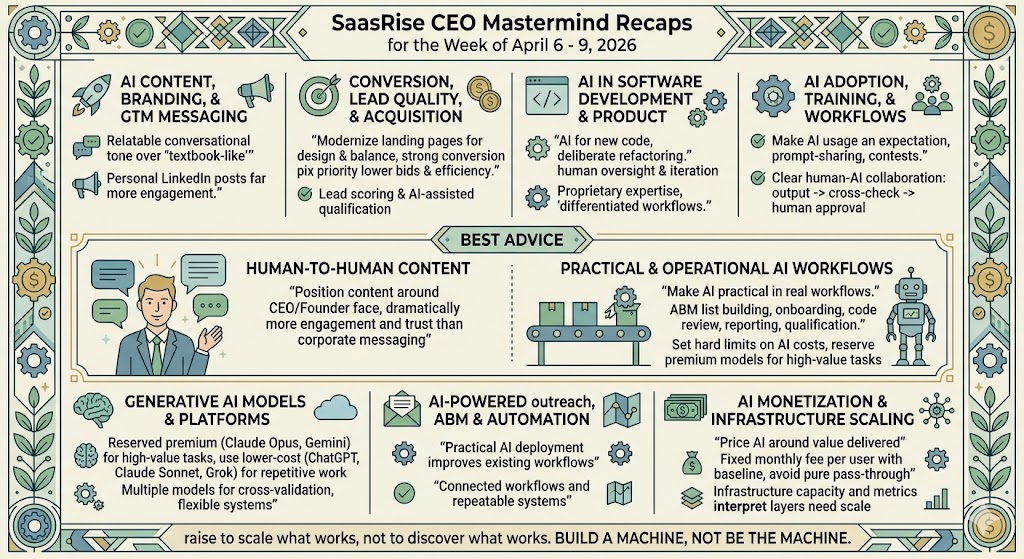
SaasRise CEO Mastermind Recaps for the Week of April 6 - 9, 2026
This week we covered founder-led content, landing page conversion, AI-assisted development, outbound and ABM workflows, AI cost control, and pricing strategy. The discussions focused on how SaaS teams can use AI in practical ways across marketing, product, onboarding, and operations while keeping messaging human and execution disciplined.

🚀 AI Content, Branding, and GTM Messaging
Challenges: Marketing materials written with AI assistance felt too textbook-like and impersonal; teams needed content that felt more engaging and credible for executives; company messaging often underperformed compared with founder-led content.
Advice: Write in a first-person conversational tone to make content more relatable. People naturally connect more with human voices than corporate messaging, and personal LinkedIn posts tend to generate far more engagement than company page posts. Repurpose existing email content into LinkedIn newsletters and consistent thought-leader posts rather than overcomplicating content production.
🎯 Conversion, Lead Quality, and Paid Acquisition
Challenges: Landing pages were getting traffic but not converting well; Google ad spend recommendations appeared confusing and often pushed higher budgets without regard to ROI; teams were also dealing with too many low-quality sign-ups.
Advice: Modernize landing pages with a cleaner design, stronger visual balance, and more detailed explanations of what users will receive. Treat Google’s calculator as a spend-motivation tool rather than an ROI optimizer, prioritize lower bids with better efficiency, and make sure conversion pixels are set up properly. Implement lead scoring and AI-assisted qualification so teams spend time on the best opportunities instead of low-quality registrations.
💻 AI in Software Development and Product Building
Challenges: Legacy codebases with millions of lines make AI integration difficult; refactoring old systems creates risk; teams are also trying to build AI products that are more than just wrappers around existing models while still managing scalability, security, and maintainability.
Advice: Use AI more aggressively for new code while being deliberate about refactoring older systems. Treat AI as a productivity multiplier that still requires human oversight and iteration. Strong AI products need proprietary expertise, differentiated workflows, and real operational value beyond simple model access, so teams should plan for long-term maintenance and avoid oversimplified assumptions about AI capabilities.
⚙️ AI Adoption, Team Training, and Human-AI Workflows
Challenges: Some team members resist using AI tools even when they are already technical or digitally savvy; non-technical teams need help applying AI effectively; organizations also struggle with how to structure human and AI collaboration.
Advice: Make AI usage an expectation, not an optional extra. Give teams access to core tools, run prompt-sharing sessions, create internal training and contests, and document marketing and operational tasks to identify automation opportunities. Embed AI agents into collaborative environments like Slack, assign them specific roles such as research, drafting, coding support, or QA, and establish clear workflows of AI output, AI cross-check, and human approval.
💸 AI Cost Control, Model Selection, and Tooling Strategy
Challenges: Managing token costs across teams can become expensive quickly, especially with premium models; companies are unsure when to use high-end models versus cheaper alternatives; there is also uncertainty around which platforms and model stack to standardize on.
Advice: Set hard daily and weekly spending limits, track usage by project or agent, and review costs regularly against ROI. Reserve premium models for high-value planning and critical reasoning tasks, while using lower-cost models for repetitive work, content, and support. Use multiple models for cross-validation where helpful, and keep systems flexible enough to switch models as pricing and performance change.
🤝 Sales Operations, Compensation, and Market Positioning
Challenges: Determining how to compensate sales versus onboarding teams for upsells can be messy, especially around trial conversions; companies are also trying to avoid saturated markets, move upmarket, and find defensible positioning.
Advice: If an upsell happens during or right after the trial, credit sales while also rewarding onboarding for influence; if it happens later, assign credit to onboarding or CSM. Prioritize more defensible channels such as CRM marketplaces over broad app stores, and move upmarket where contract sizes and churn profiles improve. Focus on strategic expansion within existing accounts and stay thoughtful about fit, competitive protection, and sales-cycle complexity.
📈 AI-Powered Outreach, ABM, and Automation
Challenges: Teams want practical AI applications across go-to-market, outreach, and reporting, but often lack connected workflows and repeatable systems; some AI interface tools may be too general for specialized use cases.
Advice: Use AI for ABM list building, ICP verification, transcript-based content creation, report generation, email automation, and dashboard building. Favor tools that integrate well with the rest of the stack, and test platforms before committing if the workflow is highly specific. Practical AI deployment works best when it improves existing workflows instead of creating disconnected experiments.
🧠 Autonomous AI Teams, QA Bottlenecks, and Knowledge Management
Challenges: Development teams using AI are producing code faster than QA can validate; companies experimenting with autonomous AI teams still need oversight; documentation and meeting knowledge often get scattered across tools.
Advice: Use AI agents for code review and pre-review feedback to reduce QA bottlenecks before human engineers step in. Structure autonomous AI teams with clearly defined roles and alerts for unexpected behavior, while maintaining human oversight for high-risk work. Use GitHub as a single source of truth for code, documentation, and automatically recorded meeting outputs, and pair it with project management tools like Linear to keep work organized.
🏢 AI-Driven Onboarding, Customer Expansion, and Churn Reduction
Challenges: Traditional onboarding can take weeks, slowing activation and limiting growth; companies also face churn pressure and need higher-value deal flow.
Advice: Reimagine onboarding with AI assistants to reduce setup time from weeks to minutes or hours, but pilot thoroughly before scaling to make sure users actually complete the flow. Start with smaller companies first, then expand once the process is reliable. Moving upmarket can reduce churn significantly, and expansion within existing customers through new features and products can be a strong growth lever.
💰 AI Monetization, Infrastructure, and Pricing Models
Challenges: Enterprise customers struggle with token- or credit-based pricing because it creates budgeting uncertainty; conversational AI interfaces and MCP-style experiences can also create major infrastructure load and multiple downstream API calls.
Advice: Price AI around value delivered rather than raw token usage. A strong model is a fixed monthly fee per user with baseline usage included, then overage pricing if needed. Avoid pure pass-through pricing, add margin to AI costs, and think carefully about whether conversational access should be direct or delivered as a managed service. As engagement rises, infrastructure capacity and metric interpretation layers need to scale alongside the product experience.
Best Advice
The most impactful advice was about positioning content around people rather than companies: in B2B SaaS, companies that succeed build their brand around a figurehead (CEO/founder) who becomes the face of the company, sharing their personal experiences and expertise. This human-to-human approach generates significantly more engagement and trust than corporate messaging, as evidenced by the dramatic difference in engagement between founder posts versus company page posts on platforms like LinkedIn.
For cost and model management, it is important to always set hard daily and weekly spending limits on AI usage to prevent runaway costs. Premium models like Claude Opus should be reserved for complex, high-value tasks, while more affordable models such as ChatGPT-4 or Sonnet can be used for routine work. Additionally, leveraging startup credits from platforms like Azure or OpenRouter can help reduce operational costs.
The broader recommendation across the sessions was to make AI practical and operational rather than theoretical. That meant embedding AI into real workflows such as ABM list building, content repurposing, software prototyping, onboarding, code review, reporting, and qualification. The winning teams were not using AI as a novelty layer; they were building structured human-AI workflows with clear roles, approval steps, and measurable business outcomes.
Another strong thread was around simplifying GTM and operational decisions. Teams were encouraged to modernize landing pages, improve lead scoring, avoid blindly trusting ad platform recommendations, and create compensation structures that reflect actual influence on conversion. Across growth, onboarding, and monetization, the emphasis was on designing systems that are easier to manage, easier to scale, and easier for teams and customers to understand.
Recommended Tools
AI Platforms & Models
- ChatGPT
- Claude
- Claude Code
- Claude Opus
- Claude Sonnet
- Cursor
- Gemini
- Grok
- OpenClaw
AI Agents, Automation & Integration
- Cortis
- GetVictor
- Make.com
- N8N
- OpenRouter
- Paperclip
- Pipedream
- Zapier
Development, Knowledge & Project Management
- GitHub
- Google AI Studio
- Linear
- Lovable
- Replit
- VS Code
Sales, Outreach & Marketing
- Apollo
- Brive AI
- Clay
- Fireflies
- HubSpot
- Instantly
- ListKit
- Manus
- ZoomInfo
Analytics, Billing & Operations
- Bear Metrics
- Cometly
- NetSuite
- PostHog
- Stripe
Infrastructure & Training
- Authority Hacker
- Azure