
SaaS Sales Team Structure and Compensation
A founder-level guide to building a scalable SaaS sales organization—covering SDR, AE, and CSM roles, quota design, compensation models, funnel math, and how to align sales performance with ARR growth.

If you’ve done the hard work on marketing over the last couple months, this is what usually happens next: the lead flow starts to show signs of life, and suddenly the real constraint becomes your sales machine.
Not your ads. Not your outbound copy. Not your click-through rate.
It’s what happens after the lead raises their hand.
I’ve watched a lot of SaaS companies accidentally build a “marketing success story” that turns into a revenue disappointment, simply because there wasn’t a clear process, clear roles, and clear comp behind the scenes. Or worse, because the founder was still the system.
One line from the session sums it up: “We’ve spent the last six weeks talking about how to scale lead acquisition. Now we’re going to talk about how to turn those leads into paying customers.”
The simplest way to think about responsibilities
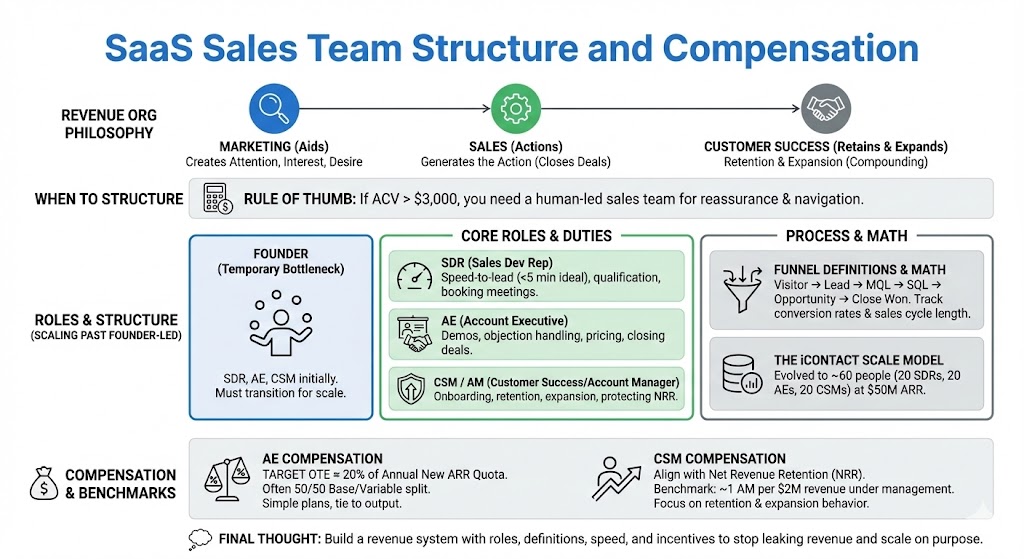
I like mapping the revenue org to a clean mental model. During the webinar I explained it as marketing’s job to “aid” the sales org.
In my words: “Marketing’s job is to aid the sales organization by creating attention, interest, and desire. Sales generates the action.”
Then customer success owns what too many teams treat as an afterthought: retention and expansion. That is where compounding happens.
If you’re trying to structure your team, start here. Clarity before headcount.
When you actually need a sales team

A lot of early SaaS founders want to skip sales and go full self-serve. Sometimes that works. Most of the time, it stops working right around the point you want real growth.
The rule of thumb I shared is straightforward: “If you have an ACV north of $3,000, you should probably have a sales team.”
Once you’re in that range, a human-led motion is usually necessary. Your buyer needs reassurance, navigation, and someone who can translate the product into their specific situation.
And even if you have a product-led motion, you still need sales to pick off the deals that are bigger, more complex, or require procurement.
Roles that scale past founder-led sales
Here’s the big shift: at the beginning, the founder is the SDR, AE, and sometimes even the CSM. That’s normal. It’s also temporary.
At some point, you need a structure that produces revenue even when the founder is not on the calls. In the session I said it plainly: if you’re the CEO and you’re still on most sales calls, it becomes “a bottleneck.”
The core roles and what “good” looks like:
- SDR (Sales Development Rep): Speed-to-lead, qualification, booking meetings for the AE.
- AE (Account Executive): Running demos, handling objections, pricing conversations, and closing.
- CSM (Customer Success Manager) / AM (Account Manager): Onboarding, retention, expansion, and protecting NRR.
That’s the structure. Everything else is a variation.
The hidden killer: slow follow-up
If your team is paying for leads and responding a day later, you’re lighting money on fire.
One of the cleanest quotes from the session: “Speed to lead is critical.”
And then I got even more specific: “The most successful sales organizations get back to their leads within five minutes.”
Do most B2B SaaS companies actually do five minutes? No. But if you’re not responding within an hour during business hours, you’re giving away conversion rate.
Also, speed is not just one email. It’s using every reasonable channel you can, quickly, and consistently, in a way that doesn’t feel spammy.
Funnel definitions matter more than people admit
Most companies have a funnel. Very few companies have clear definitions.
You need definitions because you need math. If you don’t have math, you can’t scale confidently. You can’t say what a qualified lead is worth. You can’t defend budget. You can’t tell whether the problem is marketing or sales.
The funnel stages I see most often look like: visitor → lead → MQL → SQL → demo/opportunity → proposal → close won/close lost.
You can tweak the language, but you cannot avoid the need for definitions and conversion rates at each stage.
Your sales math should answer these questions every month:
- What percentage of leads become SQLs?
- What percentage of SQLs become opportunities?
- What percentage of opportunities close?
- What is the average sales cycle length and where deals get stuck?
That’s how you decide what you can afford to pay for a lead, and where to invest next.
A real example: the iContact scale model
At iContact, we built the company to about $50M ARR, and the revenue org eventually looked like this: around 60 people in sales and success, with roughly 20 SDRs, 20 AEs, and 20 CSMs or account managers.
And here’s the thing most people miss: the structure didn’t start there. It evolved. We started founder-led, then added reps, then built process, then specialized roles.
Segmentation also mattered. We didn’t treat every lead the same. When we identified higher-value opportunities, we routed them into a higher-touch motion.
That approach is still relevant today, even if your product is different.
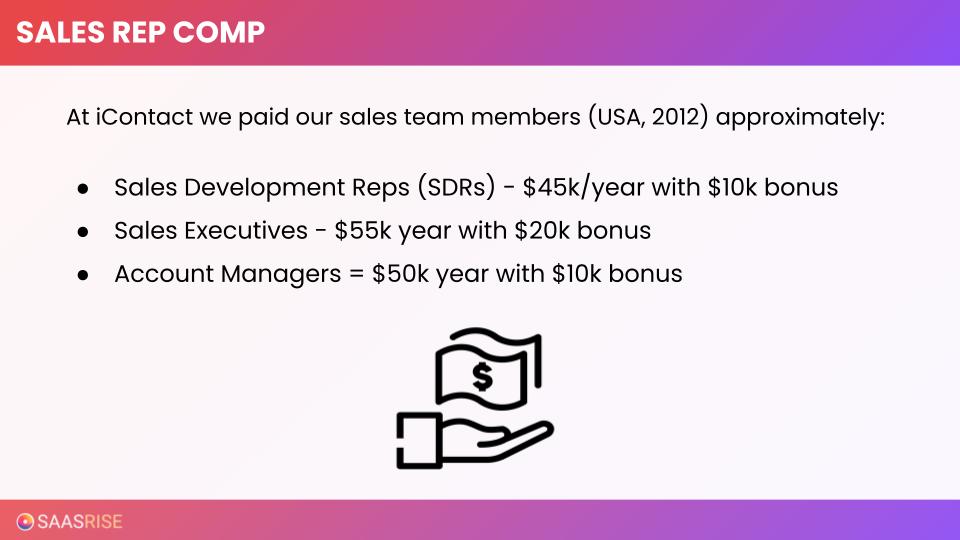
Compensation: keep it simple and tied to output
Sales comp gets complicated when leaders try to micromanage behavior instead of rewarding outcomes.
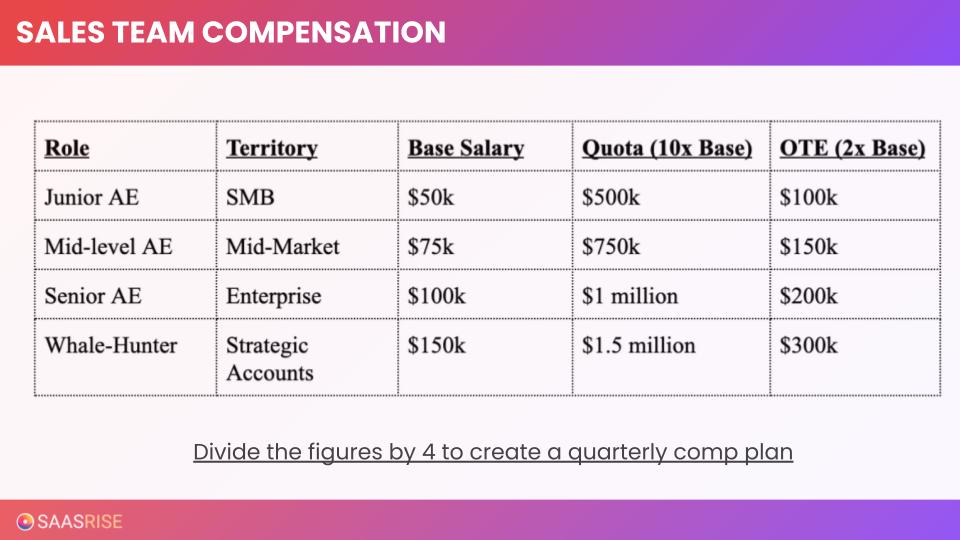
For AEs, the clean framework I gave is: “You want your AEs’ on-target earnings to be about 20% of the ARR they generate per year.”
The reason is obvious. If an AE generates $1M in new ARR, paying roughly $200k OTE is rational. If they generate $500k, paying roughly $100k is rational. The numbers can vary, but the relationship should hold.
A practical AE comp baseline (adjust for market and deal size):
- Target OTE around 20% of annual new ARR quota
- Often split roughly 50% base, 50% variable
- Avoid complicated plan designs that create loopholes and confusion
There’s also a management truth that too many founders avoid: if someone misses quota repeatedly, you can’t carry them forever. In the session I said it directly: “If you miss your quota twice, you’re gone.”
That’s not cruelty. It’s fairness to the business and to the team.
Customer success: where compounding happens
If you want to build a valuable SaaS company, you cannot treat customer success as “support.”
It’s revenue.
One benchmark I shared from our experience: “You should have about one account manager for every $2M in revenue under management.”
You can flex that depending on complexity and customer needs, but it’s a useful anchor.
And for comp, I strongly prefer aligning CSMs to NRR. It forces the right behavior: retain customers, expand accounts, and build a product and onboarding motion that keeps people winning.
CSM comp and management should center on:
- Net revenue retention (NRR), not just churn
- Expansion behavior and account health
- Clear ownership of onboarding and ongoing success milestones
Final thought
The mistake I see most often is founders investing in marketing to generate leads, then letting sales operate as an informal craft project.
A scalable SaaS company needs a revenue system: roles, definitions, speed, and incentives that make sense.
If you build that system, you can actually capitalize on what your marketing is producing. You stop leaking revenue. You stop guessing. You start scaling on purpose.