SaaS Sales Tax: When the Gray Area Ends and Compliance Begins
Sales tax is easy to ignore until an investor, acquirer, or state tax office makes it impossible. Here's how SaaS CEOs think about nexus thresholds, risk, reserves, and the moment you need to get fully compliant.

Sales tax is one of those topics that almost every SaaS founder has quietly pushed to the bottom of the list. The rules differ by state, they keep changing, and for a lot of years software sat in a gray zone where nobody was quite sure what applied. So many founders do the reasonable thing in the moment: file where they're based, keep an eye on it, and promise to sort it out later.
This came up two days in a row in our masterminds, which tells you how much it's on people's minds. In the enterprise group, a founder preparing to be diligence-ready ahead of a potential round or exit asked who was actually tracking nexus and paying sales tax. The next day, a founder running a low-ticket, high-volume product asked what we meant by the "gray area" and whether it was time to get serious. The two conversations together paint a pretty clear picture of how to think about it.
Quick note before we go further: I'm not a tax advisor, and the specific state rules below are what members shared from their own research. The rules change often, so confirm anything you act on with a sales tax professional.
The rules are messier than most founders realize
The enterprise founder had done a research project on the current state of SaaS sales tax, and the picture was complicated. Their home state used to exclude software that required significant customization, then changed its law. Thresholds vary widely. Some large states, including Texas, New York, and California, use a $500,000 sales threshold. A few states, such as Alabama and Mississippi, sit at $250,000. Around 20 states use a $100,000 threshold. And California was flagged as expanding its rules to cover SaaS revenue starting January 1.
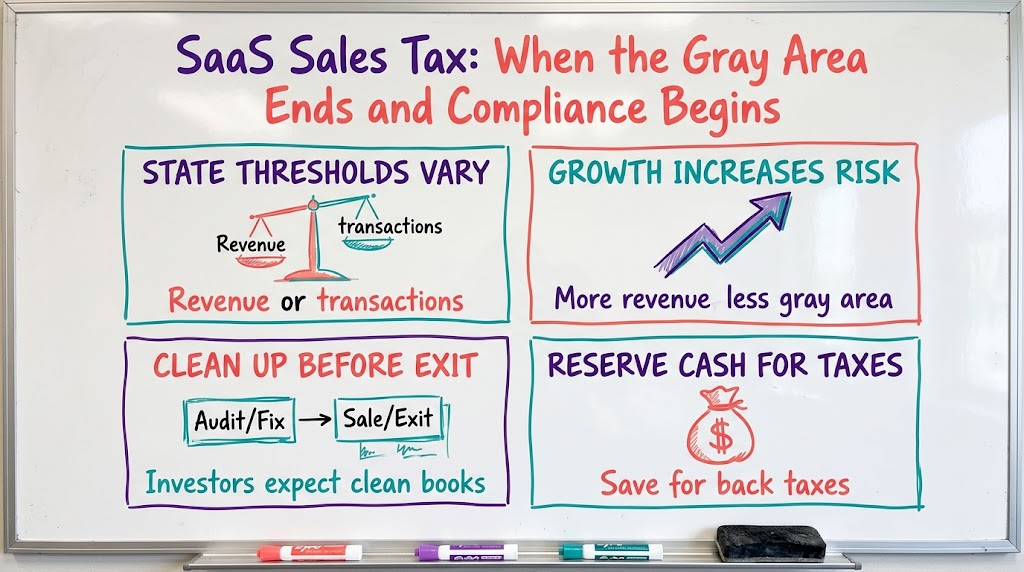
- Revenue thresholds vary by state. Members cited thresholds from $100,000 up to $500,000 in sales into a given state before you have to collect.
- Transaction thresholds exist too. Some states trigger on the number of transactions, often around 100, regardless of dollar amount.
- How you invoice matters. If a transaction means an invoice, billing annually counts as one transaction even when the customer pays monthly.
- Nexus can come from people. One CEO noted that having an employee in a state creates nexus there, which means you have to charge sales tax.
- Laws keep moving. Several states have changed how they treat software recently, so last year's answer may not hold.
The transaction rule is where low-ticket companies get squeezed. The founder with the inexpensive monthly product pointed out that 100 transactions in a state is nothing for a business like his, so he technically triggers filing requirements in many states where the actual tax owed is tiny. Those rules were clearly written with a different kind of business in mind.
There are also practical questions that don't have obvious answers. One founder sells to corporate groups headquartered in one state that own properties in a dozen others, and asked whether to count where the corporate office is or where the properties are. Another CEO's rule of thumb was simple: wherever they bill to is where they tax to, regardless of where the software is used.

Know where you sit on the risk curve
Here's the framework I shared, because I think it's what most founders actually need. The only way to sort of live in the gray is if you're under about $5 million in revenue, under about 10 employees, not raising institutional capital, and not about to be acquired. Regulation enforcement tends to be lighter on companies that size. Once you get to 20 or 30 employees and north of $5 million, it can really get you.
- Small and independent. Sub-$5M, a small team, no institutional money, and no exit on the horizon. There's more gray area here, though risk never goes to zero.
- Raising serious capital. Before you raise more than about $5 million in institutional money, expect investors to dig into sales tax.
- Preparing to sell. As I put it to the group, before you sell your company for more than $10 or $15 million, "they'll put you through the wringer on IP assignment and sales tax."
- Growing fast. Rapid growth can take you from low-risk to high-exposure faster than your finance processes catch up.
For the founder heading into a potential transaction, the answer was clear. Stay on the safe side, because it will definitely come up in diligence, and you'll have to pay it eventually anyway. Getting compliant before the process starts means it shows up as a clean line item rather than a surprise that slows down or reprices a deal.
Paying for peace of mind
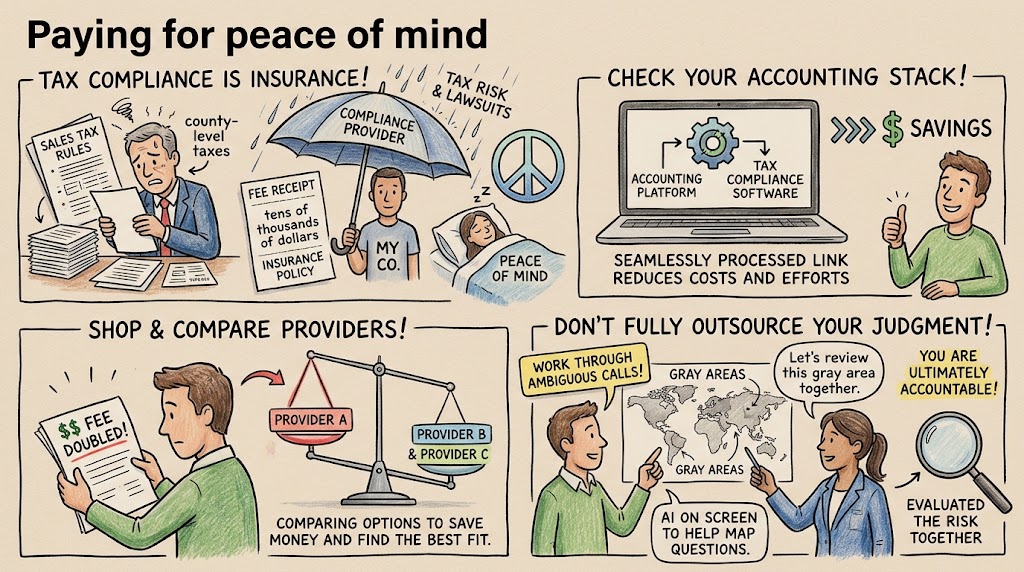
One CEO in the enterprise group explained why his company pays a sales tax compliance provider without hesitation. They had previously been exempt when they bundled hardware with software, then the rules changed, and they didn't want to discover they were out of compliance after the fact. As a founder-owner, he pointed out, sales tax issues can become personal liability. In his words, they don't mess around with taxes. They pay a provider in the tens of thousands of dollars a year, and he described it as an insurance policy that also handles obscure county-level taxes.
- Think of it as insurance. A compliance provider's fee buys you accurate calculation, filing, and protection from mistakes you didn't know you were making.
- Check your accounting stack. Some accounting platforms now integrate tax compliance directly, which can reduce the cost and effort.
- Shop your provider periodically. Another founder said their provider recently doubled its fees, which was a good prompt to compare options.
- Don't fully outsource your judgment. One member warned that providers and tax professionals can make errors or interpret gray areas conservatively. Work through the ambiguous calls with them.
That last point is worth sitting with. The member who raised it said the first step is to honestly assess your relative risk, then hammer out the gray areas with your advisors so you understand where you land and why. AI tools can help you map the questions, but you still need someone accountable for the answers.
The mistakes that hurt the most
A few specific warnings came up that every founder should hear. The first came from a sales tax lawyer one founder worked with: collecting sales tax and not remitting it is a much bigger problem in the eyes of the state than not collecting it at all. If you collect it, pay it. The second came from a member who said their tax consultant singled out California as the one state that really goes after companies and doesn't stop at a few years of lookback. Their approach has always been to do it right by California.
The third is a story from a company I sat on the board of. They grew from about $5 million to about $50 million in revenue very quickly, and a lot of that revenue came from customers in Washington, D.C. They didn't pay attention to sales tax for a couple of years, then got a letter from the D.C. tax authority asking for a percentage of everything they'd billed there. The bill landed in the millions, with a 50% penalty on top.
- Collected tax must be paid. Holding onto tax you collected from customers is treated far more seriously than failing to collect.
- Lookback windows are real. One founder who got compliant in his home state paid about five years of back taxes. States can't usually go back forever, but they can go back far.
- Fast growth creates fast exposure. The faster you grow into a jurisdiction, the faster a small oversight becomes a large bill.
I share these because each one maps to a specific way founders get hurt, and each one has a simple preventive habit.
A practical plan for each stage
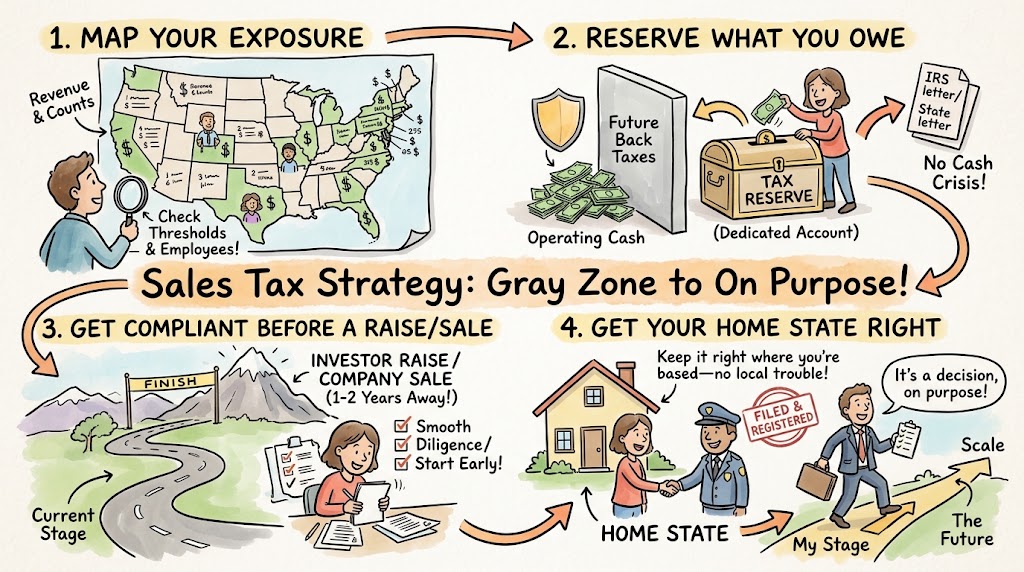
So what should you actually do? My main advice for anyone still in the gray zone is simple: don't spend the money you might have to pay someday. Set up a separate savings account and put aside what you might owe, so a letter from a state doesn't turn into a cash crisis. One founder had followed a startup lawyer's advice years ago to file in his home state and sort out everything else if and when he decided to sell. That can be a reasonable position at small scale, as long as you treat it as a deferred liability rather than money that's yours to spend.
- Map your exposure. Look at revenue and transaction counts by state, plus where you have employees, and see which thresholds you cross.
- Reserve what you might owe. Keep a dedicated account so future back taxes don't come out of operating cash.
- Get compliant before a raise or sale. If institutional capital or an exit is a year or two away, start now so diligence goes smoothly.
- Get your home state right. Whatever else you decide, don't create local trouble where you're based.
Sales tax will never be the most exciting part of running a SaaS company. But once you understand where the gray area ends, it stops being a vague worry and becomes a decision you can make on purpose, with a plan for the stage you're in and the stage you're heading toward.