
SaaS Marketing Team Structure and Roles
A clear framework for structuring a high-performing SaaS marketing team, defining ownership across content, paid media, and growth operations, and building a full-funnel system that drives predictable pipeline.

Most founders build marketing the same way they build early product: scrappy, improvised, and extremely dependent on one person.
That’s fine at $500k ARR.
At $5M ARR, it becomes fragile.
At $15M ARR, it becomes dangerous.
Because marketing isn’t “a channel.” It’s the system that creates attention and preference in your market, week after week. And without structure, you end up with random acts of marketing that look busy but don’t compound.
In the session, I framed marketing’s role in a way that’s simple but important: “Marketing’s job is to build awareness and generate leads.”
That’s true, but it’s incomplete unless you also define what marketing exists to do for sales.
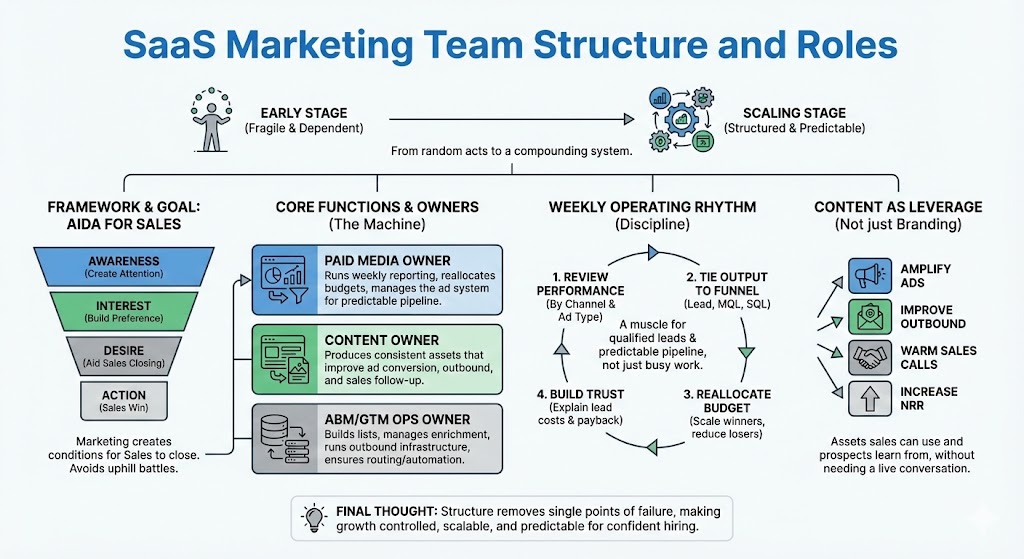
Marketing exists to “aid” sales
I like the AIDA framing because it forces clarity.
In my words: “Marketing aids the sales organization by creating awareness, interest, and desire.”
.jpg)
Marketing creates the conditions where sales can close. If your sales team is pushing every deal uphill, marketing isn’t doing its job.
This becomes even more important as you scale ads and outbound, because your spend can grow fast. The cost of confusion rises with budget.
The mistake: killing the channels that create future demand
When teams start tracking CPL by channel, they often make a predictable mistake: they fall in love with the cheapest channel and turn off the ones that are actually creating awareness.
I said it bluntly on the call: “Don’t kill the goose that lays the golden egg.”
Retargeting and brand search will usually look best. That does not mean they should get 100% of your budget. Those channels are downstream. They benefit from the demand created elsewhere.
A good marketing team understands this and builds a full-funnel system, not a single-channel spreadsheet.
What the marketing org looks like when it’s built correctly
At iContact, by the time we were at about $50M ARR, we had roughly 12 people in marketing.
And the interesting part is not the number. It’s how the work was divided.
.jpg)
We essentially organized marketing into a few core functions: paid media, content creation, ABM, and events/webinars.
That structure is still a good blueprint today, even if you modernize the tactics.
Because in SaaS, marketing has to do four things well:
- generate awareness inside the ICP
- convert demand when it appears
- deliver qualified leads to sales with clear definitions
- build trust so deals close faster and expand easier
The roles I’d build first in a modern SaaS team
When people ask me “what should my marketing hires be?” I don’t answer with job titles. I answer with responsibilities.
You need owners for the big machines.
The first three marketing “owners” most SaaS companies need:
- Paid Media Owner: runs the weekly reporting muscle, reallocates budgets, manages the ad system.
- Content Owner: produces a consistent stream of assets that make ads, outbound, and sales follow-up convert better.
- ABM/GTM Ops Owner: builds lists, manages enrichment, runs outbound infrastructure, ensures routing and automation are correct.
Sometimes one person can cover two of these early. But somebody must own them.
If nobody owns them, nothing compounds.
Weekly reporting is a marketing competency, not a task
As budgets scale, your marketing org needs a rhythm.
During the session I called out the operational expectation: build a muscle to review CPM, CPC, CTR, and lead numbers weekly, so marketing can deliver “qualified leads and predictable pipeline.”
That weekly cadence is what allows you to scale the winners 10–15% per week and reduce spend on the losers, without thrashing the system.
It also creates trust with leadership. When you can clearly explain what a lead costs, how it converts, and what payback looks like, marketing stops being an expense and starts being an investment.
A simple weekly marketing operating rhythm:
- Review performance by channel and ad type, not blended averages
- Tie marketing output to funnel stages and definitions (lead, MQL, SQL)
- Reallocate budget and effort based on what is actually converting
That’s how you avoid “busy marketing” and build revenue marketing.
Content is not branding. It’s leverage.
A lot of teams treat content as optional because it’s harder to attribute.
That is a short-term view.
Content is what allows your outbound to land better, your ads to feel familiar, your sales calls to start warmer, and your NRR to improve because customers actually understand how to win with your product.
The best content teams don’t create random posts. They create assets that sales can use, ads can amplify, and prospects can learn from without needing a live conversation.
Final thought
Marketing team structure is not about feeling “grown up.” It’s about removing single points of failure.
When marketing is structured around clear roles, weekly discipline, and full-funnel thinking, it becomes predictable. It becomes scalable. And it becomes the thing that lets sales hire confidently because the pipeline isn’t a mystery.
That’s the real win: a marketing org that makes growth feel controlled instead of chaotic.