
SaaS M&A Timing: EBITDA vs. Growth
Public SaaS valuations are climbing fast off their April lows, and buyers are calling again. That's forcing founders into a real decision: protect EBITDA for a near-term sale, or keep investing in growth and bet the market stays open.

A founder in our mastermind group came to a recent call with a good problem. His business was starting to see unsolicited acquisition interest again, something he hadn't experienced in a while, and one of his key stakeholders had just told him the opposite of what he expected to hear. Instead of pushing to double down and wait another year or two for a bigger outcome, the stakeholder said he thought there might be another good market in a year or two, but that there was a real one right now, and maybe it was time to see what they could get.
The founder wasn't so sure. His plan for the rest of the year involved moves that were explicitly counter to growing EBITDA in the short term: strategic hires he believed the business needed to be in a stronger position by next summer or fall. He was torn, because the moves that would most likely keep the business growing through a sale process, which he believed was the best way to get a strong offer and actually get it to close, were the same moves that would suppress the EBITDA number a buyer would look at right now.
Why the market suddenly feels different
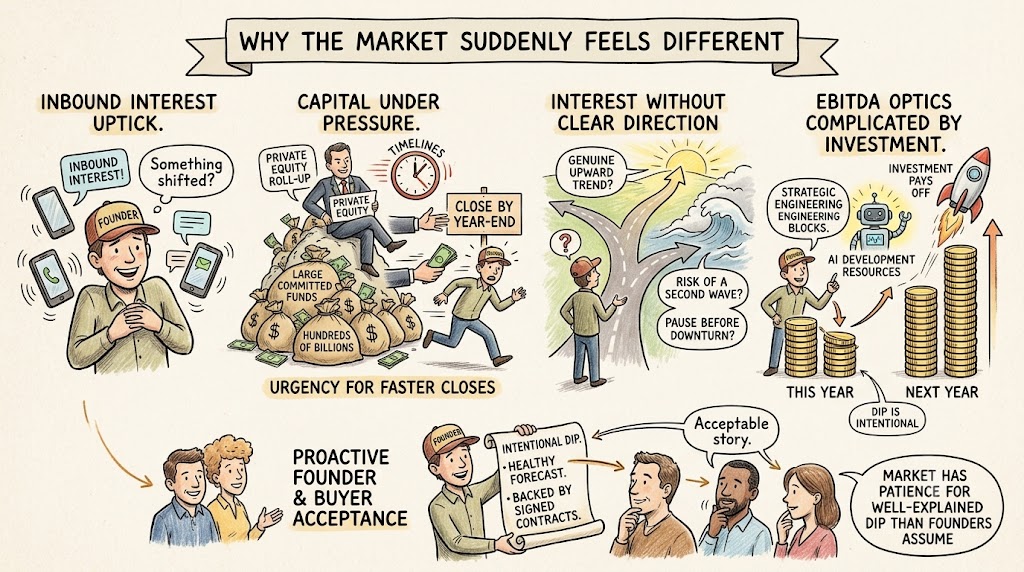
Another founder in the group backed up the sense that something had shifted. He'd seen a real uptick in inbound interest, and pointed to a dynamic worth understanding: private equity roll-up firms have raised enormous amounts of committed capital, reportedly in the hundreds of billions across the space, and that capital has to get deployed. Several buyers had directly asked him whether his company could actually close by the end of the year, which is not a question buyers ask when they're browsing.
- Capital under pressure to deploy. Roll-up firms sitting on large committed funds face their own timelines, and that urgency shows up as buyers pushing for faster closes.
- Interest without a clear signal on direction. Both founders described the same uncertainty: is this a genuine upward trend, or a pause before another downturn, sometimes described as the risk of a second wave?
- EBITDA optics complicated by real investment. One founder's EBITDA is set to drop this year specifically because of strategic decisions around AI development and deployed engineering resources, even though those investments are expected to pay off next year.
That last point turned out to matter more than expected. Rather than let a lower EBITDA number speak for itself, that founder had proactively shared the reasoning with the buyers he was in conversation with: this year's dip is intentional, next year's forecast is healthy, and it's backed by contracts that are already signed. So far, buyers have been accepting of that story rather than trying to discount the business for it, which suggests the market has more patience for a well-explained dip than founders often assume.
Why buyers can be patient with a strategic dip
It's worth digging into why that founder's buyers were willing to look past a weaker EBITDA number this year instead of using it to push the price down. Part of it is timing. Because the conversations were happening in August, several buyers were already thinking ahead to next year's numbers rather than anchoring entirely on the current year. Part of it is that the story was backed by something concrete: signed contracts that support the forecast, not just a founder's optimism about where the business is headed.
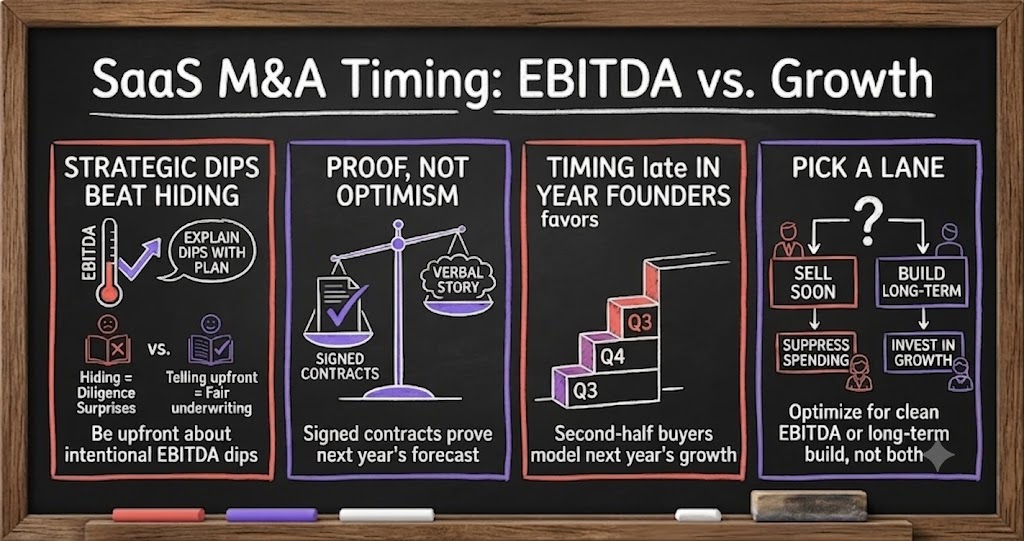
- Timing works in a founder's favor late in the year. Buyers evaluating a deal in the second half of the year are often already modeling next year's numbers, which gives a temporary dip less weight.
- A forecast needs proof, not just a story. Signed contracts that support next year's projection carry far more credibility with a buyer than a verbal explanation of why this year looks soft.
- Explaining a dip beats hiding one. Buyers who are told upfront why EBITDA is down, and shown the plan behind it, tend to underwrite the business more fairly than buyers who discover it themselves during diligence.
That last point connects directly back to the retrade problem this group talks about constantly. A surprise discovered during diligence gets treated as a red flag. The exact same fact, disclosed upfront with context and evidence, gets treated as a manageable detail. The underlying numbers don't change, but the story a buyer tells themselves about your business does.
The data behind the shift
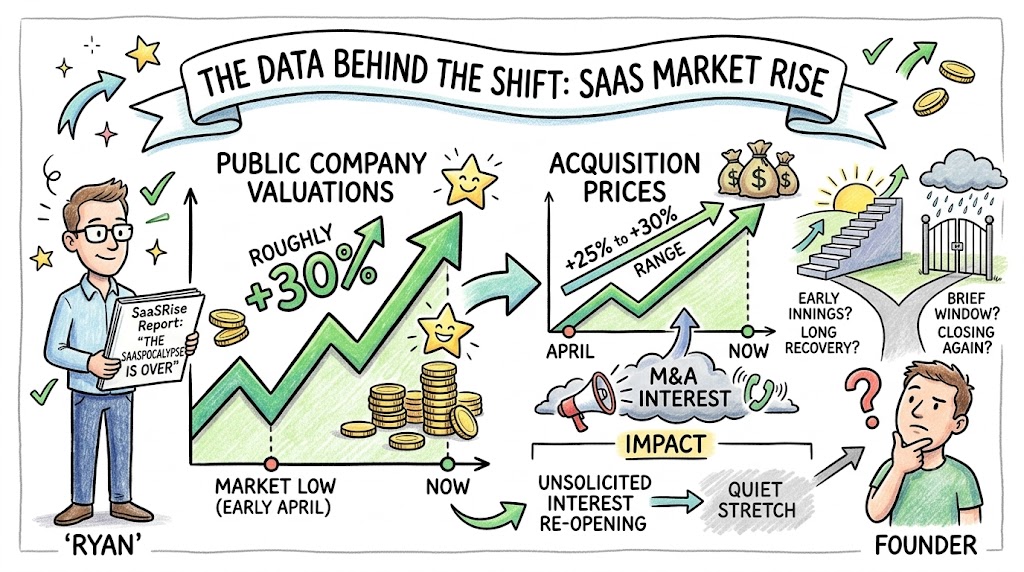
Ryan had done research of his own to check whether what the group was seeing anecdotally held up quantitatively. The result was a recent SaaSRise research report titled "The SaaSpocalypse Is Over," which found that since the market low in early April, public SaaS company valuations are up roughly 30 percent. Because acquisition multiples tend to track public market multiples, that implies the prices buyers are willing to pay have moved up somewhere in the same 25 to 30 percent range over the same window.
That's a meaningful move in a short period of time, and it explains why unsolicited interest is picking back up after what had been a quiet stretch for enterprise software M&A. It doesn't answer the harder question every founder in this position actually has to answer for themselves, which is whether this is early innings of a longer recovery or a brief window that could close again.
How to actually decide
Ryan's framing was simple, and it cuts through a lot of the anxiety around timing: growth now can turn into EBITDA later, but the two goals pull in opposite directions in the short term, so the decision has to start with what you actually want.
- If you want to sell in the next six months, hold off on new strategic investments and let EBITDA run as clean as possible, since that's the number a near-term buyer will underwrite most heavily.
- If you're building for the long term, keep making the investments the business needs and treat the current wave of buyer interest as background noise rather than a deadline.
- If you're genuinely undecided, the honest move is to be transparent with any buyer in the room about what you're investing in and why, the way one founder did, rather than quietly suppress spending to look better for a deal that may not materialize.
That last option matters because it's the one most founders in this situation actually face. Few people know with certainty six months out whether they want to sell. Trying to optimize the business simultaneously for a near-term exit and a long-term build usually means doing neither well. Better to pick a lane, or at least be honest with buyers about which lane you're in, than to make half-measure decisions that hedge against both outcomes and satisfy neither.
What this means if you're weighing the same decision
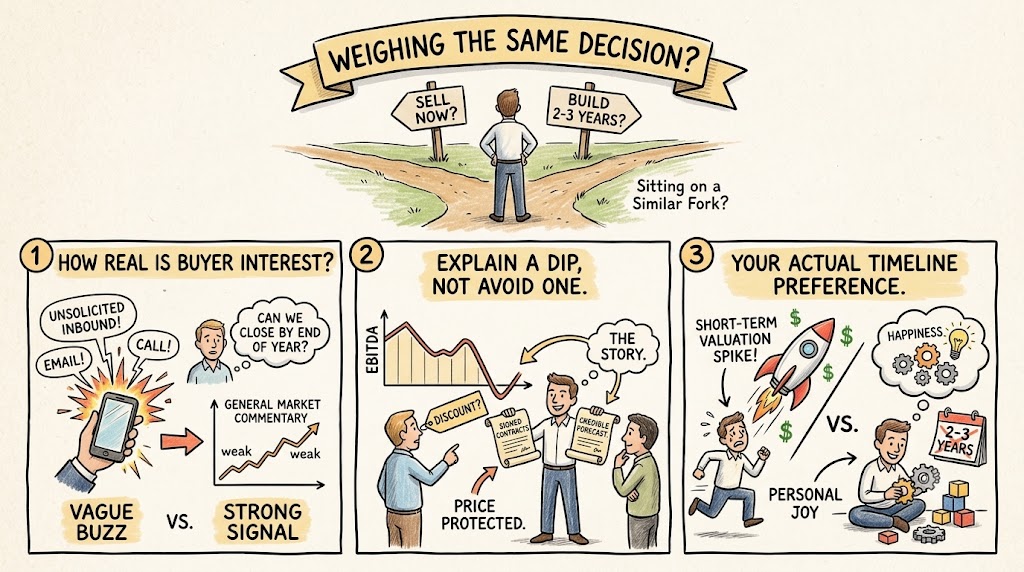
If you're sitting on a similar fork right now, a few questions are worth working through honestly before you decide which way to lean.
- How real is the buyer interest? Unsolicited inbound and explicit questions about closing timelines are a stronger signal than general market commentary.
- Can you explain a dip, not just avoid one? If a strategic investment is going to hurt this year's EBITDA, decide now whether you can tell that story with signed contracts and a credible forecast, because that's what determined whether buyers discounted for it.
- What's your actual timeline preference, independent of the market? If you'd genuinely be happy building for another two to three years regardless of what multiples do, that should weigh more heavily than a short-term valuation spike.
The risk of waiting versus the risk of moving too soon
It's tempting to treat this as a simple bet on market direction, but that framing misses something. Even a founder who's genuinely uncertain about timing still has to run the business day to day, and the strategic hires or investments in question usually have a return that shows up regardless of whether a sale happens next year or in five years. The real question isn't just when to sell. It's whether an investment makes the business better even in a world where no sale happens at all.
- Ask if the investment holds up without a sale. A strategic hire that only makes sense as a way to prop up a sale story is a weaker bet than one that would pay off regardless of what buyers decide over the next year.
- Weigh the cost of a missed window against the cost of a rushed one. Selling too early can leave real value on the table if the recovery keeps running, but overbuilding for a downturn that reverses can waste months of margin for nothing.
- Remember that valuation windows can close as fast as they open. A 30 percent move off the lows happened over a matter of months, which means the same swing could plausibly happen in the other direction.
None of this removes the uncertainty. Nobody in the group, including the founders who'd been through a sale before, could say with confidence whether the current environment is the start of a longer recovery or a temporary window. What's clear is that the founders navigating it best right now are the ones being explicit, with themselves and with buyers, about what they're optimizing for and why, instead of trying to quietly protect every option at once. Clarity about the goal, more than any read on where the market goes next, is what actually makes the decision easier.