
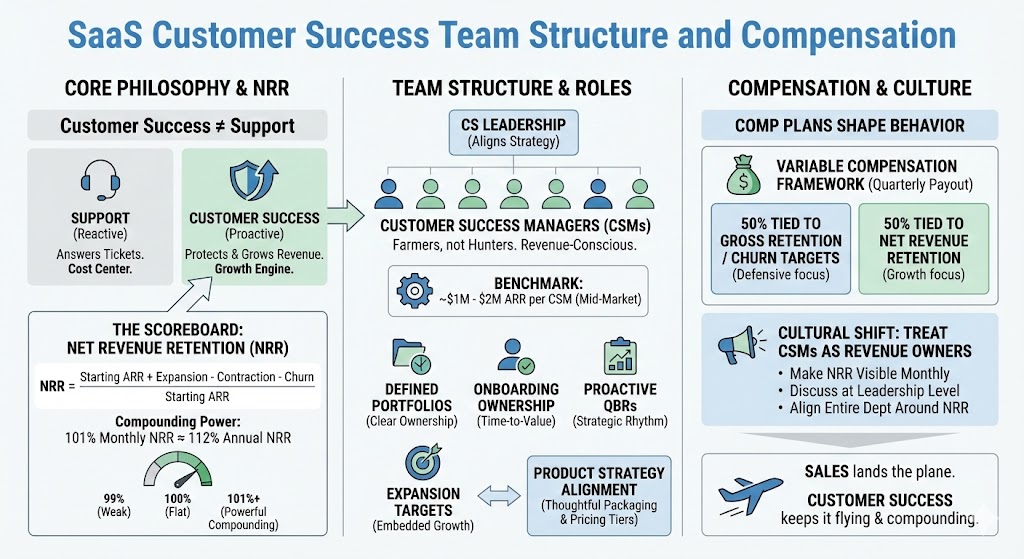
SaaS Customer Success Team Structure and Compensation
A deep dive into building a customer success organization that drives retention and expansion, including ARR-per-CSM benchmarks, NRR-focused compensation, and how to turn customer success into a compounding growth lever.

Most SaaS founders obsess over sales.
Few obsess over customer success.
That’s a mistake.
Sales might land the deal, but customer success determines whether your company compounds or quietly leaks value every month.
I’ve said this many times: if you want to build a valuable SaaS company, you have to move beyond “logo acquisition” and start thinking about net revenue retention.
During the session, I made it simple: “The single measure that captures revenue retention and expansion is NRR.”
That’s the scoreboard.
And your customer success team is the unit responsible for moving it.
Customer Success Is Not Support
Support answers tickets.
Customer Success protects and grows revenue.
.jpg)
Those are very different jobs.
If your CSMs are only reacting to problems, you don’t have a success team — you have an expensive help desk.
A real SaaS customer success function owns three outcomes:
- Retention (reduce churn)
- Expansion (upsell and cross-sell)
- Account health (proactive engagement before issues escalate)
When those three are operating well, your growth stops being linear.
When You Actually Need a CSM Team
Early on, the founder or AE may handle onboarding and account management. That’s normal.
But once you cross a few million in ARR, especially in mid-market or enterprise SaaS, the math changes.
As I explained in the webinar, “You should have about one account manager for every $2M in revenue under management.”
That’s not a rigid law, but it’s a useful anchor.
If one CSM is responsible for $5M or $10M in ARR, either they’re overwhelmed, or your customer experience is thinner than you think.
At scale, customer success becomes a revenue discipline, not a courtesy.
How to Structure a SaaS Customer Success Team
The structure depends on your ACV and customer complexity.
If you’re selling $200/month SMB subscriptions, you might run mostly automated onboarding with light-touch success.
If you’re selling $25k–$250k ACV deals, you need defined ownership per account.
In a healthy mid-market SaaS company, customer success often looks like this:
- CSMs managing defined portfolios of accounts
- Clear onboarding ownership
- Defined renewal cadence and playbooks
- Proactive QBR (Quarterly Business Review) rhythm
- Expansion targets embedded into role expectations
CSMs are farmers, not hunters. But they should still be revenue-conscious.
NRR Is the Metric That Matters
Churn percentage is incomplete.
Revenue churn is better.
Net Revenue Retention is the real lever.
In the session, I broke it down clearly: NRR is expansion revenue minus contraction revenue from customers that already existed at the start of the period.
It does not include new customer revenue.
If you start the month with $1M in ARR from existing customers and end the month with $1.01M from those same customers, you’re at 101% monthly NRR.
That might sound small. It’s not.
As I explained live, “If you can just get to 101% monthly NRR, you’re at 112% annual NRR.”
That compounding effect is enormous.
Here’s how to think about it:
- 99% monthly NRR compounds into weak annual retention
- 100% monthly NRR is flat growth from the existing base
- 101%+ monthly NRR creates powerful compounding expansion
The difference between 95% and 110% annual NRR dramatically impacts valuation.
Investors care about this deeply.
.jpg)
How to Compensate Customer Success Managers
Comp plans shape behavior.
If you pay CSMs only on churn reduction, they’ll focus defensively.
If you pay them only on expansion, they’ll ignore at-risk accounts.
The cleanest structure blends both.
During the webinar, I suggested aligning bonuses directly to NRR and churn metrics.
A practical framework looks like this:
- 50% of bonus tied to gross retention or churn targets
- 50% tied to Net Revenue Retention
- Clear quarterly measurement and payout
- Defined ARR under management per CSM
If your CSM manages $2M in ARR, their variable comp should reflect the importance of protecting and growing that base.
You don’t need complicated formulas.
You need alignment.
ARR Per CSM: A Simple Benchmark
One of the easiest structural mistakes to make is under-resourcing success.
If CSMs manage too much ARR, onboarding suffers. Proactive check-ins disappear. Expansion conversations never happen.
The benchmark I’ve used repeatedly is:
- ~$1M–$2M ARR managed per CSM in mid-market SaaS
Higher ACV enterprise deals may require fewer accounts per CSM. Lower ACV SMB products may allow larger portfolios.
But the principle is the same: define ownership, define portfolio size, define accountability.
Expansion Is a Product Strategy Decision
Customer success isn’t just a service function. It’s tied directly to product packaging.
I referenced Instantly during the session because they’re a great example. They consistently introduce features in ways that encourage upsell, rather than just giving everything away for free.
That’s intentional.
Expansion happens when:
- Customers clearly see incremental value
- Pricing tiers are structured thoughtfully
- Onboarding shows customers how to win
- CSMs are trained to identify growth triggers
Customer success and product strategy must be aligned.
.jpg)
The Cultural Shift That Makes It Work
If your internal language treats CSMs as “support,” they’ll behave like support.
If you treat them as revenue owners, they’ll behave differently.
NRR should be visible.
It should be reviewed monthly.
It should be discussed at leadership level.
As I said in the session, align your entire success department around NRR and track it visibly.
When CSMs understand that retention and expansion are company-level priorities, not side metrics, behavior changes.
Final Thought
Landing new logos feels exciting.
Renewals and expansions feel operational.
But the real enterprise value in SaaS comes from the back half of the funnel.
Sales lands the plane.
Customer success makes sure it keeps flying.
If you build a structured CSM team, define ARR per manager, align compensation with NRR, and make expansion intentional, your growth stops depending solely on new acquisition.
It starts compounding from within.
That’s when SaaS becomes powerful.