
Reducing M&A Offer Re-Trades
A signed LOI doesn't lock in your number, it just starts the clock on how hard a buyer will try to chip it down. Here's what actually protects the price between signing and close, and why one common type of buyer deserves extra caution.

A founder in our mastermind group got a verbal offer on his company last week. He'd been in parallel conversations with four other parties, and at least two of them looked ready to make competing offers of their own. He and his co-owner had already agreed on the number that would get them to yes. What he wanted from the group wasn't help getting to a deal. He'd been through an acquisition once before, and the thing that stuck with him wasn't the negotiation, it was what happened after: the buyer chiseling the price down once diligence started. He wanted to know how to keep that number from moving once the LOI was signed.
That question comes up constantly in this group, and for good reason. Signing a letter of intent feels like the finish line, but it's really the start of the part of the deal where a buyer has the most negotiating power. They've got you exclusive, you've told your team, you may have already turned down other conversations, and every week that passes makes walking away more expensive for you than for them. A buyer who wants to retrade knows exactly how that math works, and a founder who hasn't thought about it in advance is the easiest target there is.
What actually protects the number
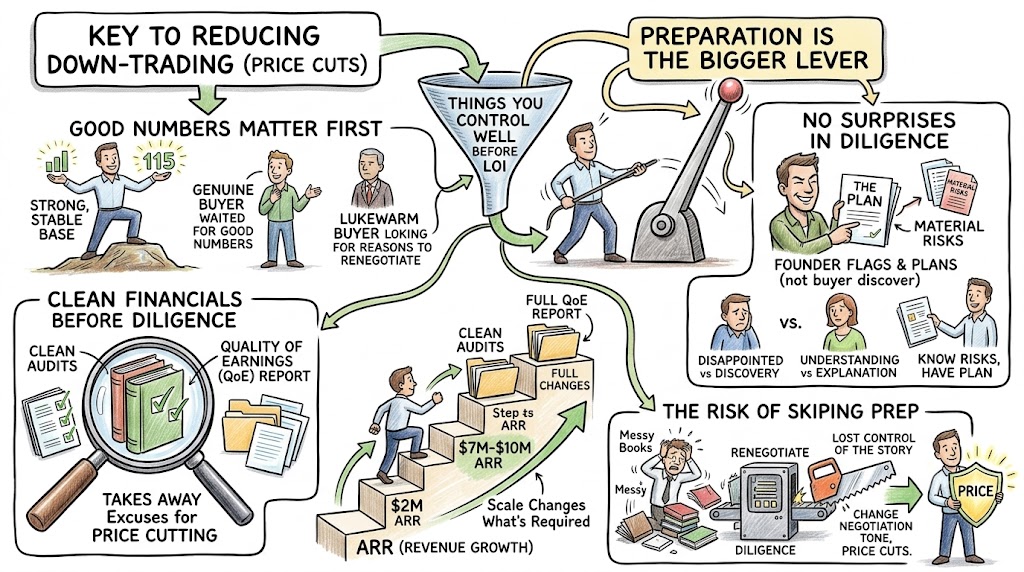
Ryan's advice on this was direct: the key to reducing any down-trading of valuation in the final stages of a deal comes down to a small number of things you control well before you ever sign an LOI. Good numbers matter first, because a buyer who genuinely wants your company behaves differently than one who's lukewarm and looking for reasons to renegotiate. But the bigger lever is what happens during diligence itself.
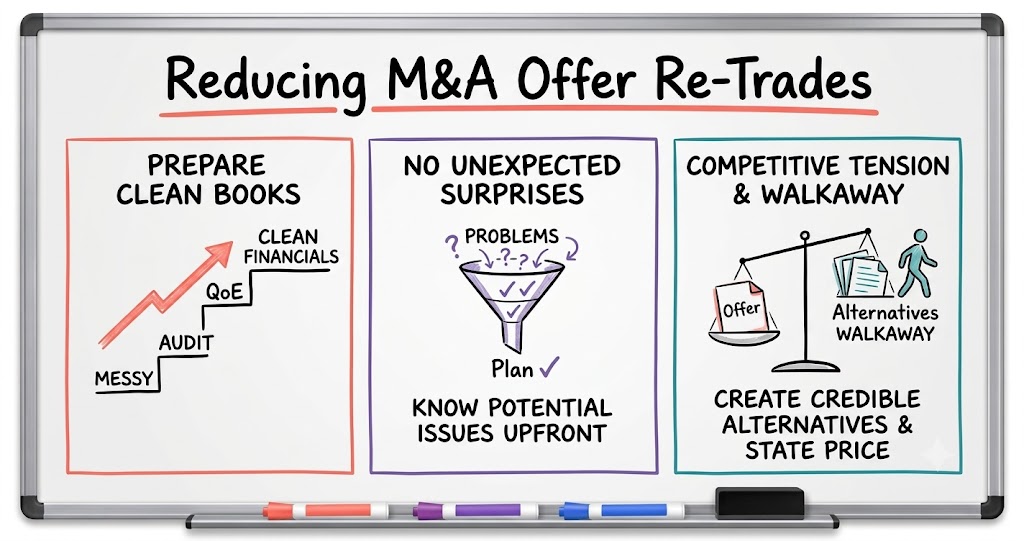
- Clean financials, before diligence starts. Clean audits and a real quality of earnings report, done ahead of time, take away the easiest excuse a buyer has for cutting the price.
- No surprises in diligence. If there's something material in the business, a founder should already know what it is and have a plan for how to address it, rather than let a buyer discover it and use it as an excuse to renegotiate.
- Revenue scale changes what's required. A clean audit and QoE report may not be strictly necessary at two million in ARR, but somewhere between seven and ten million ARR, it starts to matter a lot.
None of that is exotic advice, but founders skip it constantly because it feels like spending money on the deal before the deal is real. The problem is that by the time a buyer is deep in diligence and finds something you didn't flag, you've lost the the ability to control the story. A messy set of books doesn't just cost you money, it changes the whole tone of the negotiation from that point forward.
Set the walkaway price before you sign
The other piece of Ryan's advice is about what you say to the buyer before the LOI is signed, not after. As he put it, walk into that conversation and be explicit: "I need your assurance that this is going to close at this number. If you go lower than this, unless there's something truly material found, we will cancel the deal and go with one of the other parties we've been talking to." That level-set conversation, done upfront, can reduce the retrade substantially.
This works because it changes what the buyer believes about their own position. A buyer who thinks you have nowhere else to go will almost always test the price late in the process, because the downside for them is small and the upside is real. A buyer who knows there are other serious parties waiting, and who believes you'll actually walk, has a much weaker incentive to try it. The catch is that this only works if it's true. If you don't have real alternatives and you're not actually willing to walk, a buyer will eventually figure that out too, usually at the worst possible moment in the process.
It's also worth saying that this isn't a one-time script you deliver in a single meeting and then forget about. The founders who do this well keep the conversation alive throughout diligence: reminding the buyer, without being combative about it, that other paths exist and that the number on the table is the number that gets this done. It's a small habit, but it keeps a buyer's team anchored to the original terms instead of drifting toward the idea that late-stage pressure is normal and expected.
The search fund warning
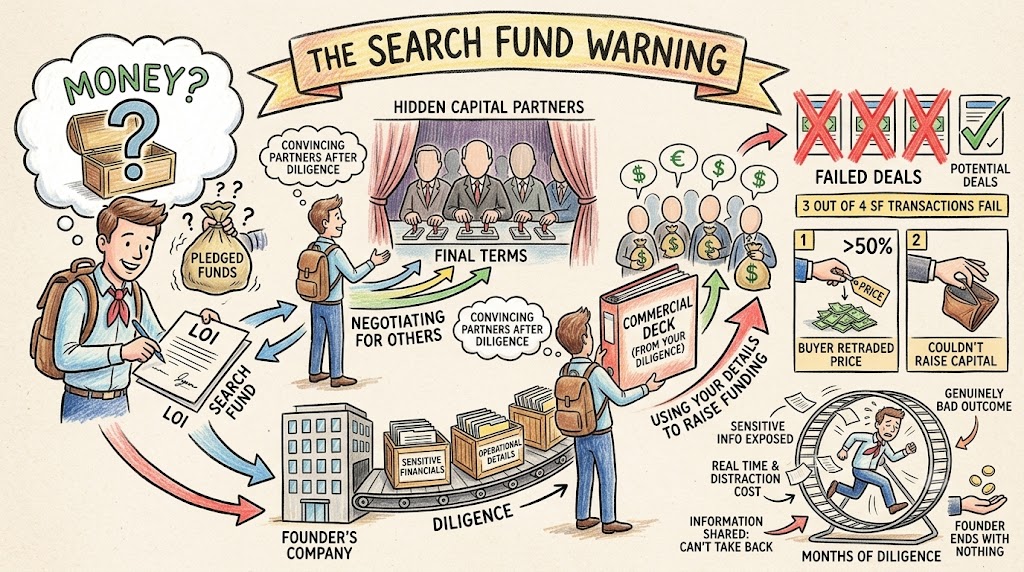
One founder in the group who has sold a company before, and walked away from a couple of near-deals for other reasons, raised a specific warning about search funds. The model is straightforward: a young executive gets backed to spend a couple of years finding a company, running it through diligence, and closing on it. The catch is that when a search fund writes you an LOI, the terms in that letter barely matter, because the searcher usually doesn't have the money yet. What they're actually doing is using your business, your quality of earnings report, and a commercial deck they build from your diligence materials to go raise the capital from their own backers.
- You're not negotiating with who you think. The person who signed your LOI is often negotiating on behalf of a half dozen capital partners behind them, and those partners are the ones who really set the final terms.
- Soft commitments aren't real commitments. A searcher's capital is frequently pledged rather than under management, meaning it depends on convincing partners after your diligence is already done, not before.
- The failure rate is high. At a business broker gathering, the informal consensus was that roughly three out of every four transactions where a search fund wrote the LOI never made it to close.
Of the deals that fell apart, more than half failed because the buyer tried to retrade the price, and the rest failed because the searcher simply couldn't raise the money they'd promised in the LOI. Either way, the founder on the other side of the table spent months in diligence, exposed sensitive financials and operational detail, and ended up with nothing to show for it. That's a genuinely bad outcome even setting aside the retrade risk, because diligence itself has a real cost in time, distraction, and information you can't take back once it's shared.
How to filter buyers before you get burned
The founder who brought the original question had already run into this firsthand. He'd been approached by a couple of search-fund-style buyers, and one of them had actually put in the highest offer he'd received. He turned it down anyway, because digging into the offer showed it was a couple of individuals with capital pledged rather than capital under management. Based on that experience, he'd set a new internal rule for evaluating buyers going forward.
- Funds under management, not funds pledged. A buyer should control capital that's already committed and available, not capital they still need to raise after your LOI is signed.
- A real transaction history. His threshold was at least twenty-five completed deals, with a preference for buyers who've done fifty or more, as a way of filtering out first-time or inexperienced acquirers.
- Everything discovered gets shared early. His team's approach is to proactively surface anything that could be a problem before the buyer finds it themselves, rather than hope it doesn't come up.
That combination, transparency upfront plus a strict filter on who gets access to your numbers in the first place, does more to prevent a bad outcome than anything you can negotiate after the LOI is signed. By the time you're arguing about a revised number in week six of diligence, most of your position is already gone.
Reading buyer behavior before you sign anything
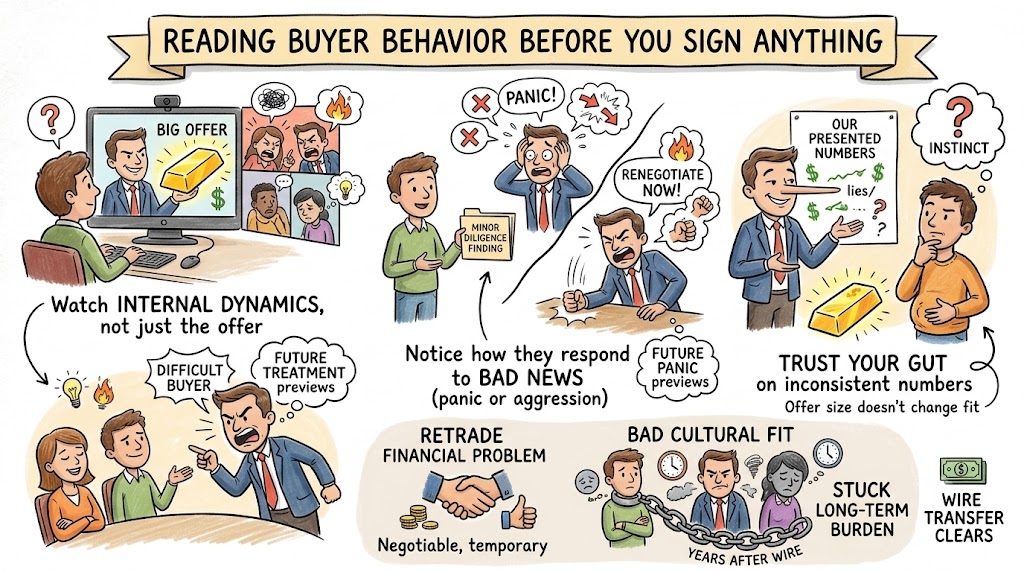
There's a simpler signal that founders sometimes miss because they're focused on the number. Watch how a prospective buyer treats other people during the process, not just how they treat you. One founder in the group described walking away from a near-deal not because of price, but because he watched how the buyer's team treated each other during calls, and it told him everything he needed to know about what life would be like inside that company after close. A retrade is a financial problem you can negotiate around. A bad cultural fit is a problem you're stuck with for years after the wire transfer clears.
- Watch the internal dynamics, not just the offer. How a buyer's team speaks to each other on calls is often a preview of how they'll treat your team after the deal closes.
- Notice how they respond to bad news. A buyer who reacts to a minor diligence finding with panic or aggressive renegotiation is showing you exactly how they'll behave the next time something goes wrong.
- Trust your gut on liars. If something about how a buyer presents their own numbers or track record feels off, that instinct is usually worth more than the size of their offer.
The takeaway
Retrades don't happen because buyers are dishonest by nature. They happen because the structure of a typical deal gives a buyer every incentive to test your resolve late in the process, when you have the weakest position and the most sunk cost. Founders who avoid it aren't the ones who negotiate the hardest in the final week. They're the ones who did the unglamorous work months earlier.
- Clean financials nobody can poke holes in. Audits and a real quality of earnings report done ahead of time remove the easiest excuse for a lower price.
- No undisclosed surprises waiting in diligence. Know what a buyer will find before they find it, and get ahead of the story.
- Real competitive tension, established before the ink dried. A credible alternative and a stated walkaway number change what a buyer believes they can get away with.
- A genuine willingness to walk. None of the above works if you're not actually prepared to use it.
If you're heading into a process now, the best time to build that position isn't after you sign the LOI. It's the conversation you have right before you do.