
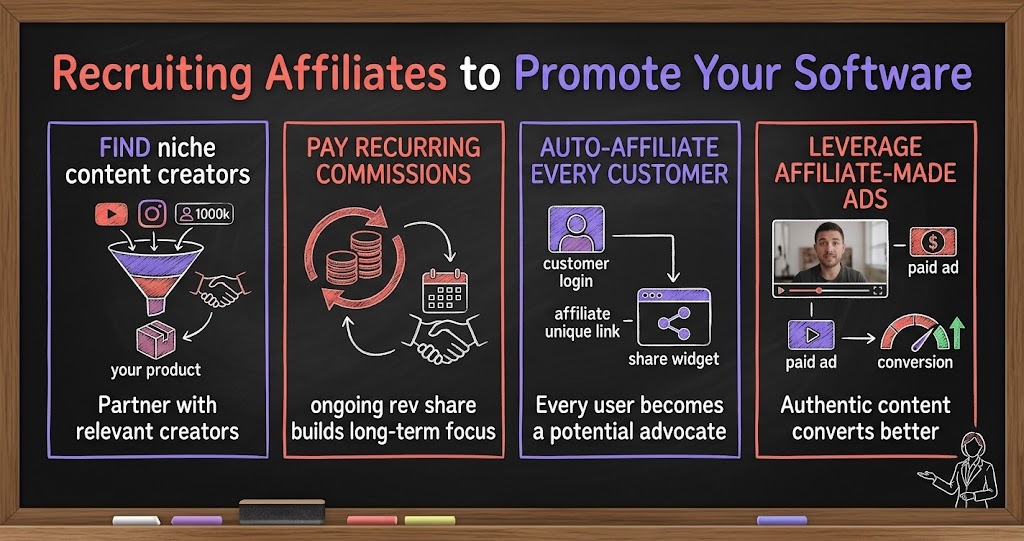
Recruiting Affiliates to Promote Your Software
How founders in a SaaS mastermind actually structure, staff, and scale affiliate programs, from paying nothing until a customer converts to buying your way into a creator's audience.

Ask a room full of SaaS founders which single marketing channel they'd bet their company on, and you'd expect a dozen different answers. On a recent mastermind call, several founders converged on the same one: affiliate marketing. One member put it bluntly, saying that if he had to credit one channel with keeping his company alive in the early days, it would be affiliates, without question. That's a strong claim, and the specifics of how these founders actually run their programs explain why they believe it.
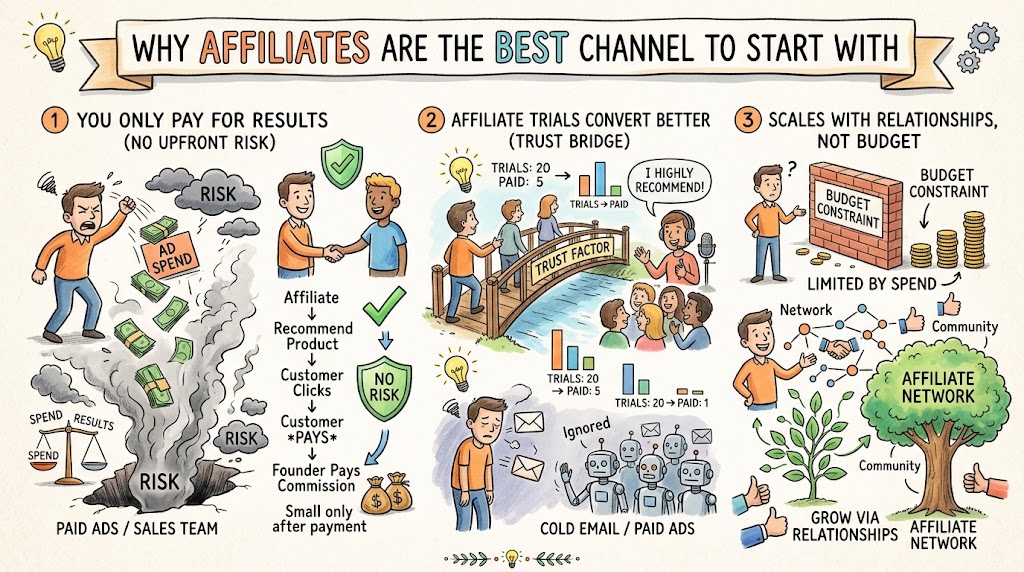
Why affiliates are often the best channel to start with
The core appeal is simple: you're not paying anything until an affiliate actually brings you a paying customer. There's no upfront ad spend, no agency retainer, and no risk of burning cash on a channel that doesn't work. Compare that to paid ads or a sales team, where you're spending before you know whether it's going to pay off. One founder said that if he were starting any new business, in any industry, this is the one channel he'd start with: find the people who already have an audience in your space and offer them a reason to bring that audience to you.
- You only pay for results. Most affiliate arrangements only trigger a payment once a referred customer is actually paying, which removes the risk of spending on something that doesn't convert.
- Affiliate-driven trials convert unusually well. Multiple founders reported meaningfully higher trial-to-paid conversion from affiliate traffic than from cold email or paid ads, because the audience already trusts the person making the recommendation.
- It scales with relationships, not budget. The constraint isn't how much you can spend, it's how many good relationships you can build and maintain.
Finding the right people to recruit
The recruiting process founders described wasn't complicated. Look at YouTube, Instagram, and other social platforms for people already creating content in your industry, and reach out directly. These creators already have an audience that trusts them, which is the hard part most founders spend years trying to build from scratch. One founder keeps a full-time team member whose entire job is finding and maintaining relationships with these creators, which signals just how much ongoing effort a healthy affiliate program actually takes once it's working.
- Look where your buyers already spend time. Creators active on the platforms your customers use are easier to find, and more relevant, than a generic influencer directory.
- Not every affiliate needs to be a household name. Smaller, niche creators with a genuinely engaged audience can outperform bigger names on relevance and conversion, especially early on.
- Treat it as a relationship job, not a one-time outreach campaign. A dedicated person maintaining these relationships over time is what separates a program that compounds from one that fizzles after the first push.
How to structure the payout
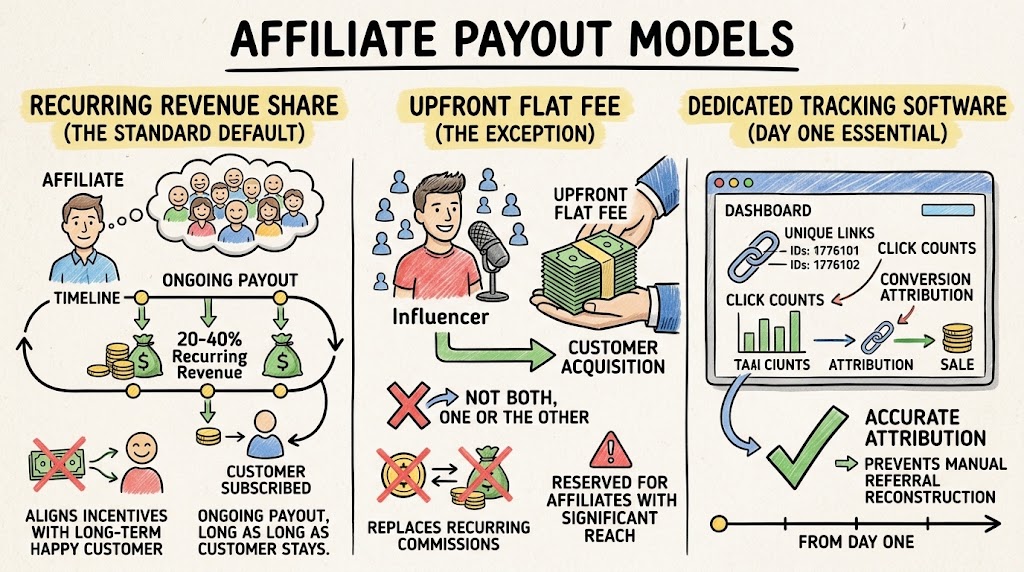
The default structure across the founders on the call was a straightforward revenue share, commonly in the 20 to 40 percent range of recurring revenue, paid out for as long as the referred customer stays subscribed. That default shifts when an affiliate has significant reach: for creators with a large following, some founders will pay a flat fee upfront instead, but in exchange they typically don't also pay ongoing recurring commission on top. It's one or the other, not both, and the upfront route is reserved for the affiliates with proven audience size, not offered by default.
- Recurring commission is the standard default. A percentage of ongoing revenue aligns the affiliate's incentive with keeping the customer happy long-term, not just closing the initial sale.
- Upfront payment is the exception, not the rule. It's reserved for affiliates with proven reach, and it usually replaces the recurring commission rather than adding to it.
- Use dedicated tracking software from day one. Tools built for affiliate tracking handle unique links, click counts, and conversion attribution, so you're not trying to reconstruct who referred whom after the fact.
Turn affiliate content into paid media
One of the more advanced plays described on the call was using affiliate-created content as the creative for paid ads. Rather than only relying on an affiliate's organic reach, one founder pays creators to produce content, a video with their face, talking about the product, and then runs paid advertising using that content directly, driving traffic back through the creator's affiliate link. The creator gets paid on the back end when it converts, the founder gets professionally made, authentic-feeling ad creative without paying a production agency, and the whole thing has converted noticeably better than in-house-made ads.
- Affiliate content often outperforms in-house ad creative. A real person talking authentically about a product tends to convert better than a polished, obviously produced ad.
- You can pay for the content and still only pay commission on results. Covering the cost of producing the video doesn't require abandoning the pay-on-conversion structure for the resulting sales.
- This works best with affiliates who already understand your product. Ask an existing, engaged affiliate to make content rather than starting cold with someone unfamiliar with what you do.
Make it embarrassingly easy for customers to become affiliates
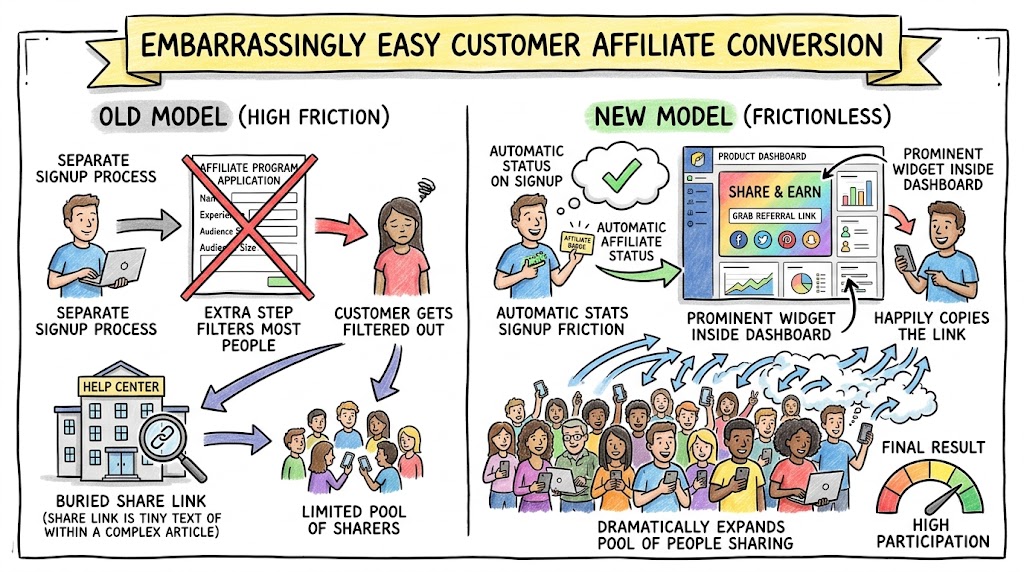
One founder shared a simple but effective structural change: instead of running a separate affiliate signup process, he made every customer an affiliate automatically the moment they sign up, and put a prominent share widget right inside the product dashboard where customers already log in. No separate application, no extra step, just a link they can grab and share. He credits that single change with meaningfully increasing affiliate program participation compared to the old model, where customers had to go find and sign up for the program separately.
- Remove the signup friction entirely. Requiring customers to separately apply to your affiliate program is a filter most of them will never get past, simply because it's an extra step.
- Put the share link where customers already are. A widget inside the product they log into daily gets far more use than a link buried in a help center article.
- Every customer is a potential affiliate. Treating affiliate status as a default rather than an opt-in dramatically expands the pool of people who might actually share your product.
Buying your way into content and placements
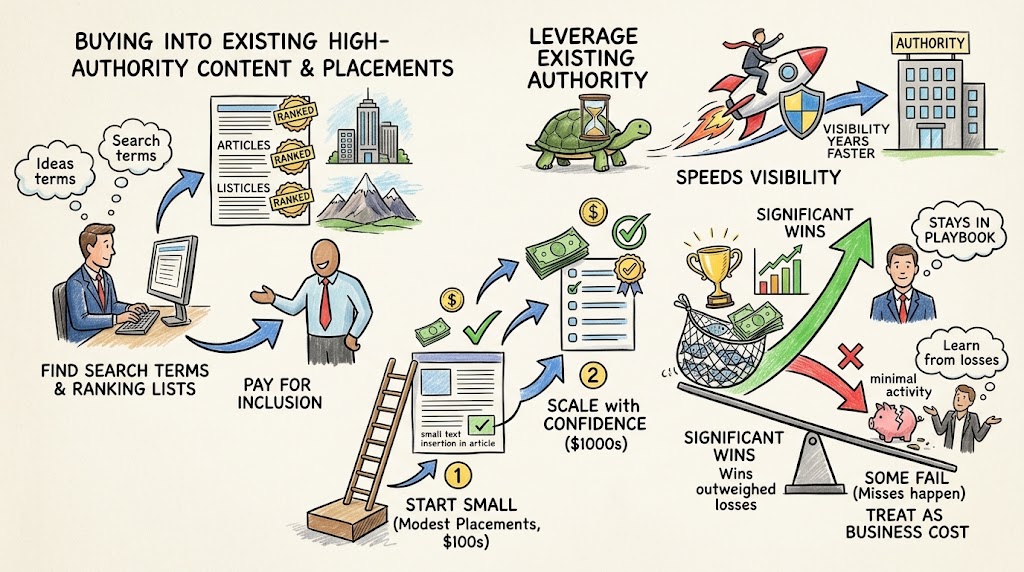
A related but distinct tactic came up: paying to be featured in existing high-authority content rather than only relying on affiliates to create new content. One founder described a technique of identifying the search terms that matter most to his business, finding the articles and listicles already ranking for those terms, and paying to be included, starting with modest placements in the low hundreds of dollars and working up to more prominent, more expensive placements as those early bets proved themselves out. Not every paid placement worked, some produced no measurable return at all, but the wins were significant enough to keep the strategy in his playbook.
- Rank on someone else's authority instead of building your own from scratch. A well-established site's existing search ranking can get you visibility years faster than building that authority yourself.
- Start small and scale with confidence, not all at once. Early paid placements at a modest cost let you validate the tactic before committing serious budget to a bigger one.
- Expect some placements to fail. Not every paid mention converts, and treating a handful of misses as the cost of finding the ones that do work is the healthier way to think about it.
Where affiliate marketing stops working
It's worth being honest about the limits. Founders on the call agreed affiliate marketing works well for deals roughly under fifty thousand dollars a year in contract value, but starts to break down for genuinely large enterprise deals. For that segment, the more effective analog is channel partnerships: dedicated people whose job is building relationships with larger firms that can route business your way, rather than individual creators promoting to a consumer or small-business audience. Trying to force an influencer-style affiliate model onto an enterprise sales motion is a mismatch that tends to waste effort on both sides.
- Affiliate marketing suits transactional, faster-close deals. It works best when a customer can evaluate and buy without a long enterprise procurement process getting involved.
- Enterprise deals need channel partnerships instead. Larger firms respond better to dedicated partnership relationships than to a creator's audience-driven recommendation.
- Match the tactic to the deal size, not the other way around. Trying to run the same playbook across every segment of your business usually underperforms compared to picking the right motion for each one.
None of this requires a big team or a big budget to start. What it requires is a willingness to reach out to people who already have the audience you're trying to build, structure a deal that only pays off when it actually works, and keep the relationship alive well past the first sale. For a lot of the founders on this call, that combination was the difference between staying in business and not.