
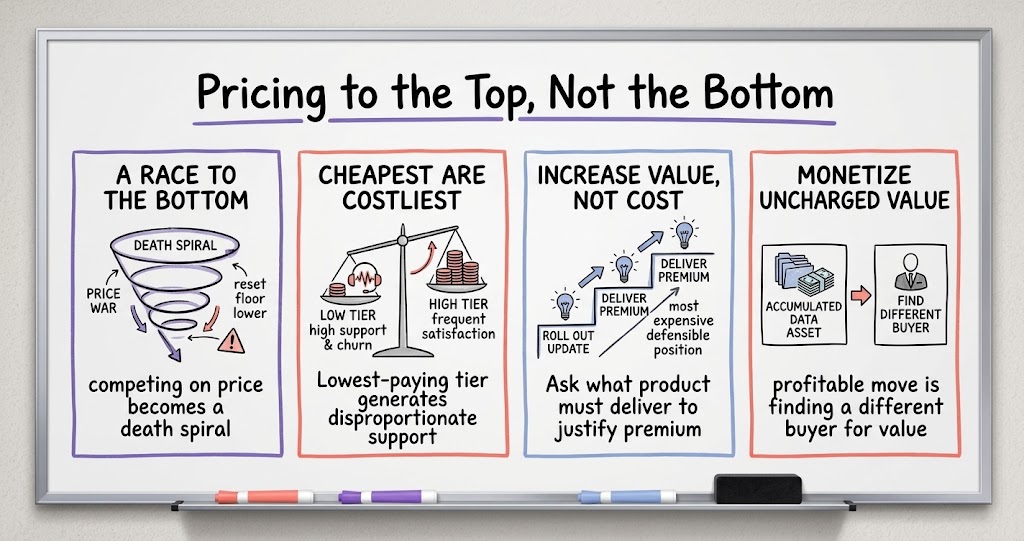
Pricing to the Top, Not the Bottom
A mastermind debate over whether to chase low-cost competitors surfaced a consistent pattern: founders who raised prices and leaned into value ended up happier, and better supported, than those who tried to win by being cheap.

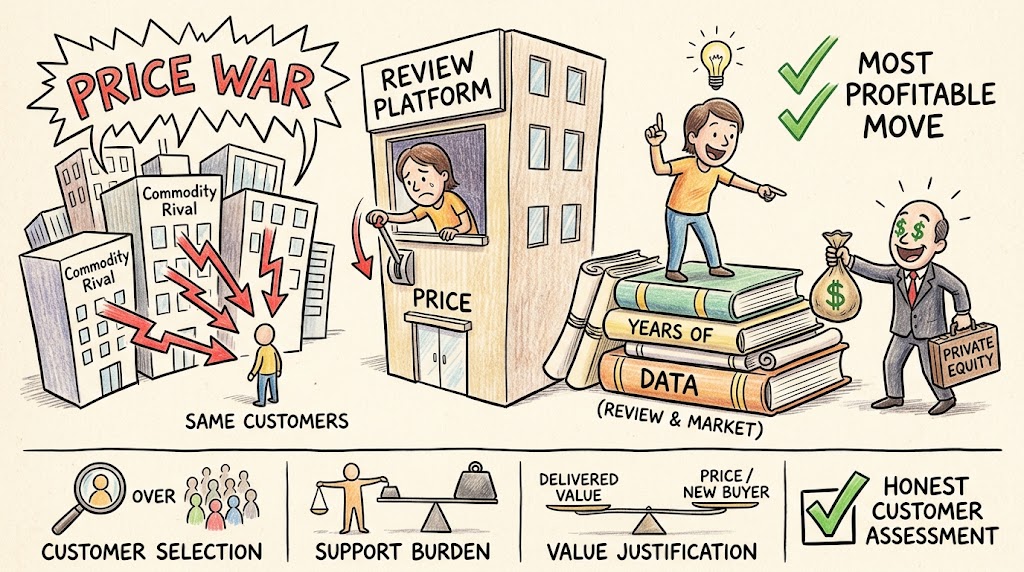
A founder running a review management platform came into a recent mastermind call with a plan he wanted the group to stress-test. His market had become commoditized, flooded with small, low-cost competitors he called ankle biters, and his idea was to spin off a cheaper, self-service version of his own product to compete with them directly on price, using the inflow of bargain-hunting customers as an upsell funnel into his higher-value services. It sounded reasonable on paper. The group's response was almost unanimous, and it wasn't what he expected to hear.
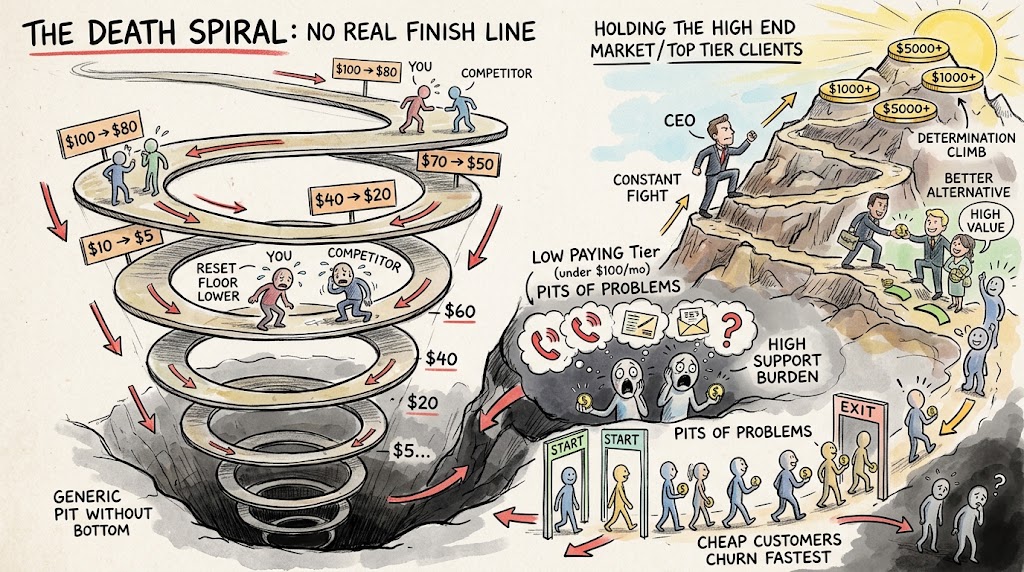
The race to the bottom has no real finish line
One founder was blunt about what happens once you start competing on price: it becomes a death spiral. You go down, and your low-cost competitors go down again to match you, and the whole exercise just resets the floor lower for everyone, including you. He described trying to hold the high end of his own market with top-tier clients, and admitted it's a constant fight, but the alternative he'd already tested was worse. His cheapest customers, the ones paying under a hundred dollars a month, generated the highest support burden of any tier and stayed the shortest amount of time before churning. He's been slowly phasing that tier out.
- A price war has no natural stopping point. Once you cut prices to match low-cost competitors, they can simply cut again, and the cycle resets lower each time.
- Your cheapest customers often cost the most. Multiple founders in the discussion reported that their lowest-paying tier generated disproportionate support demand relative to revenue.
- Cheap customers churn fastest. The same low-tier customers who demand the most support tend to stick around the shortest amount of time, which compounds the economics against you.
The counter-model: charge more, and make the product earn it
A different founder offered the clearest alternative playbook in the conversation. His company was rolling out a product update alongside a price increase, and rather than trying to be the cheapest option in the category, his team deliberately aimed to become the most expensive. The logic behind that decision was straightforward: if you're going to compete on being cheap, you have to be willing to go all the way to the bottom, undercutting everyone. If you're not willing to do that, going up is the more defensible position, because then the question becomes what the product needs to deliver to justify the price, rather than how much further you can cut.
He told his customers directly that the price was going up and that his company wasn't interested in racing anyone to the bottom. That's a real risk, telling your existing base you're raising prices rarely feels comfortable, but it forced a kind of discipline internally. Every feature and every support interaction had to actually earn the premium price tag, which is a very different posture than constantly trying to shave costs to protect a thin margin.
- Decide deliberately whether you're the cheapest or the most expensive. The middle of the market is the least defensible position. Pick an end and commit to it.
- Let the price increase set the bar for the product. Asking what the product needs to deliver to justify a higher price is a more useful design question than asking how to cut costs.
- Tell customers plainly why prices are going up. Framing the increase around a refusal to compete on price, rather than apologizing for it, sets expectations honestly.
The data backs up which tier is actually worth keeping
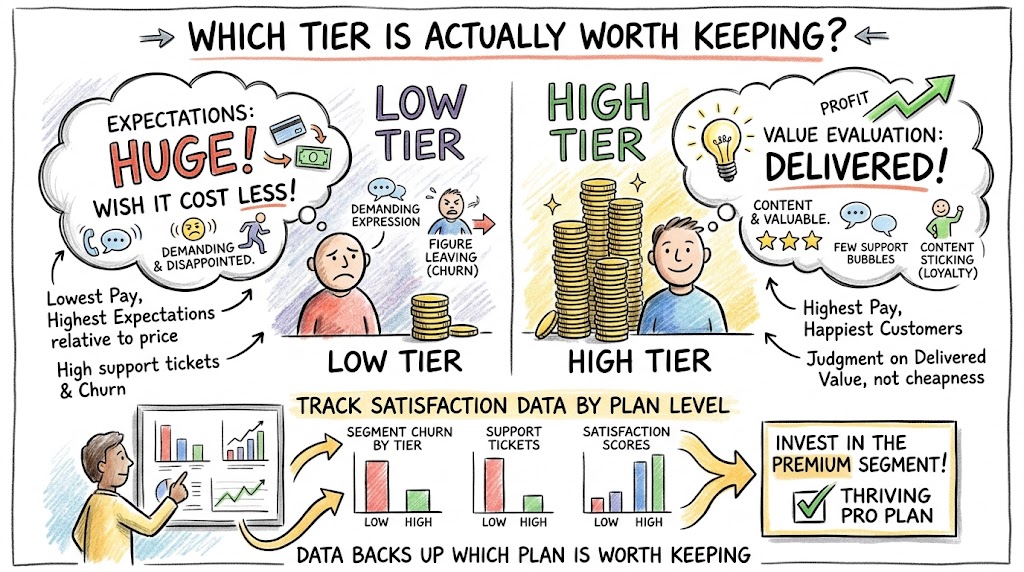
The founder who raised prices had a specific pattern worth naming directly. Across his different pricing plans, the customers on the lowest tier paid the least and had the highest expectations. The customers on the highest tier paid the most and were consistently the happiest with the product. That's a counterintuitive result if you assume higher-paying customers are pickier, but it tracks with what plenty of SaaS founders eventually discover: customers who pay for value tend to evaluate a product against what they're getting, while customers chasing the lowest price tend to evaluate it against what they wish it cost.
- Low-tier customers often have the highest expectations relative to price. Paying less doesn't lower what people expect. In several founders' experience, it raised it.
- High-tier customers are frequently the most satisfied. Customers who buy in at a premium price tend to judge the product on delivered value, not on how cheap it could theoretically be.
- Plan-level satisfaction data is worth tracking on its own. Segmenting churn, support tickets, and satisfaction by pricing tier reveals which segment is actually worth investing in.
There's a real case for going low, but know what you're buying
Not every voice in the room agreed that competing on price was automatically a mistake. One founder made the case that going after the low-cost segment, deliberately becoming the cheapest credible option, is really a distribution decision dressed up as a pricing decision. He pointed to a competitor in an adjacent space that has built real scale by openly positioning itself as the cheapest option in its category and leaning into that identity rather than fighting it. His view was that if you already have the operational scale to survive on thinner margins better than newcomers can, going low can buy you distribution and market share that would be far more expensive to acquire any other way, and that distribution itself becomes valuable, especially if you ever want to sell the business. He framed it less as a pricing choice and more as a deliberate bet on market share, using price as the lever to acquire distribution that would otherwise take years and a much larger marketing budget to build.
That's a real strategy, not a mistake, but it's a different strategy than the one the founder who opened the conversation was actually describing. Going low on purpose, with the operational infrastructure to make thin margins work at scale, is not the same as drifting down in price reactively to chase away smaller competitors. The first is a deliberate bet on distribution. The second is usually just the beginning of the death spiral described earlier.
- Going cheap on purpose is a distribution strategy, not a pricing accident. It only works if your operational scale lets you survive on thin margins better than the competitors you're trying to out-cheap.
- Distribution built this way has real value, especially at exit. A large, price-driven customer base can be worth more to an acquirer than a smaller, higher-margin one, depending on what they're buying you for.
- Know which strategy you're actually running. Deliberately building a low-cost, high-scale business is different from reactively cutting prices to defend against competitors nipping at your edges.
Look for value you're not yet charging for
One more idea from the discussion deserves its own mention, because it reframed the entire question. Rather than lowering prices to compete with commoditized competitors, one founder suggested the review platform look at monetizing an asset it already owned: years of accumulated review and market data that could be valuable to private equity firms or businesses trying to figure out where to expand. That's not a pricing conversation at all. It's a recognition that the most profitable move available to a founder considering a price war is sometimes to find a completely different buyer for value they're already sitting on, rather than fighting harder for the same customers everyone else is also fighting for.
The throughline across all of this is that pricing decisions are rarely just about the number on the page. They're a proxy for a bigger decision about who you want as a customer, what kind of support burden you're willing to carry, and whether the value you're delivering, or could be delivering to a different buyer entirely, actually justifies what you're charging for it. The founders who came out ahead in this conversation weren't the ones who found the cleverest way to undercut a competitor. They were the ones who got honest about which customers were actually worth keeping.
It's also worth noticing what didn't come up in this discussion: nobody argued that price should stay flat forever, or that raising prices is automatically safe. The founder who went to the top of his market's pricing was candid that it required real internal discipline, constantly checking whether the product actually justified what customers were paying, not just assuming a higher price tag alone would carry the business. Pricing at the top just moves the work rather than removing it, trading a larger, more price-sensitive customer base for a smaller, more demanding one that expects the premium to show up in every interaction.
If you're weighing a similar decision right now, the questions worth asking are less about what your competitors charge and more about your own numbers. Which pricing tier actually generates the most support load relative to revenue. Which tier churns fastest. Which tier's customers are happiest with what they're getting. Once those numbers are in front of you, the choice between chasing the bottom of the market and defending the top usually isn't close.