Podcast Clipping: How One Founder Turned a Dinner into 1,000 Video Submissions in a Week
A founder-to-founder look at podcast clipping: paying editors per thousand views, the early numbers, the guardrails that keep spend honest, and where it fits for a low-ticket B2B product.

Most B2B founders I know treat video as a cost center. You hire an editor, you publish a few polished clips a month, and you hope something travels. One founder in our mastermind is running a very different experiment right now, and the early numbers are interesting enough that I want to walk through how it works. He turned a single in-person dinner into a content engine that attracted roughly 1,000 video submissions in its first few days, for a total cost that, at the time he shared it, was only around $33 in payouts.
It's early, and he was careful to say so. This is his first time trying clipping, and the program had been live for only a day or two when he shared his dashboard. But the structure is clever, and parts of it are worth borrowing even if you never run a clipping program of your own.
The Engine Starts With a Dinner
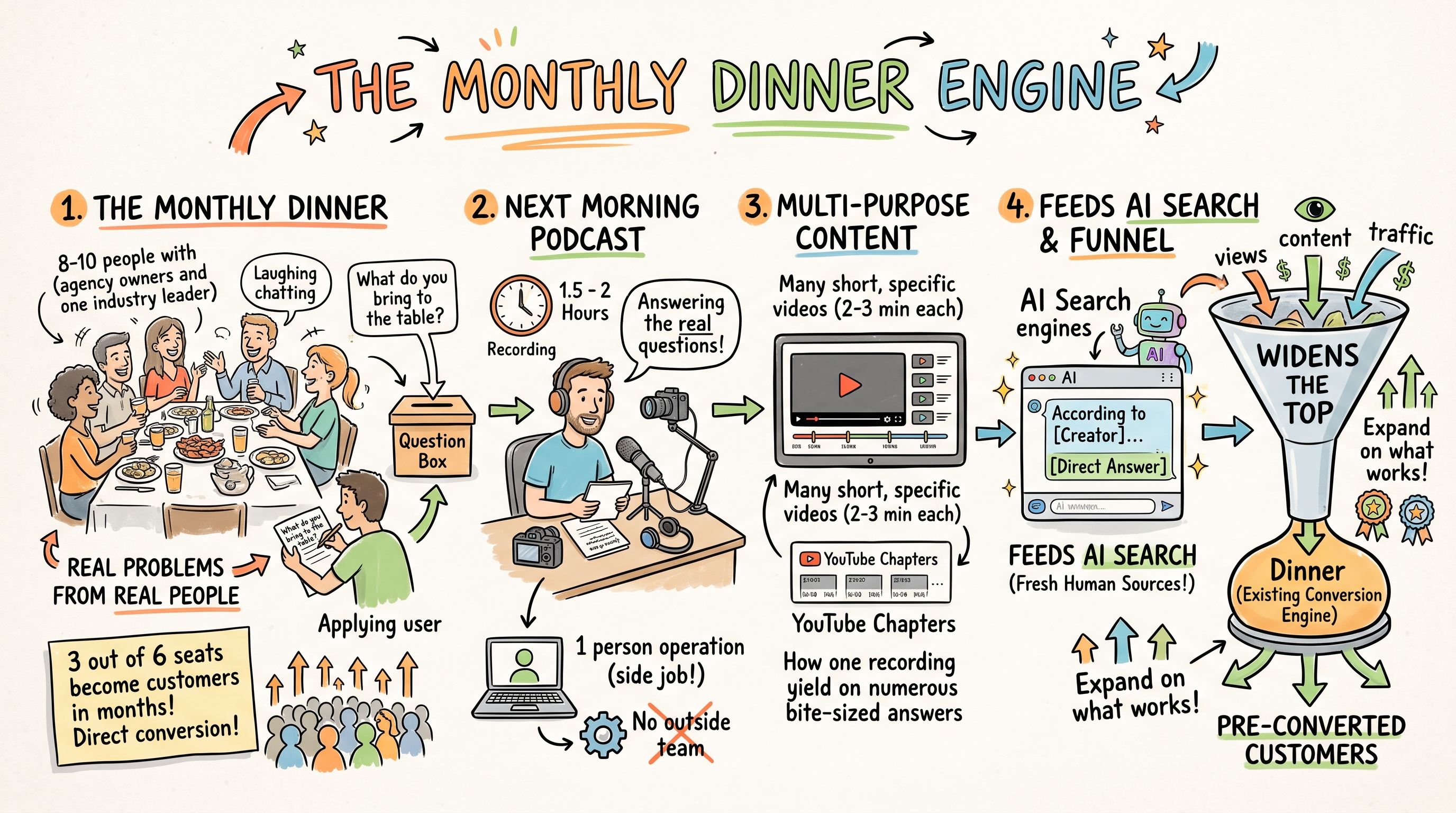
The clipping program sits on top of a monthly event. Every month he hosts a dinner for about eight agency owners, and he always brings in an industry leader with a large LinkedIn following to sit at the table. He doesn't have to do much beyond booking the restaurant, because the guest brings the conversation. When people apply to attend, they answer one question: what would you bring to the table? That question becomes the raw material for everything that follows.
The morning after the dinner, he films a podcast episode that takes about an hour and a half to two hours. He reads through the questions from the applications and the answers that came up at the table, and answers them on camera. Each question gets two to three minutes, labeled clearly in YouTube, which matters because he is also trying to get picked up by AI search tools. The whole operation is run by one person as a side job, with no outside team.
- The dinner generates the questions. Applicants submit real problems, so the content starts from what the target customer is actually asking.
- The podcast turns the dinner into reusable content. One session produces many short answers, each tied to one specific question.
- The format feeds AI search. He reported seeing his YouTube answers show up in AI-generated responses, because the tools keep looking for fresh, human sources.
- The dinner converts on its own. Roughly three of every six seats turn into customers within a couple of months, which is the baseline the video program has to beat.
That last number matters. Before he put a dollar into clipping, the dinners were already producing customers. The video engine is meant to widen the top of the funnel around something that already works, not to replace it.
How the Clipping Program Works
Clipping is the practice of paying creators to cut long videos into short clips and post them on their own channels. He went live with a program about two days before our conversation, and he describes it as an army of people who like to edit. Creators take his podcast footage, edit it however they like, post it on their own accounts, and then submit the link for approval. The key detail is that he only pays for approved clips, and he pays on performance: $1.50 for every 1,000 views.
To keep the program from becoming a spending leak, he built in several guardrails. Payment happens only after approval, only on views that count, and only when the audience matches his core market. He requires at least 30% of a clip's views to come from the United States, his core region. If a clip goes viral somewhere else in the world, he doesn't pay. That filter alone changes the economics, because viewers in the wrong country can't buy the product.
- Pay on approval only. Nothing leaves the account until he has looked at the clip and accepted it.
- Pay per thousand views. At $1.50 per 1,000 views, a clip that reaches 10,000 people costs about $15, far below typical ad pricing.
- Set a geographic floor. Thirty percent of views must come from his core market, or the clip earns nothing.
- Use a platform built for it. A submissions and payouts tool handles approvals and tracking so he doesn't run it from a spreadsheet.
His dashboard showed roughly 20,000 views and 119 likes and comments across the first batch of posts, for about $33 in total payouts. That was after about a day and a half of the program running. Those are tiny numbers against what a funded media company would see, but the cost per view is already well below what he would pay to run ads against the same audience.
Outsourcing the Recruiting
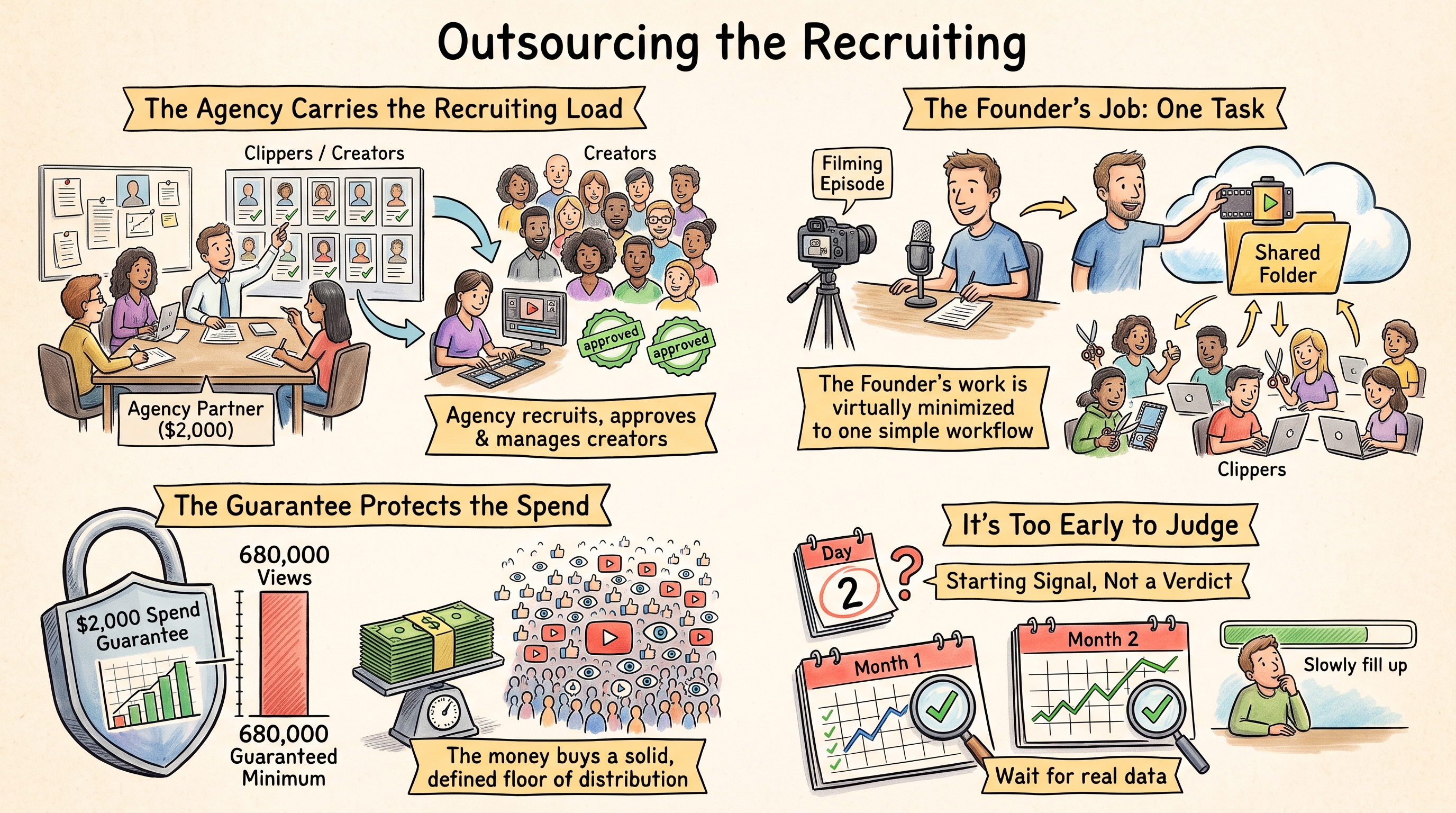
The hardest part of a clipping program is finding the clippers, and this is where he made his most interesting decision. Instead of recruiting creators himself, he hired an agency for about $2,000 that guarantees a minimum of 680,000 views. The agency recruits and approves clippers, sets up the process, and keeps working until the view target is hit. So far they've recruited enough creators to produce about 1,000 submissions, and he hasn't had to do any of the recruiting.
What's left for him is the part only he can do: filming the podcast and dropping the finished videos into a shared folder. From there, the clippers pick up the footage and start cutting. He told us he is happy with the agency so far, although he reminded us that it's only been two days, and he promised to share results once there's real data.
- The agency carries the recruiting load. It finds creators, sets up the process, and approves people into the program.
- The guarantee protects the spend. A minimum view count means the $2,000 buys a defined floor of distribution.
- The founder's job shrinks to one task. Film the episode and put it in the folder.
- It's too early to judge. Two days is a starting signal, not a verdict, so the real test is the one-month and two-month numbers.
A guaranteed view count is a smart structure for any outsourced growth work. It turns a vague promise to get you exposure into a measurable commitment, and it gives you a clear point at which to evaluate the vendor.
Is Clipping Right for a B2B Product?
The most honest part of his presentation was how he framed the fit. Clipping is a consumer-style tactic, and he is testing it on a B2B product with a low ticket: an average basket of roughly $65 a month. He said he wouldn't try this for a high-tech company selling $100,000 or $200,000 contracts, because the audience for those deals doesn't discover vendors by scrolling short-form video. For a product priced in the tens or low hundreds of dollars a month, the math is different, and an impression is worth chasing.
Several people in the group raised the targeting question. There is no audience targeting built into the clipping platform, so the geographic filter is the only control he has. That means the content itself has to do the work of attracting the right people, which is another reason the dinner questions matter: they start from the real problems of his ideal customer.
- Best fit: low-ticket B2B and SMB products. Prices from roughly $50 to a few hundred dollars a month tolerate a broad top of funnel.
- Poor fit: large, long-cycle enterprise deals. Buyers at that level are not discovered through short-form clips.
- Expect weak targeting. You can set geography and a quality bar, but you can't pick the exact viewer.
- Judge it by customers, not views. Views are cheap and plentiful, and the metric that matters is conversion.
I run a similar experiment in my own business. Since late October I've been publishing about six short videos a day, up from about one a week before I started using AI to produce them, and it generally takes six to twelve months of consistent posting in one niche before anything breaks out. A clipping program shortens that timeline by putting more people to work on your behalf, which is its real appeal.
The Best Part: Using Viral Clips in Ads
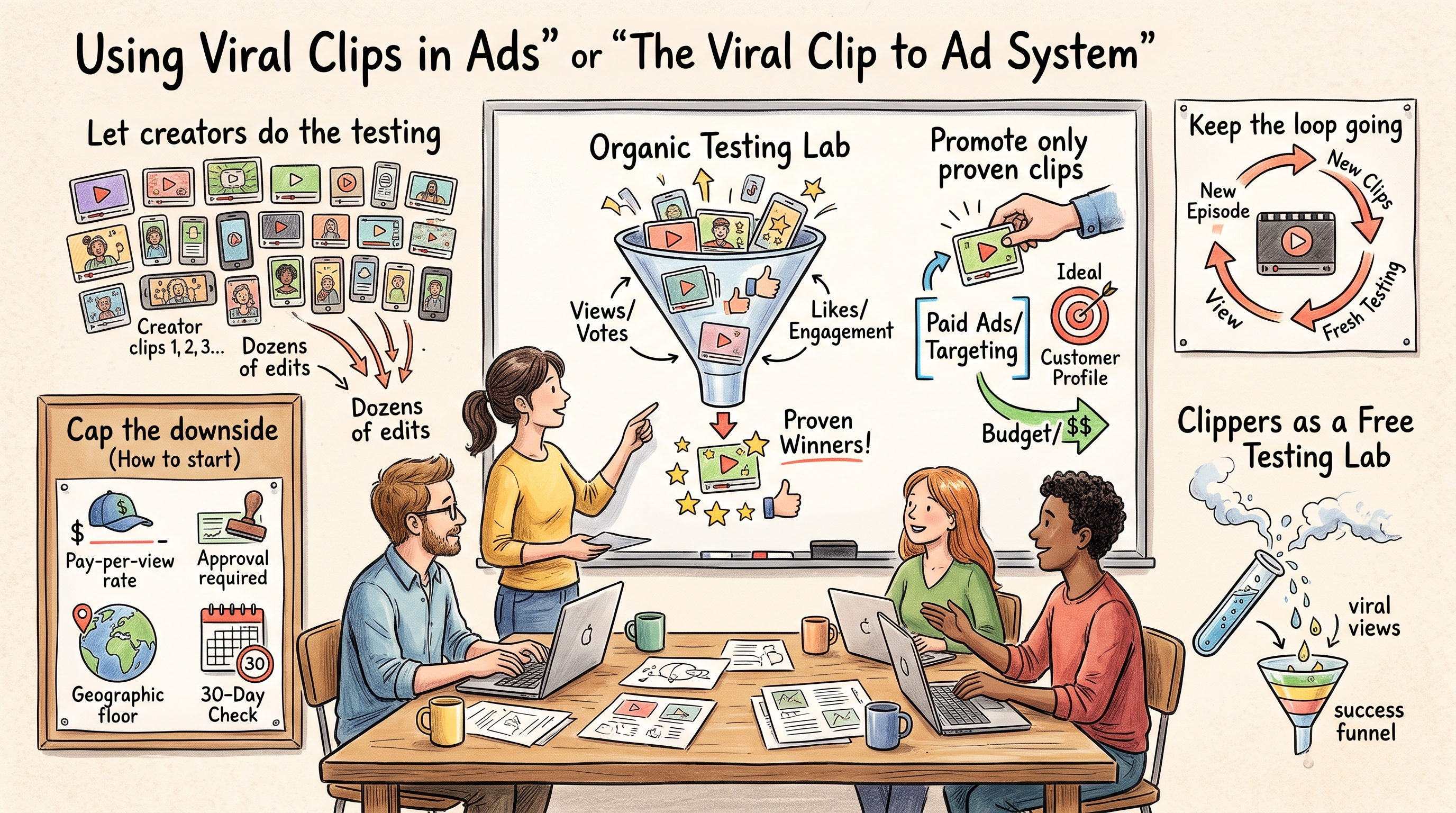
The most interesting part of his plan is what happens after the clips go out. He wants to see which clips do well organically across hundreds of creator accounts, then take the winners and use them in paid advertising, targeted to his ideal customer profile. In other words, the clippers become a free testing lab. Instead of guessing which hook or topic will land, he lets 1,000 submissions vote with their views, then spends ad dollars only on the clips that already proved themselves.
- Let creators do the testing. Dozens of edits of the same footage show which hook and framing earn attention.
- Promote only proven clips. Winning clips move into targeted ads, where he can pick the audience.
- Keep the loop going. Each new episode creates a fresh set of clips and a fresh round of testing.
If you're thinking about trying something like this, start small and cap the downside. Set a pay-per-view rate you're comfortable with, require approval before any payout, put a geographic floor on the views that count, and write down what a good result would be after 30 days. Then check back in on the numbers, and don't be surprised if the real value turns out to be in the ads you build from the winners.