Pay Design for SaaS Teams: Base, Bonus, and Profit Share
Real compensation structures from SaaS founders planning 2027: how to split base and variable pay by role, tie bonuses to EBITDA without starving growth, run a profit share, and keep salaries at market.

It is planning season, and the same set of questions keeps coming up in our masterminds. How much of your team's pay should be variable? Should a bonus depend on the company, the department or the individual? And if EBITDA matters more to you this year than it did last year, how do you get your executives to care about it without cutting the muscle off the business?
A founder on our Tuesday call put it plainly. His core team is on an 85/15 base and variable split, his managers would prefer 95/5, and he wondered whether 15% was too aggressive. The answers he got from the group covered a wide range, and they point to a way of thinking about pay that I find more useful than any single ratio.
Match the variable pay to what each role can influence
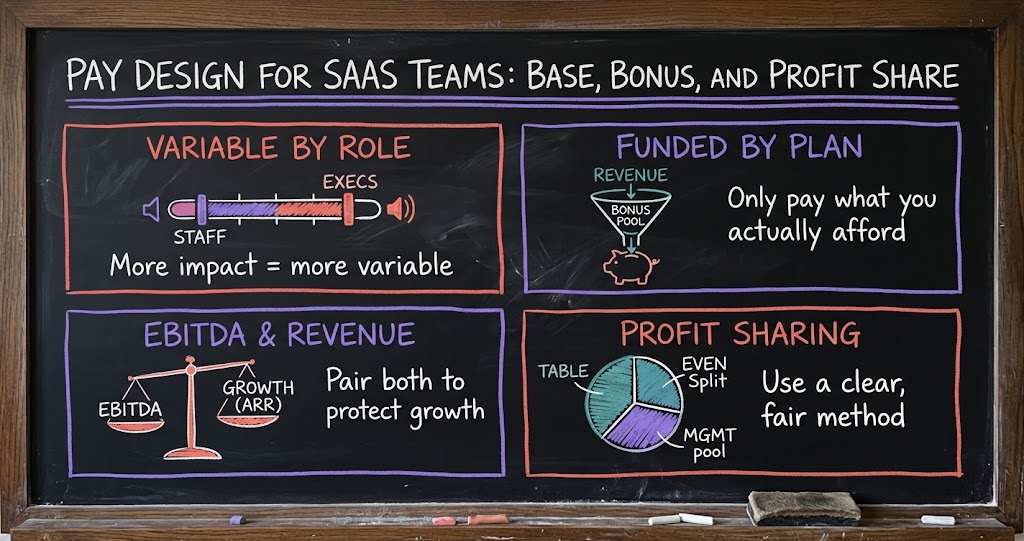
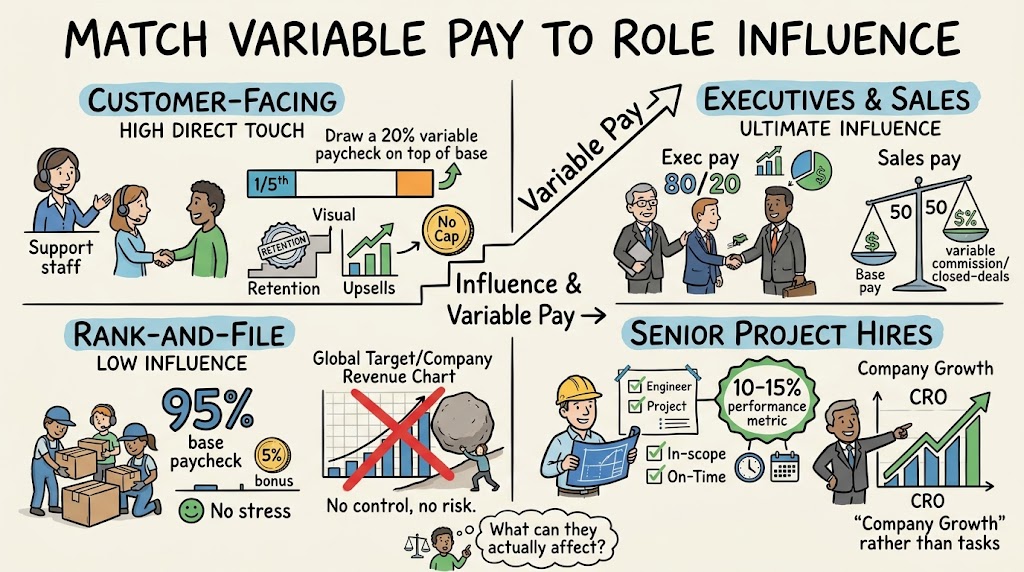
The most useful rule I heard on the call is to ask what a person can actually affect. One founder with a team of around 125 people has about 35 on commission. For the rest, he pays a flat company bonus of roughly 5% of salary. His shipping team, for example, wants to ship on time, but they can't move the company's revenue, so a large variable component would just create stress. When his company went through two bad years of churn, he paid people anyway to show respect, which is a good illustration of why tying too much of a paycheck to results people can't control backfires.
The higher you go, the more variable pay makes sense. The same founder runs a 70/30 split for his second-level managers, with half of the 30% tied to company results and half tied to individual goals. Other members described structures that follow the same logic at different levels.
- Rank-and-file staff. A modest company bonus, around 5% of salary, rewards the team without exposing them to outcomes they don't control.
- Customer-facing staff. One founder pays 20% variable on top of a market salary for anyone who touches the customer, funded by the company's growth rate. If the business grows 15% the whole 20% is earned.
- Customer success. Another member pays a healthy market base and an uncapped bonus tied to upsells and retention, so the bonus rewards specific behaviors.
- New senior hires. A third founder structures 10% to 15% of base as performance pay, tied to the individual's own metrics, such as in-scope and on-time integrations. A chief revenue officer's bonus is tied to company growth instead.
In my own companies, executives were on roughly 80/20, with half of the variable portion based on how their department performed and half based on company revenue and net profit. The head of sales was split 50/50, which is the more common structure for that role. Nothing about these numbers is sacred, but each one reflects a decision about how much of a person's result belongs to them and how much belongs to the team.
Fund the bonus from the plan, not from hope
The cleanest idea I heard came from a founder who ties the customer-facing bonus to the company's growth rate. He knows how much growth he needs to break even and how much he needs to hit his profit target, and he sets the variable pay to match. If the company reaches a 15% growth rate this year, everyone earns the full 20%. Last year the goal was 33%, the company missed it badly, and most people missed most of their bonus, which was painful but at least it was funded by results that had actually happened.
The weakness of this approach is that it isn't tied to individual contribution, and he said so himself. He thinks he will need to add an individual component. That is a fair observation, and it is why many of the members blend the two.
- Start from your plan. Work out the growth you need to break even and to hit your profit goal, then set the bonus pool to those numbers.
- Pay out only what the company can afford. A bonus pool that depends on actual results is never a surprise to your cash flow.
- Add an individual piece. Company-wide bonuses can feel distant, so a share based on personal goals keeps people connected to their own work.
- Tell people what they are getting. A plan only motivates if the team understands how it works.
A short sentence on equity, because it came up too. In my companies, everyone had stock options, including the most junior people, and I made sure the lowest-level employee received at least $5,000 from the sale. We also accelerated everyone's vesting by a year when we sold. One member uses a phantom share plan for his top people, which works when real equity is hard to issue.
Tie bonuses to EBITDA without gutting growth
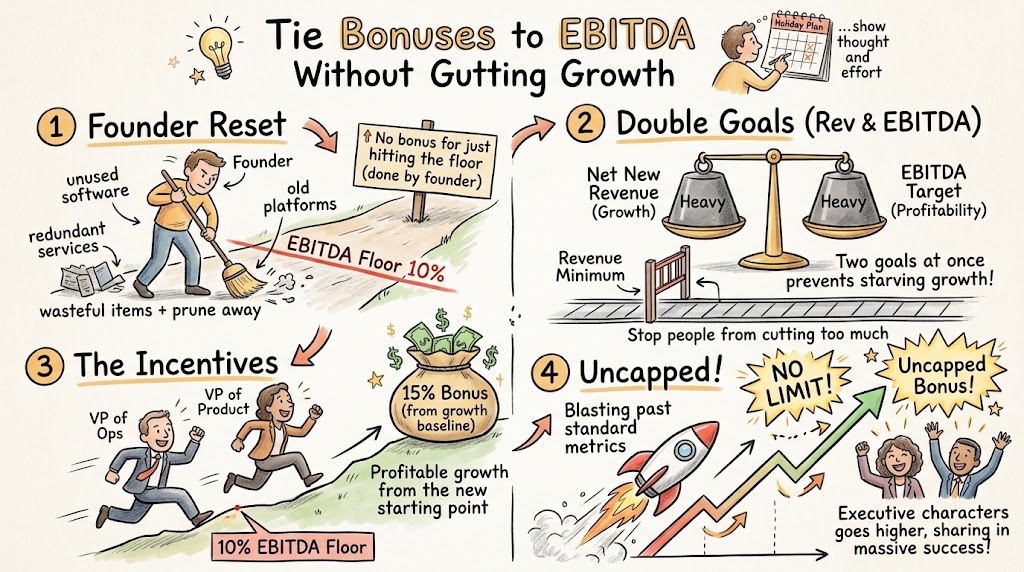
Several founders said EBITDA is becoming more important this year, usually because they plan to raise or sell. A common worry is that rewarding executives for EBITDA will lead them to cut costs and starve the business. One member solved it by using two goals at the same time. His VP of operations and VP of product each earn a bonus on top of base from net new ARR and from an EBITDA target, uncapped in both cases, and he expects it to come to roughly an additional 15% of base this year.
He built in a few details that I like. As he described it, he set an EBITDA floor of around 10% and paid nothing for reaching it, because he had already done the cutting himself. He also set a minimum on net new revenue, so nobody could reach the EBITDA goal by cramming expenses down and ignoring growth. He told us that he spent his holiday last year designing the plan, which is the kind of effort I think this deserves.
- Do the first round of cuts yourself. Nobody wants to cut, so the founder has to push for the answers, whether that is an unused tool, a service or a legacy platform nobody wants to migrate.
- Pay for what comes after the floor. The bonus is for helping the company grow profitably from the new baseline.
- Pair EBITDA with revenue. Two goals at once keep executives from improving one number by hurting the other.
- Leave it uncapped. If people beat the goals by a wide margin, you want them to share in that.
The idea underneath this is that cutting costs is a decision that someone has to force, and rewarding people for future profitability only works once you have reset the baseline. Without that reset, an EBITDA bonus is just a prize for people who find the cuts they would have liked to make anyway.
Profit sharing that people can understand
Profit sharing was the other big topic, and we heard three different versions. One founder publishes a table at the start of every year. If the company reaches its goals, people get about 10% of base pay, and a little more if results are stronger, though it is capped. He pays quarterly, trues it up at year-end, and pays at the highest bracket the company reached for the year. Another aims for a pool of about 10% and spreads it evenly, which he uses to level pay across a team where salaries range from $60,000 to $200,000, and the payouts come to a few hundred to about $1,500 per person per quarter.
I use the third version at a services company I own. I give 50% of profits each quarter to the management team and let them decide how to distribute it between themselves and the rest of the staff, based on what they think is best for the long term. I keep a veto, but I have never needed it. We do a true-up on December 31 for tax purposes and another at the end of the first quarter if needed.
- A published table. People know roughly what to expect, and a cap protects the company in a very good year.
- An even split. A fixed percentage of profit, shared equally, works as a leveler when salaries vary a lot.
- A management-led pool. A large share of profit goes to the team that runs the business, and they allocate it.
- A year-end true-up. Settling the final quarter before year-end keeps the payouts accurate and helps with taxes.
The open question from one member is how much to promise. He keeps the target vague, and I understand why. If you make a specific promise and the profit isn't there, you have created an obligation that damages trust.
Pay market rates, and stop negotiating one at a time
Everyone on the call agreed that SaaS salaries are rising. A founder hiring a controller started with a budget and had to raise it well above the original range to attract anyone with SaaS experience. Another re-leveled his whole team this summer and found significant raises were needed, and a third pointed out that when you hire at higher salaries, you then have to look at the people already on the team.
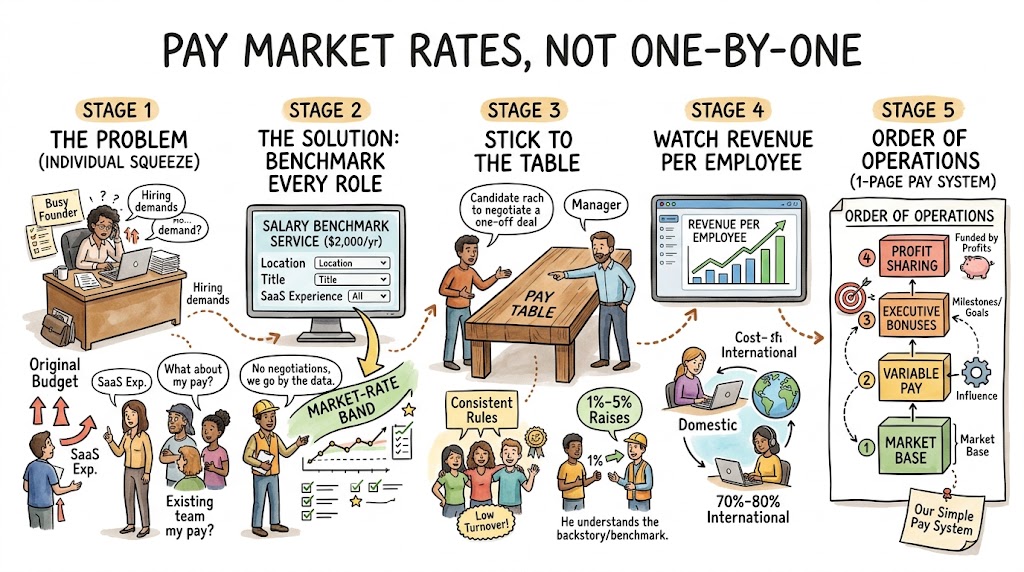
The most practical answer came from a member who subscribes to a salary-benchmarking service for about $2,000 a year. You enter the location, experience, job title and industry code, and it gives you a range. His company has used it for five years, he says it has brought turnover close to zero, and he doesn't negotiate individually. This year his raises ranged from 1% to 5% by role. Some people received only 1%, which is uncomfortable, but the service gives him the backstory for each role and people tend to nod.
- Benchmark every role. A subscription service or an AI tool can give you a range for a specific job, location and experience level.
- Stick to the table. Consistent rules are easier to defend than a series of one-off deals.
- Expect upward pressure. New hires at current market rates will pull up the salaries of people who joined earlier.
- Watch revenue per employee. One founder tracks it alongside average compensation, and uses lower-cost international contractors for some roles, which he says cost about 70% to 80% of a US hire.
If you take one thing away from all of this, make it the order of operations. Start by setting salaries at the market, then add variable pay where people can influence the outcome, then tie executive bonuses to the goals your next stage depends on, and finally add profit sharing if the business can fund it. Each piece is simple, and together they give you a pay structure you can explain on one page.