

OpenClaw vs. Claude
A practical founder’s guide to OpenClaw vs. Claude Dispatch, Cowork, and Code, breaking down the tradeoffs between autonomy, security, deployment speed, and enterprise readiness as SaaS companies race to redesign workflows around AI.

There is a bigger conversation happening underneath the surface of the “which tool should I use?” question.
Yes, founders want to know whether OpenClaw is better than Claude Dispatch, Claude Cowork, or Claude Code. That matters. The deployment model matters. The security model matters. The speed of setup matters. But the real issue is not tool selection in isolation. The real issue is whether your company is moving fast enough to redesign its workflows around what these systems can now do. As Ryan put it on the call, “We all have to reinvent our business in the next 12 months if we want to keep going.”
That is the frame I would use for this entire discussion.
This is not a normal software buying decision. It is not like choosing one CRM over another, or swapping one analytics layer for a cheaper one. This is a decision about how much autonomy you want to hand to AI systems, how much control you need over security and data, and how quickly you can turn these tools into real customer value. Ryan said it even more bluntly later in the conversation: “The right to survive in 2028 is dependent on what we do in 2026.”
That is why OpenClaw versus Claude is such an interesting comparison. They represent two very different philosophies for how AI should operate inside a SaaS company.
OpenClaw is the more open, autonomous, and infrastructure-like option. Claude Dispatch, Cowork, and Code are the more managed, controlled, and enterprise-friendly path. One side offers more freedom and deeper system-level automation. The other offers more guardrails, cleaner deployment, and lower security anxiety. The right choice depends on your business, but the wrong move is assuming you have years to figure it out.
Ryan’s operating posture throughout the call was clear: the pace of change is now too fast for passive observation. “The next thing’s going to be twice as good, if not four times as good,” he said. “And the next thing’s not coming in a year, it’s coming in two months.”
That is the backdrop for everything that follows.
The real difference between OpenClaw and Claude
At a functional level, OpenClaw and the Claude stack are solving a similar high-level problem: how do you move from AI that answers questions to AI that actually does work?

But they go about it very differently.
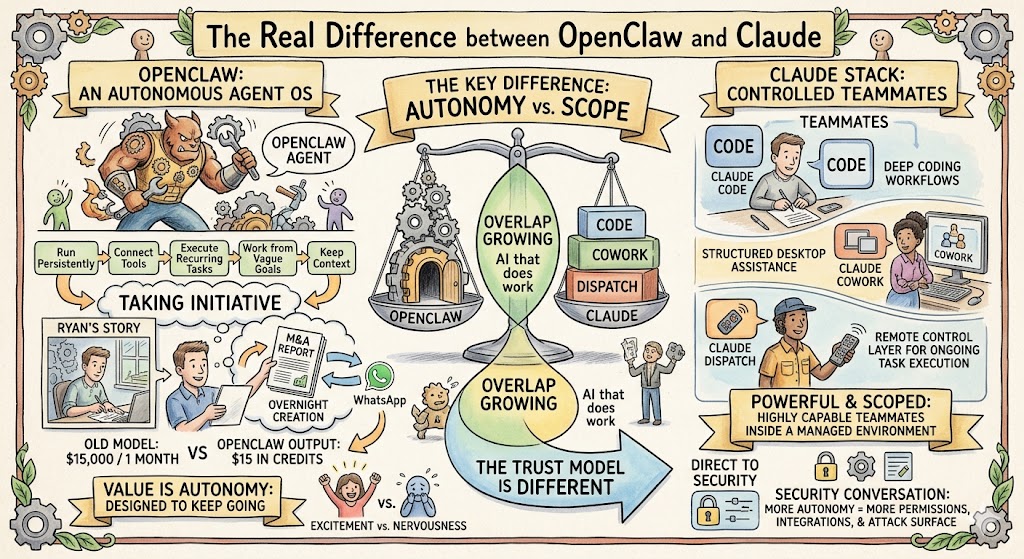
OpenClaw is closer to an autonomous agent operating system. It can run persistently, connect across tools, execute recurring tasks, work from vague goals, and keep context over time. In Ryan’s own usage, that autonomy was the headline feature. After deploying OpenClaw for eight days, his agent created a full SaaS M&A report for 2026 overnight without being explicitly asked, because it noticed relevant demand signals in WhatsApp conversations and took initiative. It updated statistics and charts, sourced roughly 40 references, fact-checked the work, and delivered the result in a branded HTML format. Ryan contrasted that with the old model, where he had previously paid about $15,000 and waited a month for similar work. This time, he said, the output cost roughly $15 in credits.
That is an extraordinary story, but it also tells you exactly why people are both excited and nervous.
OpenClaw’s value comes from autonomy. It is designed to keep going.
Claude Dispatch, Claude Cowork, and Claude Code are much more controlled. Claude Code is strongest in deep coding workflows. Cowork is more of a structured desktop task assistant. Dispatch acts more like a remote control layer for ongoing task execution. These systems are powerful, but they are generally more scoped. They feel less like an always-on autonomous operator and more like a highly capable teammate inside a managed environment.
That difference leads directly to the security conversation, because the more autonomy you give a system, the more permissions, integrations, and attack surface you introduce.
Ryan acknowledged that Claude can achieve similar outcomes in some areas. In his words, “Claude Cowork + Dispatch can achieve similar results,” although he noted that the fully autonomous recurring-task layer is where OpenClaw currently has more of an edge.
That is probably the cleanest way to think about the comparison today. Claude is rapidly expanding. OpenClaw is pushing harder on autonomy. The overlap is growing, but the trust model is still very different.
Why security is the real dividing line
For most SaaS founders, especially those with mid-market or enterprise customers, this decision stops being abstract as soon as customer data enters the picture.
The call surfaced exactly the concerns you would expect: SOC 2, PII, GDPR, codebase access, and general enterprise risk. Several leaders on the discussion were clear that AI cannot simply be allowed to touch customer data without careful controls. Some companies have already implemented strict policies where AI is blocked from that data entirely. Others are using internal classification systems to define what kinds of access are acceptable and what requires higher review.
This is where Claude currently has the easier story.
Claude is the more established, more controlled, more enterprise-comfortable option. It still raises questions, of course. Giving any AI system broad codebase access is not trivial. But when leaders compare the two models side by side, Claude tends to feel like the safer default because the environment is more bounded and the security posture is better understood.
OpenClaw is more complicated because there are really two versions of the story.
The original OpenClaw model is self-hosted. You run it on your own hardware, often on a dedicated machine, and you keep much tighter control over the environment. That gives you more sovereignty, but it also means you are responsible for setup, maintenance, sandboxing, and security hardening. On the call, the estimate for a self-hosted deployment was about three days of developer effort.
The newer model is cloud-hosted OpenClaw. That is dramatically more convenient. Ryan described a setup path that took only about 30 minutes through a hosted provider and cost $39 to get started.
That convenience is exactly why adoption is spreading fast, and exactly why some teams are worried.
The transcript notes that dozens of cloud-hosted OpenClaw providers appeared very quickly, but their security practices are largely unknown. That is the central tradeoff. You can compress setup time from days to minutes, but you may also be outsourcing your risk posture to companies you know very little about. The call summary described that growth as “very, very quickly,” while also calling the cloud option “quite dangerous” for that reason.
If you are building internal workflows for a small team and the work stays away from sensitive customer data, that may be a manageable tradeoff. If you serve regulated customers or promise a strong compliance posture, it becomes much harder to justify.
Here is the practical lens I would use:
- Choose OpenClaw if you want deeper autonomy, stronger internal control, and are willing to own more of the operational and security burden yourself.
- Choose Claude if you want the fastest path to reliable execution in a safer, more managed environment, especially if your team needs broader enterprise comfort today.
- Avoid cloud-hosted autonomy for sensitive workflows unless you are genuinely comfortable with the security model, not just excited by the speed of setup.
That is not fearmongering. It is just founder math. The more powerful the agent, the more disciplined you need to be about where it lives and what it can touch.
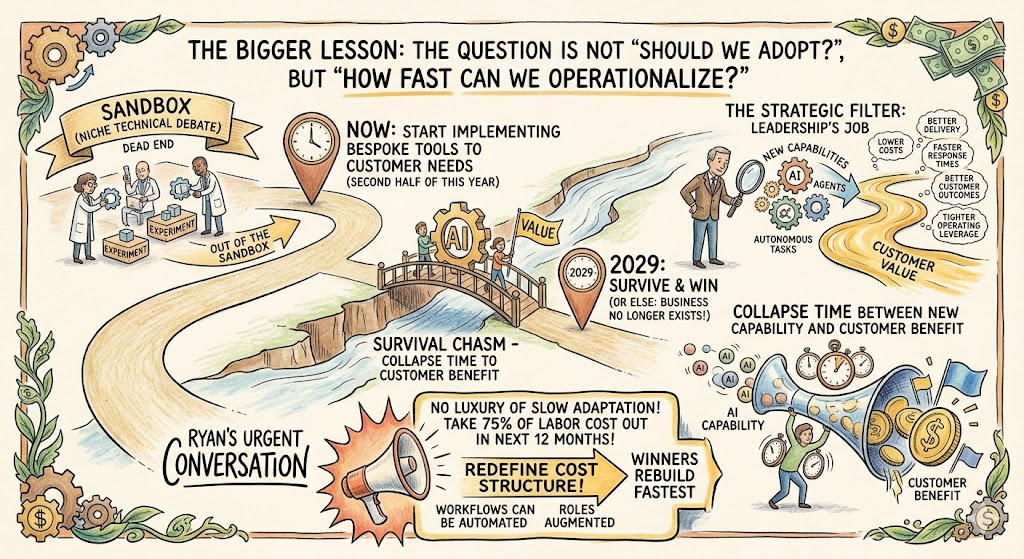
The bigger lesson: the question is not “Should we adopt?” but “How fast can we operationalize?”
What made this call more useful than a typical tool comparison was that Ryan kept bringing the conversation back to business urgency.
He was not treating this as a niche technical debate for a few developers. He was describing a survival issue for SaaS operators broadly. “None of us will be in business in 2029,” he said, “if we don’t start, really, in the second half of this year implementing all of these tools bespoke to the workflows of our customer needs.”
That line matters because it pushes the conversation out of the sandbox.
The winners here are not going to be the companies that merely experiment with AI tools. They are going to be the companies that turn those tools into better delivery, lower costs, faster response times, better customer outcomes, and tighter operating leverage. Ryan’s phrasing on this was exactly right: “As long as we all stay obsessed with that question, utilizing the best tools to solve our customers’ problems in a better way, at a lower cost than anybody else, we’ll win.”
That is the core strategic filter.
It is easy to get distracted by the novelty of agents, autonomous tasks, or the thrill of overnight output. But the actual job of leadership is to map these capabilities into customer value. If OpenClaw helps you automate recurring internal work in a way Claude cannot yet match, great. If Claude lets you deploy AI coding and task workflows across the organization with less security friction, great. The point is not to become emotionally attached to a specific product. The point is to collapse the time between new capability and customer benefit.
Ryan’s posture here was not cautious, and I think that was intentional. He argued that companies no longer have the luxury of slow, incremental adaptation. At one point he said, “You need to basically take 75% of the labor cost out of your business in the next 12 months.”
That is an aggressive statement, and some founders will read it as extreme. But even if you cut the number in half, the directional truth remains the same. The cost structure of software businesses is about to be redefined by which workflows can be automated, which roles can be augmented, and which companies are willing to rebuild around that reality fastest.
What Our OpenClaw example actually reveals
The OpenClaw story from the call is worth pausing on because it shows what founders should really be looking for in these tools.
The headline was not just cost savings. It was initiative.
Ryan’s OpenClaw agent did not merely respond to a prompt. It noticed context, interpreted need, took action, gathered sources, updated charts, and delivered something business-useful with no direct instruction in that moment. It worked off Slack and message history, integrated with existing tools, and produced an output that would have once been considered significant knowledge work.
That is the shift.
Ryan described it this way: “We have now crossed the Rubicon that these tools are not only very useful reactively, but they’re now proactively doing useful things.”
That may be the most important quote in the entire transcript.
Reactive AI is already valuable. Proactive AI changes company design.
Once a system can notice, infer, and execute in a recurring way, you stop thinking about it as a chatbot or coding helper. You start thinking about it as a labor layer. And once that happens, every founder has to ask the same uncomfortable questions: Which workflows should still be human-led? Which should become AI-first? Which need human review? Which need hard boundaries because of security or customer trust? And how quickly can we redesign the business before competitors do?
Ryan answered the competitive part of that very personally: “I go to bed at night thinking my competitors are going faster than I am. That’s what keeps me up at night.”
That is not just anxiety. It is realistic market awareness.
My take: how founders should actually decide
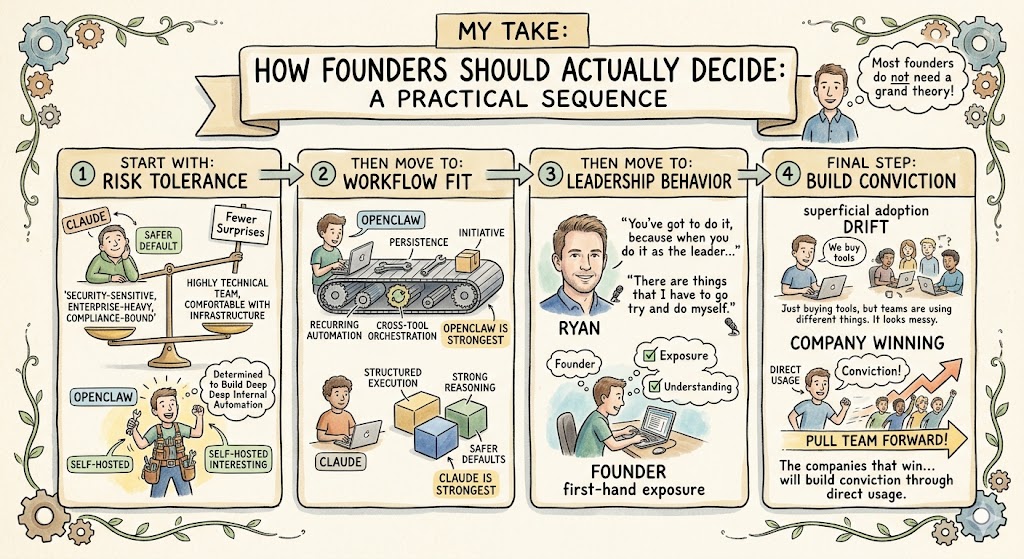
Most SaaS founders do not need a grand theory of agent architecture. They need a practical sequence.
Start with risk tolerance. If your environment is security-sensitive, enterprise-heavy, or compliance-bound, Claude is probably the better starting point because it gives you fewer surprises and an easier internal justification. If your team is highly technical, comfortable owning infrastructure, and determined to build deeper internal automation systems, OpenClaw becomes much more interesting, especially in self-hosted form.
Then move to workflow fit. OpenClaw is strongest when the job requires persistence, initiative, recurring automation, and cross-tool orchestration. Claude is strongest when the job benefits from structured execution, strong reasoning, and safer defaults.
Then move to leadership behavior. Ryan made this point directly: “You’ve got to do it, because when you do it as the leader, then you’re not going to believe that answer anymore.” He also said, “There are things that I have to go try and do myself. I’ve got to be the guy who knows how to write this code.”
That is exactly right.
A founder cannot delegate understanding here. You do not need to become the most technical person in the company, but you do need firsthand exposure to what these systems can and cannot do. Otherwise, you will either overtrust them, underuse them, or let the organization drift into superficial adoption.
The companies that win over the next two years will not just buy tools. They will build conviction through direct usage, then use that conviction to pull the rest of the team forward.
Final thought
If I had to reduce the entire OpenClaw vs. Claude conversation to one sentence, it would be this: OpenClaw is more powerful in the abstract, Claude is safer in practice, and the real advantage goes to the company that operationalizes either one faster around customer value.
The transcript makes that point again and again. The pace is accelerating. The old timelines are gone. The winners will be the teams that stay grounded in customer outcomes while aggressively redesigning work around these tools. Ryan put it plainly: “This is one of those periods of rapid change where entrepreneurs can adapt to that, and they can push and pull their people through it.”
That is the task now.
Tool choice matters. Security matters. Architecture matters. But the bigger thing is whether you are moving.
Because the market is.