
One Prompt, Eight Hours, a Finished Game: What It Means for Your SaaS Roadmap
Builders are already shipping games, simulations, and even an operating system from a single prompt. Here is what the early results show and a simple overnight experiment that tests how safe your roadmap really is.

A single prompt produced a complete video game in about eight hours. That sentence should make any SaaS founder stop and look at their roadmap, because the feature your team has been estimating at two quarters of work may now be something a model can attempt overnight. The model in question is the one the builder community has been calling Claude Fable 5.2, which came out on November 9th, and the early results are worth walking through.
Everything in this post comes from examples that builders have shared publicly since the release. I have not run all of them myself, so treat them as reports from the field, and treat the lesson at the end as an experiment you can run on your own product.
What builders have made so far
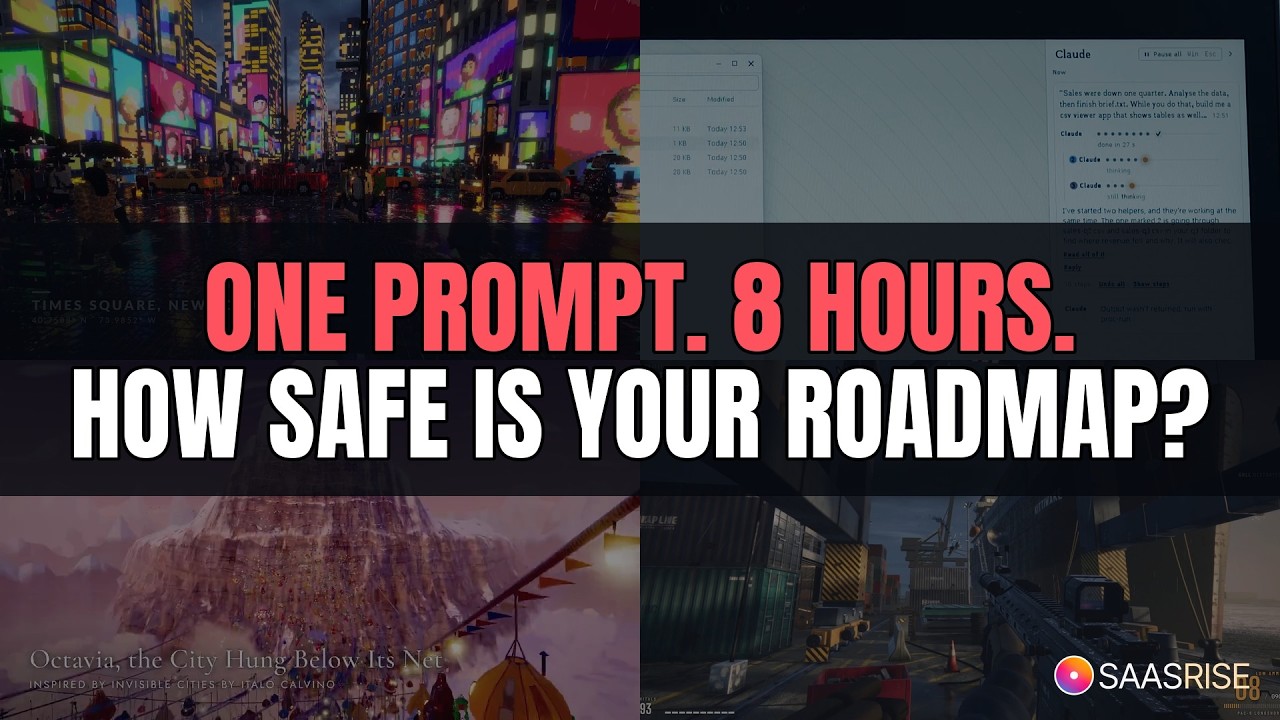
The examples fall into a few groups, and each one says something different about what the model can do. A researcher at Anthropic got a shooter game out of a single prompt, and every model, sound, and texture in it was written from scratch. Another builder asked for the whole Earth as a game, where you can fly anywhere and destroy anything. A well-known AI researcher asked for an endless journey, and 25,000 agents built more than 450 worlds, all in code.
- A shooter from one prompt. Every model, sound, and texture was written from scratch, with no stock assets.
- The whole Earth as a game. The prompt asked for a world where you can fly anywhere and destroy anything.
- An endless journey. 25,000 agents built more than 450 worlds, all in code.
Then the work left the screen. From one paragraph of description, the model designed three working physical devices. Software founders should notice that jump, because it means the model is not limited to the kind of output that lives inside a browser tab.
The big one: an operating system from an empty folder
The largest example so far is the one that changes the scale of the conversation. Starting from an empty folder, more than a thousand agents worked for eight days and built an operating system that boots on a laptop. An operating system is one of the most complicated pieces of software there is, with a huge number of parts that have to work together. Seeing a system like that come out of a single instruction says a lot about how far long-running agent work has come.
The way it works matters more than the headline. The model keeps going for days on its own, splits the job across thousands of agents, and checks its own work. Each of those three behaviors addresses a weakness of earlier AI tools. Running for days removes the need for a person to prompt it every few minutes. Splitting the job lets many pieces progress at the same time. Checking its own work catches errors before they pile up.
- It works for days without help. A long project no longer needs a human to restart it every few minutes.
- It divides the job. Thousands of agents can work on different parts at once, much like a large engineering team.
- It reviews its own output. Self-checking catches mistakes while they are still small.
I would not read these demos as proof that every company can replace its engineering team next month. They are public examples, and each one was chosen by someone who wanted to show what was possible. What they do show is that the ceiling has moved a long way, and a roadmap built around the old ceiling deserves another look.
It is also worth noticing how different these examples are from each other. A game, a simulation, a set of devices, and an operating system share almost nothing on the surface. What they share is a clear request and a long, self-checking run, which suggests the pattern will carry over to business software as well.
Why this matters for a SaaS roadmap
Every product roadmap has a graveyard of features that got cut for being too big. They were too expensive to build, too risky to start, or too far from the next quarter's targets. Those decisions made sense when the cost of building was fixed by the size of your team. If a model can attempt large builds overnight, the cost side of the equation changes, and some features on the cut list may now be cheap to try.
There is a defensive side to this as well. If a founder can try the big feature in a night, so can a competitor, and so can a new startup with no legacy code and no roadmap committee. A roadmap is safe to the extent that it relies on things that are hard to copy, such as your customer relationships, your data, and your distribution. Features that took a year to build may stop being a moat quickly.
- Re-examine the cut list. Features dropped for being too big are the first place to test what the model can do.
- Expect faster competitors. A small team can now try ambitious builds that used to need a large one.
- Invest in what is hard to copy. Customer trust, proprietary data, and distribution hold up better than code does.
An overnight experiment for your own product
Here is the move I suggest for SaaS founders. Take the feature you cut from the roadmap for being too big. Write one clear paragraph describing what it should do, who it is for, and what a finished version looks like. Then let the model run overnight and see what is on your screen in the morning. The paragraph is the real work, so give it some care.
A good paragraph has a few ingredients. It names the user and the problem in plain language. It describes the result the user should get, so the model has something to check its work against. It also lists the constraints, such as the systems the feature has to connect to and anything it must not change. The clearer the paragraph, the better the output, which is the same lesson founders learn when they hand work to a new hire.
- Name the user and the problem. Say who the feature is for and what it should let them do.
- Describe the finished result. Give the model a clear picture of done so it can verify its own work.
- List the constraints. Mention integrations, data rules, and anything that must stay untouched.
- Run it in a safe place. Use a copy of your code or a sandbox so an overnight run cannot disturb production.
In the morning, review the result the way you would review a contractor's first draft. Some of it will be useful, some will need rework, and a few parts may surprise you in either direction. Either way, you will learn something concrete about how much of your cut list is now within reach.
What a human still has to do
Handing a model a large task does not remove the founder from the process. Someone has to decide what is worth building, judge whether the result serves customers, and own the decision to ship. A model can produce a lot of working code in a night, but it cannot know which of your customers are about to churn or which feature will change a renewal conversation. That knowledge sits with you and your team.
- Choose what to build. Product judgment about customers and timing stays with your team.
- Review for quality and safety. Security, data handling, and edge cases still need a careful human review before anything reaches users.
- Decide what to ship. Fast output makes selection more important, since you can now produce more options than you can launch.
The practical effect is that the scarce resource shifts. Engineering hours used to be the bottleneck for most roadmaps. If building gets cheaper, attention, taste, and a clear understanding of the customer become the limits, and those are skills a founder can develop on purpose. Teams that get good at writing clear descriptions and reviewing results quickly will get the most from any model.
What to do this week
Pick one feature and write the paragraph. Set up a safe copy of your code and let a run go overnight. Then bring the result to your team and ask a direct question: if this had taken one night instead of two quarters, what else on the roadmap would we reconsider? That conversation is worth having even if the first attempt falls short.
One prompt built a game. What will your team build? If you want to compare notes with other founders working on this, our community for AI founders and builders is at lounge.ai, and SaaS CEOs with $1 million or more in ARR can apply to join our growth mastermind at sasrise.com.