
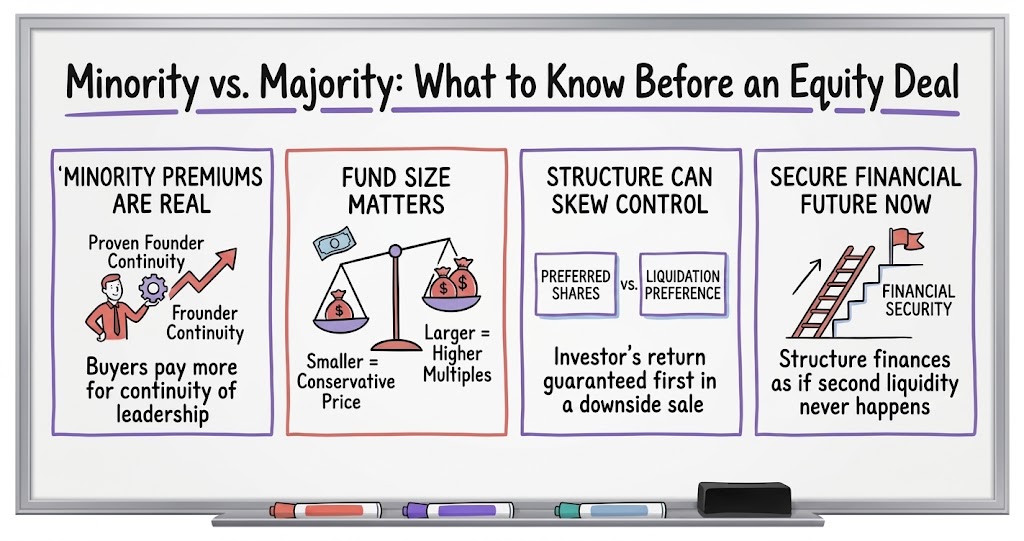
Minority vs. Majority: What to Know Before an Equity Deal
Founders who've actually sold a stake in their company shared the terms that mattered more than the headline percentage, and the consistent warning was the same: read the operating agreement before you get excited about the multiple.

A founder in a recent mastermind was weighing an equity transaction for the first time, looking at options that ranged from a minority raise to a full acquisition, and wanted to understand whether majority deals really do command a premium over minority ones the way he'd heard. The founders who answered had actually been through these transactions, and what they described went well beyond the headline multiple. The real lessons were about what happens after the deal closes.
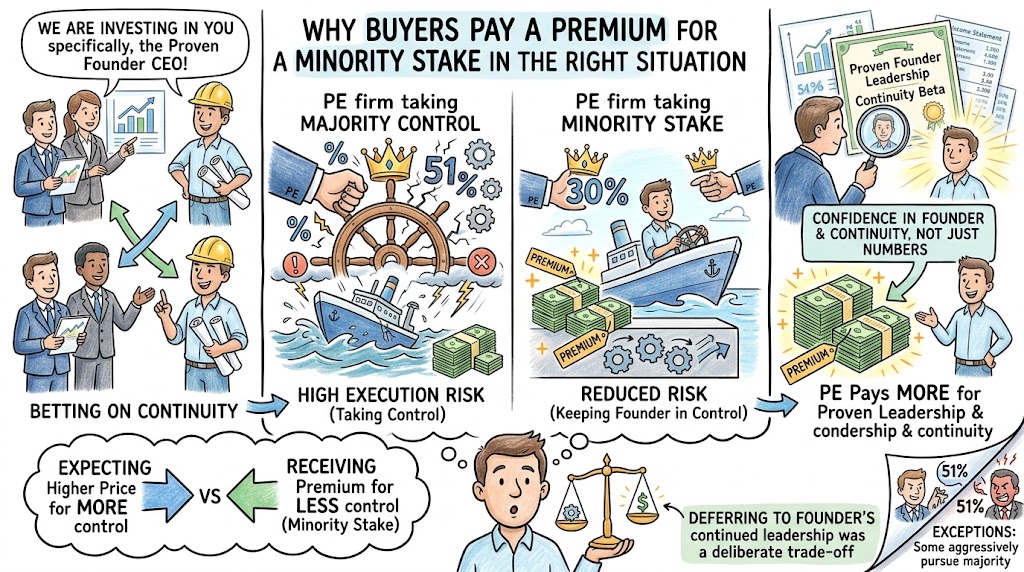
Why buyers pay more for a minority stake in the right situation
One founder who sold a meaningful minority stake a few years ago explained the logic his private equity partner gave him directly: they were investing in him specifically, as the CEO and founder who'd built and run the business, and keeping him in control with a majority stake reduced their risk. Paying a premium for a minority position, rather than pushing for majority and losing the founder's continued leadership, was a deliberate trade-off on their end. He admitted it was counterintuitive to him at the time. He expected to be paid more for giving up more control, not less.
- A premium for a minority stake often reflects reduced execution risk. Buyers may pay more to keep a proven founder running the business than to take full control themselves.
- This isn't universal. Other founders in the discussion noted plenty of firms take the opposite approach, pursuing control aggressively regardless of the percentage on paper.
- The premium reflects the buyer's confidence in you, not just the business. It's a bet on continuity of leadership as much as it is a bet on the underlying numbers.
The size and type of the fund changes everything
A second founder who'd been through multiple fundraising conversations without ultimately raising added an important variable: the size and stage of the fund itself. Newer, smaller funds run by people who spun out from bigger shops tend to be more conservative on multiples, because they're still building a track record and need an early win. Larger, more established funds with a lot more assets under management are often willing to pay higher multiples, and they also tend to be more hands-off once the deal closes, simply because a single investment is a smaller piece of a much larger portfolio. One founder who took an investment from a very large, multi-billion-dollar fund described the experience as notably hands-off, in contrast to two smaller funds he'd talked to that he suspected would have been far more involved in day-to-day decisions.
- Smaller, newer funds tend to be more conservative on price. They're often more risk-averse because they need an early success to build their own track record.
- Larger funds tend to pay more and stay more hands-off. A bigger portfolio means any single investment matters proportionally less, which often translates into less day-to-day involvement.
- Ask directly about involvement expectations before signing. Fund size is a reasonable proxy for how hands-on an investor will be, but it's worth confirming directly rather than assuming.
The percentage on the term sheet isn't the whole story
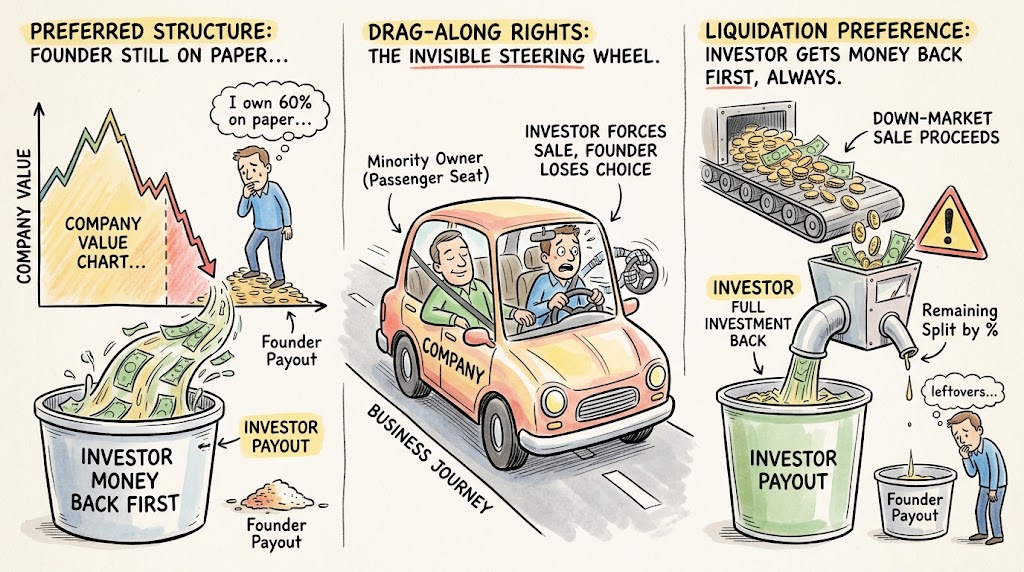
This is where the conversation turned genuinely cautionary. One founder who sold a minority stake described the deal structure that came with it: preferred shares. On paper he retained the majority of the company, but the preferred structure meant that if the business's value ever dropped below the price the investor paid in, the investor got their money back first before any remaining value was split according to the ownership percentages. He put it bluntly: he retained ownership on paper, but if the value hadn't held up, he wouldn't have actually had the effective majority stake the percentage suggested. There were months, he said, where he genuinely didn't know whether he'd end up upside down despite technically holding control the whole time.
A different founder added a related warning: drag-along provisions. He'd walked away from a deal with an excellent valuation specifically because of two terms buried in the agreement, drag-along rights that would let the investor force a sale of the entire company whenever they wanted, regardless of what the founder wanted, and a liquidation preference that guaranteed the investor got their money back first in any sale, even one that returned barely more than what they'd put in. He described the effect of these terms memorably: the investor might sit in the passenger seat on paper, but the agreement quietly hands them the steering wheel, the brake, and the accelerator.
- Preferred shares can make a stated ownership percentage misleading. A preferred structure can mean an investor recovers their full investment before remaining value is split, even if you technically hold the majority stake.
- Drag-along rights let an investor force a sale you didn't choose. Regardless of your percentage ownership, this clause can hand control over the timing and terms of an exit to the investor.
- A liquidation preference protects the investor first, always. In a down-market sale, the investor's return is often guaranteed before the founder sees anything from their remaining stake.
Control can hide inside the accounting, too
A third founder described a deal he ultimately walked away from that revealed yet another place control can hide. The offer looked strong on the surface, a favorable multiple with roughly two-thirds paid upfront, but the remaining third was structured as a contingency tied to quadrupling EBITDA, while the buyer would hold full ownership in the meantime. His question, once he worked through the implications, was pointed: if the buyer controls the financial statements during that earn-out period, who's actually deciding what the EBITDA number looks like? He walked away, and his advice to the group was to look past the percentage and the multiple entirely and ask what isn't written explicitly into the agreement, because that's usually where the real control sits.
- Earn-outs put you at the mercy of whoever controls the numbers. If a deferred payment depends on a financial metric, and the buyer controls the accounting during that period, the metric can be shaped by more than just business performance.
- Ask who has operational control during any earn-out period. A deal that looks generous on paper can quietly shift real negotiating power to whoever manages the books afterward.
- The details not written into the agreement matter as much as the ones that are. Founders who've been through these deals consistently pointed to the fine print, not the headline terms, as where real risk was hiding.
The practical advice: take enough off the table on the first bite
The clearest piece of forward-looking advice came from a founder reflecting on his own transaction a few years back. An experienced advisor told him at the time that a second liquidity event down the road would probably happen, but to structure his life and finances as though it might not. He took a strong multiple on his first transaction and made sure he and his family were financially secure on that basis alone, rather than counting on a future payout. He called this the last money you should assume you'll ever take off the table, because markets shift and deals that look reliable can go sideways for reasons that have nothing to do with how well the underlying business performs.
That advice cuts through most of the deal-structure complexity above. Whatever percentage you sell, whatever preferences or drag-along rights end up in the final agreement, the one variable fully within your control is how much of the first check you treat as real, spendable security rather than a number on paper you're still counting on growing. Get good legal counsel who will read every clause of the operating agreement with you, understand exactly what happens in a downside scenario before you sign, and structure your own finances as if the second bite of the apple might never come. If it does come, that's a bonus. If it doesn't, you're still in a strong position either way.

The questions worth asking before you sign anything
Pulling all of this together, a founder heading into an equity conversation is better served asking a short list of specific questions than fixating on the headline multiple. What happens to my return in a down-market sale, given the preference structure. Who controls the timing of an exit once this deal closes. Who controls the financial reporting if any part of my payout depends on a future metric. How involved does this investor expect to be in day-to-day decisions, and does that match what I actually want. None of these questions show up in the number everyone talks about first, the multiple or the percentage sold, and all of them mattered more than that number to the founders who'd actually lived through these deals.
It's also worth remembering that market timing shapes how much leeway you have to ask these questions and walk away from a bad answer. One founder in the discussion pointed out that private equity firms sitting on a lot of uninvested capital, worried about missing a window if conditions improve, can mean unusually strong offers are available right now for founders willing to sell. That kind of environment can work in your favor, but it cuts both ways: firms in a hurry to deploy capital are also the ones most likely to bury aggressive terms in the fine print, betting that excitement over the multiple will keep a founder from reading the operating agreement as closely as they should.