
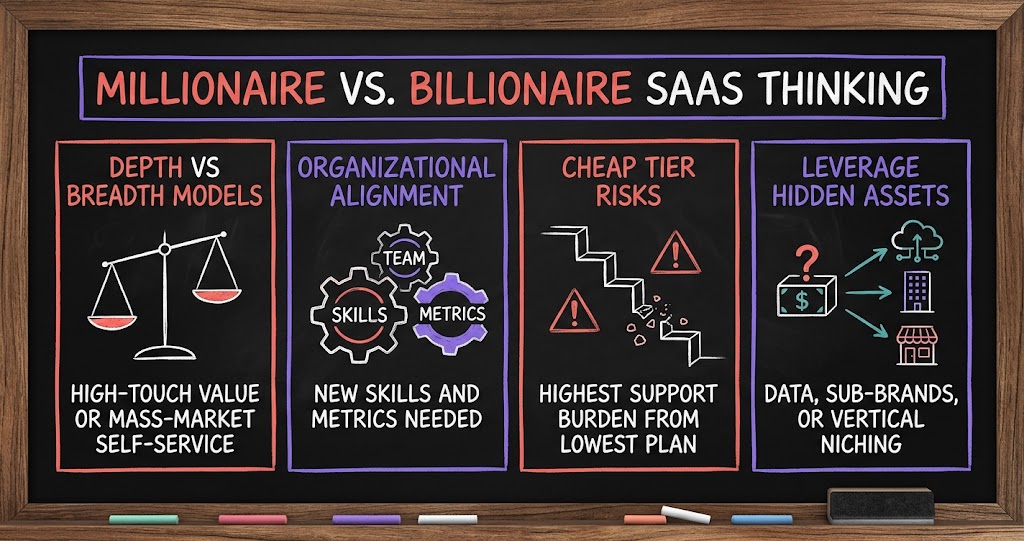
Millionaire vs. Billionaire SaaS Thinking
Two very different playbooks separate a comfortable seven-figure SaaS business from a billion-dollar one, and most founders don't realize which one they're actually running until someone asks them to switch.

A founder in one of our recent mastermind calls asked a question that stopped the room: does the idea of "millionaire thinking" versus "billionaire thinking" in SaaS actually hold up? His definition was simple. The millionaire builds a rich feature set by staying responsive to loyal customers. The billionaire defines a minimum viable solution for the masses and scales it with self-service, value-based pricing. He said flatly that he was running the millionaire playbook, and he wanted to know whether switching to the billionaire one made sense for his business.
It is a good framework, and the conversation that followed, with founders running review management software, employee retention platforms, and AI visibility tools all weighing in, surfaced something more useful than a yes or no answer. The framework is real, but the decision to switch between the two isn't really a strategy question. It's a question about what you want your life and your company to look like in five years.
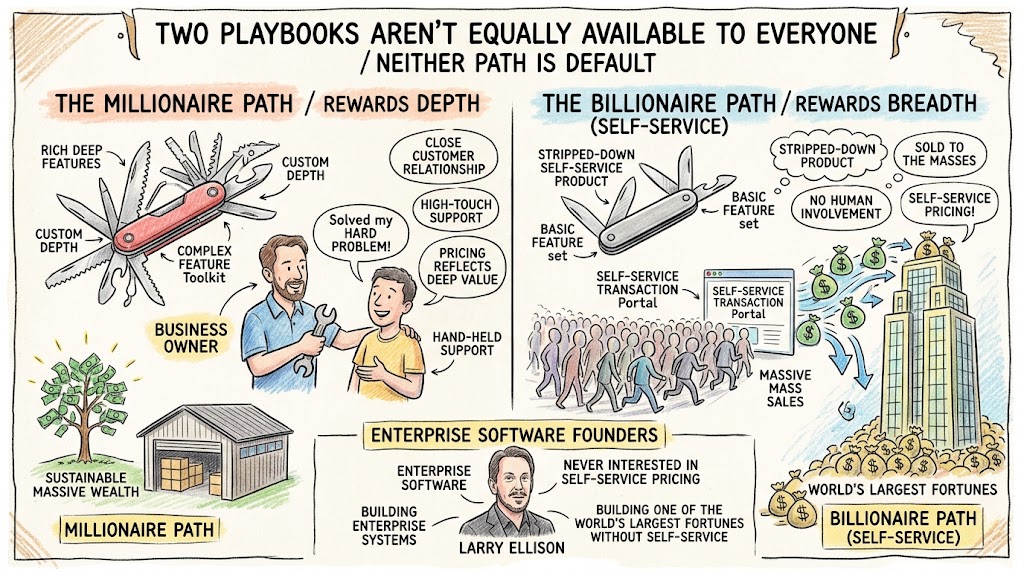
The two playbooks aren't equally available to everyone
One founder in the group brought up Larry Ellison as the clearest example of the opposite path: someone who built one of the largest fortunes in the world through enterprise software and never had any interest in self-service pricing. That's worth sitting with. The billionaire path isn't inherently better than the millionaire path. It's a different bet, with a different set of required skills, and plenty of massive outcomes have been built on the millionaire side of the line, staying close to customers, building deep feature sets, and charging accordingly for that depth.
- The millionaire path rewards depth. Rich features, high-touch support, and pricing that reflects the value of solving a hard problem well for a specific customer.
- The billionaire path rewards breadth. A stripped-down, self-service product that can be sold to the masses without a human ever getting involved in the transaction.
- Neither path is a default. Enterprise-focused founders like Ellison built enormous outcomes without ever touching self-service pricing.
Before you switch, ask what outcome you actually want
The most useful moment in the conversation wasn't about tactics. It was a question one founder asked the person considering the switch: what is the outcome that would be most exciting for you in this business? Not the tactical plan, the actual life outcome. The founder answering said he was thinking about retirement in six years and wanted a business that could sustain itself beyond him for the sake of his team. That answer changed the whole conversation, because it revealed that the real question wasn't millionaire versus billionaire thinking. It was whether he wanted to build a bigger version of the business he already had, or something structurally different.
Once you know the outcome you want, the tradeoffs of switching get a lot clearer. Moving from a rich-feature, high-touch model to a self-service, value-priced model is not a pricing change. It's an organizational change. The team that got you to where you are is not the team you need to run a self-service motion. You need different skills, different metrics, and a different way of thinking about what the company does day to day.
- It changes who you hire. Cross-sell and upsell motions, self-serve funnels, and support-at-scale require a different bench than relationship-driven enterprise sales.
- It changes your timeline. Multiple founders in the discussion agreed that this kind of shift reshapes a company within twelve to twenty-four months, not overnight.
- It changes what you're optimizing for. You're no longer optimizing for depth of relationship with a smaller set of customers. You're optimizing for volume and self-service conversion.
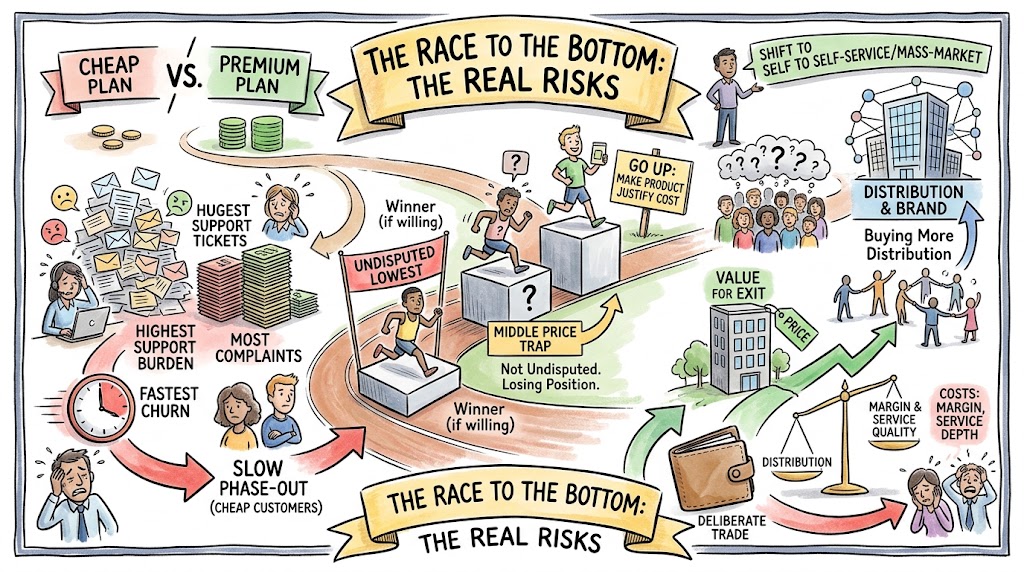
The race to the bottom is the real risk
Several founders pushed back hard on the idea of competing purely on price, and their experience was consistent enough to take seriously. One founder running a services platform said his support burden was highest with his lowest-paying customers, the ones on his cheapest plan were also the ones who churned fastest and complained the most. He'd been slowly phasing them out. Another founder made the same point from the other direction: he raised prices on a recent product update and told customers directly that he wasn't going to compete on being the cheapest option. His logic was that if you're going to compete on price, you need to be the undisputed lowest, and if you're not willing to go there, you're better off going up and making sure the product justifies it.
This matters directly for anyone weighing the shift to self-service, mass-market pricing, because self-service by definition means competing for a much larger, much more price-sensitive audience. One founder put it plainly: going after the low-cost competitors in a commoditized market is "buying more distribution," and if you ever want to sell the business, a chunk of that value comes from distribution and brand, not just revenue. But that distribution comes at a cost, and it's not free money. It's a deliberate trade of margin and service quality for reach.
- Cheap customers can cost more than they pay. Lower-tier plans often carry disproportionate support burden relative to the revenue they generate.
- Price wars favor whoever can go lowest. If you're not willing to be the absolute cheapest option in the category, competing on price alone is a losing position.
- Distribution has real value, but it isn't free. Going after commoditized, price-sensitive segments can build brand and distribution, at the cost of margin and service depth.
A third option: use the infrastructure without racing to the bottom
One of the more interesting ideas raised wasn't about pricing at all. A founder pointed out that a review management platform sitting on years of accumulated data has a monetization path that has nothing to do with competing on price against low-cost competitors. That data, aggregated and packaged well, could be valuable to private equity firms or larger businesses trying to figure out where to expand, essentially competitive and market intelligence built from data the company already owns. The pitch here is that sometimes the highest-ROI move isn't a new pricing tier. It's recognizing an asset you already have that nobody else can replicate.
There's also a middle path worth naming explicitly, because it came up repeatedly: staying rock-solid on infrastructure while spinning off a separate, self-service product under different branding. This avoids diluting an established premium brand with a bargain-tier offering, while still capturing the self-service audience and using it as a funnel toward higher-value services. It requires more operational complexity, sub-brands, separate positioning, careful management of channel conflict, but it lets a founder test billionaire-style, self-service thinking without abandoning what already works.
- Look for monetizable assets you already have. Years of accumulated data or infrastructure can be worth more repackaged than sold as another low-cost feature.
- Consider a sub-brand instead of a full pivot. A separate, self-service brand can test the billionaire playbook without cannibalizing an existing premium position.
- Industry specificity compounds. Niching into a vertical, where you already have integration advantages with the tools that industry uses, can be more defensible than going broad.
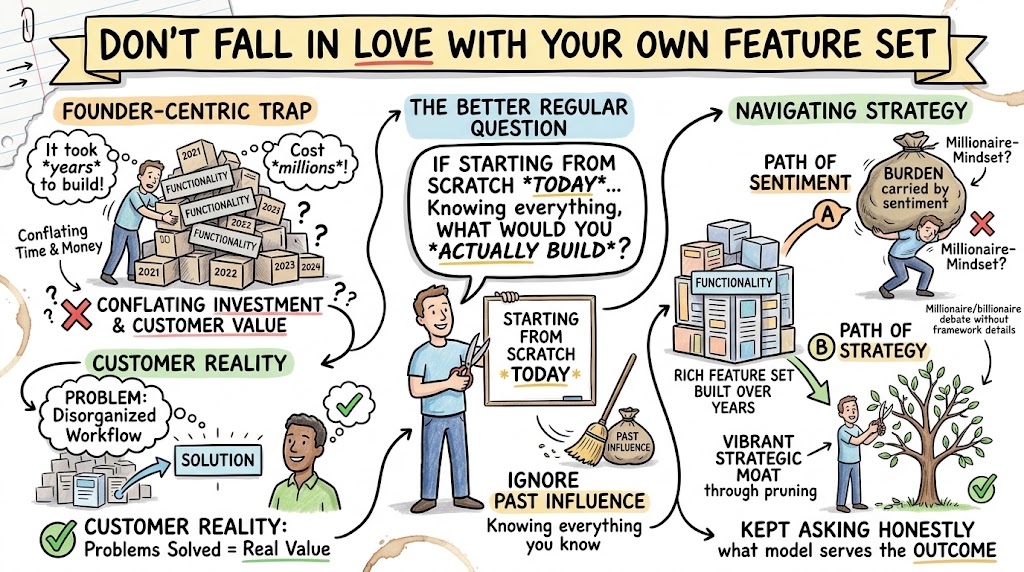
Don't fall in love with your own feature set
The conversation ended on a note that applies regardless of which path you choose. One founder gave advice that's easy to agree with and hard to actually practice: don't fall in love with features. Founders spend years building out functionality and start to conflate the amount of time and money invested with the amount of value delivered. Customers don't care how long something took to build. They care whether it solves their problem. As he put it, the better question to ask yourself regularly is: if you were starting from scratch today, knowing everything you know now, what would you actually build? Then don't let the past influence the answer.
That question cuts through the millionaire-versus-billionaire debate more directly than the framework itself. A rich feature set built over years in response to loyal customers can become a moat, or it can become a burden you're carrying out of sentiment rather than strategy. The founders who navigate this well aren't the ones who pick a side and commit forever. They're the ones who keep asking honestly which model actually serves the outcome they want, and who are willing to prune what doesn't.
Picking a lane on purpose
What struck me most about this exchange was how many good, experienced founders were willing to say plainly that they didn't fully know the answer either, and that they were still testing their own assumptions in real time. One founder running a hospitality-focused ERP said his entire growth strategy is built on staying deep in a narrow vertical rather than chasing a broader, lower-priced audience, and he's fine with the slower, more relationship-driven sales cycle that comes with it. Another founder scaling employee retention software was actively weighing whether to bring in outside capital specifically so he could fund the shift toward a more self-service motion, because he recognized that his current team, built for high-touch enterprise sales, wasn't the team that self-service growth would require.
The lesson from watching a dozen founders wrestle with this in real time is that millionaire versus billionaire thinking isn't a label you adopt once and move on from. It's a lens you keep checking your decisions against. Every time you consider a new pricing tier, a new hire, or a new feature, you're implicitly choosing a side. The founders who end up building something bigger than they planned tend to be the ones who make that choice consciously instead of drifting into it by default, one comfortable customer request at a time.