
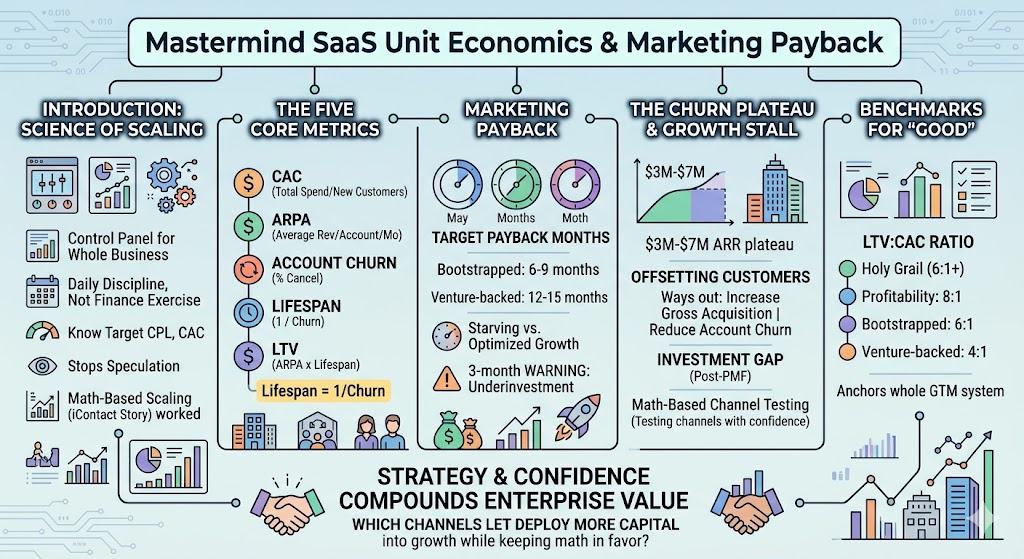
Mastermind SaaS Unit Economics & Marketing Payback
A founder-focused breakdown of the SaaS metrics that actually determine whether growth is sustainable. This post explains how to use CAC, LTV, churn, and payback period to make smarter marketing decisions, avoid the churn plateau, and scale with confidence.

If you want to scale a SaaS company, you cannot treat unit economics like a finance exercise you revisit once a quarter. They are the control panel for the whole business. They tell you how much you can spend, how fast you can grow, which channels deserve more budget, and whether you are building a profitable machine or just buying noisy growth.
That was the real theme running through this mastermind session. Ryan framed unit economics as the science of SaaS scaling, not because the formulas are complicated, but because most founders never get disciplined enough to use them in daily decisions. As he put it, “You need to know your target cost per lead as well as your target cost per qualified lead and your target cost per customer or customer acquisition cost CAC in order to start doing your marketing in a scalable way.”
That is the unlock. Once you know what a customer is worth and how quickly your sales and marketing investment comes back, marketing stops feeling speculative. You are no longer guessing whether to spend more. You are deciding whether a dollar put into growth is likely to return four, six, or ten dollars over time.
Ryan told the story of learning this lesson back in 2005 from a mentor who asked him two deceptively simple questions: how much does it cost to acquire a new customer, and how much is that customer worth over their lifetime? When he ran the math at iContact, the numbers changed how he saw the entire business. That framework later helped drive the company from about $1 million in revenue to $49 million in annual revenue before its sale, with $20 million in sales and marketing producing $50 million in sales in the final year before exit. “Our method of math-based scaling worked,” Ryan said.
That is why this matters so much. Good founders usually know their product. Great founders know their numbers.
The five metrics every SaaS leader needs to know
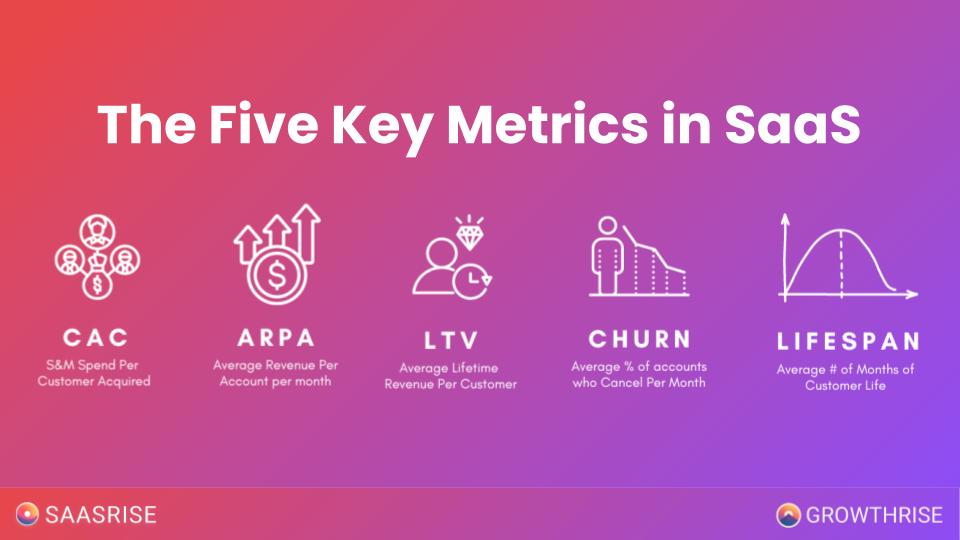
Ryan kept coming back to five core metrics because together they explain almost everything about scalable growth:
- CAC: total sales and marketing spend divided by new customers acquired
- ARPA: average revenue per account per month
- Account churn: the percentage of customers who cancel in a given period
- Lifespan: one divided by account churn
- LTV: ARPA multiplied by lifespan
The elegance of the model is that it turns messy operating reality into a few clear decisions. If churn is too high, your LTV shrinks and your allowable CAC drops. If ARPA rises, your acquisition budget can rise with it. If payback is too slow, your growth might be mathematically sound but cash-flow dangerous. If payback is too fast, that often means you are under-investing and leaving growth on the table.
Ryan said one formula “changed my life” when he first learned it: average customer lifespan equals one divided by monthly account churn. That single step makes customer value much more tangible. A business with 2% monthly churn has a roughly 50-month lifespan. A business with 5% monthly churn has only about 20 months. That difference alone completely changes how aggressive you can afford to be in paid acquisition.
This is also why he was careful to distinguish account churn from revenue churn. For growth planning, he wants founders focused on logo churn because it helps estimate how long the average customer stays. “Account churn is the same thing as logo churn, which is the same thing as customer churn,” he explained.
Why marketing payback is the metric that sharpens every decision
The most practical part of the session was Ryan’s explanation of marketing payback. For most bootstrapped SaaS companies with normal churn, the target is usually around 6 to 9 months. Venture-backed companies can often tolerate 12 to 15 months because they are optimizing for market capture more than near-term profitability.
That range is not arbitrary. If a typical customer stays for 30 to 50 months, spending 6 to 9 months of revenue to acquire them is usually a healthy trade. It is aggressive enough to grow, but not so aggressive that you starve the business of cash. Ryan summarized the logic clearly: “Your target payback months, by definition, should be about six to nine months.”
He also made a point that many founders miss. A 3-month payback sounds amazing, but it often signals underinvestment. At the unit level, it is efficient. At the company level, it may mean you are not pushing hard enough into channels that are already working. If you can reliably get your money back that quickly and churn is healthy, the rational move is usually to scale spend until payback stretches into a more optimized range.
That is a mindset shift. Too many founders wear hyper-efficiency like a badge of honor when what they really have is a timid growth engine.
The churn plateau is where a lot of SaaS companies stall
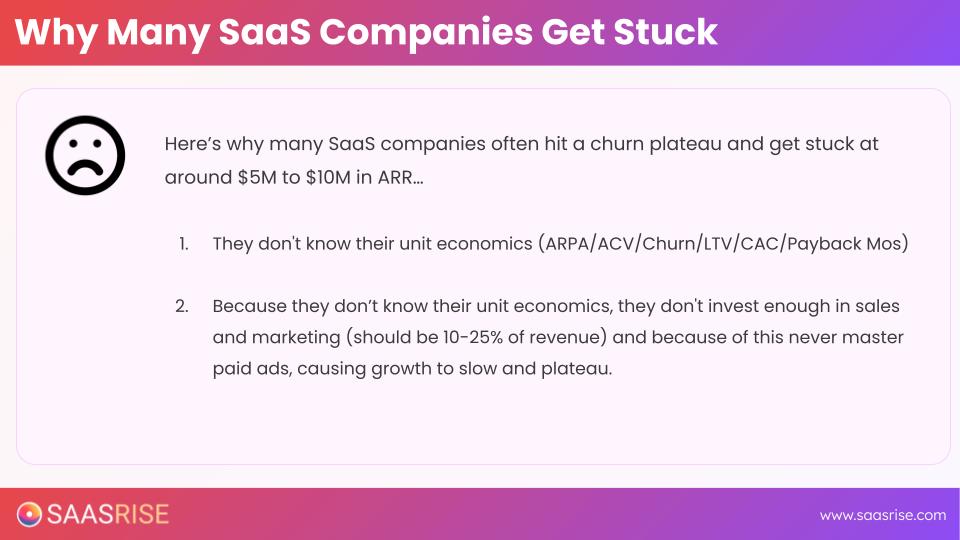
One of the strongest ideas from the session was Ryan’s concept of the churn plateau. Many SaaS companies get stuck in the $3 million to $7 million ARR range because new customers coming in are roughly offset by customers leaving. Growth feels possible, but the math quietly traps them.
There are only two real ways out of that trap:
- increase gross customer acquisition
- reduce account churn materially
That sounds obvious, but most companies fail here because they do not know their unit economics well enough to invest with conviction. Ryan was blunt about it: “The biggest mistake SaaS CEOs and founders make is not investing enough in growth once they’ve achieved product market fit.”
This is where the relationship between unit economics and marketing becomes practical. If you know your LTV, your target CAC, and your target CPL, you can test paid channels with confidence. You can compare actual CAC to target CAC. You can see whether Meta, LinkedIn, Google, outbound, events, or affiliates are producing efficient customers. And you can stop treating growth like a creative gamble.
Ryan pushed this point hard because many SaaS companies still spend far too little on growth. In the session, he noted that a normal SaaS company that wants to grow often spends around 10% of top-line revenue on advertising and roughly 10% to 25% on total sales and marketing. Companies far below that level may be protecting margin while quietly capping their own valuation upside.
What “good” actually looks like
Ryan gave a simple benchmark framework founders can use right away. For most bootstrapped SaaS companies, he likes to see an LTV:CAC ratio around 6:1. For companies that care even more about profitability, 8:1 is attractive. Venture-backed businesses can often live around 4:1 because the goal is speed and market share.
His line here was especially clear: “Profitable paid customer acquisition is where the LTV to CAC is six to one or better, and that is the holy grail of scaling.”
That benchmark matters because it anchors your whole go-to-market system. If your ratio is much worse, something is broken in pricing, retention, funnel conversion, or acquisition efficiency. If your ratio is dramatically better, it may be time to scale harder.
In other words, the answer is not always “fix marketing.” Sometimes the answer is fix churn. Sometimes it is raise ARPA. Sometimes it is move upmarket. Sometimes it is simply stop being so conservative with spend.
Why founders need to know these numbers cold
The deeper lesson from this mastermind was not really about formulas. It was about leadership. Founders cannot delegate understanding the core economic engine of the company. Ryan said, “Know your numbers cold, especially if you’re the CEO, founder, head of growth, head of marketing.”
He is right. If you are leading a SaaS business and cannot quickly explain your CAC, ARPA, churn, lifespan, LTV, and payback window, then you are not really steering the business. You are reacting to it.
The reason this matters so much is that every major growth decision depends on these numbers. Whether to hire another salesperson. Whether to increase ad budget from $10,000 to $50,000 a month. Whether outbound is worth scaling. Whether a channel should be cut. Whether the company is ready for a bigger push. Whether you are building enterprise value or just adding activity.
Ryan tied it all back to valuation in a simple way. If your company trades at roughly 4x ARR and every $1 spent in sales and marketing efficiently adds recurring revenue, then a disciplined growth engine does not just produce customers. It compounds enterprise value.
That is the real takeaway from this session. Unit economics are not back-office math. They are strategy. They are confidence. They are the difference between hoping growth happens and knowing how to buy it responsibly.
And once you truly understand them, you stop asking whether you should invest more in marketing. You start asking a much better question: which channels let us deploy more capital into growth while keeping the math in our favor?
