
M&A Advisors: Should We Use Them to Sell Our SaaS Company?
Several SaaS founders compared notes on hiring M&A advisors, from fee structures and contract terms to what an advisor actually buys you beyond the deal itself. Here's what came out of that conversation, plus two questions worth asking before you sign with one.

One founder in our Enterprise Mastermind, running a hospitality accounting and ERP platform, brought a question that a lot of SaaS founders eventually face: should you hire an M&A advisor or investment bank to run your sale process, or go it alone? He'd been building relationships with a boutique bank that focuses on hospitality technology, attending their annual event where they bring together around two hundred private equity firms, and last year alone that relationship generated thirty meetings with different SaaS companies. His own attorney, who specializes in SaaS transactions, had told him he probably didn't need a banker unless they could introduce him to buyers he didn't already know.
That's the tension almost every founder runs into once a sale starts to feel real. The fee isn't small, and the value an advisor adds is hard to measure until you're deep in a process and it's too late to change course.
What advisors actually cost
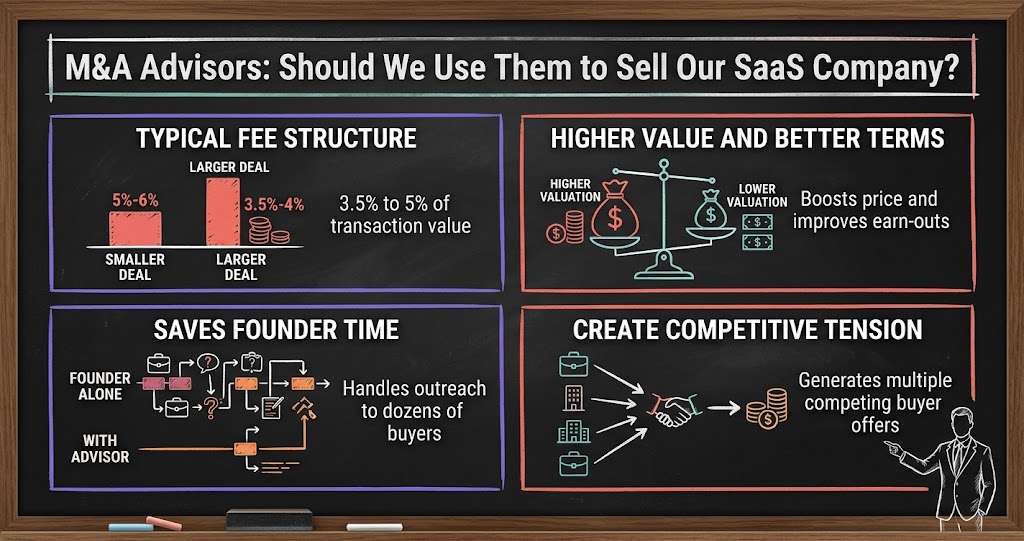
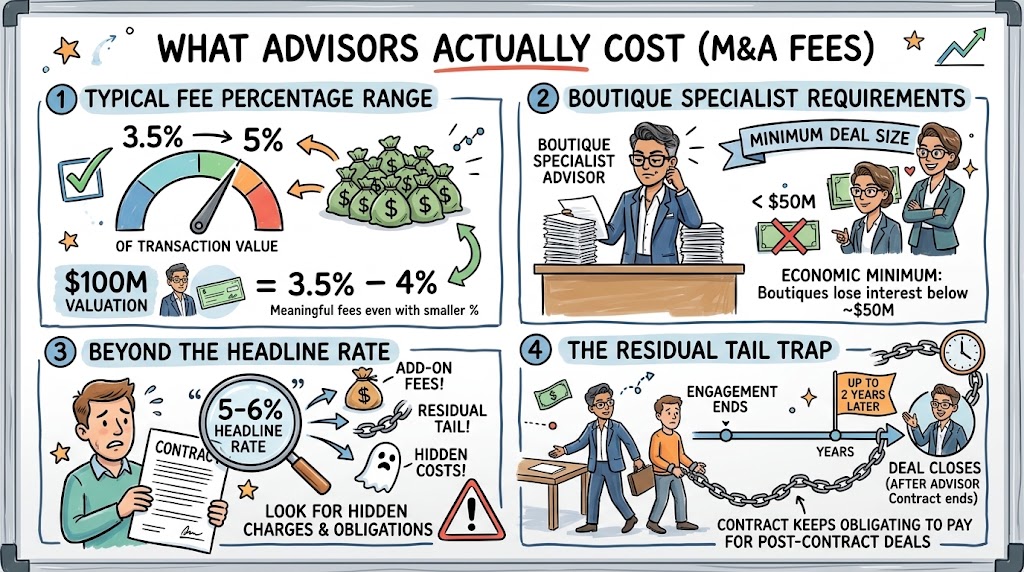
The fee conversation got specific fast. The founder mentioned he was expecting to pay somewhere around one and a half to two million dollars in advisor fees, which prompted a sharp observation from another founder: M&A advisors typically charge around five percent of the transaction, so a fee in that range implies a roughly one hundred million dollar valuation. My own experience matches that math closely. At around a one hundred million dollar valuation, you'll typically pay something in the range of 3.5 to 4 percent.
- Expect roughly 3.5% to 5% of the transaction value. The exact percentage tends to shrink somewhat as deal size grows, but the fee is meaningful either way.
- Many firms have a minimum deal size they'll take on. One founder was told his firm's boutique specialists might lose interest below roughly a $50 million transaction, because it doesn't clear their minimum economics.
- Watch the contract terms as closely as the headline rate. A quoted 5-6% rate can come with add-on fees and a residual tail that keeps you obligated to pay even on deals that close after your contract with the advisor ends.
That last point came from a founder who's worked with M&A firms before and specifically warned the group to watch for advisors trying to push a residual tail out to two years after the engagement ends, since that's exactly the kind of term that makes it hard to walk away cleanly even after you've stopped actively working with a firm.
The two questions I ask before hiring an advisor
When this question comes up, I boil it down to two things worth actually testing before you sign anything. A relationship-driven introduction from a trusted advisor also tends to get read differently by a buyer than a cold email from a founder they've never heard of, which is worth factoring in even before you get to the fee math.
- Can they increase your valuation by more than their fee? If a 3.5 to 4 percent fee is on the table, the bar is whether the advisor can realistically move the valuation more than that. In my experience good advisors increase valuations by something like 10 to 20 percent, which clears that bar comfortably.
- Can they materially improve your deal terms? This matters as much as the headline price. A good advisor can often get you paid faster, for example collapsing an earn-out from 24 months down to 12, which is real economic value even if the sticker price looks similar.
If an advisor clears both bars, the fee usually pays for itself. The harder question is the one underneath those two: how much is your own time worth during a process that can easily involve conversations with sixty or more potential buyers?
What founders who've actually run a process said
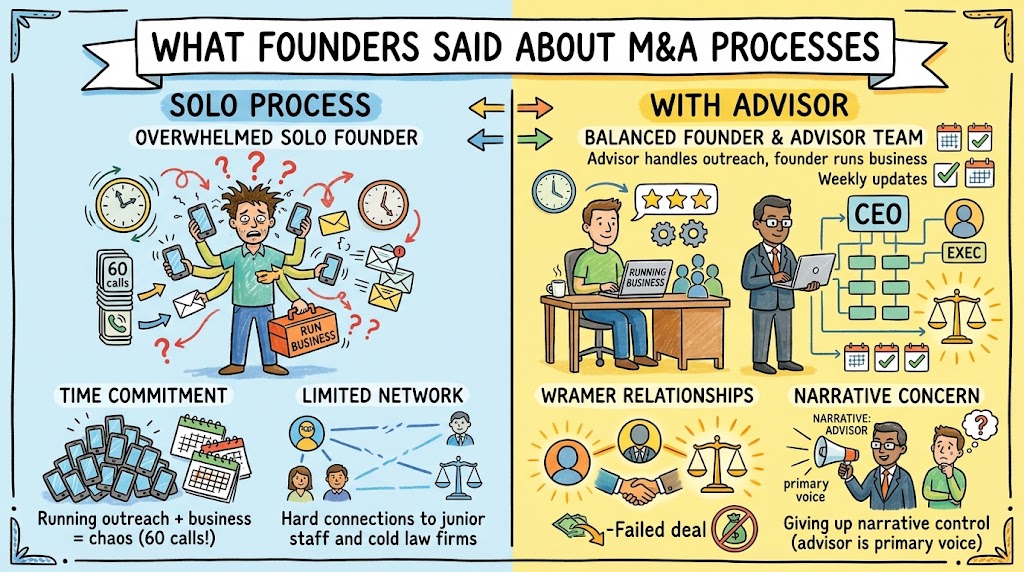
One founder who'd gone through sixty conversations with private equity firms on his own described it honestly: it's taken a significant amount of his time, and having someone manage that volume of outreach and conversation is a big part of what he sees in the value of hiring an advisor. Another founder who worked with an M&A firm, though the deal ultimately didn't close, described the experience in mostly positive terms. The firm did the bulk of the outreach work, he got weekly updates, he was able to keep running the business instead of getting pulled into the process full time, and the firm had faster relationships with the law firms involved than he would have had cold.
But he raised a question worth sitting with even when an advisor does a good job: you're going to be the best representative of your own company most of the time, so how do you know the conversations they're having on your behalf are landing the way they should? His honest conclusion was that he didn't think the difference was a landslide either way, but he couldn't fully shake the question of whether he personally could have cracked through one or two more buyers than the advisor did.
- An advisor buys you back your time. Running outreach to dozens of potential buyers while also running your company full time is genuinely difficult to do alone.
- An advisor often has warmer relationships. With law firms, and often with the actual decision makers at target companies rather than the junior staff who handle initial outreach.
- You give up some control over the narrative. Since someone else is now the primary voice representing your company in early conversations, which is worth weighing against the time you get back.
When competition matters more than the advisor relationship
A related point came from the same hospitality-focused founder, who's an OEM partner of a larger ERP platform whose parent company recently told him directly they'd be interested in acquiring his business when he's ready. It would be easy to just negotiate with that one strategic partner. But he was clear-eyed that having real competition in the process, rather than a single interested party, is what would let him actually capture the full value of the relationship and the strategic fit that partner brings, instead of leaving it on the table in a one-on-one negotiation.
That's a strong argument for an advisor even when you already have an interested buyer. A single interested party rarely gives you their best offer. Real competitive tension usually does, and running that competitive process well is exactly the kind of work an experienced advisor is built for.
Boutique versus bulge bracket, and why deal size matters
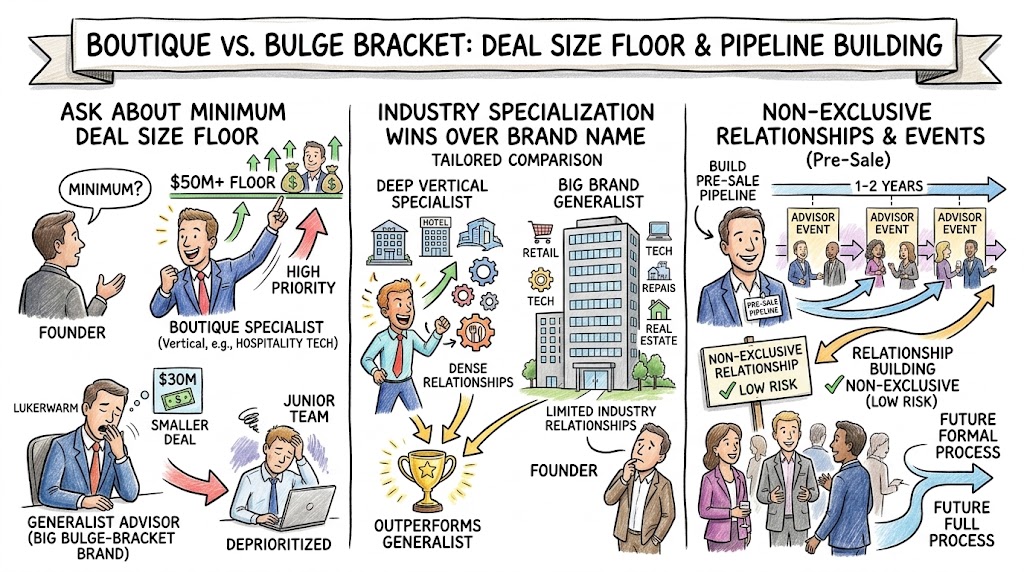
One thing worth planning around is that not every advisor wants every deal. A founder in the group described being told, somewhat candidly, that his advisor's hospitality-focused specialists might lose interest if a transaction came in below roughly $50 million, because it simply doesn't clear the minimum economics that justify their time. That's common across the industry. Boutique and mid-market advisory firms often have an informal or formal floor on deal size, and it's worth asking directly, early in the relationship, whether your expected transaction size is genuinely a priority for them or something they'll work on when they have spare capacity.
- Ask about their deal size floor directly. A firm that's polite but lukewarm about your deal size will likely put a junior team on it and deprioritize you when a bigger mandate comes in.
- Industry specialization is worth more than brand name. An advisor with deep relationships in your specific vertical, hospitality technology or otherwise, often outperforms a bigger generalist firm.
- Non-exclusive relationships can still be valuable before you're ready to sell. Attending an advisor's events and building the relationship over a year or two, without signing exclusivity, is a low-risk way to build the pipeline before you formally start a process.
The bottom line
If you're weighing whether to hire an M&A advisor, the math is fairly simple to reason through even before you talk to anyone. Ask what they'll charge, then ask honestly whether they can move your valuation or terms by more than that fee, and factor in what your own time is worth across a process that can easily mean dozens of buyer conversations. In my experience, when the valuation is large enough to attract a good advisor's attention, the answer is usually yes on all three counts. Just read the contract terms carefully, especially anything about residual tails or add-on fees, before you sign.
And don't wait until you're actively ready to sell to start building the relationship. Every founder in this conversation who spoke positively about their advisor had built that relationship over a year or more before a transaction was even on the table, through industry events, informal conversations, and simply staying in touch. By the time you need an advisor, you want to already know which one you trust, not be evaluating strangers under time pressure while trying to run a process.