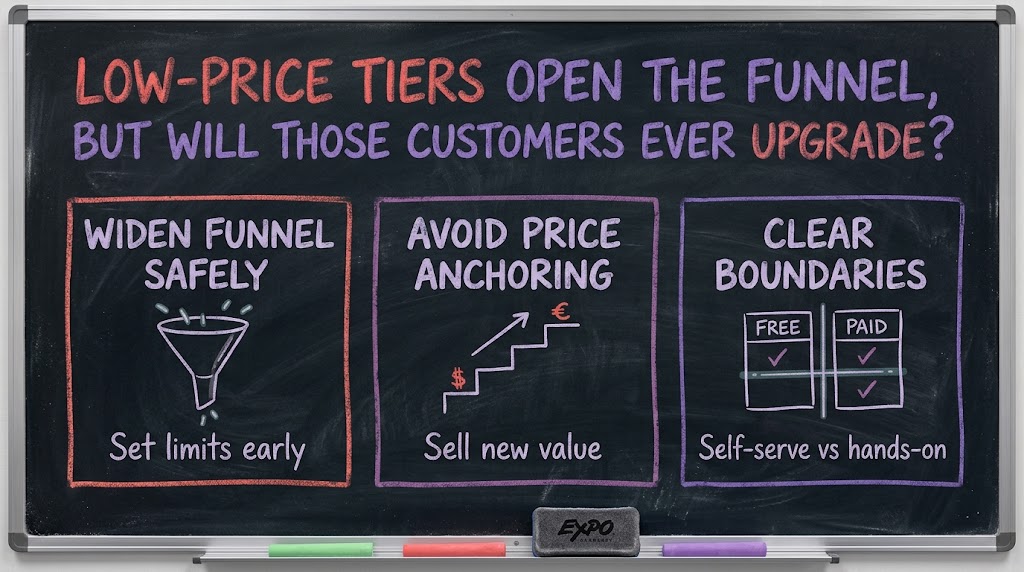
Low-Price Tiers Open the Funnel, but Will Those Customers Ever Upgrade?
A cheaper entry tier can widen your funnel, yet customers closed at a low price rarely grow into your real one. Here is what a room of SaaS founders has learned about land-and-expand pricing, anchoring, and guardrails.

It is a tempting idea, and one of the founders in our mastermind is testing it right now. His regular price is well into four figures a month. He has built a second offer at roughly one fifth of that, with mostly the same features and far less support, and he is treating it as a pilot. The bet is that those customers will get comfortable, see results, and upgrade. He brought the question to the group in two parts: does this approach work for anyone, and does it just attract the wrong kind of customer?
The answers were more mixed than a founder hopes for when he is about to invest in a new tier. Most of the people on the call had tried some version of it. What they agreed on is that a low-price offer is a real tool, and that it comes with conditions you need to set up before you launch, not after.
A cheap tier does open the funnel
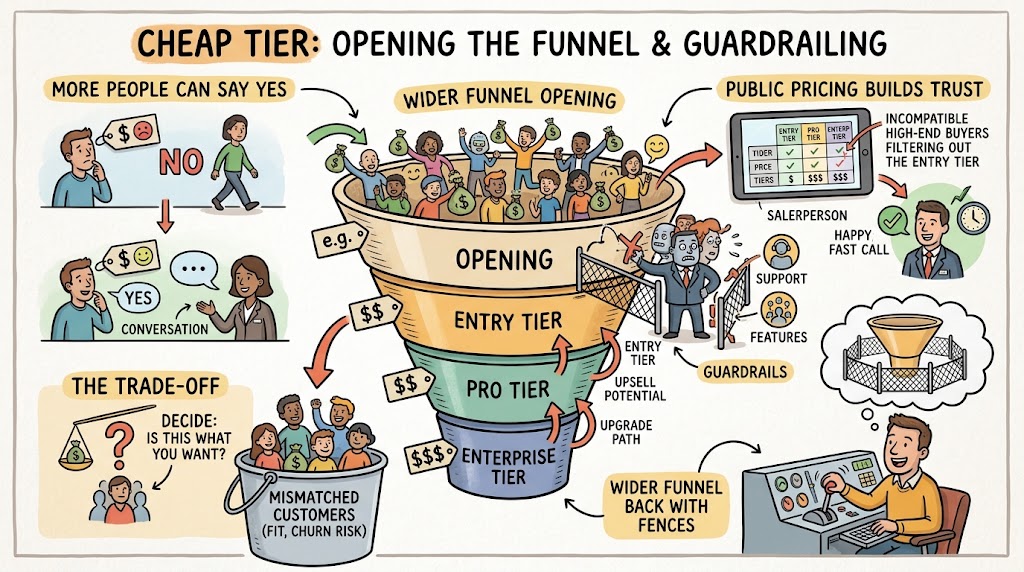
Let's start with what works. One member said his company began life this way, with lower pricing tiers shown openly on the website and a sales motion that moved the right customers up to a higher tier based on their requirements. It worked. When prospects come in saying the product is too expensive or that they can get something similar for less, a lower tier gives you something to say yes to. A buyer who would have walked away ends up in your pipeline, and some portion of them turn out to need more than the entry tier gives them.
The same founder has since moved his company upmarket and narrowed his funnel, and he is now planning to put transparent pricing back on his site, with lower prices and some guardrails that protect the top of his market. That is a telling detail. Even after deciding to go upmarket, he wants the wider funnel back, and he wants fences around it.
- More people can say yes. A lower tier turns a flat no on price into a conversation, which matters most for buyers who have a real budget constraint.
- Public pricing builds trust. Showing prices on the site filters out buyers who would never pay your standard rate and saves your team from long calls that end in sticker shock.
- Guardrails protect your top end. Limits on support, users, or features keep your best customers from downgrading into the cheap tier.
Notice the trade-off built into all of this. You will close customers who may not be the best fit, and, as the member put it, you just have to decide whether that is what you want.
The anchoring problem
The most important warning of the call came from a founder who has lived with the consequences of this decision for years. His point was simple: when you close a client at a low price, you are never going to get them up to the price you really want them to pay. He gave an example from his own company. A customer who signed years ago at a modest price should today be paying two to three times that. Sending a notice that says the price has gone up does not move them. The number they have in their head is the number they agreed to, and everything above it feels like a penalty. To get that customer to the higher figure, he said, you have to sell them something else.
That framing changes how to think about the entry tier. The customers who move up are the ones whose needs grew into a different product, not the ones whose price was gradually raised. If the upgrade path is just the same software with a bigger number on it, the customer will look at the larger bill and start wondering whether they need the product at all.
- Design the upgrade as a new thing. Give the higher tier something the entry tier truly lacks, such as services, integrations, or higher limits, so the customer is buying more rather than paying more.
- Expect price increases to be noticed. The same member said a 10 percent annual increase is reasonable, but that customers on autopilot, who barely think about your product, may use the renewal notice as a moment to reconsider.
- Do not count on the upsell. Model the entry tier as its own revenue line. If some customers upgrade, that is a bonus, not a forecast.
That is a useful discipline for a planning meeting. If the pilot only works when a large share of low-tier customers upgrade, the plan is weaker than it looks.
Give away the small product, not the main one
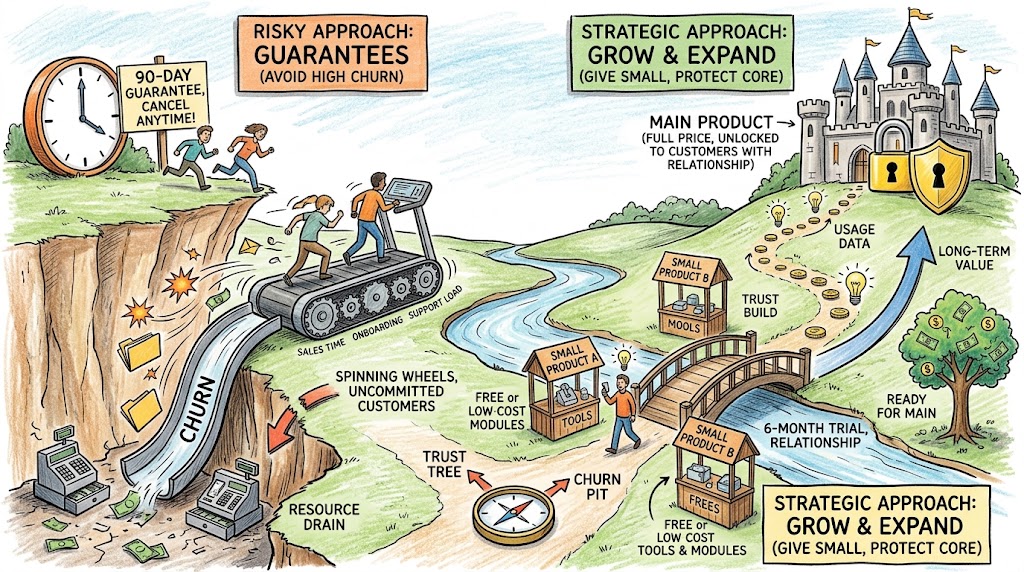
One CEO described a cleaner version of land-and-expand. His company has a primary product that it never discounts. Alongside it, it sells a few smaller products that solve adjacent problems, and those are the ones he gives away or sells at half price to get a foot in the door. A customer might try one for six months. The goal is to build a relationship and create hooks, so that when the customer is ready for the main product, there is already trust and usage data behind the conversation.
He also told the group about an older habit of his. Early in his career, when he had no credibility and very little marketing budget, he offered 90-day performance guarantees that customers could cancel at any time. It helped him win business. Looking back, though, he is not sure it is wise today. In his words, it tends to attract people who use up your resources and your time and do not stay with you long term.
- Protect the core price. If you have an adjacent or smaller product, use it as the low-cost door opener and keep the main offer at full price.
- Think twice about guarantees. A cancel-anytime promise made sense when you had no track record. Once you do, it mainly draws in customers with little commitment.
- Do not spin your wheels. The cost of winning a customer who leaves quickly includes sales time, onboarding time, and the support load they create while they are around.
When a low price becomes permanent
One of the more sobering stories came from a member whose company signed a deal many years ago with a large membership organization. Under that agreement, the local groups under its umbrella could start using the product at almost no cost, with a small usage fee going to the parent organization. The hope was that those groups would move up to the full product over time. In all the years since, they mostly did not. A few years ago she had to renegotiate the big contract just to start charging the local groups a meaningful amount.
What she learned came from watching how the product got used. Because the users of the cheap version were not the paying client, nobody inside the organization had a reason to care about adoption. The buyer was satisfied, the users got a piecemeal experience, and the result was poor engagement across the whole group. She called it a failed experiment, though she is now pushing on each renewal to fix it.
- Watch who the economic buyer is. If the person who pays is not the person who uses the product, a cheap offer can leave the real users with no advocate.
- Put an end date on anything free. Pricing set to get a relationship started tends to become the baseline, so write the step-up into the agreement from the beginning.
- Renegotiate early. Each year a legacy price sits untouched makes the eventual conversation harder.
Keep the cheap tier honest about what it is
The last piece of the conversation answered the pilot founder's second question, which was whether customers on the low tier will be less successful. They will. Less support and fewer features mean lower success rates, and the same member who warned about anchoring called this a pain everyone in the room has felt. If a customer signs on to the lower tier, does not succeed, decides the product does not work, and churns, you have hurt both the account and your reputation.
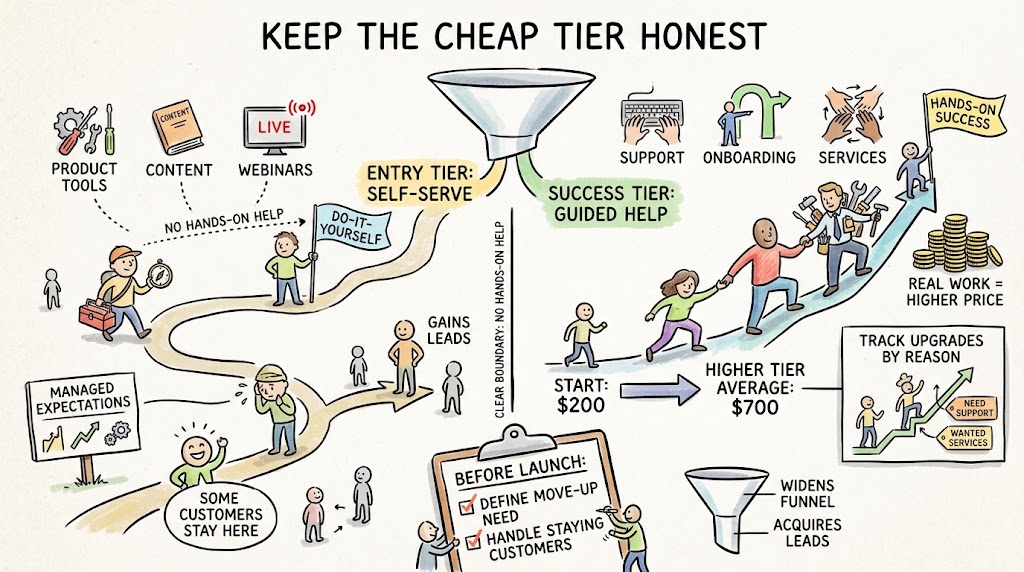
The suggestion was to make the separation explicit. The entry tier is self-serve: here is the product, here is our content, here are our webinars, go be successful. If a customer wants hands-on help, that is a higher tier with a higher price, and you will make them successful. This makes the low tier a separate product line with its own expectations, not a weak version of the main offer that customers are supposed to outgrow.
I shared how we handle this at SaaSRise. Our entry price is $197 a month, and we offer additional services on top that sell through to roughly 4 to 5 percent of our members. Our average member pays about $700 a month, even though they start around $200. The upsell works because it is a different set of services, not a rebranded price increase.
- Call the entry tier what it is. Describe it as self-serve and tell customers exactly what it includes and what it does not.
- Sell help separately. Put support, services, and onboarding in the higher tier so the price difference reflects real work.
- Track upgrades by reason. If customers who upgrade always do so because they wanted services, that tells you the actual engine of your upsell.
If you are planning a low-price tier, the most useful exercise is to write down, before you launch, what a customer has to need in order to move up, and what you will do if most never do. A cheap tier can widen your funnel and give you leads you would have lost. It works best when you treat it as a product in its own right, with a clear boundary, and you are comfortable if some of those customers stay exactly where they started.