Long Enterprise Sales Cycles: How to Stay Top of Mind and Turn Interest Into Action
Prospects say they're ready at the conference, then go silent for months. Here's what experienced SaaS CEOs do to keep deals warm, qualify faster, and get a real next step while they still have the buyer's attention.

Every founder who sells into enterprise or into slow-moving industries knows this feeling. You go to your industry's big annual conference, buyers walk up to your booth and tell you they're finally ready to move forward, and you fly home with a list of hot conversations. Then you try to book the follow-up meeting and nothing happens. The interest was real, the timing seemed right, and still the deal sits there.
A founder in our enterprise mastermind brought exactly this to the group. Their sales cycles can run for years. Some prospects come back long after a proposal has expired and say they're ready to start immediately, and some buyers show up having never spoken to the company at all because peers in the industry recommended them. Their question was a good one: when you finally have a buyer's attention, in person or on Zoom, how do you get them to commit to the next step right then, and how do you keep that attention once the moment passes? A lot of CEOs in the room had lived this, and the advice they shared was worth writing down.
Understand why the deal is really stalling
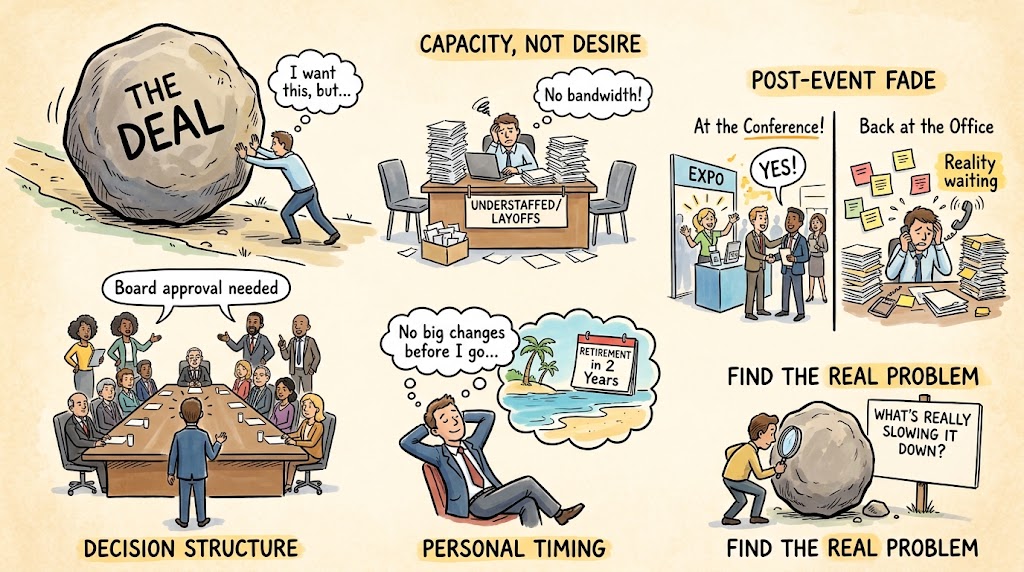
Before you change tactics, it helps to figure out what's actually slowing the deal down. Several members pointed out that the reason is often outside your control and has little to do with how good your product or your pitch is. One CEO said a lot of his pipeline was stuck because buyers wanted to move forward but were dealing with layoffs, so nobody had the bandwidth to carry the project. Another said that with small offices run by larger boards, the stall is often personal timing: someone plans to retire in two years and doesn't want to start a big change before they go.
- Capacity, not desire. Many stalled buyers want the outcome but don't have the people to run the implementation.
- Decision structure. Boards and multiple decision makers mean the person at your booth often can't say yes alone.
- Personal timing. Retirements, role changes, and internal politics can freeze a deal regardless of ROI.
- Post-event fade. Buying signals at a conference are sincere in the moment and then get buried under everything waiting back at the office.
Once you know which of these you're dealing with, you can respond to the real problem. A buyer who lacks capacity needs a different offer than a buyer who lacks authority.
Find the angle that speaks to the decision maker
One CEO shared a story about an existing client they had been trying to upgrade for a long time without getting on anyone's calendar. Eventually he emailed the COO directly. When they finally met, he named the real situation out loud: your team is small, everyone is stretched, and you have a million things on your plate. Then he asked what would happen if his company just did the work for them as a full-service offer. That's when the COO started leaning in, because it spoke directly to their pressure to do more with less.
- Go to the person who feels the pain. The day-to-day contact may be happy with the status quo. The executive above them is often the one under pressure.
- Name their constraint. If a lack of people is the blocker, lead with how you remove work from their plate.
- Package around capacity. A done-for-you or full-service option can unstick a deal that a self-serve product never will.
- Iterate the message. If one angle doesn't land, try another. Finding what resonates with a specific decision maker is an iterative process.
Another long-time enterprise seller in the room reduced it to two habits: persistence on every channel you can use, and quickly identifying the buyer's key pain points with their legacy system, or lack of one, then focusing every conversation on how you solve those specific pains.
Use a sales process that qualifies hard and early
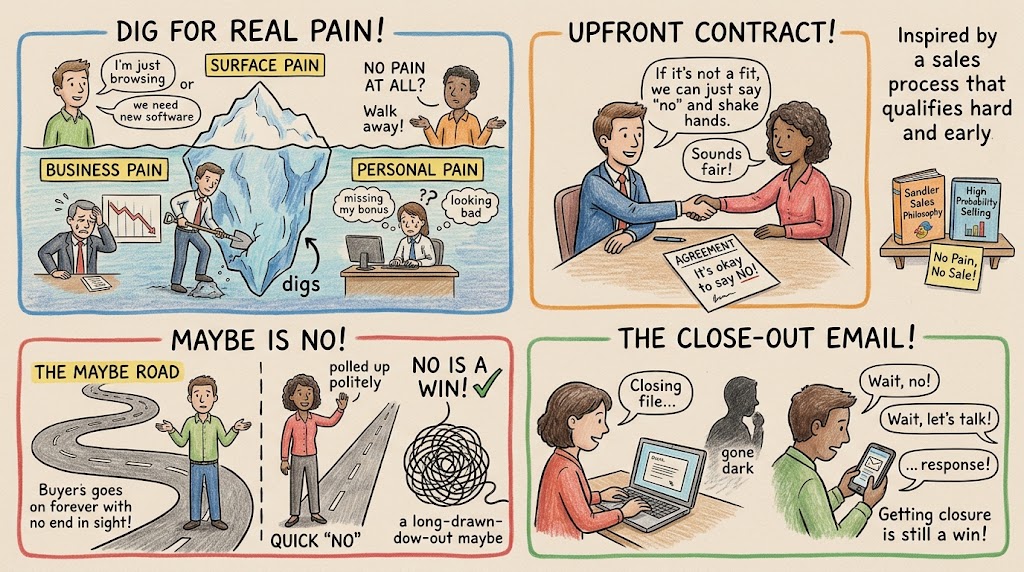
The most useful advice for this founder came from a member who spent years training in the Sandler sales system. Sandler's whole philosophy is "no pain, no sale." You won't uncover the real pain just by asking, because buyers give you surface-level pain first. Underneath that is business pain, and underneath that is personal pain: the fear of missing a bonus, looking bad, or getting fired. That deepest layer is what actually moves a buyer to act. The member was honest that the training didn't turn him into a superstar, but it helped him close deals he would otherwise have lost and gave him confidence in the process.
- Dig for the real pain. Surface pain rarely moves a deal. Business and personal pain do, and sometimes you'll discover there's no real pain at all.
- Set an upfront contract. Tell the buyer early that no might be the right answer, and agree to walk through it together. If it fits, you'll make the ask. If not, you'll shake hands.
- Treat maybe as no. A quick no is better than a prolonged maybe. Saying so out loud often gets you a more honest answer.
- Send the close-out email. When a prospect goes dark, a polite note saying you're going to close the file often prompts a response, even if it's a no. Closure is still a win.
The member also shared a blunt Sandler idea that's uncomfortable but true: buyers often send false signals. Usually there's no manipulation involved. Buyers are busy, confused, or don't want to deal with a hard conversation, so they nod along instead of telling you what's really going on. A structured process gives you a way to surface that early instead of discovering it six months later. A couple of members also recommended the book High Probability Selling, which is focused almost entirely on qualifying prospects, and another offered an intro to a sales coach he's worked with for years who turns the book material into hands-on practice.
Show up in person when the deal is big enough
The founder asked whether the answer is simply to go back to flying out and visiting buyers in their offices. Several CEOs said yes. One founder who sells a large ERP product said they go in person whenever they can, because their demo takes hours. Sometimes they spend a whole day with a prospect: a few hours of demo in the morning, lunch together, and a few more hours in the afternoon. Another member said he's talking with an experienced field salesperson whose whole job would be to physically get in front of major prospects and move deals forward.
Then one CEO shared a trade show lesson from his previous company that stuck with everyone. He used to spend heavily on booths at several shows a year and found most of them didn't pay back. At one show, he noticed his much larger competitors weren't trying to do business on the floor at all. They had rented hotel rooms upstairs and pre-booked eight meetings a day with major buyers before the event even started, then fed them and sat down one on one.
- Pre-book before you arrive. The best meetings at an event are scheduled weeks in advance, not hoped for at the booth.
- Get off the floor. A room at the conference hotel, maybe $200 a night, turns a hallway chat into a focused 15-minute sit-down.
- Keep it short and personal. Busy buyers will say hi at your booth but won't sign there. A quiet one-on-one is where real decisions get discussed.
That approach also solves the post-event fade, because the next step is already in progress before anyone flies home. If you know you'll see buyers at an annual conference, book the follow-up meeting while you're still in the room with them.
Stay memorable between conversations
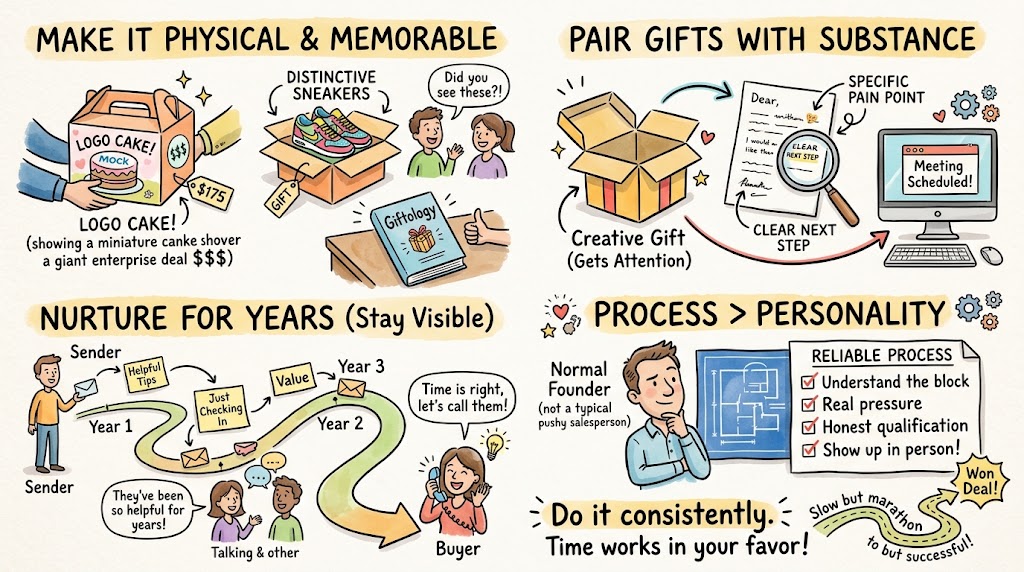
For the long stretches between active conversations, the group came back to physical, memorable touches. One founder joked that she was starting to think she needed to send people cakes, and it isn't a bad idea. A logo cake can run around $175, which is nothing next to the value of a single enterprise deal. One member landed ten large clients after mailing them distinctive sneakers, a gift memorable enough that people talked about it. The book Giftology was also recommended as a practical guide to doing this well.
- Make your follow-up physical. A creative, branded gift after a conference keeps you from becoming just another email in the inbox.
- Pair gifts with substance. The gift earns attention. A specific note about their pain and a clear next step is what turns it into a meeting.
- Nurture for years. Buyers in long-cycle industries talk to each other. Staying useful and visible means you're the first call when timing finally lines up.
None of this requires being a natural salesperson. The founder who raised this topic is the only one doing sales at her company and doesn't think of herself as a wine-and-dine type. What the room kept coming back to is that process can stand in for personality. Understand why the deal is stuck, speak to the decision maker's real pressure, qualify honestly, show up in person when the stakes justify it, and keep showing up between meetings. Do that consistently and those long sales cycles start working in your favor instead of against you.