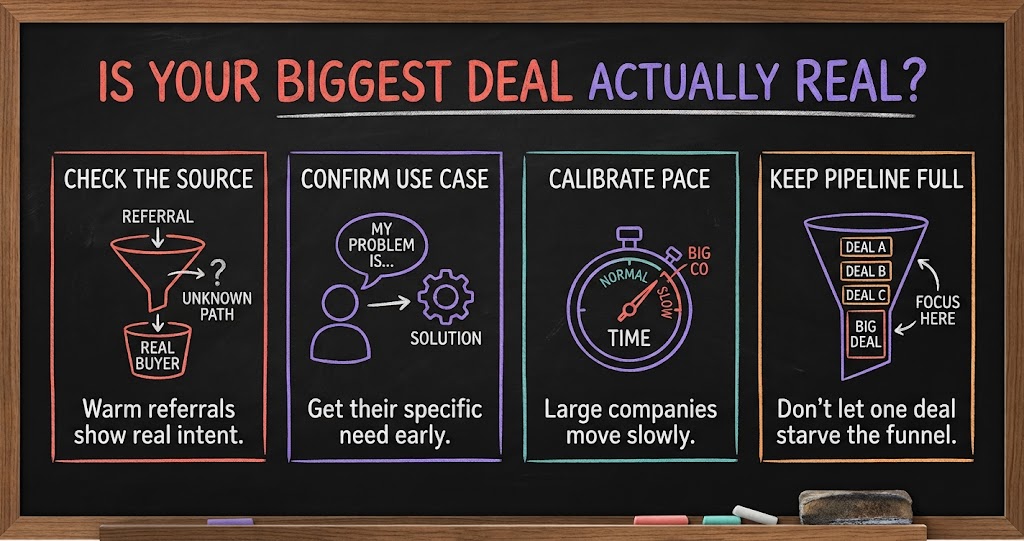
Is Your Biggest Deal Actually Real?
Three months of back-and-forth, a verbal agreement on every term, and then silence after the contract lands in their inbox. Here's how a room full of founders talked through whether a huge deal gone quiet is really dead, or just moving at big-company speed.

A founder came into our mastermind with a good problem, or at least what looked like one. A massive, unsolicited deal had shown up out of nowhere. Three months of near-daily contact followed, multiple rounds of contract redlines, and eventually both sides had verbally agreed on every term. Then the signed contract sat untouched for a few days. No response. No explanation. Just quiet. The question he brought to the group was simple and universal: did someone really spend three months negotiating a deal they never intended to sign, or is this normal, and he's just letting his skepticism get the better of him?
The questions that actually tell you something
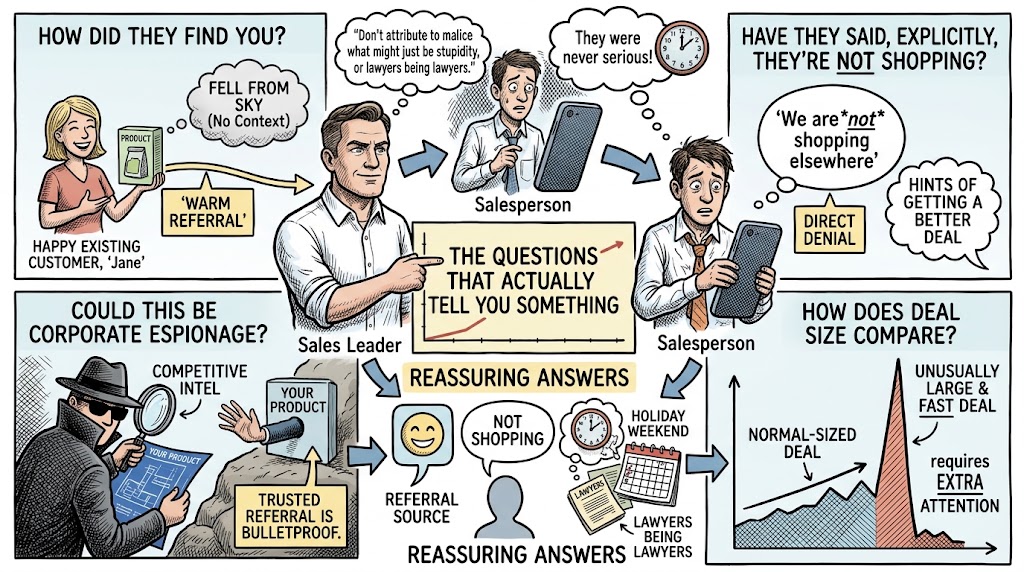
The instinct when a big deal goes quiet is to sit and wonder. The more useful instinct, and the one the group kept coming back to, is to go back through what you already know and ask whether it adds up to a real buyer or a fishing expedition. A few questions did most of the work.
- How did they find you? A lead that came through a referral, especially from an existing customer having real success with your product, carries a completely different weight than one that fell out of the sky with no context. Warm paths in are far more likely to close.
- Have they said, explicitly, that they're not shopping? If a prospect hasn't hinted that they're using you to get a better deal elsewhere, and especially if you've asked directly and they've denied it, that removes one of the most common reasons big deals stall.
- Could this be corporate espionage instead of a real deal? It sounds dramatic, but it's a real pattern at the largest companies: someone gathering competitive intelligence under the guise of a purchase conversation. A referral from someone you trust makes this far less likely.
- How does this deal size compare to what you normally close? An unusually large deal that came in fast deserves more scrutiny than a normal-sized deal moving at a normal pace, simply because it's further outside your typical pattern.
In this case, the answers were reassuring. The lead came through a referral from a customer already succeeding with the product. The prospect had explicitly said they weren't shopping around. And a few days of silence, it turned out, fell right around a holiday weekend, which is a far more boring explanation than "they were never serious." As one founder in the group put it, don't attribute to malice what might just be stupidity, and don't attribute to lack of interest what might just be lawyers being lawyers.
Big companies move at big-company speed
One theme came up again and again from founders who sell into large enterprises: size predicts slowness far more reliably than intent does. One founder described a deal with a major financial institution that took what felt like an eternity, going quiet for weeks at a time while internal legal teams worked through their own process, before a reply would finally surface. Another founder shared an almost identical story, a request for quote that took three months just to get through demos and answers, followed by a full year of internal deliberation, followed by another three months of contract negotiation once they were finally ready to move.
- A few quiet days is not a red flag on its own. Especially with a company that size, legal review, internal approvals, and simple calendar conflicts can easily eat a week without meaning anything about the deal's health.
- The pattern to actually watch for is going dark for weeks, not days. A prospect who stops responding entirely for an extended stretch, especially after previously being in daily contact, is a very different signal than a short gap.
- Your own visibility into their internal process is limited by design. You are not going to see the legal review, the procurement sign-off, or the internal politics happening on their side. Expect delays you can't explain and don't read too much into them.
What you can actually do about it
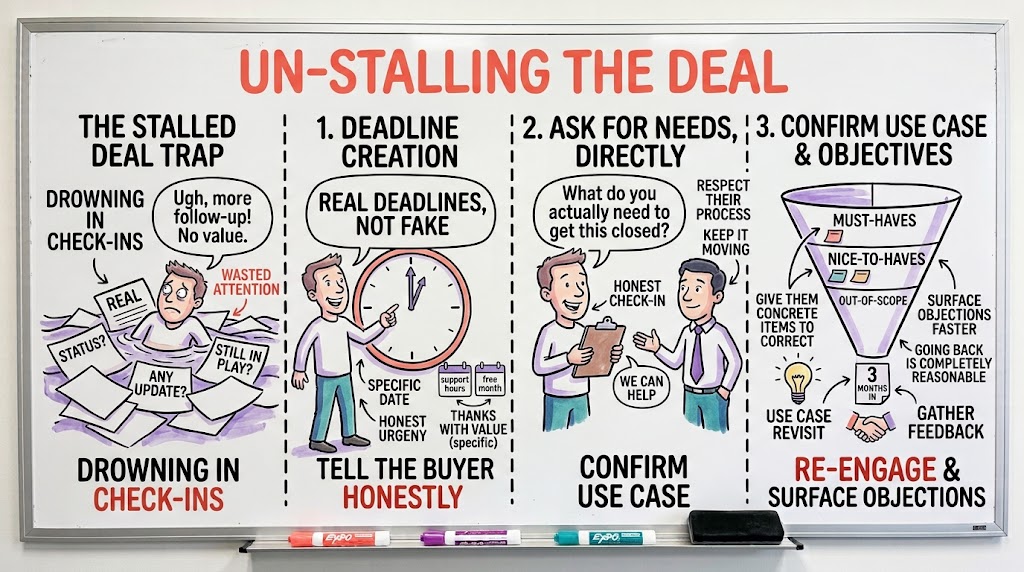
Sitting and waiting isn't the only option, and the group offered several concrete ways to move a stalled deal forward without coming across as desperate or pushy.
- Create a real deadline, not a fake one. If you have a genuine business reason, a quarter-end goal, an internal milestone, tell the buyer honestly. Something like "we're trying to hit a real milestone this quarter, and if we can get this signed by then, I'd love to thank you with some extra support hours or a free month" works because it's true and specific, not manufactured urgency.
- Ask what's actually needed to get it closed, directly. Rather than waiting anxiously, a simple and honest check-in, asking what's holding things up and what you can do to help, respects their process while keeping the deal moving.
- Confirm your understanding instead of asking an open-ended question. Rather than asking a blank "what do you need," lay out what you believe the must-haves, nice-to-haves, and out-of-scope items are. That gives them something concrete to correct rather than a blank page to fill in, and it usually surfaces objections faster.
- Ask what their actual use case is, if you never fully got it. It's easy to get swept up in the size of a deal and forget to ask, in the prospect's own words, exactly what problem they're solving. Going back to ask this later is a completely reasonable move, even three months in.
The real risk isn't the deal falling through
One of the more useful reframes from the discussion was this: as long as continuing to negotiate isn't actually costing you anything, meaning you're not turning away other real opportunities to keep chasing this one, you're not really losing by staying patient. You're learning more about how large buyers in your market operate, sharpening your own negotiating instincts, and keeping the door open. The real risk isn't that a big deal takes longer than you'd like. It's letting the size and promise of one deal distract you from the rest of your pipeline while you wait.
If you find yourself in this exact spot, checking your inbox every hour for a signature that hasn't come, the healthiest move is usually the boring one: send one clear, honest message asking where things stand, keep working the rest of your pipeline in the meantime, and resist the urge to read too much into a few quiet days from a company large enough to have an entire legal department standing between a verbal yes and an actual signature.
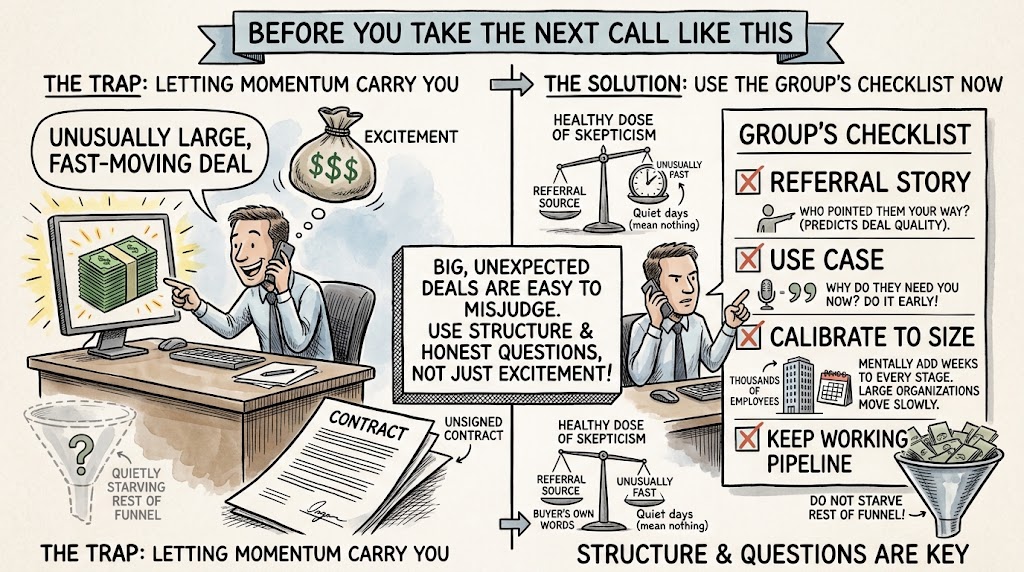
Before you take the next call like this
Whatever happens with any single deal, the more lasting value from a conversation like this is the checklist the group built together in real time, the kind of thing worth writing down now so you're not reconstructing it from scratch the next time an unusually large, unusually fast-moving deal lands on your desk.
- Get the referral story on record early. The moment a big inbound deal appears, ask how they heard about you and who, if anyone, pointed them your way. That single answer does more to predict deal quality than almost anything else you'll learn in the first conversation.
- Ask about their use case in their own words, on the first call, not the fifth. It's tempting to let momentum carry a fast-moving deal forward without slowing down to ask the basic questions. Do it anyway, early, while it's still easy to ask.
- Calibrate your expectations to company size from day one. If you're talking to a company with thousands of employees, mentally add weeks to every stage of your normal sales cycle before you're even surprised by a delay.
- Keep working your pipeline no matter how good this one deal looks. The biggest mistake founders make here is letting the excitement of one big prospect quietly starve the rest of their funnel while they wait for a signature.
Big, unexpected deals are exciting precisely because they don't happen often, and that rarity is exactly what makes them easy to misjudge. A little structure, a few honest questions asked early, and a healthy respect for how slowly large organizations actually move, will tell you far more than staring at an unsigned contract ever will.
It's also worth remembering that a healthy dose of skepticism is doing real work here, keeping you asking the right questions instead of getting swept up in the size of the number on the table. The useful version of that skepticism points itself at the signals that actually predict whether a deal closes, the referral source, the buyer's own words about their need, the company's typical pace, rather than spending itself on a few quiet days that are just as likely to mean nothing at all.