
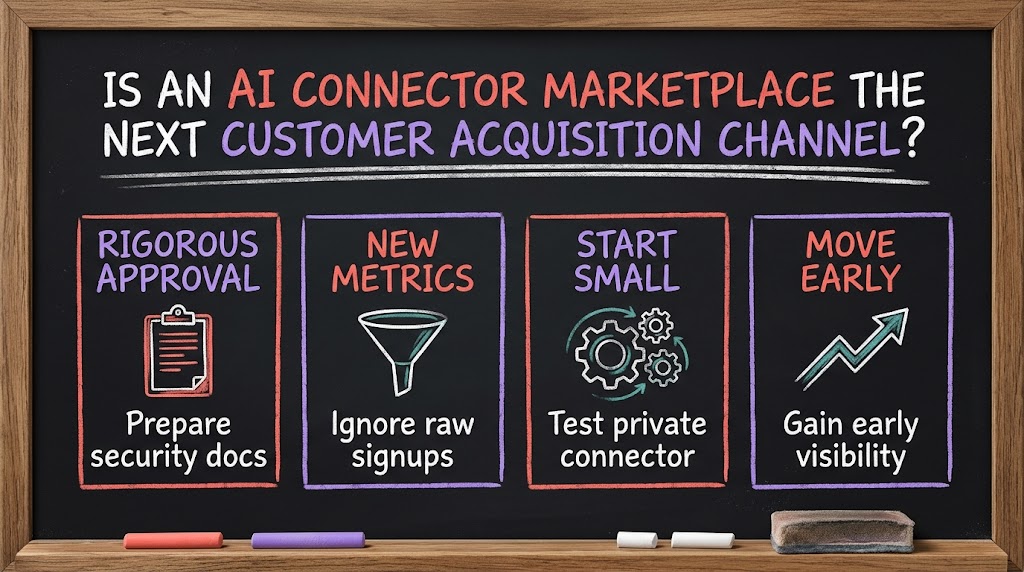
Is an AI Connector Marketplace the Next Customer Acquisition Channel?
Listing your product as a connector inside an AI assistant could become a new way customers find you, but nobody knows what the numbers look like yet. Here is what founders are learning about approval, budgeting, and expectations.

Every few years a new distribution channel opens up, and the founders who show up early tend to do well. Think of the app stores, the plugin directories for website builders, and the marketplaces built by the big CRM platforms. Right now, a new candidate is forming around AI assistants. Products can publish connectors that let an assistant work directly inside them, and those connectors can be listed in a marketplace. Several members of our mastermind are working on exactly this, and the honest summary is that everyone is figuring it out as they go.
What a connector does and why founders want one
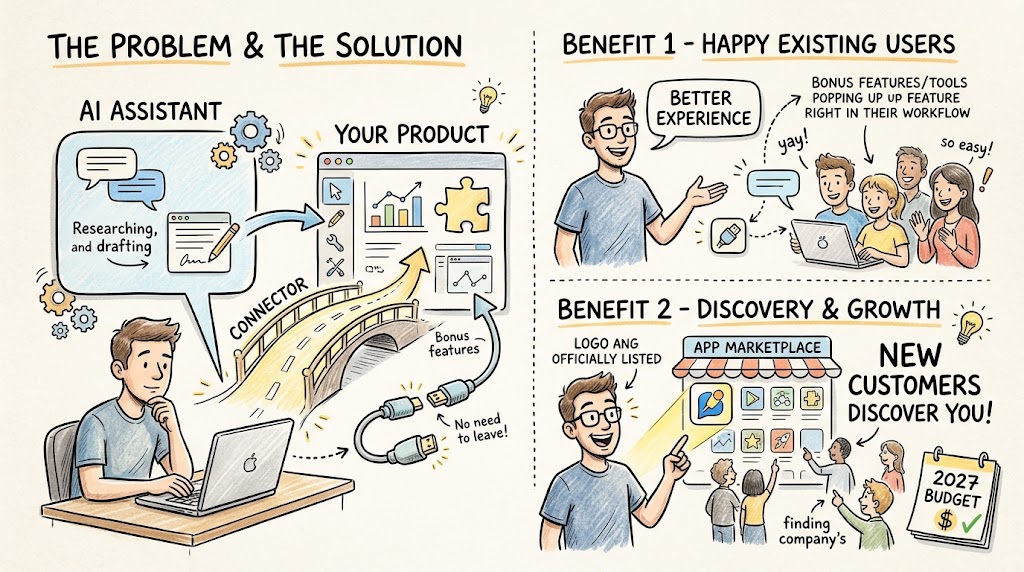
Imagine one of your customers is working in an AI assistant. They are researching something, building something, or drafting a plan. At some point the task needs to move into your product to finish the job. A connector makes that handoff possible. The assistant can call your product directly, so the customer never has to leave the conversation.
For a founder, this opens two possibilities:
- A better experience for current users. People who already use the assistant get your product's features where they work.
- A new way to be discovered. Once you are listed as an official connector, people browsing the marketplace, or the assistant itself, can find you.
That second possibility is why one member is putting the question into his 2027 budget. His company has already built a connector for its end-user product. A private connector can be shared with your own users right away. Getting listed in the official marketplace is a separate step, and that step is where the work is.
The approval process is a real project
The member described the path to an official listing as rigorous. Having a private connector is easy by comparison. To be listed, you have to have all of your documentation and security certifications in place. The review team ran extensive testing and asked for specific changes to his company's server, because they did not like certain interactions between the assistant and the product.
His estimate was six to eight weeks start to finish, with several weeks already behind him and a couple more to go. Several people were involved, including the whole development team with a mix of expertise. He called it a multifunctional effort.
If you plan to pursue a listing, build the following into your timeline:
- Security documentation. Have your certifications and policies ready before you apply.
- Developer time. Expect revisions to how your server responds to the assistant, so reserve engineering capacity.
- Several weeks of review. Do not plan a launch date that depends on a quick approval.
- A cross-functional owner. Someone needs to coordinate security, engineering, and marketing.
Despite the effort, he said he actually likes the rigor. A strict approval process means fewer low-quality tools in the marketplace, and once you are approved, that becomes a competitive advantage over the flood of connectors that anyone can publish.
Nobody knows the conversion numbers yet
The harder question is how to budget for the channel. This member was candid that his team has no idea which numbers to put in a plan, because nobody has meaningful data. He asked the group if anyone had actual experience with acquisition through a marketplace listing, and the answer was no.
One member offered a useful frame from history. Plenty of platforms have marketplaces, including website builders, content management systems, the large CRMs, and event software. His view is that this will probably follow similar rules. A certain share of the people who find you will become customers, but you need a business model and processes to move them there. He also guessed that the conversion rate could end up lower, because the AI tools can do so much on their own, and much of the industry buzz is about stripped-down versions of products that work without a front end.
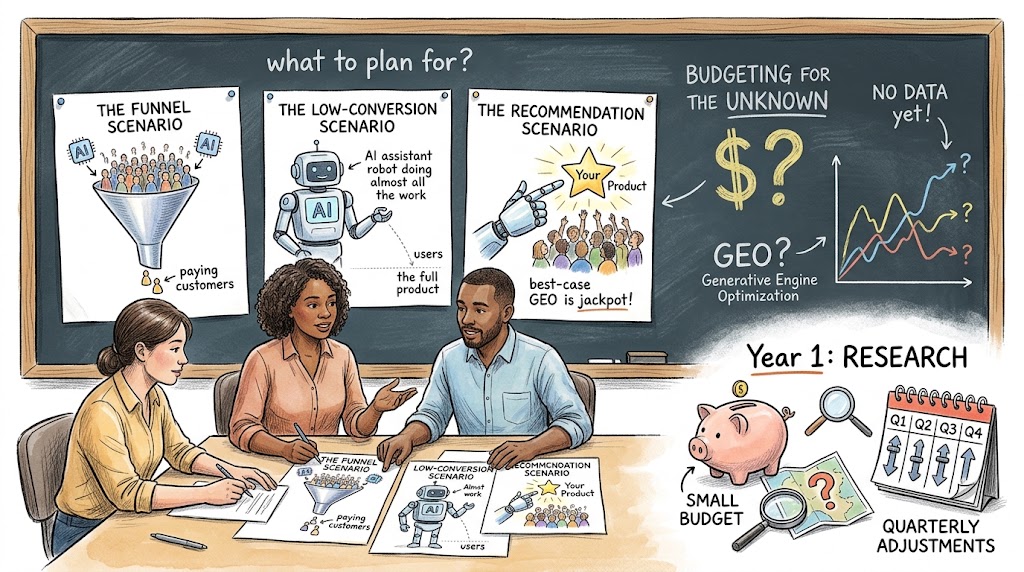
Here are the scenarios worth planning for:
- The funnel scenario. People browse the marketplace, try your connector, and a modest share become paying customers, as with other marketplaces.
- The low-conversion scenario. The assistant handles most of the task itself, so fewer people need your full product.
- The recommendation scenario. The assistant suggests your product as the right tool for a task, which could outperform any traditional channel.
The member named the third scenario as the best case, and said it is the one that makes the whole effort worthwhile. How often it would happen is unknown. Another member suggested this may fall under what people now call generative engine optimization, the practice of making your product easy for AI systems to find and recommend.
Because nobody can predict which scenario will win, treat the first year as research. Set a small, specific budget, define what you will measure, and plan to adjust the forecast every quarter.
Redefine what counts as a conversion
The funnel itself may change shape. A member whose product is aimed at developers told the group that when you allow signups from agents and coding tools, signups stop being a useful metric at all. His company once required a credit card, which shrank the funnel dramatically but improved the quality of the people who got through. They removed it so developers working in AI coding tools would not be blocked, and the floodgates opened.
His conclusion was that the definition of conversion has to move further down the funnel. Instead of tracking signups, or even the step from signup to opportunity, his team now tracks how many of the people they actually talk to turn into approved leads in the pipeline.
If your connector brings in a similar wave, the same shift will probably apply. A practical way to set it up:
- Pick a qualified event. Choose something that signals real intent, such as a connected account or a completed task.
- Track the cost of reaching it. Include engineering time and review effort in your cost per qualified user.
- Ignore raw signups. They are the easiest number to inflate and the least informative.
For budgeting, an example may help. Suppose a thousand people try your connector in a quarter, five percent reach your qualified event, and one in five of those buys. That produces ten customers. Whether ten customers justify the work depends on your price and your cost of building the integration. These are placeholder numbers, but writing the funnel out this way forces you to say which assumption you are betting on.
Who is in the marketplace today
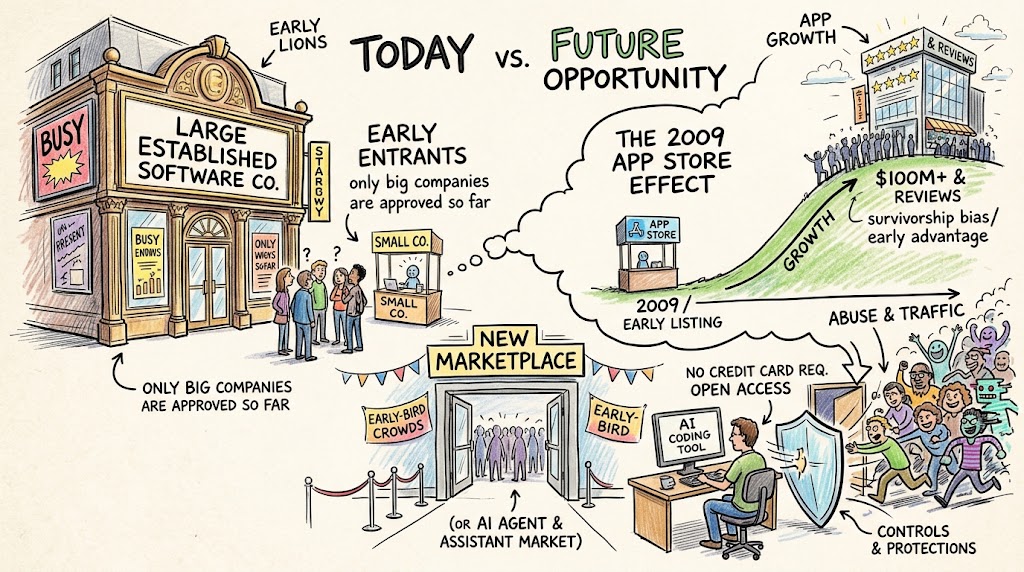
When one of our members asked whether anyone in the community had been approved, I looked through the current listings. The names there at the moment are large, established software companies. I had not heard of any member getting in yet, which means the first small company to do it will have an interesting story to tell.
A member who is further behind in the process shared the case for moving early. His company is out of beta with an interactive voice agent, and it wants to be present in many assistants and workplace tools. His comparison was to the early days of the app stores. If you were on one in 2009, he said, you could be doing a hundred million dollars today. That is a big claim, and survivorship bias is real, but the instinct is sound. Early listings in a new channel tend to collect reviews, trust, and visibility that late entrants have to work hard to match.
I would add a related observation from a different member on the call. His company serves developers, and he removed the credit card requirement from its signup flow about a year ago. The reason was to avoid blocking developers who are working inside an AI coding tool. The change brought an influx of signups, and with it a surge of abuse, so the company had to tighten its protections. That is a useful preview of what happens when you open your product to assistants and agents. More traffic arrives, and some of it is not what you want.
What to do now
You do not need to rush into a six-week approval project to take advantage of this. There are smaller steps that cost little and teach you a lot. Here is a sensible order:
- Build a private connector first. Let a few customers try it, and learn from how they use it.
- Track usage separately. Tag signups and activity that originate from the assistant so you can compare them with other channels.
- Teach people how to use it. One member now includes guidance on using his company's connector in a newsletter, since most people do not yet know how.
- Reserve a modest test budget. Put money in the 2027 plan, with clear expectations that the first year is for learning.
- Plan for abuse. Expect bots, scraping, and misuse, and have rate limits and monitoring ready.
- Watch what the big players do. Their listings will show you how the marketplace evolves.
I plan to dig further into how to market these connectors, and we will take it up in the community in the coming weeks. It is too early for anyone to claim they have a proven playbook. That is exactly why the early movers who share their numbers openly will have a real edge.