Influencer Marketing & Multi-Channel Outbound
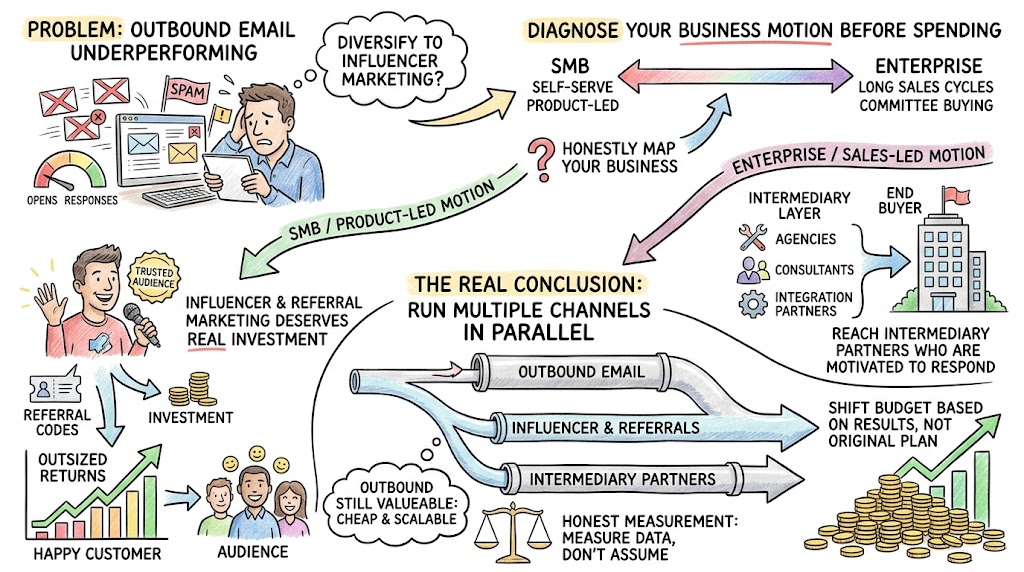
A founder whose cold email results had gone abysmal asked the mastermind about influencer marketing as an alternative, and the answer that came back was less about influencers and more about matching your channel strategy to where your business actually sits on the enterprise-to-SMB spectrum.

A founder running an AI visibility platform for brands and agencies opened a recent mastermind session with a blunt assessment of his own outbound program. Despite investing real effort and partnering with an outbound specialist to help run it, the results were more or less abysmal. Thirty to forty percent of his emails were landing in spam. Open rates were low. Response rates were low. He'd started layering in LinkedIn outreach to the same contacts and had begun a webinar series bringing in industry influencers, and he wanted to know from the group whether influencer marketing was worth investing in more seriously: how do you find them, how do you structure fees, and has anyone actually seen it work.
Referral and influencer marketing aren't the same thing
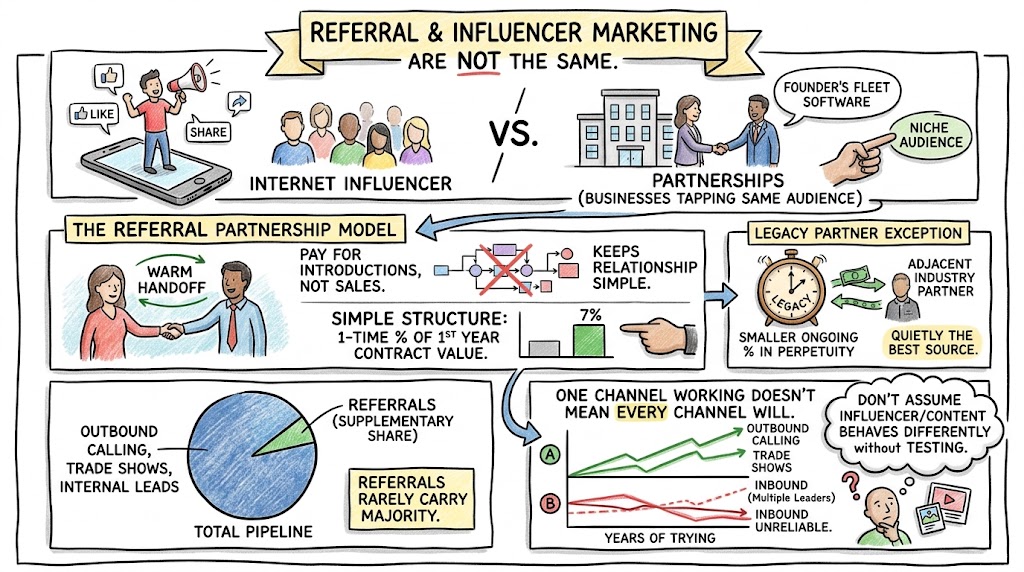
The first response reframed the question before answering it. A founder in fleet management software distinguished sharply between internet influencers and what he calls partnerships, other businesses that talk to the same audience he sells to. His structure is simple: a partner delivers a warm referral, doesn't sell anything on his behalf, and gets paid seven percent of the first year's contract value for the introduction. He has one legacy exception, a longstanding partner in an adjacent industry who gets a smaller ongoing percentage in perpetuity because that channel has quietly become his best source of new business. But he was direct about the limits of this approach: referrals make up a small share of his total pipeline. He's built his growth almost entirely on outbound calling, trade shows, and internally generated leads, because inbound has never worked reliably for him despite years of trying with multiple marketing leaders.
- Referral partnerships pay for introductions, not sales. A warm handoff to the right person, structured as a one-time percentage of first-year value, keeps the relationship simple and avoids reseller complexity.
- Referrals rarely carry the majority of pipeline. Even founders who run referral programs successfully often see them contribute a small, supplementary share rather than the core growth engine.
- One channel working doesn't mean every channel will. A founder who's struggled with inbound for years despite real investment shouldn't assume influencer or content channels will behave differently without testing.
Where you sit on the enterprise-to-SMB scale decides your channel options
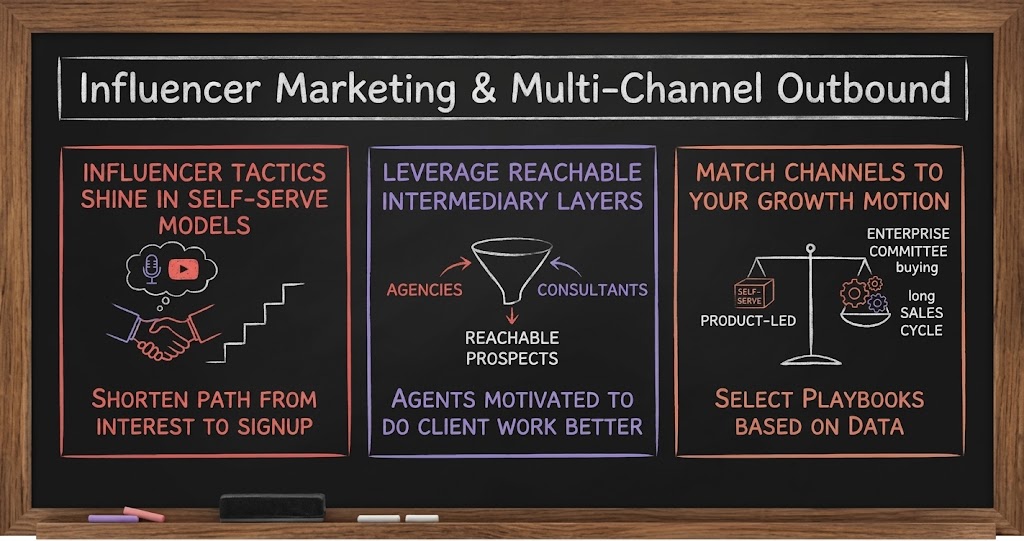
The most useful framework in the whole discussion came from a founder who has spent his career building referral and influencer programs, largely in more consumer-facing, direct-to-customer businesses. His point was that affiliate and influencer marketing playbooks get less effective the more enterprise your business is. There are too many hoops, too long a sales cycle, and too few people who actually care about an influencer's opinion when the purchase decision runs through procurement and a committee. The closer a business gets to a self-serve, product-led motion where someone can sign up and try the product without talking to a salesperson, the higher the odds that classic influencer tactics, a podcast mention, a YouTube walkthrough, a referral code from a trusted voice, actually move the needle.
This matters because the founder asking the original question turned out to have both motions running at once, without fully realizing it. His product has a self-serve, product-led signup path where brands try the tool directly, and a separate agency-led motion where marketing and SEO agencies deploy his product for their own clients. Both were already working to some degree. The question wasn't really whether influencer marketing could work in the abstract. It was which of his two existing motions to lean into harder.
- Self-serve, product-led motions are where influencer marketing performs best. Podcast mentions, YouTube reviews, and referral codes work because someone can act on the recommendation immediately without a sales conversation.
- Enterprise motions need a different channel mix entirely. Long sales cycles and committee-based buying decisions dilute the impact of any single influencer voice.
- Know which motion you're actually running before picking a channel strategy. Many SaaS businesses run more than one motion simultaneously, and each one calls for a different playbook.
The agency channel that was already working
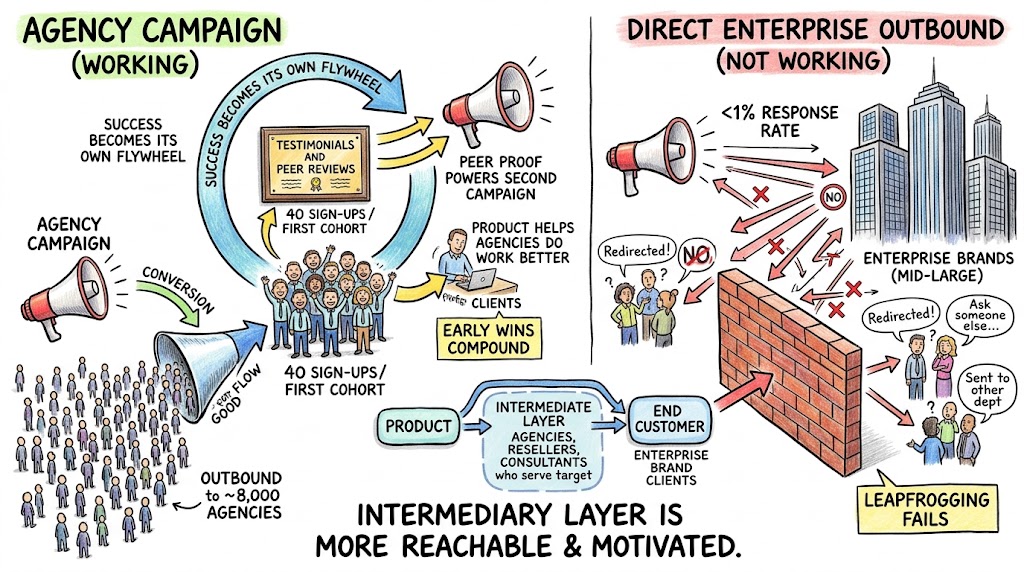
The founder's own data made the case better than any outside advice could. His team ran an outbound campaign targeting roughly eight thousand agencies and converted around forty of them to sign-ups within a month. That success became its own flywheel: those first forty customers became proof points for a second campaign, essentially telling other agencies that a meaningful cohort of their peers were already using the product. Meanwhile, outbound aimed directly at brands, especially mid-sized to large enterprise brands, was getting a response rate under one percent, and most of those responses were just being redirected to someone else.
That gap tells you something important about channel selection generally: agencies function as an intermediary layer that's naturally more reachable and more motivated to respond than the enterprise brands themselves, because the product genuinely helps the agencies do their own client work better. Selling through that layer, rather than trying to leapfrog straight to the brand, was producing results that direct enterprise outbound never could.
- An intermediary layer can be more reachable than your end customer. Agencies, resellers, or consultants who serve your target market may respond at a far higher rate than the enterprise brands themselves.
- Early wins compound into their own campaign. A first cohort of converted customers becomes powerful proof for the next outbound push to similar prospects.
- Don't force a channel that's producing a fraction of a percent response. If direct enterprise outbound is converting under one percent of contacts, that's a signal to shift effort toward what's already working, not to push harder on what isn't.
The YouTube influencer test that actually worked
The most concrete data point in the conversation came from the founder's own small experiment. He'd been a regular listener of an industry podcaster's daily short-form videos and reached out directly to ask if he'd review the product. The reviewer charged a few hundred dollars for the review and published it to an audience that typically runs fifteen to twenty thousand viewers per video, though this particular one reached around eight thousand. That single video produced somewhere around fourteen or fifteen sign-ups. A separate, unpaid mention on another site doing a product comparison drove another fifteen to twenty. Both are small numbers in absolute terms, but measured against a cost of a few hundred dollars, the return was strong enough that the founder said he'd run that play every day if he could.
What made this work wasn't the size of the audience. It was that the founder had already built a genuine relationship with the reviewer as a listener before ever pitching a partnership, and the product itself is product-led, meaning a viewer who's interested can act on that interest immediately by signing up, without waiting for a sales call. Both conditions matter. A cold outreach to an influencer with no prior relationship, or a product that requires a lengthy sales process after the initial spark of interest, would likely have produced a much weaker result.
- Build the relationship before you pitch the partnership. Reaching out as an established listener or follower, rather than a cold pitch, changes how the request lands and how genuine the resulting content feels.
- Small, engaged audiences can outperform bigger, colder ones. A few thousand attentive viewers converted at a rate that made the modest cost of a paid review a strong return.
- Make sure the path from interest to action is short. Influencer-driven traffic converts best when someone can sign up immediately, not when they have to wait through a multi-step sales process.
What to actually do with this
If your outbound email results look like the ones that opened this conversation, spam-flagged, low opens, low response, the instinct to diversify into influencer marketing is reasonable, but it's worth being precise about why before spending real money on it. Map your own business onto the enterprise-to-SMB spectrum honestly. If you're closer to self-serve and product-led, influencer and referral-code style marketing deserves real investment, and a small, well-chosen partnership with someone whose audience already trusts them can produce outsized returns relative to cost. If you're closer to enterprise, with long sales cycles and committee buying, look instead at whether there's an intermediary layer, agencies, consultants, integration partners, who are easier to reach and more motivated to respond than your actual end buyer. Either way, the lesson from this conversation isn't that influencer marketing is universally good or bad. It's that the channel has to match the motion you're actually running, and the founders who get the best results are the ones who diagnosed that correctly before they started spending.
There's one more thread worth pulling from this conversation, because it came up almost as an aside: several founders in the group admitted they still haven't given up on outbound email entirely, even after years of mixed results. One founder said flatly that he keeps taking another swing at it every few months, putting fresh budget behind a new approach, because the channel is too cheap and too scalable to abandon completely even when it's underperforming. That's a fair instinct, and it points to the real conclusion here: this isn't a story about replacing outbound with influencer marketing. It's a story about running multiple channels in parallel, honestly measuring which ones respond to your specific product and audience, and being willing to shift budget toward what the data actually shows instead of what you originally planned to rely on.