
Increasing Meta Match Rates: Enriching a List With Personal Email Addresses & Mobile Phone Numbers (Cost & How-To)
A focused guide on how to improve Meta match rates by enriching your ABM list with personal emails and mobile numbers, including the cost, the workflow, and when the investment makes sense.

Why Most B2B Meta Match Rates Start Off Disappointing
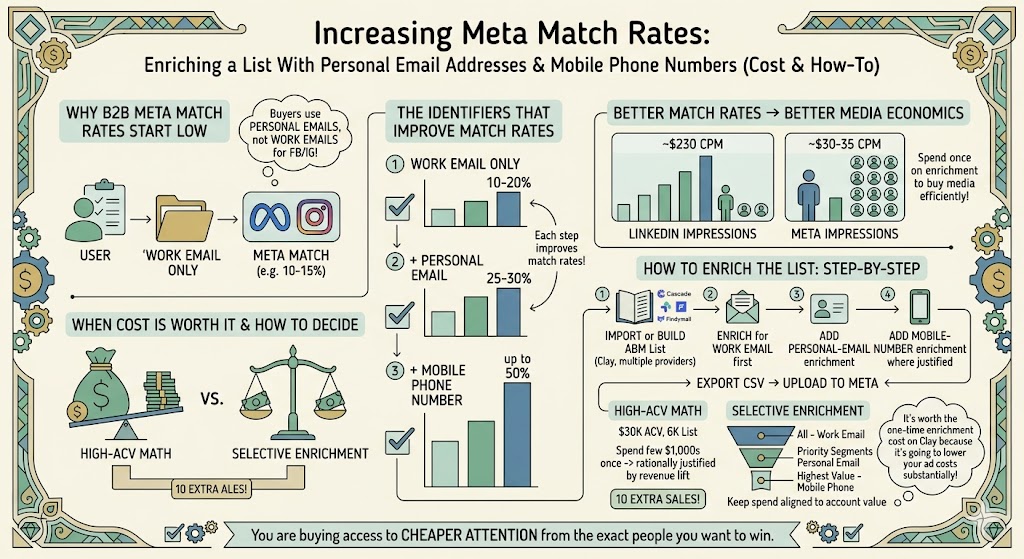
Most B2B teams upload a work-email list to Meta, get disappointing match rates, and assume the platform just is not built for their market.
That is usually the wrong conclusion.
The issue is not that your buyers are absent from Facebook or Instagram. The issue is that you are trying to match them with the wrong identifiers.
This is one of the most useful things to understand if you want matched audience ads to work well in B2B. Your prospects may use their work email on LinkedIn. They probably did not use that same work email when they signed up for Facebook or Instagram. They used their personal email. In many cases, their mobile phone number is an even stronger match key.
That one distinction explains a huge amount of wasted opportunity.
As I put it in the training, “People don’t sign up for Facebook and Instagram with their work emails.” Once you accept that, the logic of enrichment becomes obvious.

The Identifiers That Actually Improve Match Rates
If you want higher Meta match rates, you need more personal identifiers in the file you upload.
The basic progression looks like this:
- work email only,
- then work email plus personal email,
- then work email plus personal email plus mobile phone number.
Each step tends to improve match rates.
The numbers from the training are directionally very consistent. With just work email, expect roughly a 10 to 15 percent match rate, sometimes maybe 10 to 20 percent. Add personal email, and you can often reach roughly 25 to 30 percent. Add mobile phone number too, and you may get up toward 50 percent.
That is not a minor improvement. It can completely change the economics of your Meta campaigns.
Better Match Rates Usually Mean Better Media Economics Too
The second reason this matters is CPM.
If your buyers are available on both LinkedIn and Meta, and you can match them on both platforms, Meta is usually far cheaper. One of the clearest comparisons from the training was that LinkedIn impressions were costing roughly $230 per thousand while Meta impressions for the same target people were more like $30 to $35 per thousand.
That is why enrichment is often worth the upfront cost. You are spending once to create a list that can buy media much more efficiently over a long period of time.
This is the exact strategic point I want founders and marketers to understand: enrichment is not just a data purchase. It is often a media-efficiency investment.
How to Enrich the List Step by Step
The simplest workflow is to start with your existing ABM lead list in Clay or another enrichment-capable platform. Work email first. Then add personal email enrichment. Then add mobile phone enrichment selectively based on list value.
Clay is especially helpful here because it supports waterfall enrichment, which means it checks multiple providers in sequence instead of relying on one source.
That matters because personal email and phone coverage are never perfect from one provider. Waterfalls usually get you materially better results.
The how-to process is straightforward:
- import or build your ABM list,
- enrich for work email first,
- add personal-email enrichment,
- add mobile-number enrichment where justified,
- export the final CSV,
- upload the enriched list to Meta as a customer audience.

When the Cost Is Worth It
The more important question is when the cost is worth it.
And the answer depends heavily on ACV.
If you sell a high-ACV offer, the math often works beautifully.
In the training, I walked through the example of a company selling a product around $30,000 a year to a tightly targeted list of about 6,000 people. In a case like that, spending a few thousand dollars once to enrich the list is completely rational. Ten additional sales more than justify the spend.
That is the right way to evaluate this. Do not think in terms of cost per record alone. Think in terms of expected revenue lift from better match rates and lower CPMs.
What the Enrichment Usually Costs
You still need to understand the costs.
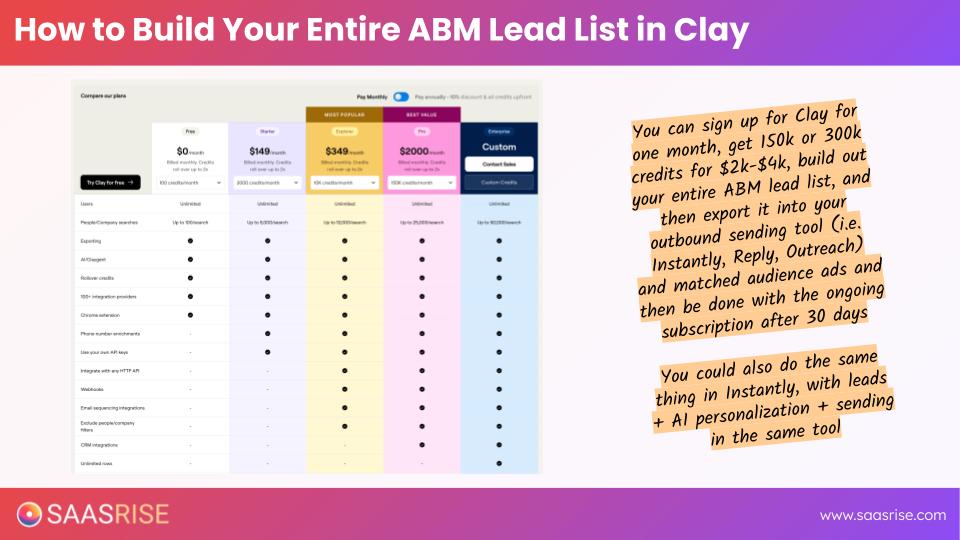
Personal-email enrichment in Clay was described at roughly twelve to thirteen cents per record in the workflow shown. Mobile phone numbers varied more depending on provider and method. Lower-cost options could get phone numbers around twelve cents per record, while fuller waterfall methods were more in the twenty- to thirty-cent range.
That means the all-in enrichment cost can become meaningful on a large audience. If you enrich 100,000 contacts with both personal email and phone number, the bill can get very real very fast.
Which is why selective enrichment is usually the smartest move.
A simple framework works well here:
- enrich the entire list with work email,
- enrich priority segments with personal email,
- enrich only the highest-value segment with mobile phone numbers.
That keeps the spend aligned to account value.
It also reflects the fact that mobile numbers are useful for more than Meta matching. If your ACV is high enough, they open up outbound calling, ringless voicemail, and more direct multichannel follow-up.
Start With a Baseline Before You Overspend
Another important strategic point is that you do not have to enrich blindly. You can upload your work-email-only audience first, let Meta process it, and look at the initial match rate. Then decide if the uplift from enrichment is likely worth the one-time cost.
That is a disciplined way to do it, especially if your budget is tight.
How to Reduce the Cost of Enrichment
You can also reduce enrichment cost by being smarter about sourcing. One of the useful points from the session was that Clay saves a huge amount of time, but its managed pricing includes markup. If you are doing enrichment at larger scale, using direct provider APIs can bring costs down materially.
In other words, if you are enriching a few thousand records, convenience may matter more. If you are enriching a hundred thousand records, laboring through a cheaper workflow may save you a very large amount of money.
And through all of this, keep the real objective in mind. You are not enriching personal emails so you can start blasting people at their private inboxes. That is not the use case. The reason to get personal emails is matching. The reason to get mobile numbers is matching plus, in higher-ACV sales motions, a stronger multichannel outreach option.
Final Thought
The big idea here is simple. “It’s probably worth the one-time enrichment cost on Clay to get this data because it’s going to lower your ad costs substantially.”
If your audience is valuable and specific, better matching on Meta usually means more reach, lower CPMs, and stronger total campaign economics.
You are not just buying data. You are buying access to cheaper attention from the exact people you want to win.