
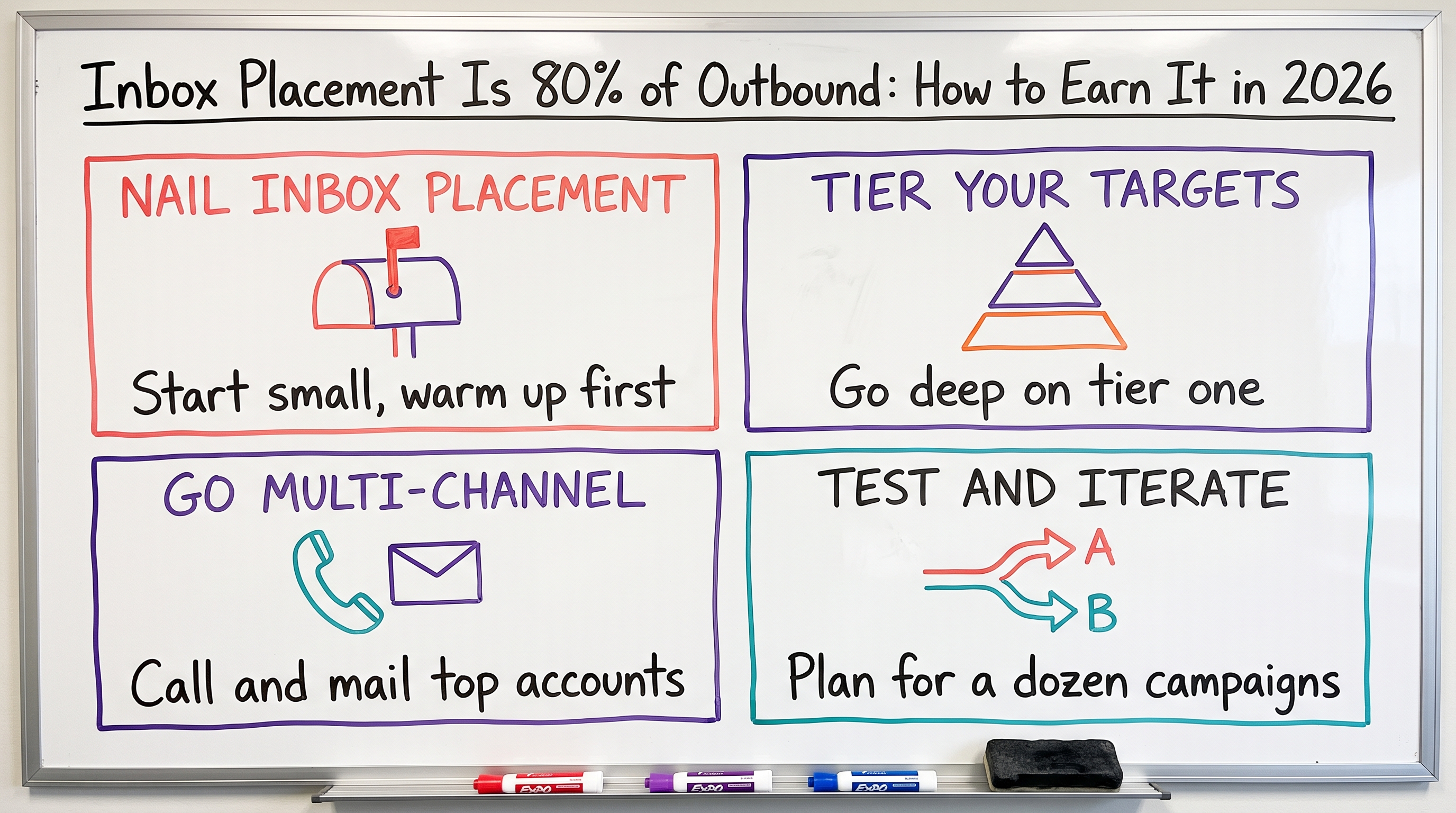
Inbox Placement Is 80% of Outbound: How to Earn It in 2026
Outbound used to be a numbers game, and now it rewards founders who earn engagement and protect their sending reputation. Here is how to start small, score your market, and build a campaign that keeps landing in the inbox.

I have had to relearn outbound twice in my life, and it seems to change completely every 12 months now. In 2018 you could send a thousand emails a day from your own tool and do really well. In 2024 and 2025 we taught a quantity-based approach, where you keep sending 30,000 to 50,000 emails a month and eventually the replies and clicks show up. That advice has an expiration date, and it has mostly passed.
What we have learned since, particularly in mid-market and enterprise, is that quality matters more than it ever has. A recent mastermind conversation made the point clearly, because a founder asked how to hand the whole meeting-setting problem to someone else, and the answers from the room all circled back to one idea: whether your message reaches the inbox decides almost everything else.
Why the volume playbook stopped working
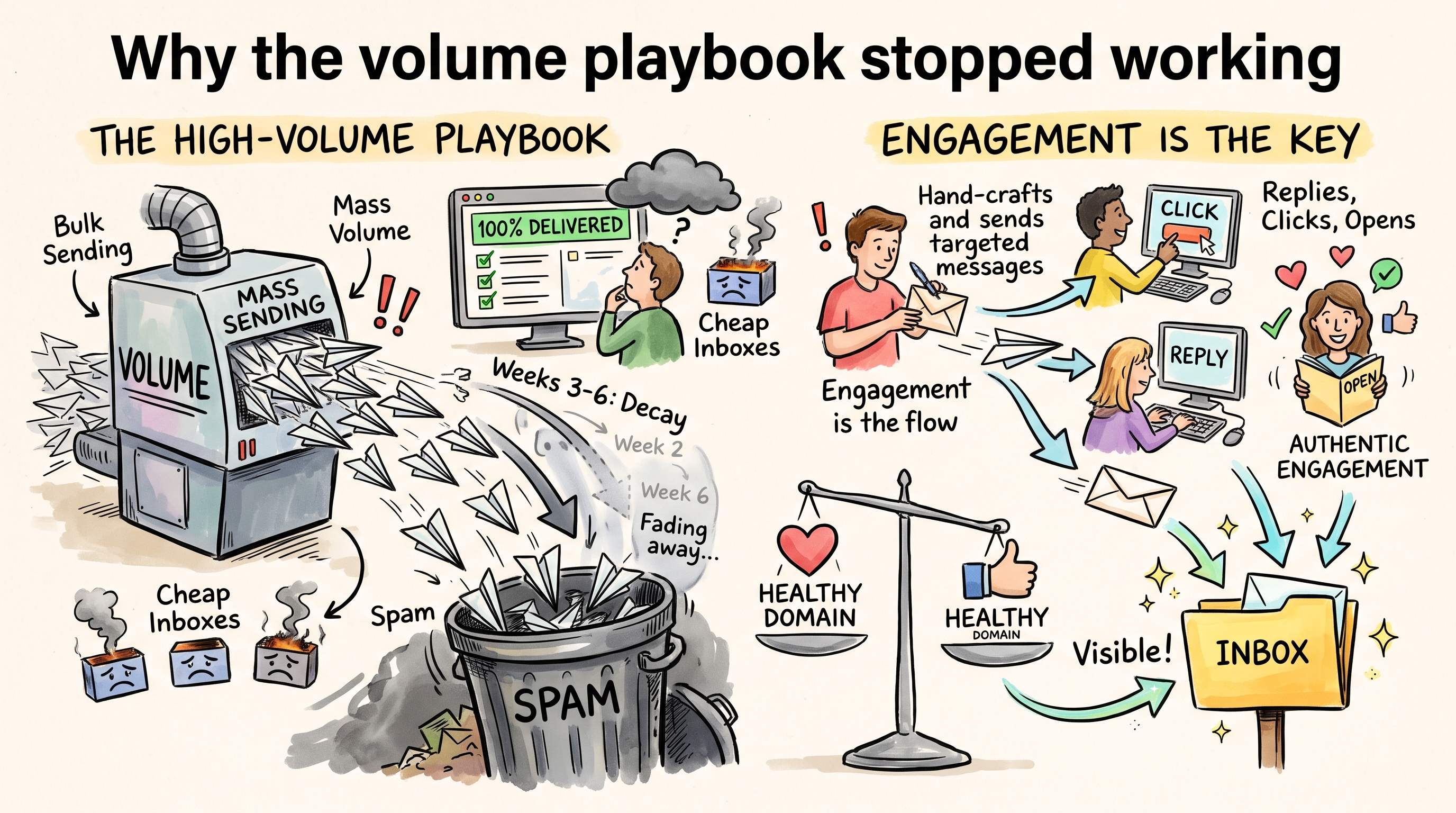
Inbox providers watch how recipients treat your mail. If people reply, click, and open, your future messages keep landing in the inbox. If they ignore you, your messages slowly slide to spam, and you never see the failure because the send dashboard still says everything was delivered. The simple setups that rely on bulk sending tools tend to work for a few weeks, and then after about three to six weeks the emails stop getting to the inbox. A campaign that looked healthy in week two can be invisible by week six.
- Engagement is the signal. Replies, clicks, and opens tell the providers your mail is wanted. Without authentic engagement, placement decays.
- Cheap inboxes burn out. I have given up on the popular mass-sending tools because the inboxes they sell are not good enough. Better inbox providers exist, but where the inboxes come from matters less than what you do with them.
- Untargeted volume backfires. Sending two or three thousand emails a day with weak targeting and low reply rates is the fastest way to lose the inbox.
Notice that none of this is about clever subject lines. The first job is keeping your domain and inboxes healthy, and the copy only matters once your message is actually in front of a human.
Start small and watch the numbers
As I put it on the call, "if you can get the message delivered to the inbox, that's 80% success in outbound." The differentiator between a campaign that sets meetings and one that does not is rarely the content, although content matters a little, and it is somewhat the list. Mostly it is whether the message gets delivered. So the way to begin is the opposite of how most teams begin.
- Warm up first. Give new inboxes a 7 to 14 day warm-up before you send real campaigns.
- Send 100 to 200 emails. Start with a small batch so you can read the signal instead of drowning in it.
- Track clicks, opens, and replies. If the numbers are healthy, scale slowly. If they are weak, fix the targeting and copy before adding volume.
Once placement is working, the job is to write copy that is highly relevant and highly targeted, the kind of email a specific person is likely to click or answer. Clicks and replies keep your messages arriving, and as long as they keep arriving, you can win. Everything about research, scoring, and personalization exists to feed that loop.
Tier your market and treat each tier differently
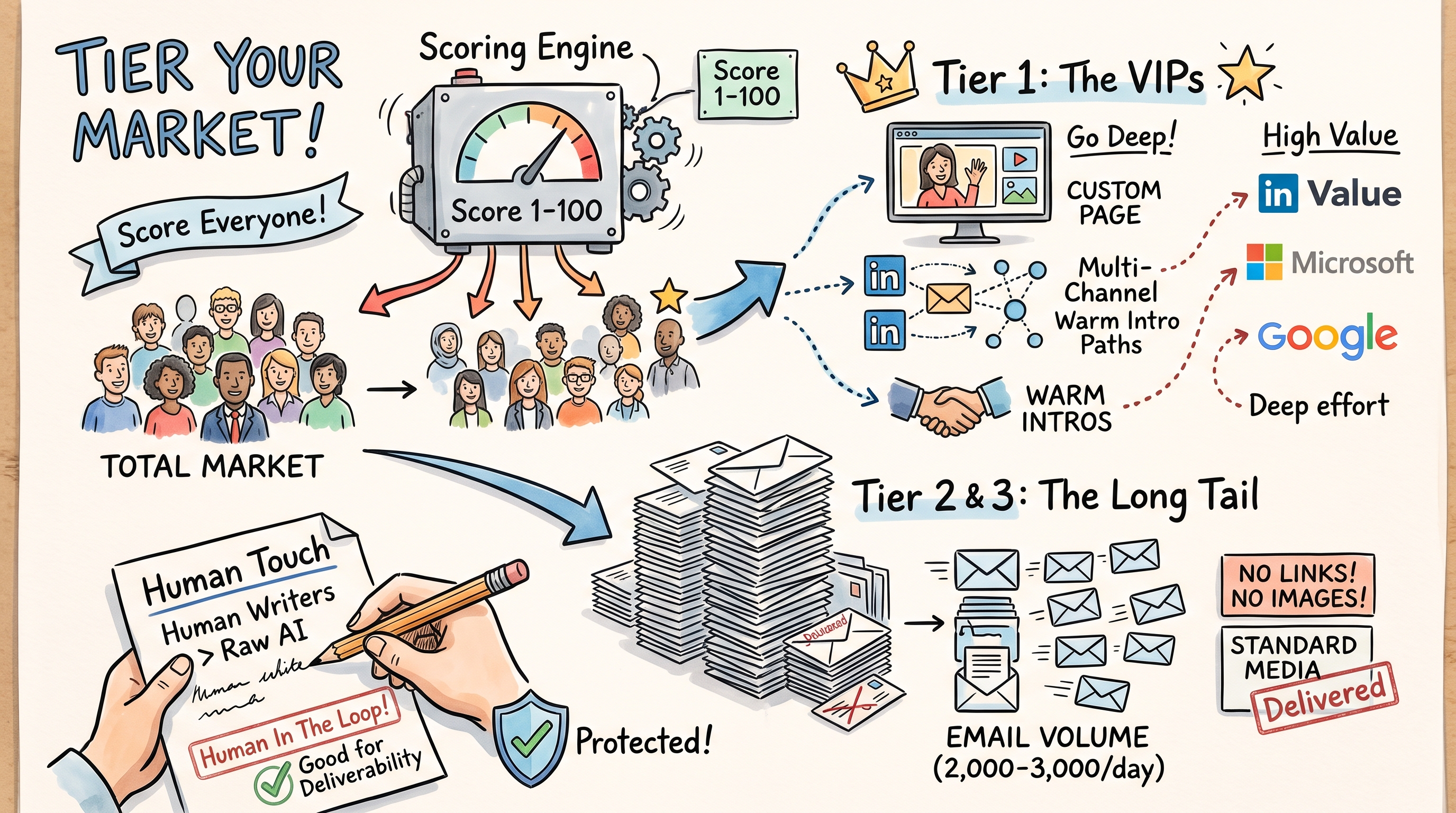
One founder in the room runs outbound for mid-market and enterprise SaaS companies, and his structure is worth copying. He takes a customer's entire total market and scores every account. The top tier gets a custom landing page, a custom video, and a custom image, and he reaches them everywhere at once, across LinkedIn and email. He even maps connection paths so he can import LinkedIn connections and request several warm introductions to the same account.
Everyone below the top tier still gets outbound, and it still works. He sends 2,000 to 3,000 emails a day to the broader list and sees replies around 1.5 percent. Those emails are personalized, but they carry no links or images, which protects deliverability. Humans still write the copy, and he made a point that is worth taking seriously: filters are getting better at spotting text that was produced by AI, so a human pass on the writing is a cheap insurance policy.
- Score everyone. Rank the whole market against your ICP so you know where the effort goes.
- Go deep on tier one. Custom pages, video, images, multi-channel touches, and warm intro paths for the accounts that matter most.
- Keep the long tail clean. Personalized text only, with no links or images, at a volume your reputation can handle.
- Keep a human in the loop. Let people write or heavily edit the copy rather than shipping raw model output.
The same tiering logic applies to my own work. For an offer that is a free account instead of a meeting, we send about 3,000 emails a day to produce roughly 150 free users a day. The offer is simpler, so the math is different, but the principle of matching effort to account value holds.
Outbound is a campaign, and the first one rarely works
Email is one channel inside an account-based strategy. If your average contract value is north of $25,000, you should also consider direct mail, shipped packages, and outbound calling, along with trade shows you are probably already attending. A good enterprise campaign has several touches in several channels, and email is the cheapest of them, not the whole plan.
- Add physical touches. Direct mail and packages cut through the noise at higher contract values.
- Call the best accounts. A phone call to a tier-one prospect can do what ten emails cannot.
- Show up in person. Events and trade shows feed the same account list.
The other hard truth is patience. One founder put it well: a funnel that makes money and repeats is worth so much that it would be too good to be true if your first outbound campaign nailed it. Another operator who does this full time says his team tests about 12 campaigns before one really works, and each of those campaigns can run 20 to 50 different A/B tests. That is a lot of testing, and it is the actual price of admission.
- Expect a grind. Plan for a dozen campaigns before you find the one that carries the program.
- Test inside each campaign. Subject lines, openings, offers, and calls to action all deserve tests.
- Judge on placement and replies. Opens alone will fool you, so watch replies and booked meetings.
If you want to outsource meeting setting
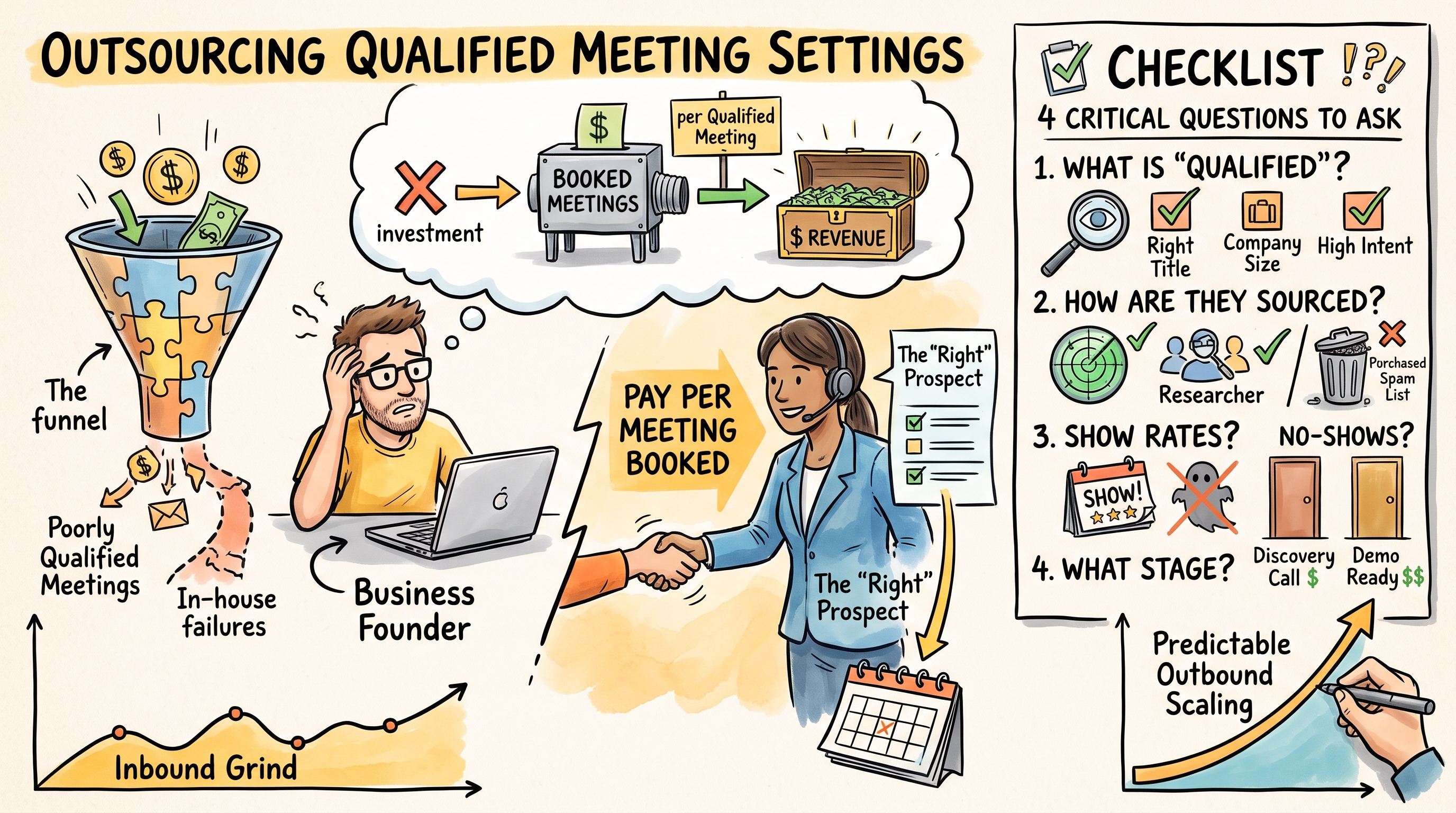
A founder in our group has an inbound business with strong close rates and wants to move up the funnel by paying someone else to book qualified meetings. He is willing to pay a few hundred dollars per qualified meeting. He tried an agency a few years ago and gave it six or seven months, but the agency kept offering near misses, and in-house sales hires struggled as well. His instinct is a reasonable one, because a predictable cost per meeting lets you model spend against revenue and scale with confidence.
The market is catching up to that instinct. The founder who runs outbound for other SaaS companies has moved his customers from monthly retainers of around $4,000 to paying per meeting booked, and almost all of his customers are now on that model. Most of what he books are discovery calls, with the occasional demo-ready account when a prospect has publicly signaled they need something right now. That shifts the risk to the provider, and it forces them to care about the right person actually showing up.
- Ask what counts as qualified. Define the title, company size, and intent before any meetings get booked.
- Ask how they get the right person. Look for scoring, signals, and research, not a purchased list.
- Ask about show rates. A booked meeting that never happens is a cost to you, so know how they handle no-shows.
- Ask what stage the meeting is. Discovery calls and demo-ready conversations should be priced differently.
There is also the question of whether to build more of what already works. Pushing harder on inbound through search, speaking, and content is real, but it is labor-intensive and grows in a fairly linear way. A founder who wants to say that spending X on Y meetings produces Z revenue is looking for a lever with a more predictable slope, and outbound can provide it when it is built carefully.
What to do this week
If your current outbound program is a high-volume blast from cheap inboxes, I would pause it and rebuild from the inbox outward. Warm up a clean set of inboxes, send a small batch to a tightly scored list, and let the click and reply data tell you whether to scale. Then add the other channels for your best accounts and keep testing until one campaign earns the right to grow. The founders who do this are building something that keeps compounding, because their reputation with the inbox providers improves along with their results.