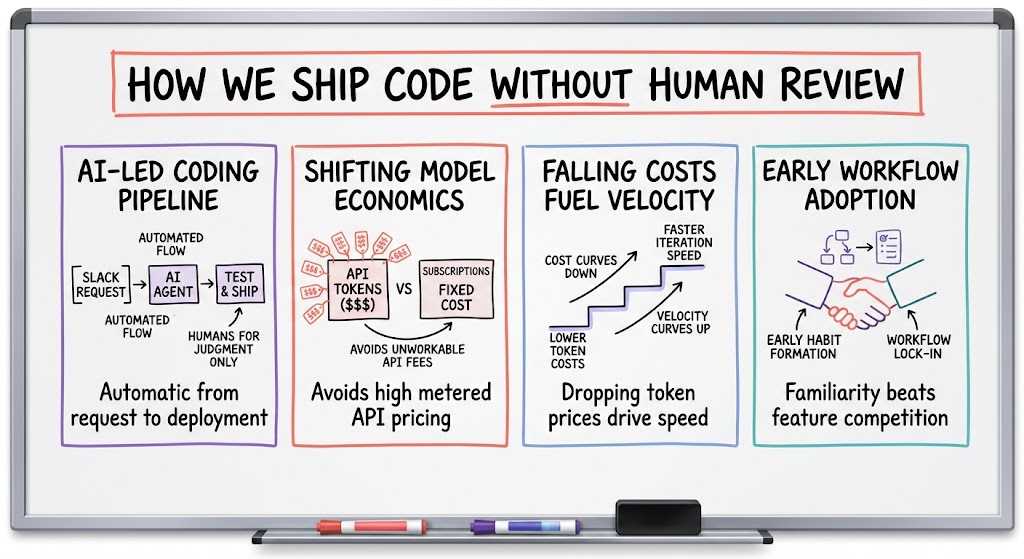
How We Ship Code Without Human Review
One SaaS founder in our mastermind now ships 90% of new features straight to production with zero human code review. Here's how the AI development stack actually works, and what it means for every founder still reviewing every pull request.

About a year and a half ago I said something on a call that got a few laughs. I said by mid-2026, AI would be doing most of the R&D coding at software companies, not assisting with it, actually doing it. That was late 2024, and to a lot of founders in the room it sounded like hype. Fast forward to a recent mastermind session, and one of our members, who runs an AI employee company, told the group that roughly 90% of the features shipping to his production environment go out with no human code review at all. Not "a quick glance before merge." None.
That stopped the conversation for a second, because most of us are still living in a world where every pull request gets a human set of eyes before it touches production, even when an AI agent wrote the first draft. What this founder described is a different model entirely: a client sends a feature request in Slack, an AI agent picks it up, writes the code, tests it, and ships it, and a human only steps in when the agent itself flags a decision it isn't confident making. As he put it, describing how the loop actually runs, "most of the features go out without human review, so we don't actually human review anymore, but certain times the agent picks up as, hey, I need a decision here, and that's when the human actually steps in."
The workflow: from Slack message to shipped feature
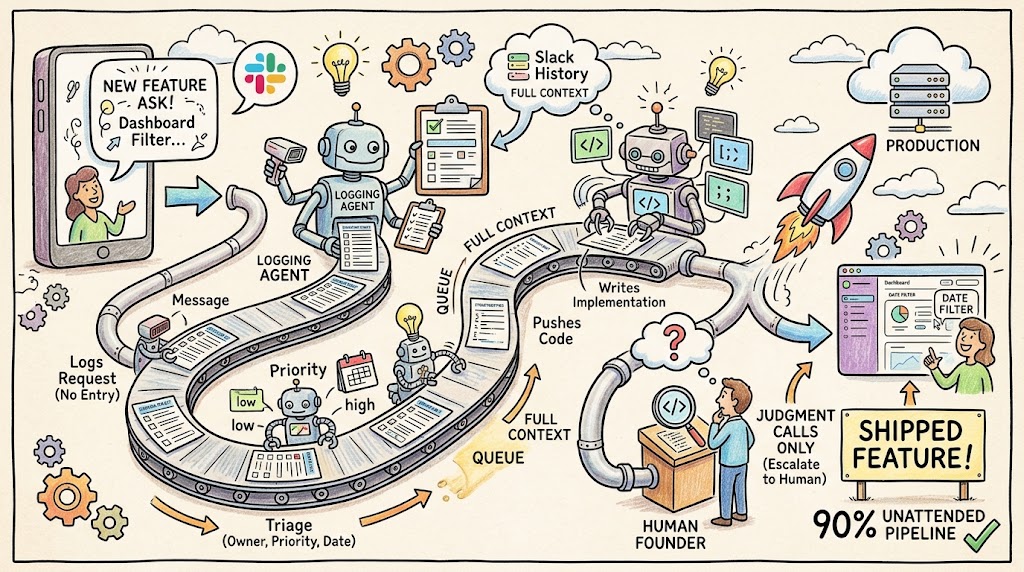
The mechanics of this are worth walking through, because it's not magic, it's a pipeline. Someone on the team, or a customer, describes a feature request in Slack in plain language. An AI agent, built by the company itself using their own AI employee product, reads that message, logs it as a formal feature request, triages it, assigns it to the right place in the queue, and sets a target date. From there, a coding agent picks up the ticket with full context already attached, writes the implementation, and pushes it toward production. The human founder only enters the loop at the points where the agent itself decides it needs a judgment call it isn't equipped to make on its own.
- The request gets logged automatically. A Slack message becomes a structured feature request with no manual data entry.
- Triage happens without a human. The agent assigns priority, owner, and a target date on its own.
- Coding starts with full context. The agent that writes the code already has the conversation history, so nobody re-explains the ask.
- Humans only get pulled in on judgment calls. The agent escalates when it hits a genuine decision point, not on every change.
- Most of the pipeline runs unattended. Around 90% of features move from request to production without a person reviewing the diff.
It's worth being honest that this isn't the default setup for most software companies right now, and probably shouldn't be for every kind of company. A team shipping code that touches payments, health data, or anything with real compliance exposure has good reasons to keep a human in the loop longer. But for a lot of internal tooling, dashboard features, and the kind of incremental product work that used to eat a huge chunk of an engineering team's week, this founder's experience suggests the ceiling on "how much can run unattended" is a lot higher than most of us assumed even a year ago.
What's actually writing the code
The obvious next question is which tools are doing this work, and the answer turned out to be more interesting than a single product name. This company runs about 13 subscriptions to one major AI coding assistant, rotated across the development team, because paying for the same volume of usage through raw API tokens would run roughly $100,000 a month, which was never going to be workable for them. They also keep three accounts on a second coding agent that's notoriously hard to get access to, and those get rotated across the team as well. More recently they've started testing a newer, faster model for specific tasks, one they described as dramatically quicker for certain kinds of work, even if the raw speed multiplier is more modest than the early hype suggested.
- They rotate multiple subscriptions instead of one account. Roughly 13 seats on one leading coding assistant get shared across the dev team.
- API pricing didn't pencil out. Paying by the token for that volume of usage would have run about $100,000 a month.
- A second tool is scarce enough to ration. Three accounts on a hard-to-access coding agent rotate through the team as needed.
- A newer model gets used selectively. It's faster for certain tasks, though not as dramatically faster as the earliest claims suggested.
- The stack keeps shifting. As new models come out, the team keeps testing and reallocating rather than standardizing on one tool.
That $100,000-a-month figure is worth sitting with for a second, because it explains a lot about how AI-native dev teams are actually structured right now. The constraint isn't whether the models are capable enough, it's the economics of running them at volume. Flat-rate subscriptions, even rationed and rotated across a team, are currently the more practical answer than metered API access for a team writing this much code. That's a purely temporary state of affairs, and everyone on the call seemed to agree it won't last.
Why the cost curve matters more than the capability curve
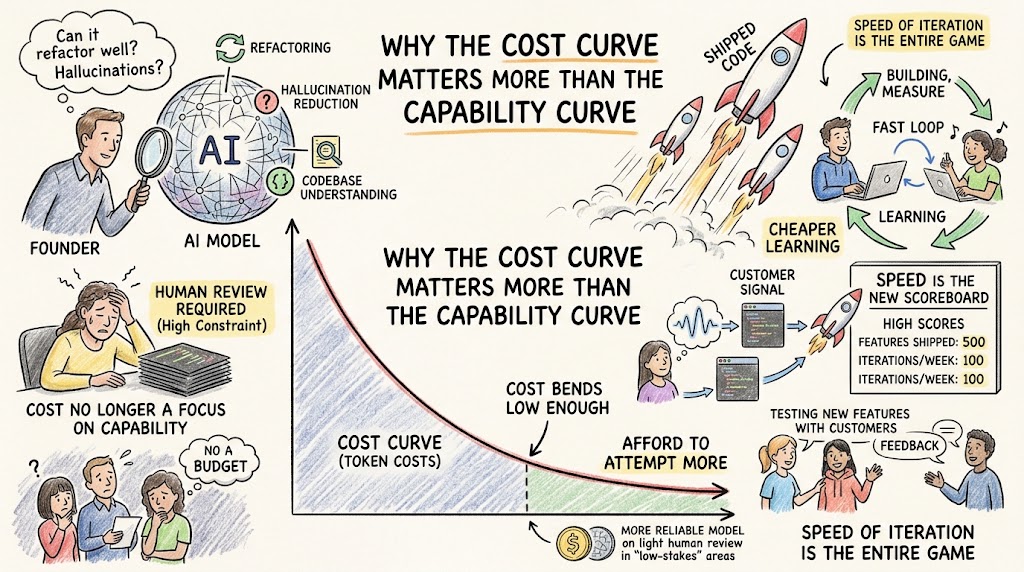
Here's the part I think most founders are underweighting. The conversation about AI coding tools tends to focus on capability, whether the model can handle a hard refactor, whether it hallucinates less, whether it understands your codebase. Those questions matter, but the founder in our mastermind made a point that I hadn't heard framed quite that way before: token costs across every major provider are heading down, and once that curve bends far enough, the question stops being "how expensive is this" and becomes "how fast can I build, and how fast can I understand my customer." Cost stops being the constraint, and speed of iteration becomes the entire game.
- Pricing is already dropping across providers. The per-token cost of frontier coding models has been trending down since these tools launched.
- Cheaper tokens change the calculus. Once cost stops being the limiting factor, teams can afford to let agents attempt more and iterate more.
- Speed becomes the new scoreboard. The competitive question shifts from budget management to how fast you can turn a customer signal into shipped code.
- Understanding the customer gets cheaper too. The same iteration speed that ships features faster also lets a team test and learn from customers faster.
One of the other founders on the call mentioned reading that this newer model claims not to hallucinate, which is obviously a strong claim and one worth treating with some skepticism until it's been stress-tested by more teams over more time. But directionally, it points at where this is heading: as models get more reliable and cheaper at the same time, the argument for keeping a human reviewing every line gets weaker, at least for the categories of work where the cost of an occasional mistake is low and easily caught downstream.
The market for AI employees is still wide open
Before diving into the coding workflow, this founder had talked about what product-market fit felt like for his company, and one thing he said stuck with me: paying customers are the real signal, everything before that is a guess dressed up as a strategy. That part of the conversation connects directly to the coding story, because his company's own AI employee product is what's automating this whole development pipeline. His own team is effectively the first and best customer, using the product to run their own operations, which tests it and improves it at the same time. He also pointed out that the category is barely penetrated, with an estimated 95% of companies not yet using an AI employee tool at all, which leaves enormous room for whoever moves first to define what the workflow looks like.
That last point matters more than it might seem at first. When a team already has an internal habit built around one AI tool, they rarely go shopping for a competitor that does roughly the same thing, even if the alternative is marginally better. Familiarity and workflow lock-in beat feature comparisons more often than product teams like to admit, which is exactly why being early into a company's workflow, before they've built habits around someone else's product, is worth more than most growth tactics you could spend that same energy on.
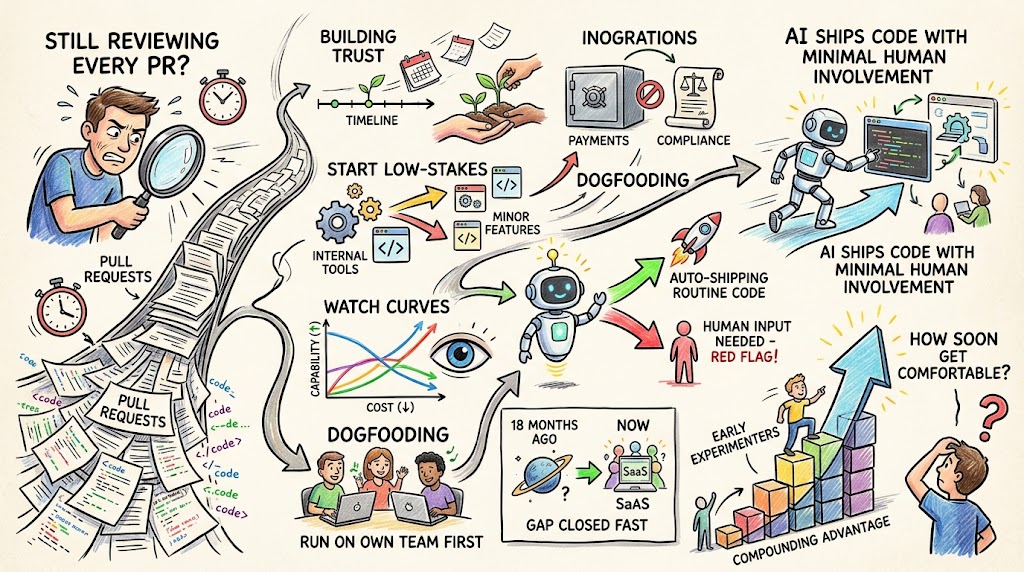
What this means if you're still reviewing every pull request
I'm not suggesting every SaaS company should flip a switch tomorrow and turn off code review. Most of us aren't there, and for good reason: this level of trust in an agent's output comes from months of tightening the process, not from installing a tool. If you want to move in this direction, the practical starting point is the lowest-stakes surface area you have, internal tools and minor feature requests, rather than anything that touches payments or compliance, and the real gain isn't removing humans from the loop, it's teaching the agent to recognize the moments when it actually needs one. Keep watching the cost curve as closely as the capability curve, since workflows that look too expensive today tend to get cheap fast, and if you're building the AI tool yourself, run it on your own team first, because that's the fastest way to learn what actually works. But the direction is worth taking seriously, because the gap between "AI assists with coding" and "AI ships code with minimal human involvement" closed faster than almost anyone predicted, and the founders who are already experimenting with loosening that human bottleneck are going to compound an advantage that's hard to catch up to later.
Eighteen months ago this sounded like a bold prediction. Now it's a working description of how one SaaS company actually ships software, and the honest question worth sitting with is simply how soon the rest of us get comfortable enough with this to try it ourselves.