
.png)
How to Write a B2B Cold Email Sequence
If you want cold email to actually work—not feel spammy or desperate—this guide walks you through how to craft a sequence that people want to open. We’ll talk tone, timing, value drops, personalization, and how to turn total strangers into warm conversations using simple, human, modern outbound strategy.

B2B cold email is one of the most misunderstood—and most powerful—growth channels in SaaS. For many teams, the perception is that cold email is a noisy tactic, a dying channel, or something only spammy SDR teams do. But when executed correctly, cold email becomes something entirely different: a scalable, predictable pipeline engine that introduces thousands of qualified buyers to your brand every month.
The truth is, cold email isn’t about blasting templates into the void. It’s about orchestrating a series of small, thoughtful touchpoints—delivered with precision, personalization, and genuine value—that help your ideal customers discover you long before they ever enter a buying cycle. And when you combine modern email infrastructure, personalized messaging, and a strategic sequence, cold email becomes one of the highest-leverage systems in your go-to-market motion.
What follows is an in-depth guide on how to craft an outbound email sequence that not only lands in the inbox but creates engagement, builds awareness, and turns strangers into pipeline. This approach is based on real operating experience across thousands of campaigns, tens of millions of impressions, and hundreds of thousands of outbound emails sent to SaaS executives around the world.
It’s cold email—but done right.
The Real Difference Between Warm and Cold Email
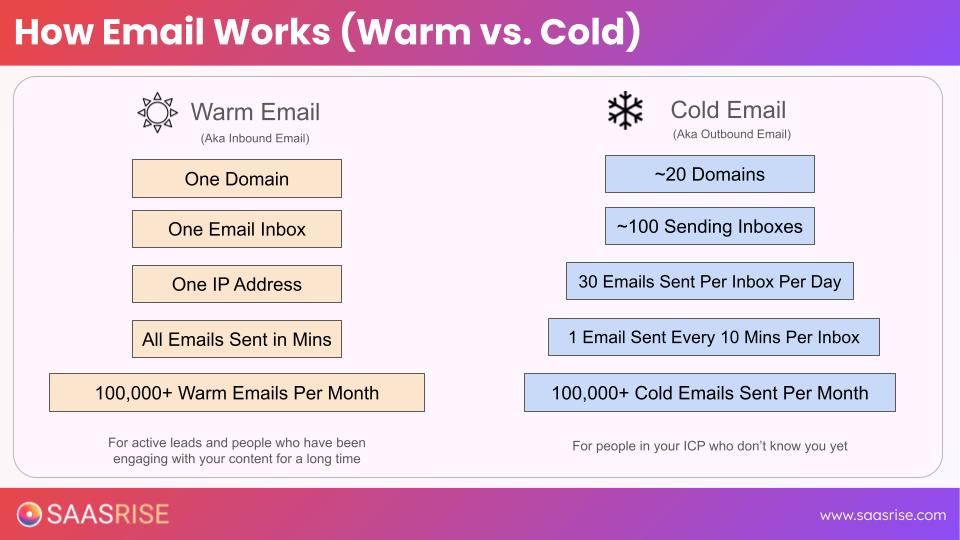
Before we even talk about writing copy, you need to understand the fundamental difference between warm and cold email—because they are two entirely different ecosystems.
Warm email is what happens when the person on the other end already knows you, expects to hear from you, and has opted in at some point. Because they’ve entered a relationship with you, you can communicate at a higher frequency, through a single domain, from a single IP, with platforms like HubSpot or Mailchimp. If you want to send 100,000 emails in five minutes, a warm platform will do it.
Cold email is the opposite. This is outbound. These are people who don’t know your brand, aren’t expecting anything from you, and have zero preexisting relationship. Sending cold emails through a warm system will get you flagged, blocked, and potentially blacklisted.
Cold email has to be slow, distributed, and decentralized.
If warm email is broadcasting, cold email is lightly tapping a single person on the shoulder once every few days.
You do it through:
- Multiple domains
- Dozens of inboxes
- Drip scheduling every 8–12 minutes
- 20–50 sends per inbox, per day
- A sequencer like Instantly
This infrastructure isn’t glamorous, but it is the difference between landing in the inbox and disappearing forever into spam. And once your infrastructure is warming and sending properly, the copy you write actually gets a chance to matter.
Why Great Cold Email Is Really About Value, Not Persuasion
Most cold email fails because it tries too hard to sell. There’s the predictable corporate greeting, the three-sentence pitch, the generic value prop, and the calendar link shoved at the bottom. Everyone knows what it is the instant they see it, and their brain ruthlessly deletes it.
.jpg)
Humans don’t hate cold email.
They hate being pitched by strangers.
The shift that modern outbound requires is simple but profound:
The first job of an outbound email is not to convince.
The first job is to deliver something valuable.
When you approach outbound from the perspective of:
“Here is something genuinely useful to you, free and with no catch,”
everything starts working.
Value does the selling.
Trust does the warming.
Your sequence simply guides the journey.
High-functioning outbound systems don’t try to “get the meeting” in the first email. They offer:
- Research reports
- Industry benchmark data
- Case studies with specific results
- Playbooks
- Short videos
- Recorded demos
- Extended free trials
- Frameworks
- Templates
- Webinars
- Detailed guides
If your content is valuable, your cold email doesn’t feel like cold email anymore. It feels like insider knowledge delivered straight to the inbox. And that’s why people click. That’s why they respond. That's why they remember your company on LinkedIn, in ads, and in future sequences.
Outbound works when it becomes a service rather than a pitch.
The Anatomy of a Modern Cold Email Sequence
While many companies obsess over templates, the sequence itself is far more important. Think of it as a small narrative that unfolds over time.
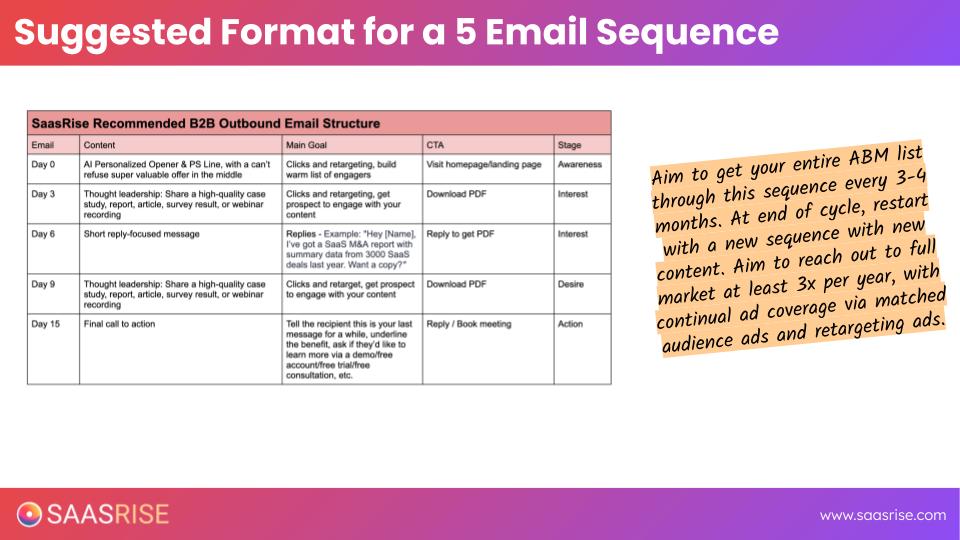
A great sequence will usually extend across 10–15 days, with 3–5 touchpoints, gradually shifting from curiosity… to credibility… to clarity… to invitation.
Here’s how that unfolds.
The First Email: A Soft Knock With Something Worth Opening
The opening email should feel like a friendly introduction—not an ambush. It should contain a hook that’s personalized and relevant, paired with a piece of value that your ICP genuinely wants.
A strong first email often does three things:
- Opens with something personal or human.
- Offers something the recipient would benefit from.
- Ends with a simple, frictionless way to engage—usually a link.
What you’re truly optimizing for early on is the click, not the reply. If someone clicks, they reveal intent. They become part of your retargeting audience. They get nurtured by your ads. They move from “cold” to “warming.”
The selling happens later. The first email is just the handshake.
The Second Touchpoint: A Human Check-In
Once the first piece of value is shared, the second touchpoint often shifts from link-based to conversational. Something simple—literally one or two sentences—often performs best.
You’re not selling.
You’re not pitching.
You’re simply showing up again, gently.
This increases deliverability, improves sender reputation, and reinforces the sense that an actual person—not a sequence—is reaching out.
The Middle Emails: Deepening Value and Authority
The next one or two emails continue offering valuable insights or examples:
- A customer story.
- A before-and-after transformation.
- A short video demo.
- A playbook or template.
Every asset should reinforce your credibility and understanding of the recipient’s world.
At this stage, your messaging starts shifting from pure value toward context: “This is the problem we help solve, and here’s the outcome others have achieved.”
Still—no hard pitch.
The Final Touch: A Clear, Compelling Offer
Only when you’ve delivered value multiple times and built familiarity should you make a clear offer.
In fact, the best final emails feel like a natural extension of the prior value rather than a shift in tone.
For example:
“If you’d like, we’re offering an extended 120-day trial this month.
Totally optional, but happy to set it up for you if you’re evaluating this space.”
This kind of offer works because it’s contextual, respectful, and rooted in the relationship you’ve been building over the prior days.
When outbound sequences are structured around generosity and timing, not pressure, they perform dramatically better.
The Role of AI Personalization
One of the biggest breakthroughs in cold email in the last year has been AI-powered personalization. Instead of sending the same subject line, same opener, and same PS to thousands of people, AI allows you to personalize each touchpoint based on:
- The recipient’s LinkedIn profile
- Their company description
- Recent achievements
- Hobbies or interests
- Career path
- Unique facts from their bio
This isn’t fake personalization. It's contextual relevance at scale.
Think of how different this feels compared to a generic opener:
“Congrats on your recent $12M Series A. Loved the direction you’re taking in applied AI—especially your focus on predictive workflows.”
…versus…
“I see you’ve done great work in your field.”
The first feels like a human.
The second feels like a bot.
AI personalization has consistently doubled click rates and significantly increased replies. And when the AI pulls in unexpected but accurate personal details—surfing, Burning Man, robotics competitions, or alma maters—it creates a moment of authenticity that is incredibly rare in outbound.
.jpg)
Cold email becomes “warm” the moment it feels like it was written just for the recipient.
The Psychological Model Behind Effective Outbound
Cold email is really about guiding someone through a simple emotional journey:
Awareness → Interest → Desire → Action
Most bad sequences try to force “Action” on day one.
Most great sequences patiently build “Interest” and “Desire” first.
The principle is simple:
People buy when they feel understood.
People respond when they feel respected.
People click when something is useful.
People take meetings when the timing is right.
Your cold email sequence shouldn’t try to accelerate the buyer.
It should accompany them.
When you respect the psychology of how executives make decisions—slowly, cautiously, and with an eye toward opportunity—you create a system that works month after month, quarter after quarter.
What Happens After They Click Is Just as Important as the Sequence Itself
A modern outbound system doesn’t end at the email.
A click triggers the second half of your funnel:
- Matched-audience ads
- Retargeting ads
- SDR follow-up for engaged users
- Warm email nurturing
- Additional outbound subsequences
Think of outbound as the top of a multi-channel awareness engine. Your sequence warms the prospect. Your ads reinforce the messaging. Your content builds trust. Your SDRs follow up when interest spikes. Your warm email deepens the relationship.
This is how outbound feeds pipeline.
Not by itself—but through the ecosystem it activates.
Cold Email Isn’t Spam—Unless You Make It Spam
Spam is irrelevant, generic, low-value outreach that creates no benefit for the reader.
.jpg)
Cold email—when done right—is the opposite:
- It’s targeted.
- It’s relevant.
- It’s personalized.
- It’s valuable.
- It’s respectful.
If you’re sending high-quality industry insights to people who want those insights, you’re not spamming. You’re helping.
And if your content is genuinely excellent, many prospects will thank you for reaching out.
The Real Secret: Your First Version Should Not Be Perfect
Many teams get stuck trying to create the “perfect” cold email sequence before sending anything.
But the truth is:
You cannot write a perfect sequence without real-world data.
You only get data by sending.
And you only start improving once the sequence is live.
The first version should be a B-.
Iterate weekly until it becomes an A.
The results will tell you what to do next.
Outbound is a living system—not a static template.
Closing Thoughts: Cold Email Still Works—Because Relationships Still Matter
Cold email isn’t about tricking someone into a call. It’s about creating a moment of connection with someone who has a real business problem you can help solve.
When you approach outbound with humility, curiosity, and value, it becomes a channel people actually appreciate. It’s a way to build brand awareness at scale. It’s a way to show up helpfully in someone’s inbox. It’s a way to create demand where none existed before.
And most importantly:
Cold email done right doesn’t feel cold.
It feels intentional.
It feels thoughtful.
It feels relevant.
It feels human.
That’s the standard.
That’s the opportunity.
And that’s how you build a B2B cold email sequence that works not just once—but for years.