How to Use Hermes AI Agent
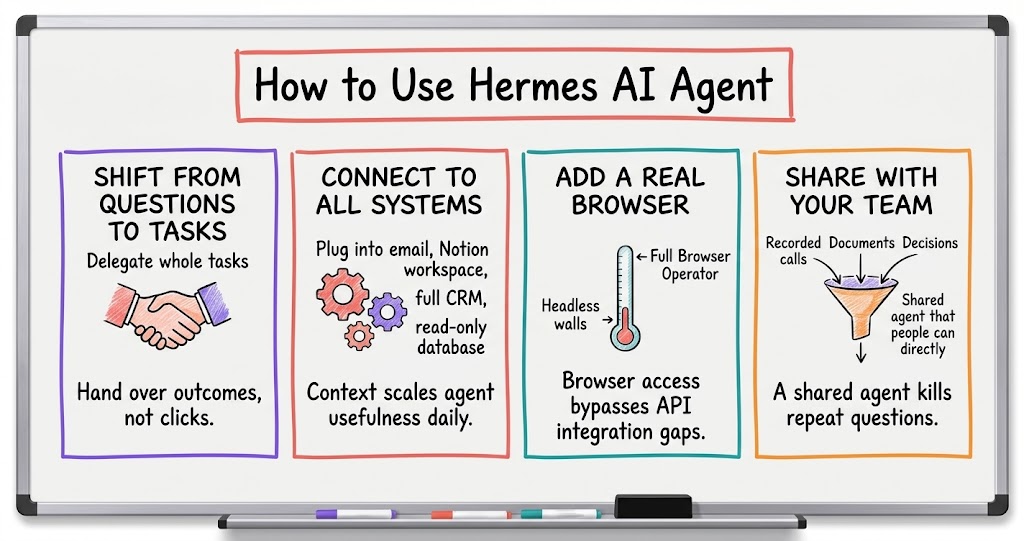
How one founder in our mastermind turned the Hermes AI agent into what he calls a complete life changer, by connecting it to his company's systems, giving it a real browser, delegating entire tasks, and sharing it with his team.

On a recent SaaSRise mastermind call, we were deep into a conversation about how CEOs can get more done when one of our founders took the discussion somewhere more interesting than time management. His answer wasn't a calendar trick. It was an AI agent called Hermes, which he described, without much hedging, as a complete life changer for how he runs his company. He's gone deeper with it than anyone else I've heard from in our community, and the specifics of how he set it up are worth passing along, because they form a pretty good playbook for any founder who wants to move from chatting with AI to actually delegating work to it.
A quick note before we get into it: he joked on the call that he's heard the name pronounced both ways, like the Greek god and like the French fashion house. However you say it, what matters is the pattern, and the pattern applies to agentic AI tools generally, whichever one you end up using.
The shift from asking questions to assigning tasks
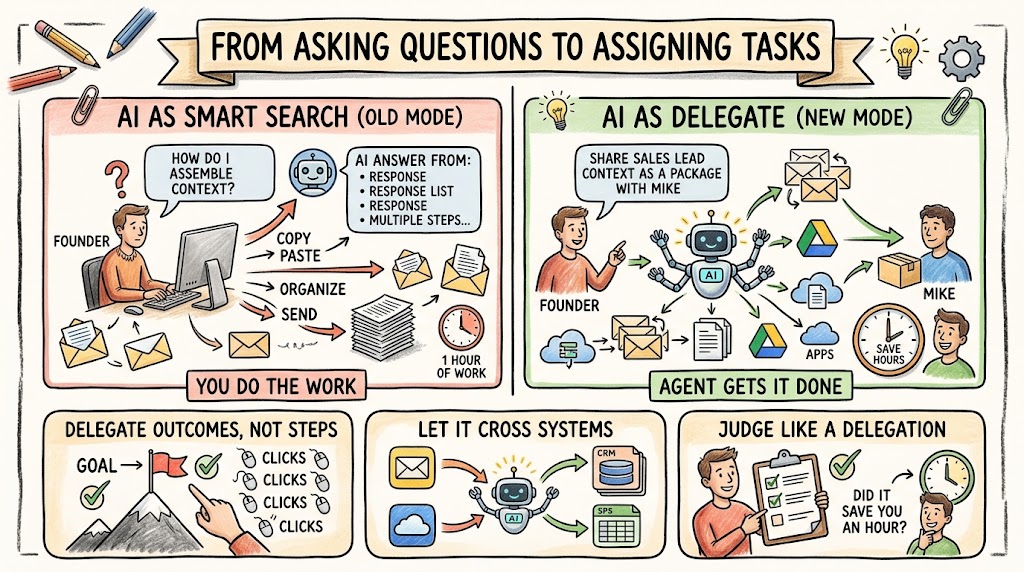
Most founders I talk to are still using AI the way you'd use a very smart search box. You ask a question, you get an answer, you copy something out, and you do the actual work yourself. What this founder described is a different mode entirely. He hands the agent whole tasks, the kind you'd give a capable operations person, and it carries them through to completion across multiple systems.
His example from the call was concrete. He needed to share context on a sales lead with someone else, and the raw material was scattered across 15 old email threads and a pile of documents. So he told the agent, in plain language, to go through those emails, pull every relevant document, drop them into Google Drive, and send the whole package along to the other person. As he put it, "I just say, please do that, and it can just get it done."
- Delegate outcomes, not steps. The instruction was the goal, share this context as a package, not a list of clicks. The agent worked out the steps.
- Let it cross systems. The task spanned email, file storage, and outbound sharing. That's exactly the tedious, multi-tab work that eats founder hours.
- Judge it like a delegation. The bar isn't whether the AI is impressive. It's whether you'd have had to do that hour of work yourself.
That reframing, from AI as an oracle to AI as a doer, is the core of everything else in this post. And it changes which tasks you should hand over first. The best candidates aren't the intellectually hard ones, they're the tedious ones with a clear finish line: assembling context from old threads, packaging documents for a handoff, chasing information across three systems, preparing a brief before a call. Those are the tasks where you know exactly what done looks like, so you can check the agent's work in a minute even though it saved you an hour.
Connect it to everything, carefully
The reason his agent can do real work is that he did the unglamorous setup most people skip: he plugged it into the systems where his company's reality actually lives. On the call he listed the connections, and it's a longer list than most founders would expect. It has his Notion workspace, his email, his full CRM, and his full production database, that last one in read-only mode. In his words, it's "much, much deeper than I was ever able to get anything public-facing to go. It's got everything I could ever ask for."
The read-only detail deserves your attention, because it's the difference between ambitious and reckless. Giving an agent read access to your production data lets it answer real questions about customers, usage, and revenue without any risk of it changing anything. Write access is something you extend later, narrowly, once you trust the setup.
- Start with the systems you check daily. Email, your CRM, your docs workspace, and your knowledge base cover most founder tasks.
- Default to read-only on anything critical. Production databases and financial systems should start as read-only connections, full stop.
- More context beats more cleverness. The agent's usefulness scaled with how much of the company it could see, not with any prompt wizardry.
Another member on the same call was independently heading the same direction, thinking about connecting his CRM, his accounting software, and his marketing data so an AI could help him figure out where to focus his time each week. The convergence is the signal here. Founders at very different companies are all discovering that a connected agent turns scattered operational data into something you can simply ask questions of, or hand work to.
Give the agent a real browser
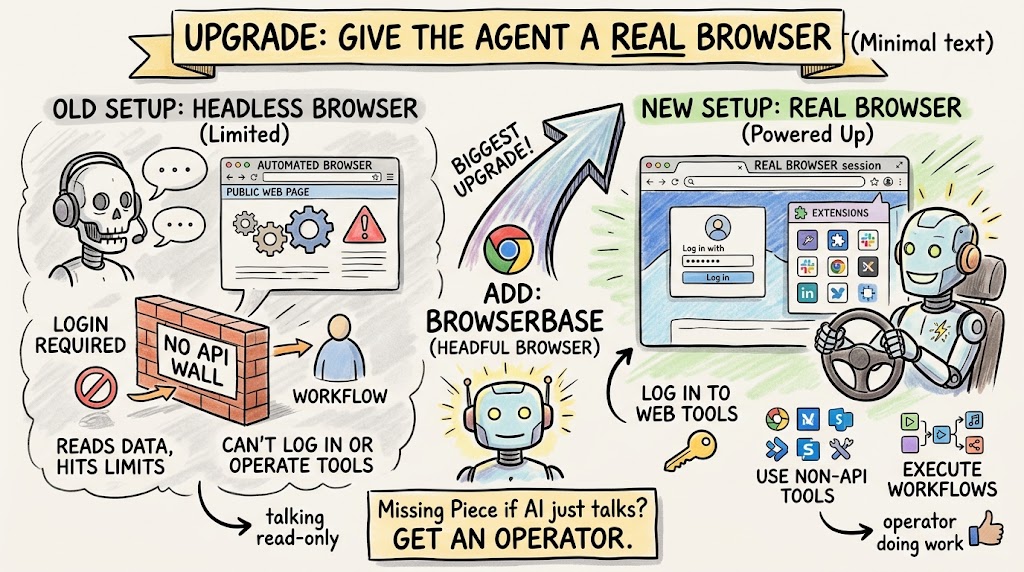
The single biggest upgrade in his setup, by his own account, wasn't a smarter model. It was giving the agent a real browser. He added Browserbase, which provides the agent with what's called a headful browser, meaning a full, visible browser session rather than the stripped-down headless kind that automation tools typically use. The practical difference is enormous: with a headful browser, the agent can log into websites and use the tools that don't have clean integrations, which in most companies is a lot of them.
- Headless browsers hit walls. Stripped-down automated browsers are, in his words, much less powerful, and many sites don't cooperate with them.
- A headful browser can sign in. Logging into the web tools your company actually uses is what turns the agent from a reader into an operator.
- This closes the integration gap. Any workflow stuck in a tool without an API becomes reachable once the agent can drive a real browser.
He called this addition a huge upgrade for everything agentic he does, and I'd flag it as the step most founders don't know exists. If you've tried an AI agent and found it could only talk about work rather than do it, the missing piece was probably this.
Don't keep the agent to yourself
The last part of his setup is the one I think pays off most for a team, and it connects to a theme that ran through the whole call. He had recently made himself dramatically less available inside his company, to the point of leaving his own engineering channels and naming someone else as the default contact. The move that made that survivable was feeding everything into Hermes and then making the agent available to other people in the company. All the context that used to live only in his head, and that people used to interrupt him to get, is now something the team can query directly.
Another founder on the call runs the same play with different tools. His team linked their chat workspace to an AI assistant, pushed questions into public channels, and set a norm that everyone asks the AI first and only escalates to a human when it can't answer. Between the two of them, the lesson is the same.
- A shared agent kills repeat questions. Once the agent holds the context, the team stops needing you to be the search engine.
- Feed it as you go. Recorded calls, documents, and decisions all become material the agent can serve back to anyone who asks.
- It makes stepping back possible. Becoming less available only works if your context stays available. The agent is how you leave without leaving a hole.
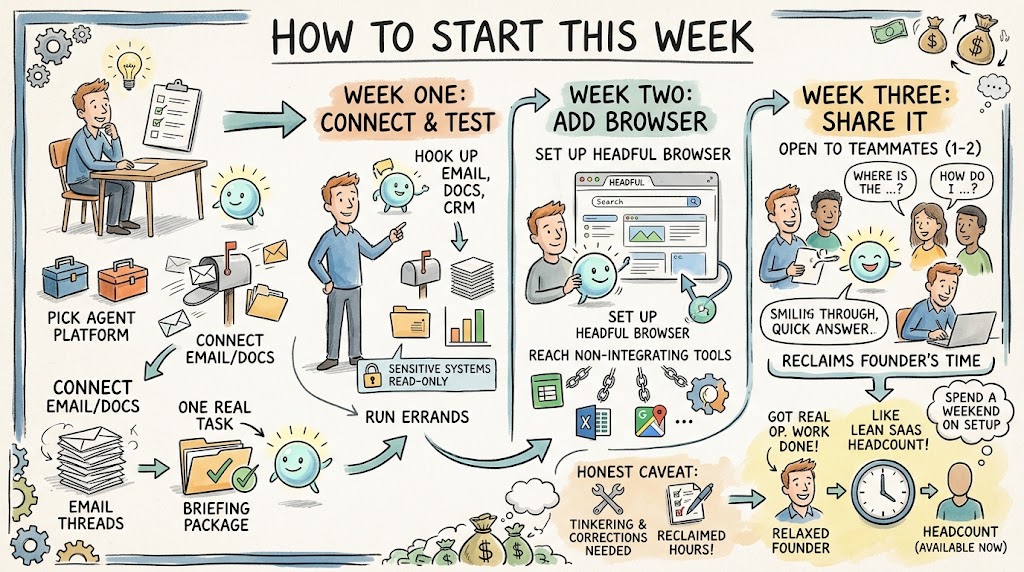
How to start this week
If this sounds appealing but you don't know where to begin, the path our member described breaks down into a sequence you can start immediately, and none of it requires being technical enough to build anything. Pick an agent platform, connect your email and your docs first, and give it one real task you'd otherwise do yourself, something like assembling a briefing package from old threads. Then expand from there as trust builds.
- Week one, connect and test. Hook up email, docs, and your CRM, keep sensitive systems read-only, and run a few real errands through it.
- Week two, add the browser. Set up a headful browser so the agent can reach the tools that don't integrate.
- Week three, share it. Open the agent up to one or two teammates and route their recurring questions to it before they reach you.
The honest caveat is that this takes some tinkering, and the first task you delegate will probably need a correction or two. But the founder who shared all this wasn't offering a cautious endorsement. He'd handed real operational work to his agent, gotten it back done, and reclaimed hours of his week. For those of us running lean SaaS companies, that amounts to headcount you didn't have to hire, and it's available right now to anyone willing to spend a weekend on the setup.