
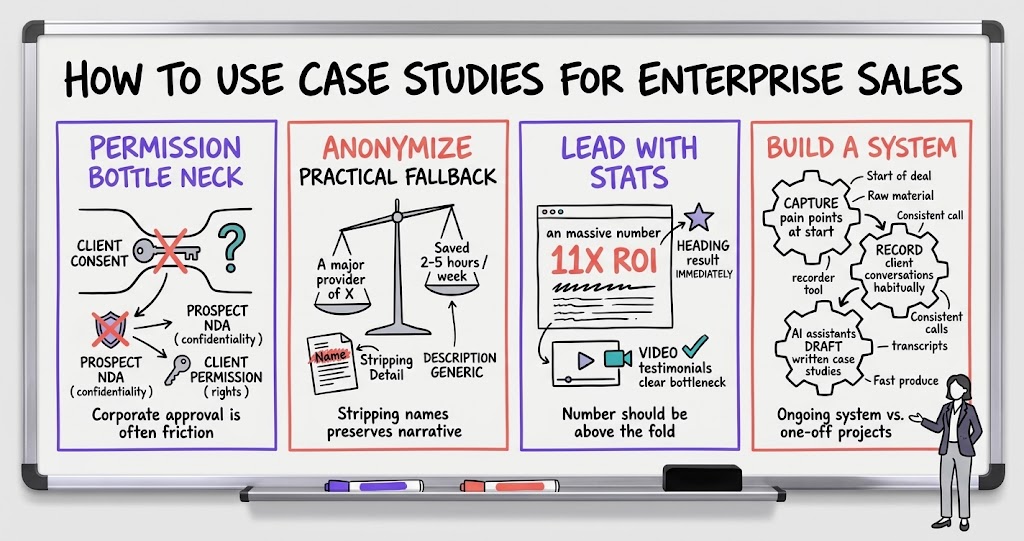
How to Use Case Studies for Enterprise Sales
A founder built a genuinely great customer case study, then got stuck on how to actually use it. The group's answer touched permission, anonymization, SEO, and a bartering tactic worth stealing for your own next renewal conversation.

A founder selling enterprise product information management software brought a great problem to the group recently: he'd built a genuinely impressive case study process, and he didn't know what to do with it. His sales cycle runs close to a year once you include onboarding, so early in every deal his team builds a formal business case, capturing the prospect's pain points and business objectives up front. After the first year working with a new client, they turn that same business case into what he calls an achievement presentation, walking through the metrics and cost savings delivered, and present it back to the client's executives.
He records those conversations with a meeting-recording tool, runs the highlights through an AI assistant to draft a written case study, and then hands that to his marketing team, who turn it into a five-minute podcast walking through the whole project. One example he showed the group was a large HVAC company where his platform cut acquisition onboarding from nine months down to twelve days. The material was, by his own admission and everyone else's, excellent. His question was simply: what do I actually do with this? Can I show it to prospects under an NDA even though I don't have public permission to publish it?
Permission is the real bottleneck, not the content
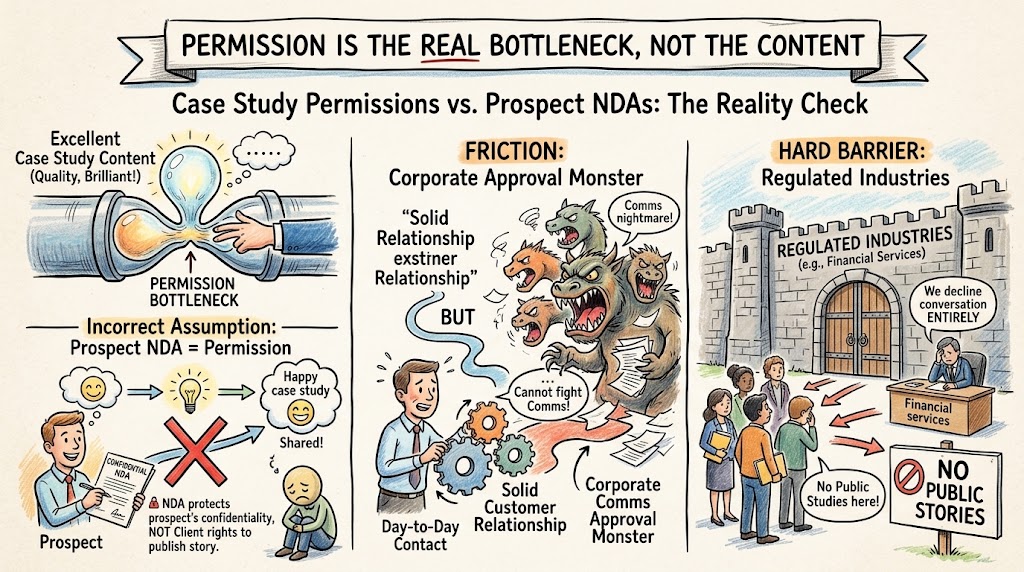
The first and most important reality check came fast. One founder pointed out that if the client hasn't given you permission to publish anything about them, an NDA with your prospect doesn't solve that problem. The client's permission and your prospect's confidentiality are two completely separate questions, and getting a prospect to sign an NDA doesn't retroactively grant you the client's consent to share their story in the first place.
That distinction matters because permission, not content quality, is almost always the real bottleneck on case studies. Several founders in the room described the same pattern: getting a client to agree to a public, named case study is slow, unpredictable, and sometimes flatly impossible depending on the industry. One founder working to break into financial services said his contacts there won't even entertain the conversation. Another described corporate communications approval as, in his words, an absolute nightmare his own point of contact has no appetite to go through, even when that contact is personally thrilled with the results.
- Client permission and prospect NDAs solve different problems. An NDA protects confidentiality with your prospect, it doesn't grant you rights to publish anything about the client in the first place.
- Corporate approval is often the friction, not the customer relationship. Your day-to-day contact can love your product and still be unable or unwilling to fight their own corporate communications process for a public case study.
- Regulated industries are hardest. Financial services and similar categories may decline the conversation entirely, regardless of how strong the underlying results are.
Anonymization is the practical fallback
The most consistent advice in the room was to anonymize rather than abandon the story. Multiple founders described doing exactly this: strip the client's name and any identifying detail, describe them generically instead, a major provider of X, a major credit union, a major lender, and put ranges around any metrics rather than exact figures, so the client in question couldn't look at it and recognize their own data. One founder targeting financial services built an entire results page this way after realizing none of his actual FinServ clients would agree to a named case study.
- Strip the name, keep the story. Most of the pain points and objectives in a good case study are common across many prospects, so the narrative usually survives anonymization intact.
- Use ranges instead of exact numbers. A stat presented as a range is far less likely to be traceable back to a specific client than an exact dollar figure or percentage.
- Test it from the client's point of view. Before publishing, ask whether that specific client could read it and recognize themselves. If yes, strip more detail.
There's a real strategic upside to publishing anonymized case studies broadly rather than sitting on a small number of named ones. One founder made the point that case studies are becoming important not just for traditional SEO but for how large language models find and cite your company when someone asks an AI assistant for a recommendation in your category. His approach is to get as much content out publicly as possible and interlink it heavily across his site, precisely so that both search engines and AI systems have more surface area to find him.
Lead with a stat, not a story
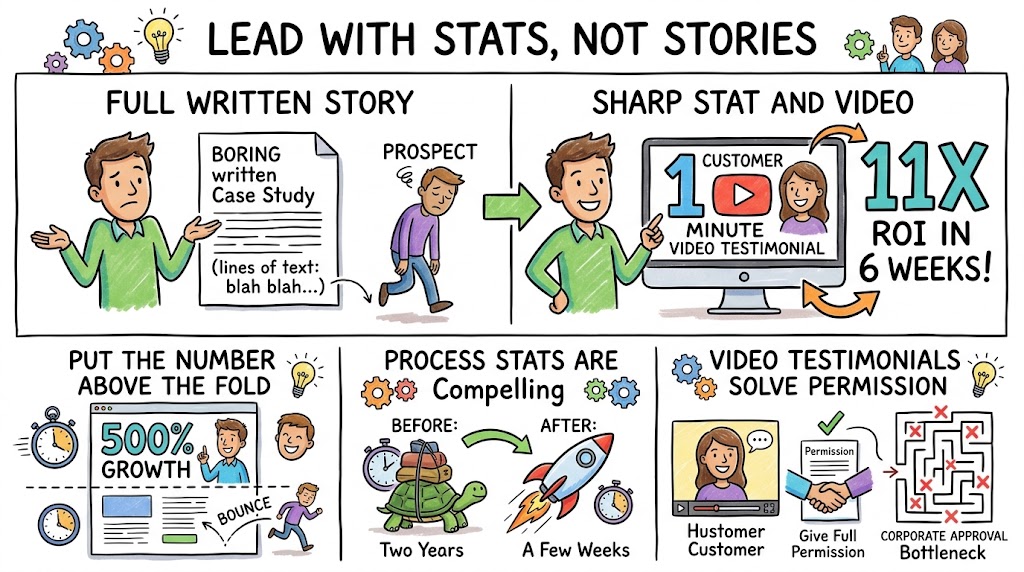
A different founder offered a sharper, more tactical piece of advice: you don't always need a full written case study. His team has had the most success with short, one-minute video testimonials paired with a single sharp stat, an eleven times return on investment in six weeks was the example he gave. He was blunt about attention spans: if a prospect lands on a case study page and doesn't see a headline number immediately, they may bounce before ever reading the story underneath it.
- Put the number above the fold. A prospect skimming your site needs to see the headline result in seconds, not after reading three paragraphs of narrative.
- The stat doesn't have to be financial. A process that used to take two years and now takes a few weeks is just as compelling as a dollar figure, sometimes more so.
- Video testimonials solve the permission problem cleanly. If a customer is willing to go on camera, you already have full, unambiguous permission, which sidesteps the entire corporate approval bottleneck.
How to actually get the permission
One founder shared a technique that's worth stealing directly: negotiate the exact wording with the client's corporate communications team ahead of time. Send them the specific language you'd like to publish, let them come back with a version they're comfortable with, and only use the quote or testimonial once they've signed off on the exact wording. His experience is that giving the client full control over the language, and making clear you won't add anything beyond what they approved, gets a yes roughly half the time. It's slow, he was clear about that, but it works often enough to be worth the friction.
Another founder has taken this a step further by building case studies directly into commercial negotiations. When a customer is pushing hard on price during a renewal or a new deal, his team will sometimes offer a concession, waiving a setup fee or extending a discount, in exchange for a commitment to a testimonial and case study written into the contract itself. It's become a standard tool his whole team reaches for during renewal conversations where a customer is asking for a break on price anyway.
- Let the client write their own quote. Send proposed language, let corporate communications edit it, and only publish what they've explicitly approved.
- Trade concessions for content. A waived fee or renewal discount in exchange for a case study commitment turns a routine negotiation into a content pipeline.
- Build it into the contract, not a separate ask. Formalizing the case study commitment as part of the deal terms makes it far less likely to get deprioritized later.
One caution came from a founder who's used the bartering approach himself: don't force it. If you negotiate a case study commitment into a deal but the customer isn't genuinely happy with the product six months later, pushing them to follow through creates an awkward relationship for very little marketing upside. The underlying value you've delivered is still what makes a customer willing to go on record, the negotiated commitment just opens the door to ask later, rather than replacing the need for a customer who's actually glad they bought from you.
Turn one case study into a system, not a one-off
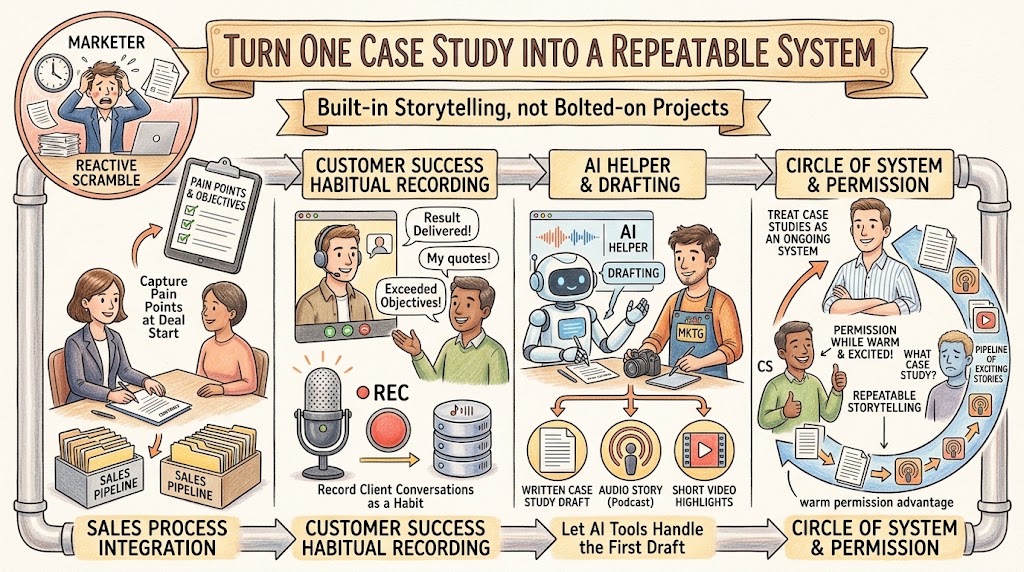
What struck me most about the original example that kicked off this conversation was the process behind it, not just the result. Capturing the business case at the start of a deal, recording the client conversations throughout the engagement, and turning the highlights into a written case study and a short podcast is genuinely a repeatable system, not a one-time marketing project. That matters because most companies treat case studies as something they scramble to produce once a quarter when someone in marketing asks for one, which almost always means the good stories get missed entirely because nobody captured them in the moment.
- Capture the pain points and objectives at the start of every deal. Building this into your sales process, not just your marketing process, means you already have the raw material for a story before the deal even closes.
- Record client conversations as a habit, not an exception. A simple meeting-recording tool used consistently across customer success calls means you're not relying on memory or a single big interview months later.
- Let AI tools handle the first draft. Turning transcripts into a written case study, and a written case study into a short audio or video piece, is exactly the kind of repetitive drafting work that's fast to produce once you have the underlying material.
Treating case studies as an ongoing system rather than an occasional project also solves part of the permission problem discussed earlier. If you're asking for approval to publish a story while the relationship is warm and recent, right after you've delivered a result the client is genuinely excited about, you have a much better shot at a yes than if you're reaching back out eighteen months later to ask a client who's since moved on to other priorities.
Putting it together
If you're sitting on strong case study material like the founder who kicked off this conversation was, the path forward isn't complicated, even if it takes patience. Start by separating the permission question from the content question, since they're not the same problem. Build an anonymized version as your fallback so great material never goes to waste just because a named story fell through. Lead with a specific, memorable stat rather than burying it in narrative. And treat permission as something you can actively negotiate for, whether that's pre-approved wording with corporate communications or a concession built into your next renewal conversation, rather than something you passively wait to be offered.