
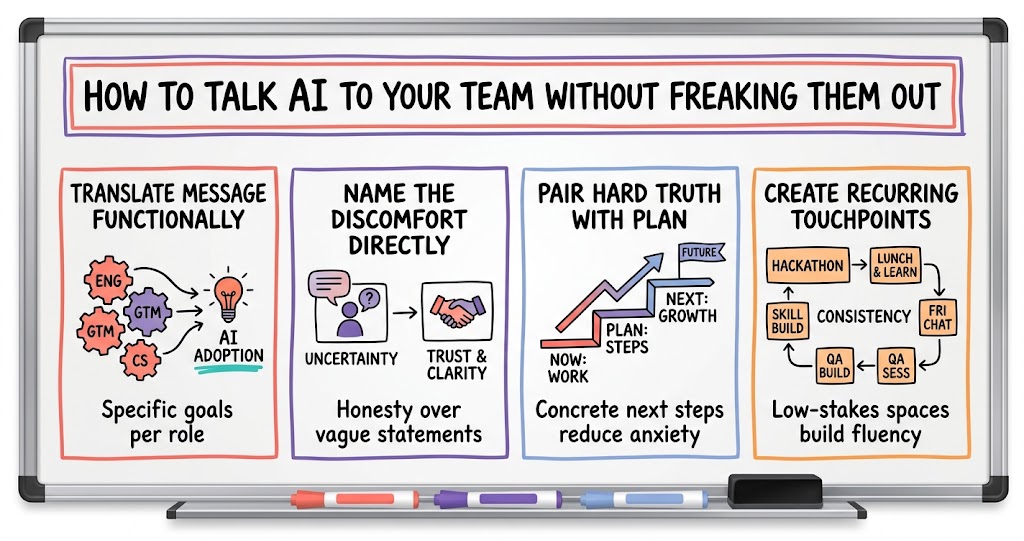
How to Talk AI to Your Team Without Freaking Them Out
Every leadership message about AI seems to boil down to the same uncomfortable truth: more is required of everyone, now. A founder in our mastermind asked how to say that honestly without sending the team into a spiral, and the answers got specific fast.

A founder brought a question to our Enterprise mastermind that a lot of leadership teams are quietly wrestling with right now. However he framed the message about AI transformation to his team, no matter how he dressed it up, the underlying truth kept landing the same way: you should expect to work harder and longer for the next six months or more. He was getting a wide range of reactions back. Some people were energized and bought in. Others were visibly overwhelmed. He wanted to know how other leaders were threading that needle, being honest about what's coming without tipping the team into fear.
The gap between the company-wide message and the individual reality
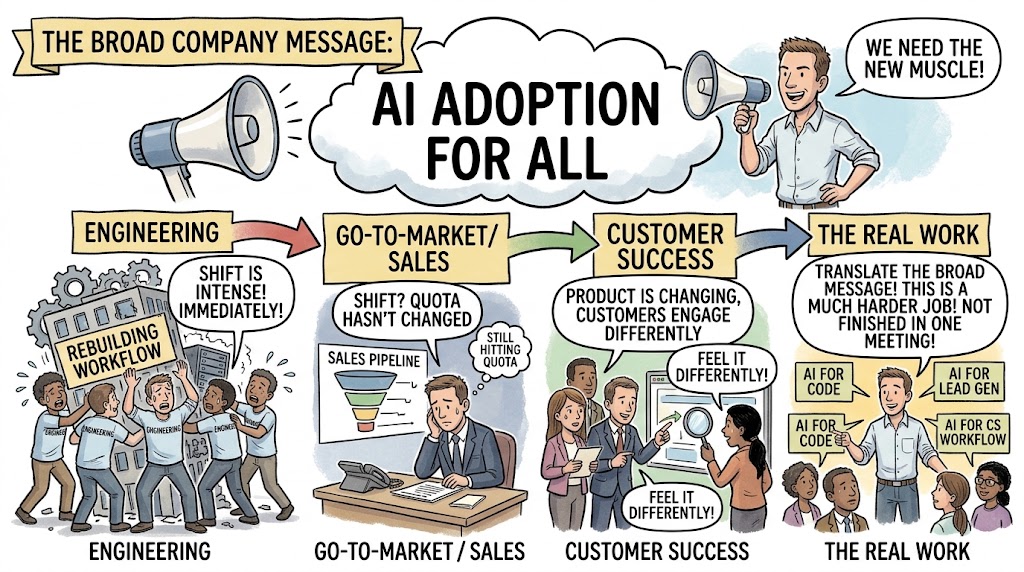
The founder's own diagnosis of the problem was sharp, and it's worth sitting with. At the company level, the message is simple and broad: AI is here, we need to adopt it, and there isn't enough time in a normal week to both keep up with current demands and build the new muscle. That much is true and doesn't change much by department.
- The broad message and the team-by-team reality pull apart fast. Engineering and go-to-market functions often feel the AI shift intensely and immediately. Sales can feel it much less directly. Customer success may feel it differently depending entirely on how the product itself is changing and how customers are engaging with it.
- A single company-wide statement can't capture that variation. Saying "we all need to adopt AI" is true, but it means something completely different to an engineer rebuilding their workflow than it does to a salesperson trying to hit a quota that hasn't changed.
- The real work is translating the broad message into something specific for each function. That's a much harder and more ongoing job than writing one all-hands speech, and it doesn't get finished in a single meeting.
Why a blanket "learn on your own time" message doesn't work
One tension that came up directly is worth naming, because it's a trap a lot of leadership teams fall into. Offering something like a dedicated day each week for learning sounds generous and thoughtful in a leadership meeting. In practice, for anyone carrying a hard quota, that day doesn't actually feel available.
- Incentive structures override stated policy every time. If someone's compensation is tied to hitting a number this month, telling them to take a day off to learn a new tool doesn't change their calculus. They'll protect the number, because that's what they're actually being measured and paid on.
- The message needs to match the incentive, or one of them needs to change. Either build learning time into how people are actually evaluated and rewarded, or be honest that the learning has to happen on the margins, in the gaps, rather than pretending it has a protected block of time it doesn't really have.
- Different roles need this solved differently. A quota-carrying salesperson and a salaried engineer are operating under completely different pressures, and a one-size-fits-all learning policy will feel generous to one and hollow to the other.
What's actually resonating: comfort the person, tell them the truth
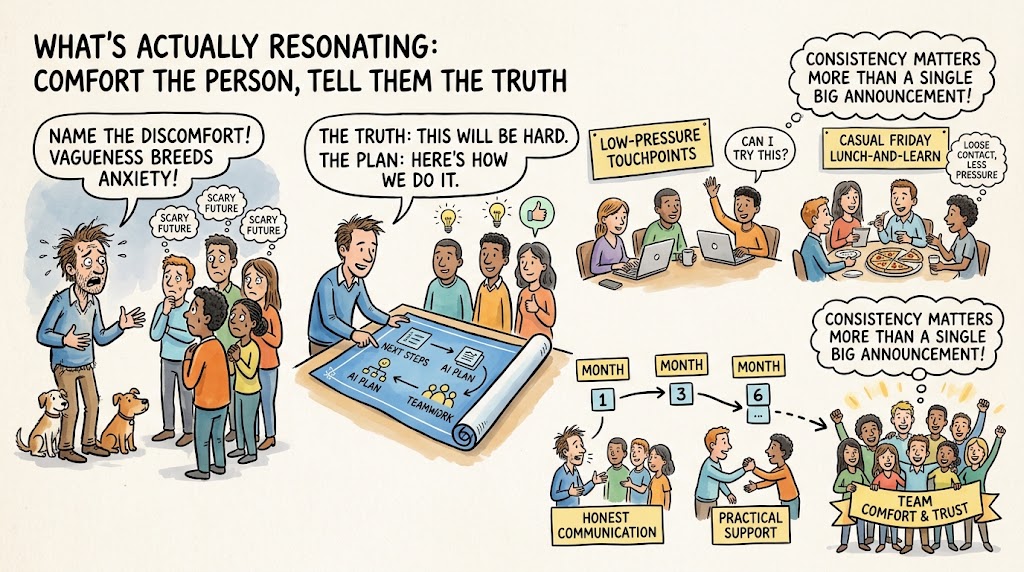
The founder who raised this topic described the emotional core of the challenge clearly: for a lot of people, this genuinely feels scary, especially for those who don't yet understand what's actually changing. The instinct to want to comfort people and the instinct to be honest about the reality can feel like they're pulling in opposite directions, but the founders in the discussion suggested they don't have to.
- Name the discomfort instead of talking around it. People can tell when a leader is being vague to avoid an uncomfortable truth, and that vagueness tends to breed more anxiety than a direct, honest statement would.
- Pair the hard truth with a real, specific plan. "This is going to take more from all of us for a while" lands very differently when it comes with concrete next steps than when it's left as an open-ended, indefinite demand.
- Low-pressure, recurring touchpoints build comfort over time. Regular, informal structures like a monthly hackathon or a casual Friday lunch-and-learn give people permission to explore and ask questions without the pressure of a formal evaluation hanging over the session.
- Consistency matters more than any single big announcement. One all-hands speech about AI transformation won't do the work of changing how a team operates. Repeated, smaller moments of honest communication and practical support do that work over months.
The emotional range in the room is normal, not a red flag
One thing worth normalizing for any leader having this conversation: the wide spread in how people react is expected, not a sign something's going wrong with your rollout. The founder who raised this topic described getting feedback across the full spectrum, some people overwhelmed, others genuinely driven and bought in, often within the same team hearing the exact same message.
- Different people process uncertainty differently. The same honest message about more work ahead will read as exciting to someone who thrives on new challenges and as threatening to someone who values stability and predictability. Both reactions are legitimate.
- Trying to get uniform buy-in from everyone at once is the wrong goal. A more realistic target is moving the whole distribution gradually toward comfort over time, rather than expecting every person to arrive at enthusiasm on the same timeline.
- The overwhelmed reactions deserve as much attention as the enthusiastic ones. It's easy to spend your energy responding to the people who are excited, since that's the more pleasant conversation. The people who are quietly struggling are usually the ones who need more direct, individual follow-up.
Building the muscle without burning people out
The deeper challenge underneath all of this is that adopting AI well isn't just a technology rollout, it's a change management problem, and change management problems don't resolve with a single company-wide email. A few practical patterns emerged from the discussion for founders trying to navigate this without either sugarcoating the demand or burning out their team in the process.
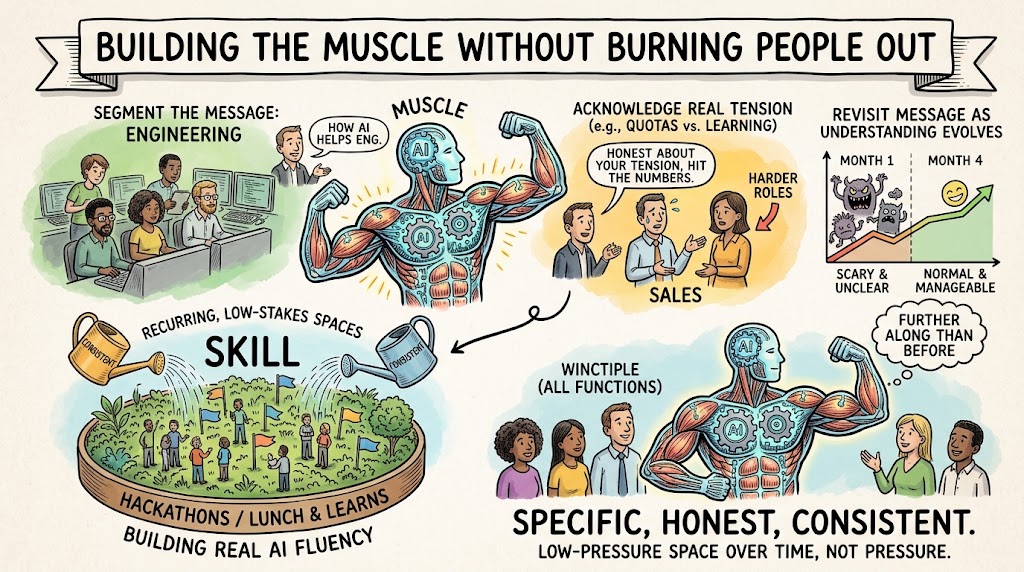
- Segment your message by function, deliberately. Take the time to translate the company-wide AI message into what it specifically means for engineering, for sales, for customer success, rather than relying on one broad statement to do all the work.
- Acknowledge where the ask is genuinely harder for some roles than others. Being honest that a quota-carrying salesperson faces a real tension between learning time and hitting numbers builds more trust than pretending everyone's situation is equally flexible.
- Create recurring, low-stakes spaces to build the new skill. A regular hackathon or lunch-and-learn, done consistently over months, does more to build real AI fluency across a team than a single urgent mandate ever will.
- Revisit the message as the team's understanding evolves. What feels scary and unclear in month one often feels much more normal and manageable by month four, once people have had repeated, low-pressure exposure. Update your messaging to reflect that people are further along than they were.
There's no version of this conversation that removes the underlying truth: adopting AI well, as a team, takes real time and real effort on top of what people are already doing. The thing that actually changes the experience for your team is being specific about what that means for their particular role, honest about the tension it creates with their existing incentives, and consistent about giving them real, low-pressure space to build the skill over time rather than all at once under pressure.
A simple way to check whether your message is landing
It's easy to assume a message has landed just because you delivered it clearly and nobody pushed back in the room. A better test is to watch what actually changes in behavior over the following weeks, not what people say in the meeting where you announced it.
- Are people actually showing up to the low-pressure sessions you created? A hackathon or lunch-and-learn with declining attendance over time is telling you something about whether people feel the space is genuinely safe to use, regardless of what they said when you announced it.
- Are quota-carrying roles quietly opting out? If your sales team consistently skips the learning time you built in, that's a signal the incentive mismatch is still unresolved, not that the team doesn't care about AI.
- Is the anxiety showing up in turnover or disengagement? A team that's overwhelmed rather than energized by an AI transformation message will often show it in subtler ways first, quieter meetings, less initiative, more people keeping their heads down, before it shows up in an exit interview.
- Are people starting to bring you their own ideas? One of the clearest signs the message has actually landed well is when team members start proposing their own uses for AI in their function, rather than waiting to be told what to adopt.
None of these signals require a formal survey or a big initiative to track. They're the kind of thing a leader notices simply by paying attention in the weeks after a big message goes out, and adjusting the approach based on what's actually happening rather than what was said in the room the day it was announced.
This is also, ultimately, a leadership skill that gets better with repetition, not a problem you solve once and move past. The founders furthest along in this transition shared one habit in common: they kept coming back to the conversation, function by function, month after month, adjusting the message as their own understanding of what AI actually meant for each part of the business got sharper, rather than treating one all-hands meeting as the finish line.