
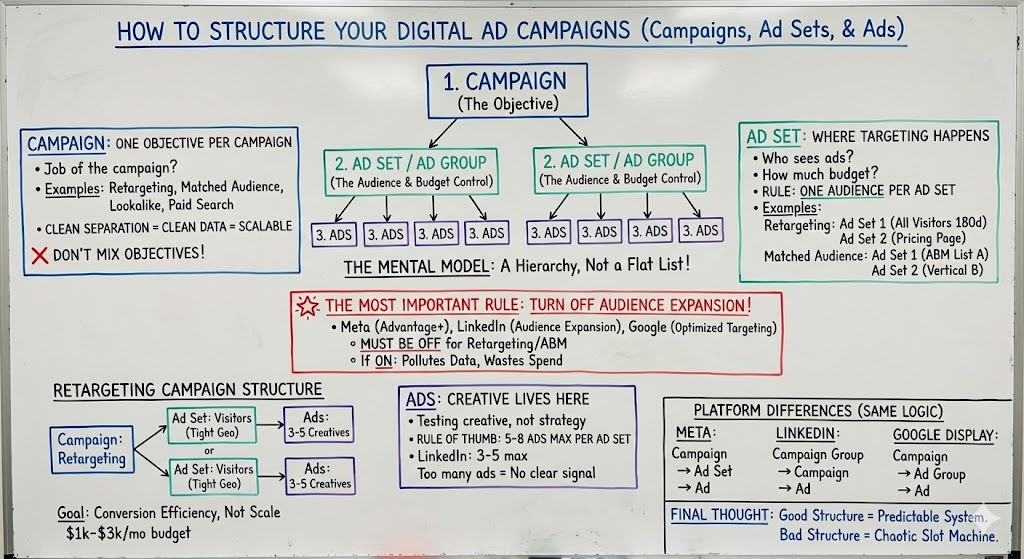
How to Structure Your Digital Ad Campaigns (Campaigns, Ad Sets, & Ads)
One of the biggest mistakes I see SaaS founders make with paid ads isn’t bad creative or weak copy. It’s messy structure.

They launch ads without a clear campaign hierarchy, mix audiences together, let platforms “expand” targeting without realizing it, and then wonder why the data is confusing—or why performance degrades as spend increases.
If you want ads to scale predictably, structure matters just as much as creative.
In this post, I want to break down exactly how we structure digital ad campaigns across Meta, LinkedIn, and Google—pulled straight from how we teach this inside the B2B SaaS Growth Program and how we manage real ad spend every day.
Once you understand this, ads stop feeling chaotic and start feeling like a system.
The Mental Model: Ads Are a Hierarchy, Not a Flat List
Every major ad platform works the same way, even if they use slightly different names.
There are three levels you need to understand:
- Campaign – the objective and intent
- Ad Set (or Ad Group) – the audience and budget control
- Ads – the actual creative being shown
If you get this wrong, the algorithm gets confused and your reporting becomes meaningless.
If you get it right, you can scale calmly and confidently.
.jpg)
Campaigns: One Objective Per Campaign, Always
At the campaign level, the question is simple:
What is the job of this campaign?
Not “who are we targeting?”
Not “what creative are we using?”
Just the objective.
For example:
- Web traffic retargeting
- Matched audience conversions
- Lookalike awareness
- Paid search (brand or non-brand)
Each of these should live in its own campaign.
Why this matters:
When you mix objectives inside one campaign, the platform can’t optimize properly. You end up with blended data and no clear signal about what’s actually working.
Inside the program, we strongly recommend:
- One campaign for retargeting
- One campaign for matched audiences
- One campaign for lookalikes
- One campaign for paid search
.jpg)
Clean separation creates clean data—and clean data is what allows you to scale.
Ad Sets: Where Targeting and Budget Control Actually Happen
If campaigns define intent, ad sets define control.
This is where most people accidentally break their performance.
At the ad set level, you decide:
- Who sees the ads
- How much budget is allocated
- Whether targeting can expand (usually: no)
A simple but powerful rule we use:
One audience per ad set.
For example, in a retargeting campaign you might have:
- One ad set for all website visitors (last 180 days)
- One ad set for blog readers
- One ad set for pricing page visitors
In matched audience campaigns:
- One ad set per ABM list
- Or one ad set per vertical if messaging differs
This structure keeps signals clean and lets you see performance differences clearly.
.jpg)
The Most Important Rule: Turn OFF Audience Expansion
This is critical.
Meta, LinkedIn, and Google all default to expanding your audience beyond what you selected. They call it:
- Advantage+ (Meta)
- Audience Expansion (LinkedIn)
- Optimized Targeting (Google)
For retargeting and matched audience campaigns, this must be OFF.
If it’s on:
- You are no longer retargeting
- You are no longer running true ABM ads
- Your data becomes polluted immediately
Expansion has its place later—but not when you’re trying to measure CPL, CAC, or early performance.
This single setting is responsible for more wasted ad spend than almost anything else we see.
Ads: Creative Lives Here (And Less Is More)
At the ad level, you’re testing creative—not strategy.
The biggest mistake here is adding too many ads to one ad set.
If you’re spending:
- $20–$50 per day
- And you have 15 ads in one ad set
None of them will get enough volume to produce a signal.
Our rule of thumb:
- 5–8 ads max per ad set
- Even fewer on LinkedIn (often 3–5)
If you want to test a new creative “style” (for example, founder videos vs static ads), that usually deserves a separate ad set, not just another ad inside the same one.
This keeps testing intentional instead of random.
Retargeting Campaign Structure (The First One You Should Launch)
Retargeting is where structure matters most, because budgets are small and audiences are finite.
We recommend:
- One retargeting campaign per platform
- One or two ad sets max
- Tight geographic targeting (only your TAM countries)
- No expansion, no off-platform placements
The goal of retargeting isn’t scale—it’s conversion efficiency.
Most B2B SaaS companies only need $1k–$3k per month per platform to make retargeting effective.
.jpg)
Why We Separate Demand Gen and Demand Capture
This is a concept we repeat often because it’s foundational.
Retargeting and paid search are demand capture.
Matched audiences and thought leader ads are demand generation.
They should never live in the same campaign.
If you mix them:
- Reporting becomes meaningless
- Algorithms optimize for the wrong thing
- CPL and CAC calculations break
By separating them structurally, you can:
- Allocate budget intentionally
- Scale the right campaigns
- Know exactly what’s driving pipeline
This is how ads become predictable instead of emotional.
Platform Differences (But the Same Core Logic)
The names change, but the structure doesn’t.
- Meta: Campaign → Ad Set → Ad
- LinkedIn: Campaign Group → Campaign → Ad
- Google Display: Campaign → Ad Group → Ad
The same principles apply everywhere:
- One objective per campaign
- One audience per ad set
- Limited creative per ad set
- Expansion OFF unless intentionally used
Once you internalize this, switching platforms becomes easy.
Final Thought: Structure Is What Lets Ads Scale
Most SaaS teams don’t fail at ads because of bad copy or weak creative.
They fail because:
- Everything is mixed together
- Budgets aren’t controlled cleanly
- Data can’t be trusted
- Decisions are made emotionally instead of analytically
Good structure removes guesswork.
It turns ads into a system you can improve week by week instead of a slot machine you hope pays off.
If you want ads to scale beyond experimentation—this is where it starts.