
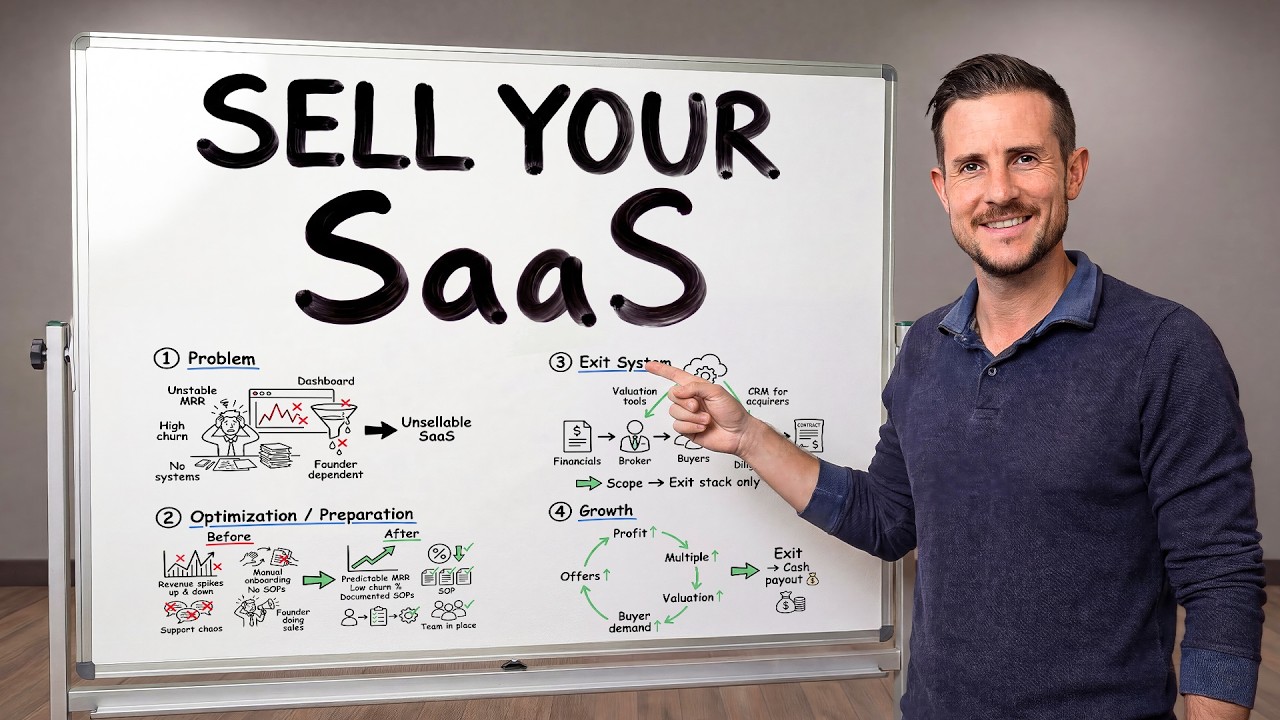
How to Sell Your SaaS (from a Founder with a $169m exit)
What does it really take to sell your SaaS company for a meaningful exit? In this founder-to-founder breakdown, Ryan Allis shares the real lessons behind his $169M exit — from mastering unit economics and profitable acquisition to building a company that runs without you. If you want to build something buyers pay a premium for, this is where to start.

When we sold iContact for $169 million, the exit didn’t begin the year we hired bankers.
It began years earlier — in how we structured growth, how we thought about unit economics, and how we built a company that could run without me.
Most founders think selling a SaaS business is a transaction.
It isn’t.
It’s the result of how you build.
If you want a real exit — not just the idea of one — you need to design the company for durability from the beginning.
Choose the Game You’re Actually Playing
There are two very different types of SaaS companies, and founders often blur the line between them.
One optimizes for lifestyle. The other optimizes for enterprise value.
A lifestyle SaaS business usually focuses on:
- Cash flow
- Freedom
- Stability
- Personal control
An exit-ready SaaS business focuses on:
- Repeatable, scalable growth
- Transferable systems
- Strong unit economics
- Leadership depth beyond the founder
Neither path is wrong.
But they produce very different outcomes.
Buyers don’t pay premiums for founder-dependent hustle. They pay for machines. If revenue slows down the moment you step away, the company isn’t yet an asset — it’s a job.
The earlier you internalize that, the more intentional your build becomes.
.png)
Know the Math Before You Scale
Most SaaS founders don’t stall because they lack effort. They stall because they lack clarity.
And clarity in SaaS comes down to unit economics.
As I’ve said before:
“The biggest mistake SaaS CEOs make is not investing enough in growth once they have achieved product-market fit.”
But you can’t invest aggressively until you understand what a customer is truly worth.
There are four core numbers that matter more than anything else:
- ARPA and ACV
- Account churn
- Lifetime value
- Customer acquisition cost
Once you know LTV, you can determine target CAC. A healthy rule of thumb is to keep CAC around one-sixth of LTV, or roughly half of ACV if you want a six-month payback window.
When that math works, growth stops feeling reckless.
It becomes strategic.
At iContact, we scaled based on those fundamentals.
“We added 216,000 new trial users, 36,000 new customers, and spent $20M on sales and marketing. We generated $50M in sales that year and sold iContact for $169M.”
That wasn’t a marketing trick.
It was disciplined allocation.
Make Paid Acquisition Work — Or Plateau
Founder-led sales can take you to your first million.
Inbound and referrals might take you to three or five.
But if you want to build a company that reaches $30M, $50M, or beyond — and becomes sellable at a strong multiple — you need scalable acquisition.
Here’s the uncomfortable truth:
“The difference between a $5M ARR firm and a $50M ARR firm is making ads work profitably.”
Profitable doesn’t mean positive in theory. It means measurable, repeatable, and expandable.
In SaaS terms, profitable paid acquisition means:
- CAC payback inside 6–12 months
- LTV significantly higher than acquisition cost
- Channel-level visibility into CPL and CAC
- The ability to increase spend without degrading performance
Once you hit that point, growth becomes mechanical.
And mechanical growth is what buyers love.
.png)
Build Omnipresence, Not Just Pipeline
Modern B2B buyers do not convert from a single touch.
They see you multiple times.
They open your email.
They see your ad later.
They notice a LinkedIn post.
They Google your brand.
They watch a short video.
Each touch builds familiarity.
The companies scaling fastest today coordinate three layers:
- AI-personalized outbound email
- LinkedIn connection and content reinforcement
- Matched audience and retargeting ads
This isn’t about being loud. It’s about being consistently visible inside your defined ICP.
When your prospect feels like they “keep seeing you everywhere,” your brand begins to feel established — even if they’ve never spoken to you.
That shortens sales cycles. It reduces friction. It increases trust before the first call.
You’re not pushing harder.
You’re appearing more often.
Install a Real Sales and Success Engine
If your ACV is meaningful, marketing alone is not enough.
You need structure.
By the time we exited iContact, our sales organization included dozens of SDRs, account executives, and account managers. Marketing generated awareness. Sales converted it. Customer success retained and expanded it.
Net Revenue Retention becomes critical at this stage.
Expansion revenue offsets churn. It stabilizes growth. It increases valuation.
Enterprise buyers and acquirers pay attention to durability. If revenue compounds internally through expansion, your company becomes dramatically more attractive.
Optimize Before You Scale
Most founders try to scale budget before tightening the funnel.
That’s backwards.
Small improvements across the funnel have outsized impact.
When you improve:
- Ad click-through rate
- Visitor-to-lead conversion
- Lead-to-close conversion
- Sales cycle efficiency
Your overall CAC drops.
Lower CAC gives you leverage.
It allows you to win more auctions, spend more aggressively, and still maintain payback targets.
Scaling isn’t about increasing spend. It’s about increasing efficiency first.
.png)
Raise Capital Only to Accelerate What Works
Capital does not fix broken fundamentals.
It amplifies functioning ones.
If you have predictable acquisition, healthy payback windows, and a team that executes independently, capital becomes fuel.
If you don’t, it becomes dilution.
The right time to raise is when you can confidently say, “We know how to turn this dollar into two.”
Not when you’re still guessing.
Build for Transferability
Selling your SaaS depends heavily on ARR range, growth quality, and operational maturity.
But ultimately, buyers care about one question:
Does this business run without the founder?
If revenue depends on your personal involvement in every deal, valuation suffers.
If the company operates through systems, teams, and repeatable processes, valuation expands.
That’s why the real work of selling your SaaS isn’t about preparing pitch decks.
It’s about building something that doesn’t rely on you.
As I’ve said many times:
“Know your numbers cold and don’t give up if it doesn’t work on the first try.”
When the math works, growth becomes predictable.
When growth becomes predictable, buyers pay attention.
And when buyers pay attention, exits follow naturally.