
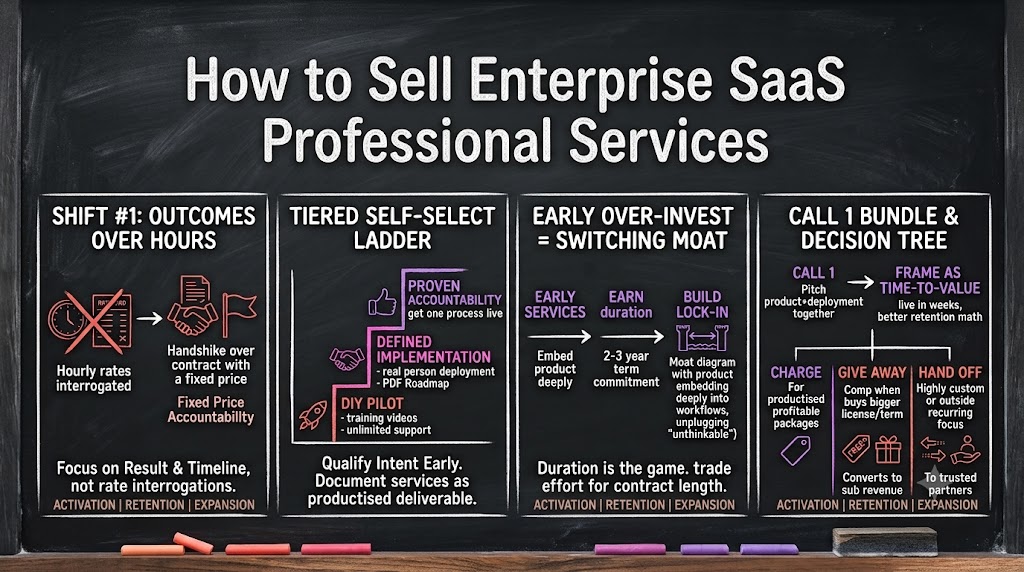
How to Sell Enterprise SaaS Professional Services
Most founders sell professional services the wrong way and end up fearing scope creep and cannibalization. Here's a playbook for selling SaaS services as outcomes, with fixed pricing, self-selecting tiers, and the right moment to give them away.

A lot of SaaS founders are quietly afraid to sell professional services, and the fear tends to take two shapes. The first is cannibalization: if I offer a done-for-you service, will customers who should just buy the software instead pay five times as much for the service, or will the cheaper self-serve option pull people away from the higher-value help they actually need? The second is messiness: services mean hourly billing, scope creep, weekend phone calls, and customers picking apart your rates. Both fears are legitimate, and both come up constantly when founders start figuring out how to attach services to their product. The good news is that the founders who've worked through it have a fairly consistent playbook, and most of the fear comes from selling services the wrong way rather than from selling them at all.
Sell the outcome, not the hours
The single biggest shift is to stop selling services as a rate and start selling them as a result. One founder in our mastermind described how his mid-market deals come together in two or three calls, and the thing the customer keeps saying is, "I need an outcome." They don't care whether the outcome comes from the software or from a person you deploy alongside it. They care that it gets done, on a timeline, at a price they can approve. When he leads with that framing, product plus deployment as a single path to a specific result, it lands. When the conversation drifts into hours and skill sets, it stalls.
Another member put the anti-hourly case more colorfully. He genuinely hates hourly services, because the moment you quote an hourly rate you invite the customer to interrogate it. He described a large enterprise account that wanted to break his engagement down into what he was billing per person and what each person's skill set was, and his answer was that it isn't about the hours or the skill sets, it's about what the work will do for them. His approach now is to build everything into a fixed price. As he said, "it's all fixed price, and the reason it's fixed price is so that you don't have to worry about every time you want to call me, just call me." That reframing takes the whole hourly negotiation off the table and puts the focus back on the result. The pattern that keeps this working:
- Lead with the result. Customers are buying an outcome on a timeline, not a rate card, so frame the whole proposal around what gets done and by when.
- Kill the hourly interrogation. Fixed pricing takes per-person rates and skill-set scrutiny off the table before they can derail the conversation.
- Keep the door open. "Just call me" pricing removes the friction of the customer second-guessing every request, which is what makes the relationship feel like a partnership.
Make your services transparent so customers self-select
One of the cleanest solutions to the cannibalization fear is to stop trying to steer every customer manually and instead build a pricing structure that sorts them for you. A founder in the group walked through his own pricing page, which has clearly defined tiers that let customers self-select based on how much help they actually want. At the entry level, there's a low-cost package for teams running a pilot: they do it themselves, they get free training videos, and they get unlimited support. If someone just wants to kick the tires, that's where they belong, and it protects your services team from getting pulled into low-value work.
Above that sits a defined implementation package, in his case roughly 25 to 40 hours of a real person's time, documented down to a short PDF that spells out exactly what the customer goes through. That's the tier for a customer trying to get one department or one process genuinely live. The structure does the qualifying work in the first or second meeting, because the customer can see the ladder and place themselves on it. The way he framed the value of that transparency was sharp: instead of "you bought the software, now go hope your people find time for training," it becomes "you bought this tier, and it comes with enough services that you can hold us accountable to get your first process live and see proof." Services sold as accountability for the outcome are a much easier yes than services sold as an add-on cost.
A few principles make self-selection work:
- Anchor tiers to intent, not just seat count. A pilot buyer, a single-department deployment, and a multi-department rollout are three different jobs. Name them clearly so customers recognize which one they are.
- Document the service as a real deliverable. Getting the implementation package down to a two-page description of the process removes ambiguity and makes it feel like a product, not an open-ended engagement.
- Steer the wrong-fit buyers away early. The same transparency lets you tell a customer who doesn't fit to go use a simpler, cheaper tool. Losing a bad-fit deal in the first meeting is a win, not a loss.
Fixed price, and use it to buy a longer contract
Once you're selling outcomes in packages, fixed pricing becomes the natural structure, and it opens up a genuinely clever move. One founder frames his deployment work as deliberately over-investing at the front of the subscription. He tells the customer, in effect, we are going to put in more than we get paid for at the beginning to make sure this works, and in exchange we want a three-year commitment instead of two, or two instead of one. The heavy early services are the reason he earns the longer term, and the longer term is what makes the whole account profitable. The customer gets a locked-in price and a partner who's clearly motivated to make the deployment succeed. He gets duration, which in subscription businesses is most of the game.
This is the same logic behind the forward deployed engineer model that companies like Palantir made famous. You deploy people close to cost early, not to make money on the labor, but to wire the product so deeply into the customer's operations that leaving becomes unthinkable. One member described the goal plainly as building a switching lock-in moat: by the time renewal comes around, the customer looks at the prospect of unplugging everything and rebuilding it elsewhere, along with all the institutional knowledge that would walk out the door, and decides to stay. The mechanics come down to three moves:
- Over-invest early, on purpose. Front-load the delivery so the product becomes genuinely embedded, not just installed.
- Trade that investment for term. Use the early over-delivery to justify a two- or three-year commitment instead of a one-year deal.
- Build the switching moat. By renewal, the cost and risk of unplugging and rebuilding elsewhere is what keeps the customer in place.
Bundle services into the very first conversation
A common failure mode is treating services as a second sale that happens after the software sale. One founder described losing deals precisely because product and services came up separately: he'd need two or three calls to get to a combined proposal, and some prospects dropped off in between, peeling away to a growth partner who could deploy the product for them. His conclusion was that he needed to initiate the product-plus-services conversation on the very first call, so the customer never has to go looking elsewhere for the deployment piece. If your buyer needs an outcome and you make them assemble it from two separate purchases on two separate timelines, you've given a competitor room to hand them the whole thing in one.
The framing that makes bundling honest rather than pushy is time-to-value. You're not upselling services for the sake of it. You're competing against how long it takes the customer to get value, whether they use your product or anyone else's. So the pitch becomes: here's the software, and here's the deployment tier that gets you live and integrated in weeks instead of months. That's a real difference customers feel, and the retention math supports it, since customers who hit first value fast retain dramatically better than those who stall out in the first month. To put that into practice:
- Raise it on call one. Don't split product and services into two sales on two timelines, because the gap is where prospects wander off to someone else.
- Frame it as time-to-value. You're competing on how fast the customer gets value, not only on features, so make the deployment tier the answer to that.
- Close the gap a partner would fill. If you don't offer to deploy the product, a growth partner will happily step in and own that relationship.
Know when to charge, when to give it away, and when to hand it off
Not every services dollar should be maximized, and some of the best operators deliberately zero services out. One founder said that whenever possible he tries to charge nothing for the implementation services, or he folds them into a bigger commitment: sign the multi-year deal, or order 300 seats instead of 200, and we'll throw the deployment in. The revenue lands in the same place, but now it's clean subscription revenue instead of low-margin services revenue, which is worth more to him today and to any future buyer. When services do need a price, keeping them profitable matters, but not so aggressively priced that they force discounts on the software or turn every renewal into a line-item fight. Healthy services margins tend to run in the 15 to 25 percent range, and the point of the services was never the margin anyway. It was the retention.
Here's a simple way to think about the three options for any given piece of services work:
- Charge for it when it's productized and profitable. Well-defined packages with predictable delivery can carry a real price, especially when the value to the customer far exceeds the hours involved.
- Give it away when it buys something bigger. Zeroing out services in exchange for a longer term or a larger license order converts low-multiple services revenue into high-multiple subscription revenue.
- Hand it off when it's truly custom and outside your model. A trusted consulting partner can carry non-standard work, sometimes paying you a fee or sending deals back, so you stay focused on recurring revenue. Just protect quality, because a bad partner experience becomes your problem at renewal.
One more structural tool worth keeping in your back pocket for the heavier, ongoing services work: some founders convert enterprise services into prepaid buckets, selling blocks of time as tokens the customer draws down, which brings predictability to something that would otherwise sprawl. And if services ever grow large enough to distort the company, a separate small entity with its own P&L owner can house them, so the software business keeps its clean margins and its clean story for an eventual acquirer.
The through-line
Selling enterprise SaaS professional services well comes down to a handful of consistent choices. Lead with the outcome, not the hourly rate. Package the work and price it fixed, so customers can hold you accountable to a result instead of auditing your timesheets. Build a tiered structure that lets buyers self-select and steers the wrong ones away early. Bring services into the first conversation so no one has to assemble the outcome from pieces. And stay clear-eyed about which services to charge for, which to give away in exchange for a bigger or longer software commitment, and which to hand to a partner. Do that, and services stop feeling like a distraction and start doing what they're for: getting customers to value fast and keeping them there.