
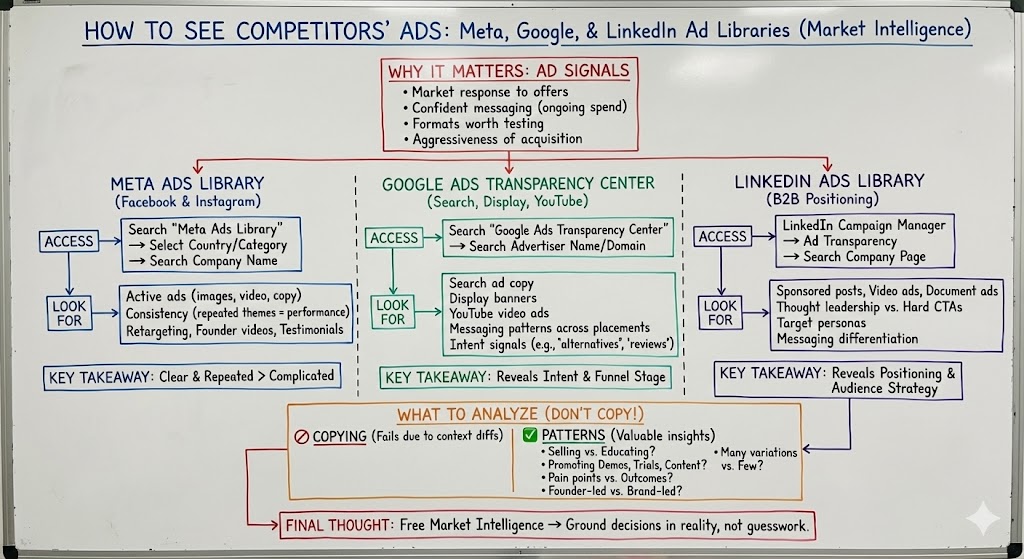
How to See Your Competitors' Ads with Meta Ads Library, Google Ads Library, and LinkedIn Ads Library
One of the biggest advantages B2B SaaS founders have today is transparency.Ten years ago, if a competitor was running ads, you had to guess. You might notice something scroll by in your feed, maybe screenshot it, and try to reverse-engineer what they were doing.Today, you don’t have to guess at all.

Meta, Google, and LinkedIn all make competitors’ ads publicly visible. If you’re not using these ad libraries regularly, you’re leaving free market intelligence on the table.
This post walks through how to use each ad library, what to actually look for, and how to turn competitor ads into insight — not blind imitation — exactly as we teach it inside the B2B SaaS Growth Program.
Why Competitor Ad Transparency Is So Valuable
Before getting tactical, it’s important to understand why this matters.
Ads that don’t work get turned off quickly. Ads that stay live for weeks or months usually hit acceptable CTRs, CPLs, or downstream conversion metrics. In other words, competitor ads are signals.
They show you:
- What offers the market is responding to
- What messaging companies are confident enough to keep spending on
- Which formats are worth testing first
- How aggressive competitors are being with paid acquisition
You’re not spying. You’re observing how the market is voting with dollars.
How to Use the Meta Ads Library (Facebook & Instagram)
Meta’s Ads Library is the easiest place to start and the one we use most often.
You can access it by searching “Meta Ads Library,” selecting your country, and choosing the appropriate ad category. From there, simply search for a company name.
If that company is running ads, you’ll see every active ad they’re running across Facebook and Instagram — images, videos, headlines, copy, and often multiple variations.
What we pay attention to is not just what the ad says, but how consistently it’s being run. When you see similar creative themes repeated across multiple ads, that’s a strong sign those ads are performing well enough to justify ongoing spend.
Meta’s library is especially helpful for understanding:
- Retargeting ads
- Founder video ads
- Testimonial and social proof formats
- Visual styles designed to stop the scroll
.jpg)
This is often where founders realize that effective ads don’t have to be complicated — they just have to be clear and repeated.
How to Use the Google Ads Transparency Center
Google’s Ads Transparency Center is slightly different, but just as valuable.
Instead of focusing on social feeds, Google shows ads running across Search, Display, and YouTube. You can search by advertiser name or by domain, which is especially useful when a company’s product name differs from its brand name.
You won’t see keyword-level data, but you will see:
- Search ad copy
- Display banners
- YouTube video ads
- Messaging patterns across placements
What Google’s library really tells you is intent. If you see competitors running lots of ads around “alternatives,” “reviews,” or category-level keywords, that’s a clear signal about where buyers are actively searching and comparing options.
.jpg)
Google ads are less about creative inspiration and more about understanding where in the funnel competitors are investing.
How to Use the LinkedIn Ads Library
LinkedIn’s Ads Library is a bit more hidden, but it’s extremely useful for B2B.
You access it through LinkedIn Campaign Manager by navigating to ad transparency and searching for a company page. From there, you can see sponsored posts, video ads, and document ads that company is currently running.
Because LinkedIn ads are expensive, their presence alone is meaningful. If a company is consistently running LinkedIn ads, they almost certainly believe those ads are contributing to pipeline — even if the CPL looks high on the surface.
On LinkedIn, we look closely at:
- Thought leadership posts being boosted
- Educational content versus hard CTAs
- Which personas the ads are written for
- How LinkedIn messaging differs from Meta or Google
[Insert Slide #560 from Program Slides here]
LinkedIn ads often reveal positioning and audience strategy more than raw performance.
What to Analyze (Instead of Copying)
This is where many founders go wrong.
The goal is not to copy a competitor’s ad word for word. That usually fails because your brand, audience, pricing, and context are different.
Instead, we look for patterns.
When reviewing competitor ads, ask yourself:
- Are they selling directly, or educating first?
- Are they promoting demos, trials, or content?
- Are they speaking to pain points or outcomes?
- Are ads founder-led or brand-led?
- Are they running many variations or just a few?
Patterns across many ads are far more valuable than any single headline.
How This Fits Into Your Own Ad Strategy
Competitor ad libraries are best used as validation, not direction.
If you already believe founder video ads might work, seeing competitors run them confirms it’s worth testing. If you’re unsure whether to promote content or demos, libraries help you understand how others structure their funnel.
Inside the program, we encourage founders to:
- Review competitor ads before creating new creative
- Use libraries to generate testing ideas
- Avoid reinventing the wheel unnecessarily
- Focus on structure and consistency over cleverness
Ads don’t win because they’re unique. They win because they’re clear and persistent.
One Important Reality Check
Not every ad you see is wildly profitable.
Some ads exist for awareness. Some support retargeting. Some are designed to reinforce outbound or matched audience campaigns rather than drive immediate conversions.
That’s why you shouldn’t assume performance — but you should assume intent. If a company keeps spending money to show a message repeatedly, it matters to their strategy.
Final Thought: This Is Free Market Intelligence — Use It
Founders routinely spend thousands on consultants to answer questions they could answer themselves in half an hour with an ad library.
You can see:
- What offers competitors believe in
- How they position their product
- Where they’re spending attention and budget
- How aggressive their go-to-market motion is
And it’s all public.
If you’re running ads — or thinking about it — reviewing competitor ads should be a regular habit. Not to copy, but to ground your decisions in reality instead of guesswork.
That alone will make you a sharper marketer.