
How to Scale SaaS Customer Acquisiton With Paid Ads (353% Increase)
A practical founder-focused guide to building a SaaS company that can scale predictably and become exit-ready. This post breaks down the systems, metrics, and growth strategies behind a $100M+ SaaS outcome, from unit economics and paid acquisition to outbound, leadership, and reducing founder dependence.

Most SaaS founders do not lose because they are lazy. They lose because they build a company for one outcome while quietly hoping for another.
They say they want a meaningful exit. They say they want a business that compounds in value. But then they build something that depends on founder heroics, inconsistent lead flow, loose economics, and a growth model that works only when the founder is personally pushing every deal forward. That is not an exit-ready company. That is a stressful job with software wrapped around it.
As Ryan Allis puts it, “The founders who get there tend to do a few things really well: they build real revenue before chasing capital, they treat unit economics like oxygen, they make outbound a core muscle, and they build a company that doesn’t require the founder to be the glue holding everything together.”
That line gets to the heart of it. A $100M+ SaaS exit usually does not come from one clever growth hack. It comes from building a machine that a buyer trusts. Buyers pay premiums for durability. They pay for predictable acquisition, healthy retention, strong margins, and a company that keeps working when the founder steps away.
Ryan says it in a way I think every founder should internalize: “Your job becomes build a machine, not be the machine.”
That is the shift.
Start by deciding what game you’re playing
This sounds philosophical, but it is actually operational. If you want a calm, profitable company that throws off cash and funds a great life, that is a good business. If you want a premium exit, you are building for transferability. Those are not always the same thing.
An exit-ready SaaS company is designed to be owned by someone else. That means the revenue engine cannot live inside your personality, your inbox, or your calendar. It has to live inside systems, channels, metrics, and leaders. The business has to keep producing pipeline, closing customers, and retaining revenue without constant founder rescue.
This is also why Ryan consistently pushes founders to stop relying on vague growth ambition and start building around concrete economics. In the SaasRise framework, the order matters: first understand your unit economics, then build repeatable acquisition, then scale the channels that stay within target CAC.
Bootstrap early, because leverage matters
One of the smartest ideas in the transcript is also one of the simplest: bootstrap early, not forever. The point is not that outside capital is bad. The point is that capital works best when it accelerates something already working.
Ryan’s guidance is practical. A strong early milestone is reaching roughly $500K ARR before even considering a raise, and in the iContact path the company stayed bootstrapped until it reached about $1M ARR. That matters because it changes the posture of the conversation. You are not raising because you need to survive. You are raising because you have found something repeatable and want to move faster.
That posture preserves leverage. It helps you keep more ownership, make better decisions, and avoid building your whole company around investor pressure before your growth engine is really ready. In Ryan’s words, “Raise to scale what works, not to discover what works.”
That one sentence can save founders years of pain.
The real foundation is unit economics
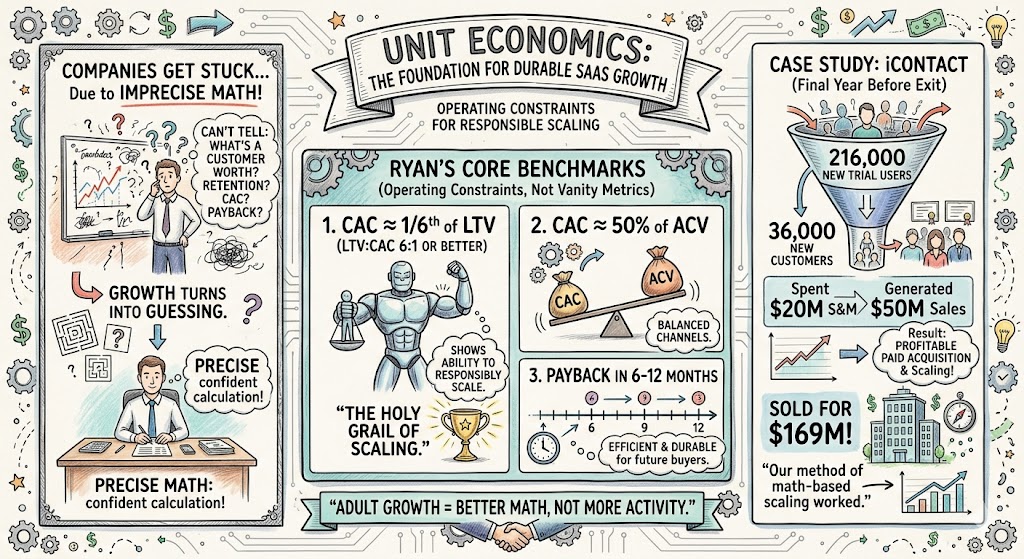
A surprising number of SaaS companies get stuck not because demand is impossible, but because they never get precise about the math. They cannot tell you with confidence what a customer is worth, how long that customer stays, what they can afford to spend to acquire one, or how quickly their sales and marketing spend pays back. Once that happens, growth turns into guessing.
Ryan’s framework keeps coming back to a few core benchmarks:
- CAC around one-sixth of LTV
- CAC roughly 50% of ACV
- Payback in the 6 to 12 month range, depending on cash position and business model
Those are not vanity metrics. They are operating constraints. They tell you whether you can responsibly scale, whether your channels are healthy, and whether a future buyer will view your business as efficient and durable.
One of Ryan’s clearest lines on this is: “Profitable paid customer acquisition where LTV:CAC is 6:1 or better is the holy grail of scaling.”
That is what adult growth looks like. Not more activity. Better math.
And the upside is not theoretical. Ryan shares that in iContact’s final year before exit, the company added 216,000 new trial users, 36,000 new customers, spent $20M on sales and marketing, generated $50M in sales, and sold for $169M. His conclusion is direct: “Our method of math-based scaling worked.”
Paid acquisition is often the bridge from traction to scale
A lot of SaaS businesses get from zero to early traction through founder-led sales, referrals, organic distribution, and sheer force of will. That can get you to real revenue. It rarely gets you to a large, transferable company by itself.
The reason is straightforward. Eventually you need a growth engine that is less dependent on luck and more dependent on repeatability. Paid acquisition, when tied tightly to unit economics, is often what makes that possible. The transcript frames paid as the unlock from “we can grow” to “we can grow predictably.”
The SaasRise system is disciplined about how to do this. You start with a test budget, track CPL and CAC by channel and ad type, optimize the funnel, and only then scale the channels that stay inside your target economics. Their materials recommend starting with modest test budgets, spending enough to gather statistically useful results, and increasing spend only when CPL and CAC are proving out.
Ryan is unusually blunt about why this matters. “The biggest mistake SaaS CEOs make is not investing enough in growth once they have achieved product market fit. If you’re getting your upfront S&M costs paid back in less than a year of revenue, as long as your account churn is low enough, it’s time to put more gas in the engine and put the pedal down.”
That is not reckless advice. It is what happens when growth is governed by real payback math instead of fear.
Outbound is not optional if you want predictable pipeline
Another theme that comes through clearly in the audio is that too many SaaS companies avoid outbound for too long. They build a solid product, post a little content, hope inbound will eventually show up, and then wonder why growth feels random.
Outbound fixes that because it lets you create demand instead of waiting for it.
But this only works when outbound is treated as a system, not a batch-and-blast tactic. The system SaasRise teaches is built around a real ABM list, verified and enriched data, warmed sending infrastructure, short value-driven sequences, AI-assisted personalization, LinkedIn follow-up, and matched audience ads that reinforce the same market across channels.
That architecture matters. One inbox for roughly every 30 cold emails per day. Warm-up periods of two to three weeks. Campaign slow ramp inside Instantly. AI-personalized subject lines and openers. Clickers moving into LinkedIn connection flows through HeyReach. Retargeting and matched audience ads keeping the brand visible after the first touch.
This is why Ryan keeps pushing founders to think in terms of omnipresence. The goal is not just to send an email. The goal is to become familiar enough inside your ICP that when buying intent appears, your brand already feels known. The program materials describe this as exposing your entire ICP to your messaging at least 10 times per month through email and advertising impressions.
Once you understand that, outbound stops feeling like a side tactic and starts looking like infrastructure.
Content is not a side project either
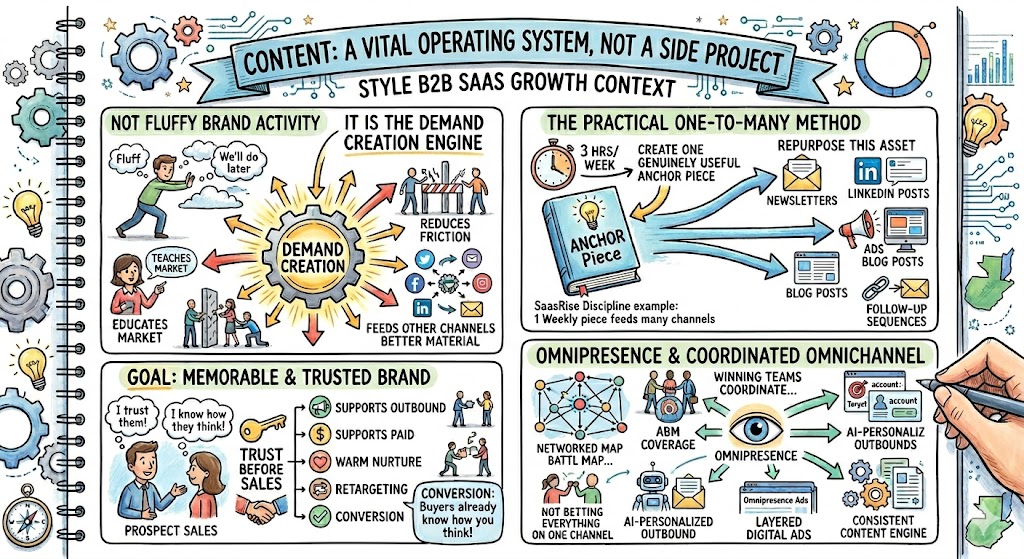
One of the most useful parts of Ryan’s teaching is that he does not treat content as some fluffy brand activity you get to later. In this system, content is demand creation. It educates the market, reduces friction, and gives every other channel better material to distribute.
The recommendation is refreshingly practical. Spend around three hours a week creating one genuinely useful anchor piece of content. Then repurpose that asset into newsletters, LinkedIn posts, ads, blog posts, and follow-up sequences. SaasRise’s own content machine is built around that discipline, with one strong weekly piece feeding multiple channels.
Ryan’s point here is not to become a media company. It is to make your brand memorable and useful enough that prospects trust you before the sales conversation. The content engine supports outbound. It supports paid. It supports warm nurture. It supports retargeting. And it supports conversion because buyers feel like they already know how you think.
This is especially important in 2026-style B2B SaaS growth, where the winning teams are not betting everything on one channel. They are coordinating ABM coverage, AI-personalized outbound, layered digital ads, and a consistent content engine to create omnipresence inside their market.
The company has to work without founder heroics
This may be the most important lesson in the entire transcript.
A lot of founders say they want an exit, but they are still functioning like the operating system. Every major sale needs their credibility. Every major customer problem needs their intervention. Every strategic decision bottlenecks at their desk. That might create short-term momentum, but buyers discount it heavily.
The transcript makes the gut-check plain. If you disappeared for 30 days, would the company still hit numbers? Do systems run, or does everyone still ask you for everything? Is growth owned by a team, or by your adrenaline?
That is why Ryan emphasizes hiring real leaders as the company scales. A strong Head of Sales. A marketing leader. Finance talent. Defined systems. Clear metrics. The goal is to make the business transferable. Buyers pay more for a company that runs on process and leadership depth than one that depends on founder rescue.
The mistakes that quietly kill big outcomes
There are two especially common mistakes Ryan calls out, and both are worth taking seriously.
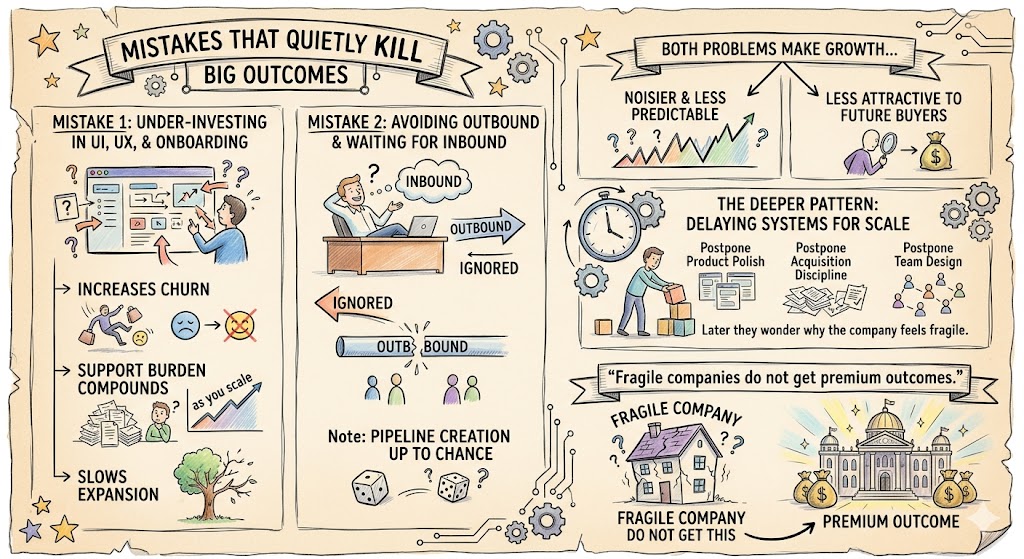
- Under-investing in UI, UX, and onboarding
- Avoiding outbound and waiting for inbound to magically appear
The first one increases churn, slows expansion, and creates support burden that compounds as you scale. The second one leaves pipeline creation up to chance. Both problems make growth noisier, less predictable, and less attractive to a future buyer.
There is a deeper pattern underneath both mistakes. Founders delay building the systems that make scale possible. They postpone product polish. They postpone acquisition discipline. They postpone team design. Then later they wonder why the company feels fragile.
Fragile companies do not get premium outcomes.
Exit prep starts earlier than most founders think
A real exit is not just a number on a dashboard. It is a process.
The transcript suggests that serious exit preparation usually starts once a company reaches about $3M to $5M ARR. At that point, the work is not only about growing faster. It is about tightening reporting, reducing founder dependence, and running a professional sale process with experienced M&A help so you maximize not just price, but terms and competitive tension.
This is where the earlier work pays off. If your customer acquisition is efficient, your growth engine is repeatable, your churn is healthy, your content and outbound systems are mature, and your leadership team can operate without you in the center of everything, the company feels acquirable. It feels safe. It feels like an asset, not a project.
And that is what buyers reward.
Ryan sums up the whole arc well: “If you do the basics extremely well, for long enough, a $100M+ SaaS exit stops being a dream and starts looking like the natural result of the way you built the company.”
That is the real message in this audio.
Not that giant outcomes are easy. Not that you can force them on a schedule. But that they become far more likely when you stop chasing isolated tactics and start building the kind of company someone else would confidently want to own.
If you want, I can turn this into a polished Google-doc style version with a stronger SEO headline and meta description next.