
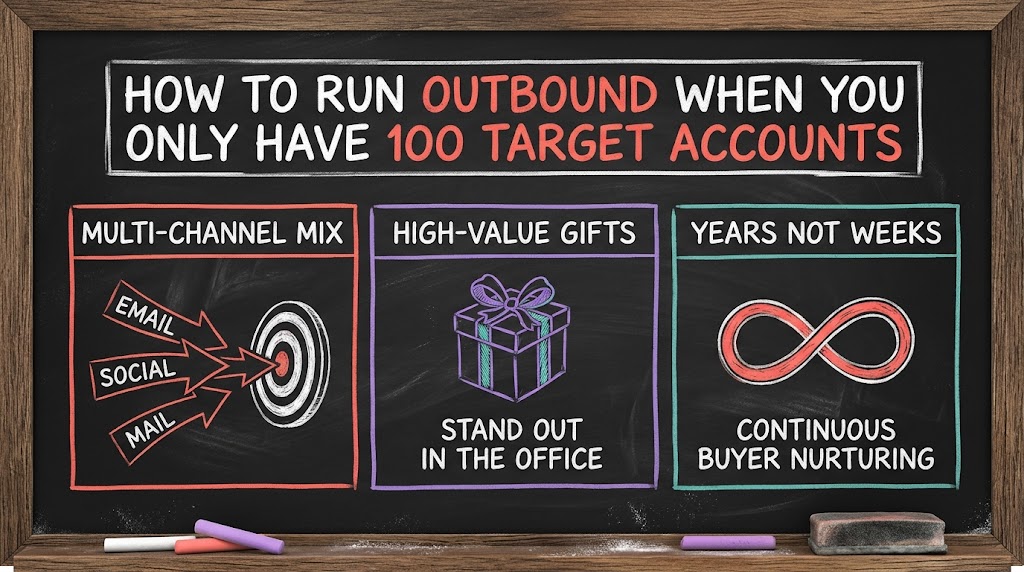
How to Run Outbound When You Only Have 100 Target Accounts
When your whole market is a hundred enterprise accounts, every email is a bet you can't afford to lose. Here's how to build a patient, multi-channel outbound program that earns attention instead of burning your list.

Most outbound advice is written for founders with a big addressable market. Send a few thousand emails, measure reply rates, tweak the copy, repeat. That math works when you have tens of thousands of possible buyers. It falls apart completely when your product sells for six or seven figures a year and there are only about a hundred companies in the world that could ever buy it.
A founder in our enterprise mastermind brought exactly this situation to the group recently. They sell an enterprise platform to some of the biggest brands in their industry, the contracts are very large, the ICP is tightly defined, and they finally had a target list and were ready to launch their first real outbound push. The question was simple: what should that first salvo look like, and what cadence makes sense? The answers from the room were some of the most practical I've heard on enterprise go-to-market, so I want to walk through them here.
Start by doing the math on how few people you can reach
The first thing I asked was how many accounts they were going after and how many people at each account mattered. The answer was roughly 100 accounts, with maybe 10 to 20 relevant people inside each one. That gives you a universe of a couple thousand contacts total. As I put it to the group, that's "a universe of a couple thousand people that you really can't burn." If you blast them with a generic sequence and get marked as spam, you don't get a second shot at that account for a long time, and you may have just lost a deal worth more than your entire marketing budget.
- Count your universe first. Multiply target accounts by relevant contacts per account. If the total is in the low thousands, you're running account-based marketing, whether you call it that or not.
- Price the value of a meeting. When a single account could be worth hundreds of thousands a year, getting the right buyer on a qualified call might be worth $5,000 to $10,000 to you. Budget your outreach like that's true.
- Assume a multi-year campaign. With a list this small, you're building relationships over years. A three-week sequence and a shrug is the wrong mental model.
Once you see the numbers that way, a lot of decisions get easier. You stop asking how to squeeze more volume out of email and start asking how to make every single touch count.

Treat email as one channel, never the whole plan
My strongest advice was that with super high ACVs, email is just one channel. It's a complementary channel, and it should never be the only one. I'd broaden the frame to think about how email fits into your overall account marketing strategy. That strategy should include things that would never make sense at volume but make total sense when you only have a hundred targets. One of the easiest wins right now is custom landing pages. With Claude, you could build a custom-designed landing page with tailored messaging for all 100 accounts in about four to six hours of work: pull in their logo, research recent news about the company, reference the key people, and speak to the specific problem you think they have.
- Build a page for every account. A personalized landing page per target used to be an agency project. With AI it's an afternoon, and it signals that you did the homework.
- Use LinkedIn for short, human notes. Another member shared that very short LinkedIn messages from the CEO, naming a relevant customer and asking for a quick chat, cut through and got real conversations going even when the deal didn't close right away.
- Reinforce the same resources everywhere. Share your content by email, then re-share it on LinkedIn in case the email got lost. Every channel you're allowed to use should be pointing the same buyer to the same useful material.
- Consider webinars as a hook. One founder is testing invite-only sessions built around a question every senior buyer is wrestling with, then using the first few minutes to earn the next fifteen.
The common thread is that each channel does a different job. Email carries depth, LinkedIn carries familiarity, landing pages carry personalization, and events carry live conversation. Together they make your company feel present in the account without any single touch being pushy.
Physical mail and gifting still get attention
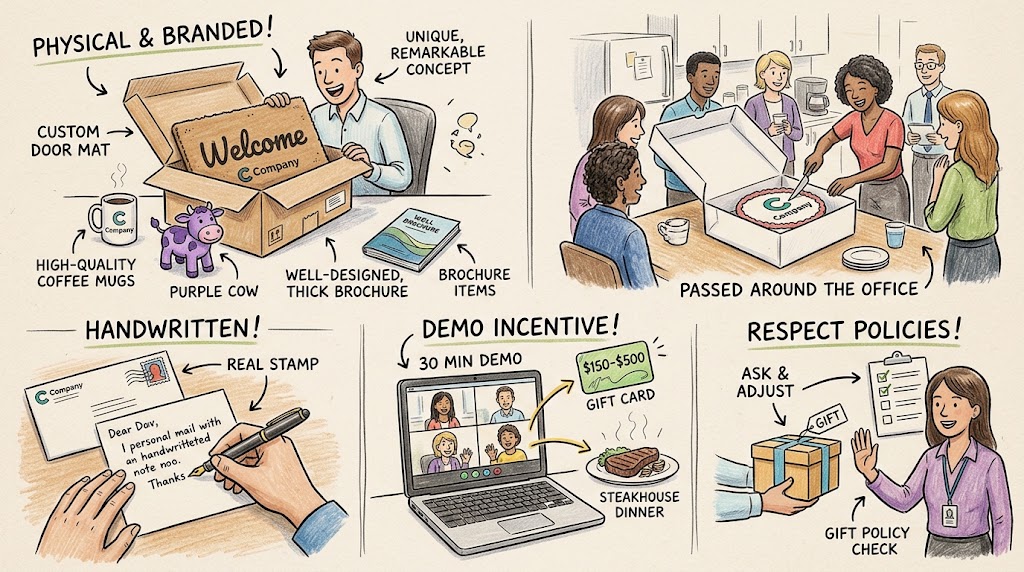
I pushed the group to think about the Seth Godin purple cow idea. How do you mail something physical to their home or office that gets your brand in front of them and is actually useful? If you're willing to put $50,000 or $100,000 behind a list of 100 accounts, that's a meaningful budget per account. It could be a well-printed brochure, a genuinely nice mug, or something more memorable like a custom office welcome mat with their logo. In San Francisco, one practice that's come up in our group before is mailing large cakes with the prospect's logo on them. If you're trying to land a deal worth hundreds of thousands a year, spending a couple hundred dollars on a cake that gets passed around the office is cheap.
- Make it physical and branded to them. Something with their logo, sent to their office or home, gets noticed in a way an email never will.
- Try handwritten notes. A member who runs outbound for a living said handwritten messages to prospects have worked well for high-ACV deals.
- Consider a demo incentive. For a legitimate buyer who takes a real 30-minute demo, an incentive somewhere between $150 and $500, such as a gift card or a steakhouse dinner, can be worth it.
- Respect gifting policies. Some large companies don't allow gifts above a small amount. Ask, adjust, and keep it modest where you need to.
That last point came up right away, and it's a fair concern. Some HR directors and CTOs are happy to receive a $300 gift card. Other companies won't allow it at all. So treat gifting as a tool you calibrate per account, and always pair it with the second half of the equation: once you have authentic attention from the right person, your message has to be useful, relevant, and valuable.
Write for replies, not clicks
Here's something that has changed in my own outreach. What I taught in 2025 is different from what I'm teaching in the second half of 2026. I've been getting better deliverability by going for the reply route instead of the click route, because too many of the clicks were fake. Security scanners and bots click links, which inflates your numbers and can hurt your sender reputation at the same time. A reply is a real human signal, and it's the start of an actual conversation.
- Never lead with a pitch. "Here's what we do, take a demo" reads as short-term and salesy. It burns attention you can't get back.
- Show your research. Open with what you know about them, name the specific pain you solve, and ask whether they have that problem.
- Offer resources, then ask for a reply. Point to a video or webinar that might help, then simply ask them to reply and let you know.
- Go long on content when it's earned. One member sends one or two long, content-heavy emails a month to their market, packed with free resources, so every send feels like value instead of a nudge.
The goal of each email is to create a conversation. If the message is something a smart buyer would forward to a colleague because it's helpful, you're on the right track.
Keep volume low and the infrastructure simple
Because your list is so small, you don't need a big sending setup. I'd start slow, around 30 to 40 emails a day, and ramp from there. If you're only doing 50 to 200 emails a day, you can send from a separate inbox on your own domain pretty safely. It's only when you get above roughly 10,000 emails a month that you need to set up a completely separate infrastructure with secondary domains.
One member added a useful nuance. If you send from your primary domain, keep the emails text-only and leave out links, and cap volume at around 15 emails per inbox per day. That keeps your main domain healthy, which matters a lot when the same domain carries your sales conversations and your customer email.
There was also a healthy debate in the room about calendar invites as an outreach tactic. One founder has seen people show up to cold calendar invites tied to a strong hook, and they send them from a third party so the risk doesn't land on their own brand. Another member was firmly against it for high-ACV deals, pointing out that many senior people hate uninvited invites and you can't afford to annoy anyone on a list this short. I lean toward caution here. When your whole market is a hundred accounts, the downside of irritating a buyer is bigger than the upside of one extra meeting.

Think of outbound as something that never stops
The last idea I'd leave you with is a mindset shift. Think of outbound as something that's never going to stop. It's ongoing nurturing, and it shouldn't come across as a campaign with a start and end date. You're going to be in these accounts for years. People change roles, budgets open and close, and the buyer who ignored you this year might be the champion who brings you in next year.
- Plan in years, not weeks. Map out a cadence of useful touches across email, LinkedIn, mail, and events for the long haul.
- Give your small team structure. Even with three or four people doing sales, a shared account list, a clear cadence, and simple controls keep everyone from stepping on each other.
- Measure conversations, not sends. Replies, meetings, and multi-threaded relationships inside an account are the numbers that matter.
When you only have 100 accounts, patience and craft beat volume every time. Build something those buyers would be glad to receive, put it in front of them through every channel you can, and keep showing up. The founders who win these markets are usually the ones who stayed thoughtful the longest.