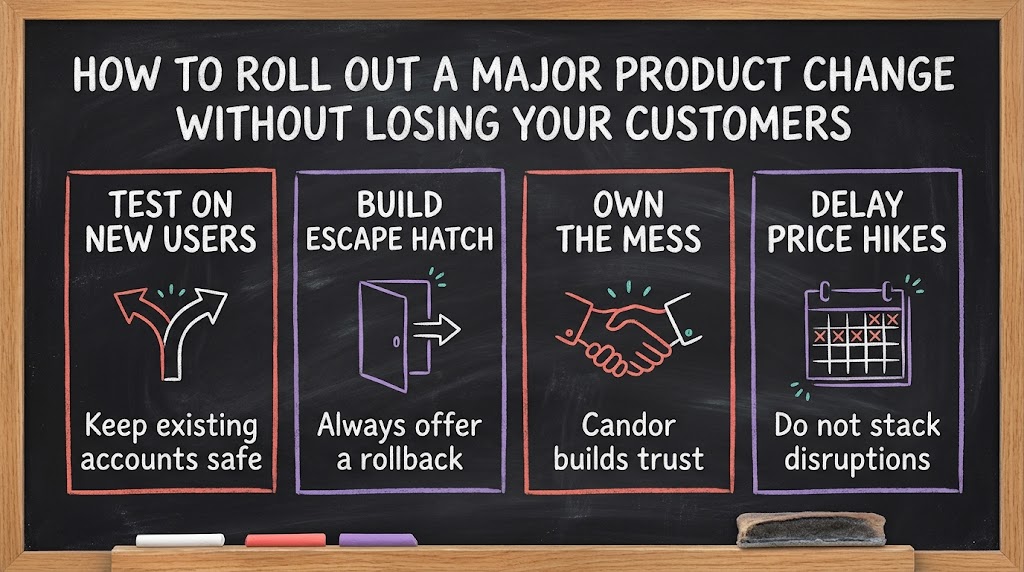
How to Roll Out a Major Product Change Without Losing Your Customers
One founder moved every existing customer onto a rebuilt product over a single weekend and spent the next three weeks on damage control. Here is what broke, what saved the relationships, and the one change that would have prevented most of it.

Our mastermind has a rule that the best lessons come from the founders willing to say out loud what went wrong. This past week one of them did exactly that, and the room got a masterclass in how not to launch a product change.
What went wrong over one weekend
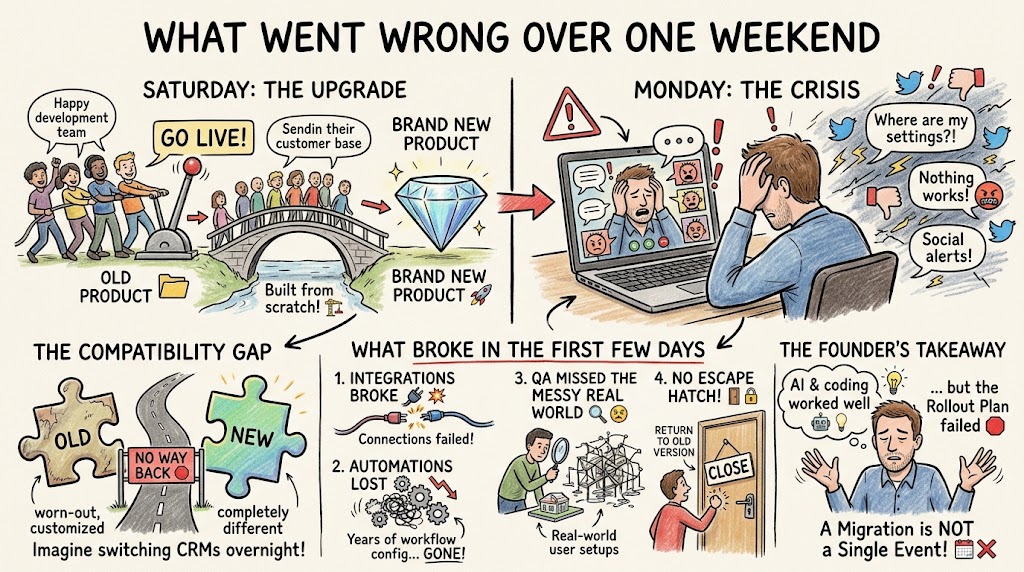
The setup sounds reasonable on paper. The company had rebuilt its core product from the ground up, the way the team would build it if they were starting from scratch today. The new version was better for the long term, with a new architecture, new packaging, and a lot more included in each plan. They went live on a Saturday and moved their existing customers over to the new product. By Monday morning the founder was on a four hour video call with angry users, and the story had picked up steam on social media for all the wrong reasons.
The core problem was that the old and new products were not compatible with each other. Customers who had spent years wiring the old product into the rest of their business logged in on Friday and found a different product on Saturday, with no way back. Imagine telling a team that runs on one CRM that they are now on a completely different one, effective immediately. That is roughly what happened here.
Here is what broke in the first few days:
- Integrations stopped working. Connections to third-party automation tools failed, which meant customers' workflows quietly stopped running.
- Automations had to be rebuilt. Years of configuration did not carry over, so every account needed hands-on help.
- QA missed real-world usage. The team tested the product, but not the messy ways long-time customers had actually set it up.
- There was no escape hatch. Customers could not return to the old version, so every problem landed on the support team at once.
The founder was blunt about his own role. He said he should have spent more time thinking things through before pulling the trigger, and that the failure was his, not the engineers'. The AI-assisted development behind the rebuild worked well. The weak point was the rollout plan, which treated a full customer migration as a single event.
The one thing he would change
Asked what he would do differently, the founder gave one answer, and it was a good one. He would have run a beta in production with new signups only. The company sees a couple hundred trial signups every week. If every new trial had been placed on the new product for a month, that would have created a pool of several hundred real users working through real problems, with nobody's existing business at risk.
The logic is simple. A rebuilt product cannot be tested with existing customers if the two versions are incompatible, but nothing stops you from testing it with people who have never used the old one. Problems stay contained in a small group, and the team fixes them before the larger migration begins.
Another founder in the room had solved this problem a different way when updating the front end of his web app. His process went like this:
- Add a banner. Invite users to try the new version while the old one stays the default.
- Swap the default. After a stretch of voluntary adoption, make the new version what people see at login, with the old one still reachable.
- Retire the old version slowly. The whole process took about a year, which is slow, but customers never felt forced.
That approach is not always available. If the architecture underneath has changed, you may not be able to run two versions side by side for existing customers. When that is your situation, the new-signups-only beta is the next best option, because it still gives you a safe place to find the failures first.
How owning the mess changed the mood
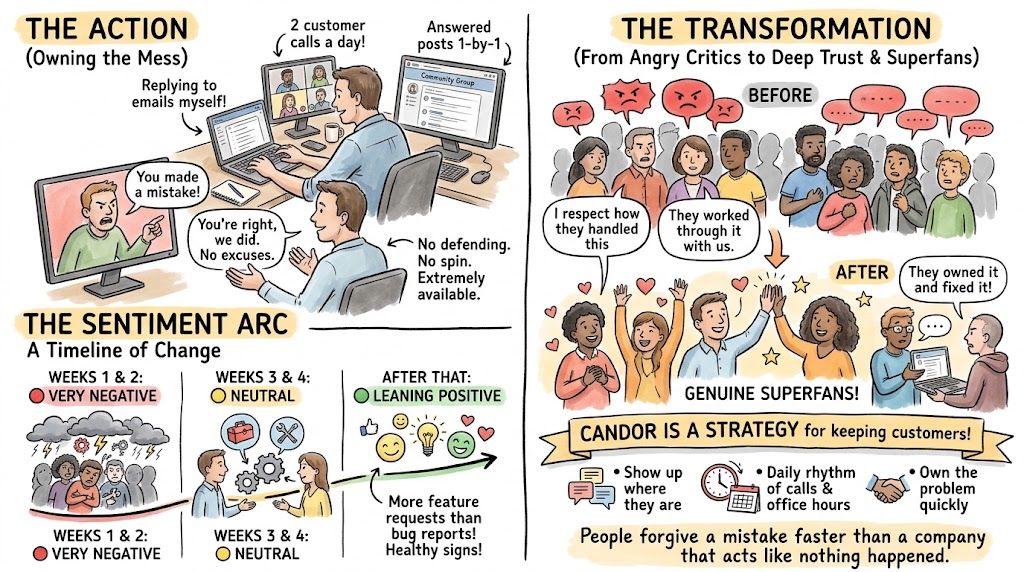
Here is the part of the story I found most useful. The founder made himself extremely available. He replied to emails himself, held two customer calls a day, and answered posts in the community group one by one. He did not screen messages. When a frustrated customer joined a call and said the company had made a mistake, the founder agreed with him. There was no defending the decision and no spin.
The result surprised him. Customers who had been quiet for years showed up in the community and on calls. A few who joined only to complain wrote afterward to say they respected how the situation was handled. The sentiment arc looked like this:
- Weeks one and two. Very negative, with most conversations focused on what was broken.
- Weeks three and four. Neutral, as fixes landed and people got used to the new product.
- After that. Leaning positive, with more feature requests than bug reports, which is a healthy sign that people are actually using the thing.
Another founder in the group described the same pattern from his own history. He has been through plenty of platform surprises, and his conclusion was that how you communicate matters more than anything else. Customers who watch you work through a problem with them learn to trust you on a deeper level, and some become genuine superfans who will defend you when others criticize you in public.
The practical takeaway is that candor works as a practical strategy for keeping customers. People forgive a mistake faster than they forgive a company that acts like nothing happened. If you own the problem quickly, show up where customers are, and keep a daily rhythm of calls and office hours, you give them a reason to stay while you fix things.
The cost to the rest of the roadmap
A bad rollout does not just hurt the week it happens. It also changes the plans you made for the following quarters. This founder had planned a price increase for his legacy customers, scheduled for the first of November, that would have added a large amount of revenue with no extra cost. After the rollout, forcing a price increase on top of a rough migration was off the table, so it moved out to the first or second quarter of next year.
The delay forced a rethink of packaging that turned out to have some upside:
- AI included in every plan. Instead of selling AI as a separate add-on, the company is moving to a model where every plan includes the agents and customers pay for the tokens they actually use.
- New features reserved for the new plans. An upcoming plugin for the major AI assistants will only be available on the new plans, which gives legacy customers a concrete reason to move voluntarily.
- A decision point next year. Once sentiment normalizes, the company will decide whether to retire the old plans entirely.
There was some healthy disagreement on this. One person on the founder's team argued for putting every feature on every plan. The founder's counterpoint was that if everything goes on the table at once, you lose the reason people have to upgrade. Another member added an important caution about price changes in general. Do not simply change a customer's price. Tell them ahead of time that a change is coming, resist the urge to defend it, and give your team a playbook for what to do when a customer says they cannot absorb the increase.
There was a positive sign in the numbers too. After the new pricing launched, the value of weekly trial signups roughly doubled, and churn rose only a little above normal. The product and the packaging were stronger, which is why the founder believes the pain will pay off over the long term.
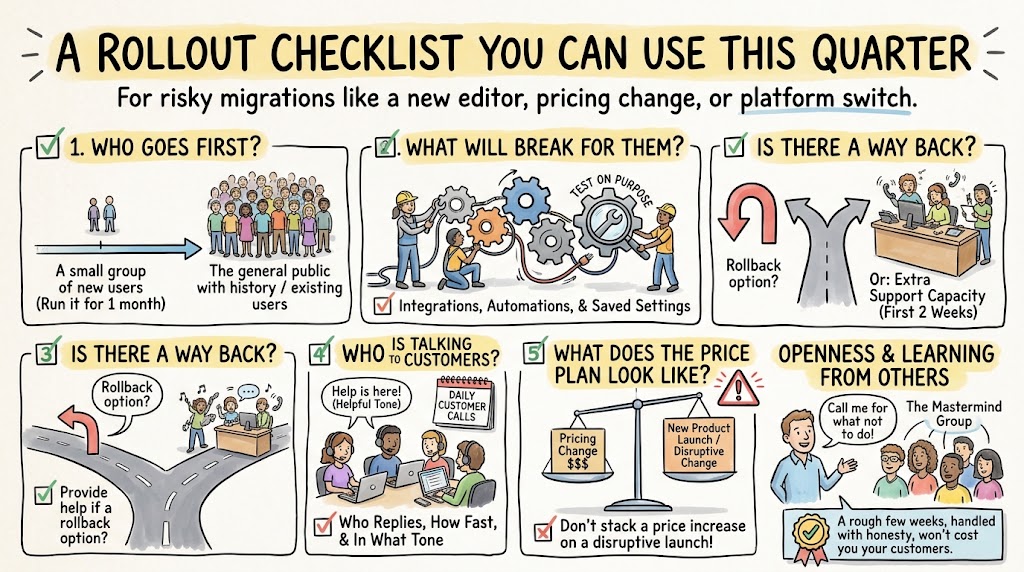
A rollout checklist you can use this quarter
You do not need to be rebuilding a whole product for any of this to apply. Any migration that touches how customers run their day, such as a new editor, a pricing change, or a platform switch, carries the same risk. Before your next one, work through these questions with your team.
- Who goes first? Pick a small group of new users to run the change for a month before anyone with history is affected.
- What will break for them? List the integrations, automations, and saved settings that customers rely on, and test each one on purpose.
- Is there a way back? If you cannot offer a rollback, plan extra support capacity for the first two weeks.
- Who is talking to customers? Decide in advance who replies, how fast, and in what tone, and expect to be on calls daily.
- What does the price plan look like? Do not stack a price increase on top of a disruptive launch unless you have to.
The founder's closing offer to the group was generous. He said anyone planning a launch could call him for a full rundown of what not to do. That kind of openness is exactly what a mastermind is for, and it is a reminder that a rough few weeks, handled with honesty, does not have to cost you your customers.