
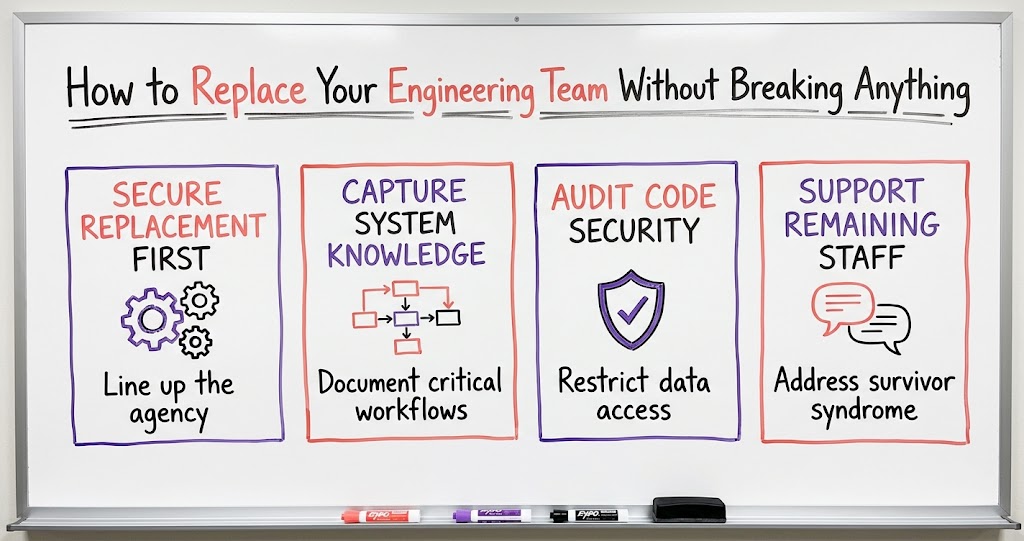
How to Replace Your Engineering Team Without Breaking Anything
A non-technical founder is moving day-to-day engineering to an outside agency while he rebuilds the team on his own terms. Here is the transition plan, the risks the mastermind flagged, and what to do about the people who stay.

Few decisions in a software company are harder to undo than replacing most of your engineering team. A founder in our mastermind recently shared that he is in the middle of exactly that, and the conversation that followed covered more ground than most management books do. If you are even thinking about a change like this, there is a lot here worth borrowing.
Why he made the call
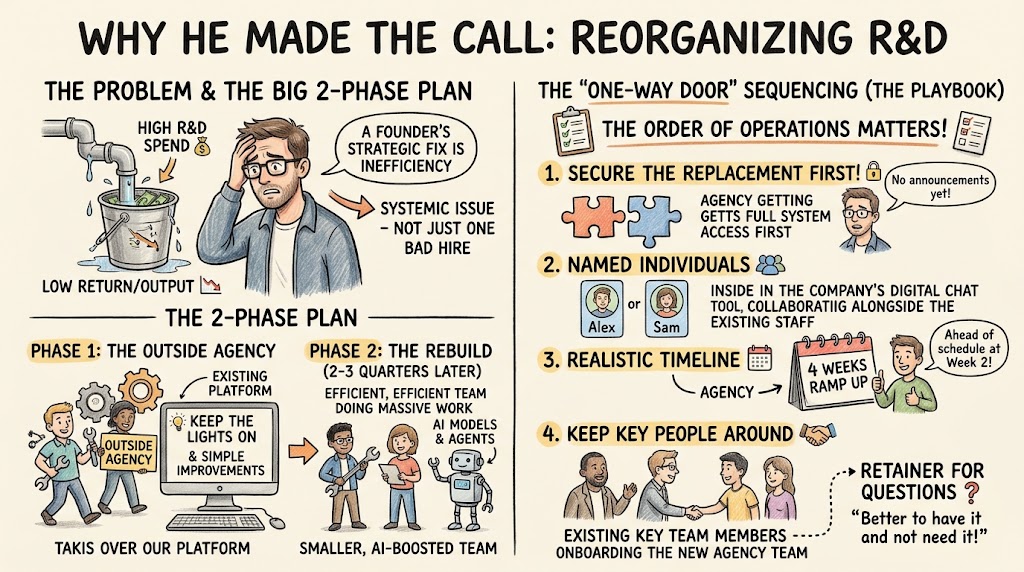
The founder runs a software company with a sizable product and a sizable team. His engineering and product group was spending more than companies his size usually spend on research and development, and he was not getting the output or the return that spend should buy. After a long stretch of watching that gap, he decided the issue was systemic and not about a single bad hire.
His plan has two phases. First, an outside agency takes over the day-to-day management of the existing platform, keeps the lights on, and ships a short list of simple, high-value improvements. Second, once things are stable, the company rebuilds an internal team, probably after two or three quarters. He is open to the possibility that by then AI models and agents will let a smaller group do much more than the current team could.
What makes this a one-way door is the sequencing. He did not announce anything publicly until the agency had confirmed it had real access to the systems and could start working. That order of operations matters:
- Secure the replacement first. Do not tell anyone until the new team can actually do the work.
- Name the people. The agency assigned named individuals to his account, and they live inside the company's chat tools alongside the staff.
- Set a realistic timeline. The agency asked for at least four weeks to ramp up. Two weeks in, they said they were ahead of schedule.
- Keep a few key people around. The most critical team members stay for roughly a month to a month and a half to help onboard the agency.
Some of those people will move to a retainer after they leave, so a question that only they can answer has a place to go. As the founder put it, it is better to have that option and not need it than to need it and not have it.
What the new setup is meant to deliver
It helps to be clear about the goal, because it shapes every later decision. The founder was direct that the company had been investing a large amount of money in engineering for far too long without a return. The agency arrangement brings that cost down significantly while keeping the product running. His plan is not to rebuild with the current group. It is to maintain the platform, ship a handful of simple, high-value improvements, and decide later how to build the next team.
A few questions can keep a plan like this honest:
- What does success look like in 90 days? Write down the specific improvements you expect, so the agency has a target.
- What is the cost compared with before? Track the monthly spend against the old team's cost from day one.
- When do we decide about the rebuild? Set a checkpoint, such as the end of the second quarter, to review the options with fresh information.
Close the knowledge gaps before they appear
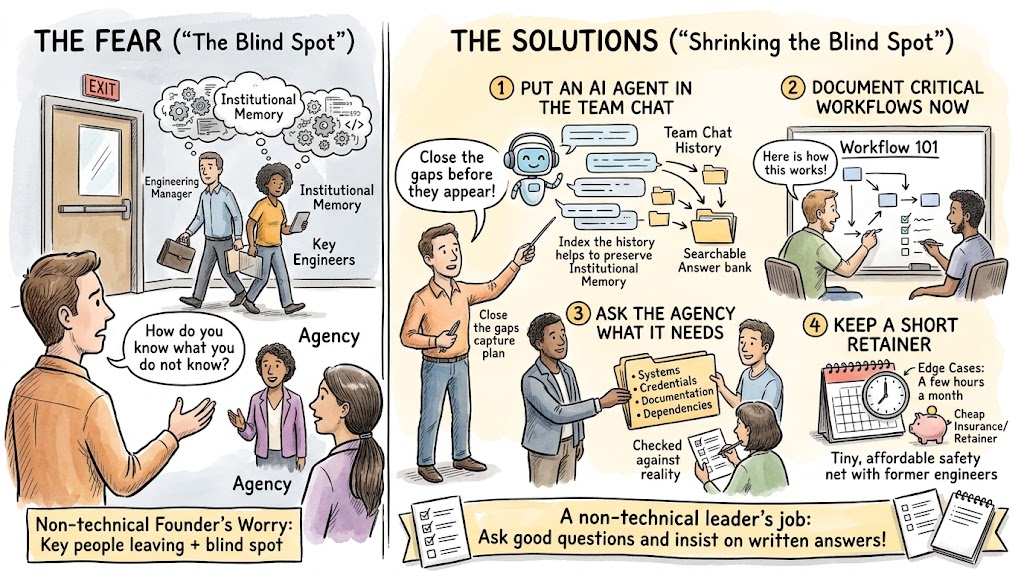
The founder was candid about his biggest worry. He is not technical, and the engineering manager who would normally be his guide through a transition is one of the people leaving. So he is relying heavily on the agency to tell him what it needs, which creates an obvious blind spot. How do you know what you do not know?
The group offered a few ways to shrink that blind spot. A technical founder pointed out that this problem is much easier to solve today than it was a few years ago because AI can help with nearly everything. His own company runs an AI agent inside its team chat that holds the full history of conversations and can find any detail on request. That kind of institutional memory is exactly what you want when the people who carry it in their heads are leaving.
A short list of knowledge-capture steps, drawn from the discussion:
- Put an AI agent in the team chat. Let it index the history so questions about old decisions have a searchable answer.
- Document the critical workflows now. Ask each departing engineer to walk the agency through the processes that only they know.
- Ask the agency what it needs to see. Have them list the systems, credentials, and documentation they depend on, and check the list against reality.
- Keep a short retainer for edge cases. A few hours a month from the people who built the system is cheap insurance.
Notice that each of these is something a non-technical leader can run without writing a line of code. The job is to ask good questions and insist on written answers.
Protect the company from the unlikely worst case
One of the more practical points came from a member who suggested a security review of the codebase and infrastructure at the moment of transition. His reasoning was blunt. You never know how someone will act when they leave a job, and some people can be nasty. A thorough audit looks for back doors or anything else a disgruntled person might leave behind.
The founder had already thought about this. Before making any changes, his team turned on a wide set of notifications in the code repository so they would see when people accessed data or ran exports. Every agency he considered ran a security audit as part of the selection process, and the company runs regular audits of its own. He even had several of the most capable AI models review the system for weaknesses and made a batch of fixes as a result.
If you want to copy that approach, this is the sequence:
- Turn on alerts. Watch for large exports, new access grants, and unusual repository activity.
- Run an independent audit. Do it before the announcement so any findings are fixed in advance.
- Review who has access to what. Remove permissions on the day each person's role ends.
- Use AI as a second reviewer. It will not replace a professional audit, but it can find issues quickly and cheaply.
Take care of the people who stay
The most useful advice in the whole conversation came from a member who works on employee retention for a living. He pointed out that the founder has two groups to worry about, and the second one is easy to overlook.
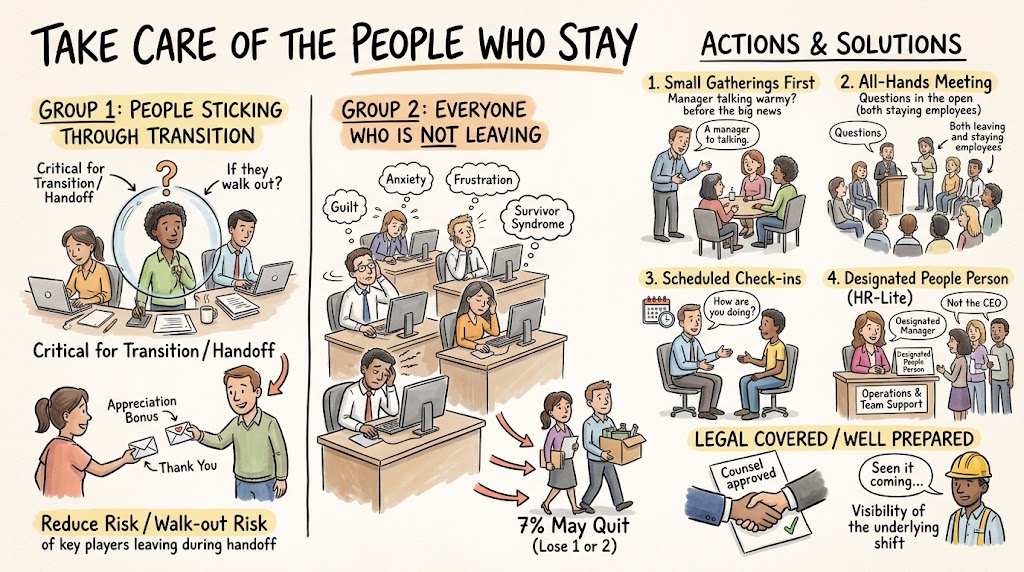
The first group is the people he needs to keep through the transition. Because the timeline is short, a full retention bonus is probably unnecessary, but it is worth thinking through what would happen if one key person walked out the next day. A modest appreciation bonus for those who stay through the handoff is a reasonable way to reduce that risk.
The second group is everyone who is not leaving. Researchers call the reaction survivor syndrome, and it is well documented. People who stay behind often feel guilt, frustration, and anxiety, and those feelings can reduce productivity and engagement. One figure that came up in the discussion was that around seven percent of the remaining people may quit as a result. Losing even one or two of them could hurt, in a team this small.
Here is what the founder had already done, along with the additions the group recommended:
- Small gatherings first. He met with the unaffected departments in small groups before the larger announcement.
- An all-hands meeting. Everyone came together, including some of the people who were leaving, so questions could be asked in the open.
- Scheduled check-ins. Set aside dedicated time with the people who remain, rather than waiting for them to raise a concern.
- A designated person for people issues. The company has no HR department, but someone on the operations side already handles many of those tasks. Formally naming her gives employees a place to go that is not the CEO.
The founder ran the legal questions past counsel before acting, and the advice from the group was that he seemed well covered there. Roughly ten people are affected, a mix of employees and contractors. His engineering manager was not surprised when told. He said he had seen it coming given how things had been going, which tells you something about how visible the underlying problem was.
What to take from this
There is a reason the group responded with respect. Another member told him directly that, from a founder's perspective, he had done the right thing for his business, and that it was not an easy decision. Moves like this are rarely popular in the moment, but they can be necessary to get to the next stage.
If you are considering something similar, keep these principles in mind:
- Sequence matters. Line up the replacement before anyone is told.
- Capture knowledge in writing. Do not depend on memory or goodwill.
- Plan for the worst case. Audit access and watch for unusual activity.
- Look after the survivors. The people who stay carry the company forward, and they need attention as much as the people who go.
Transitions like this one rarely fail on the technical details. They fail when a founder is surprised by something he never thought to ask about, and that is the problem a good mastermind is built to solve.