
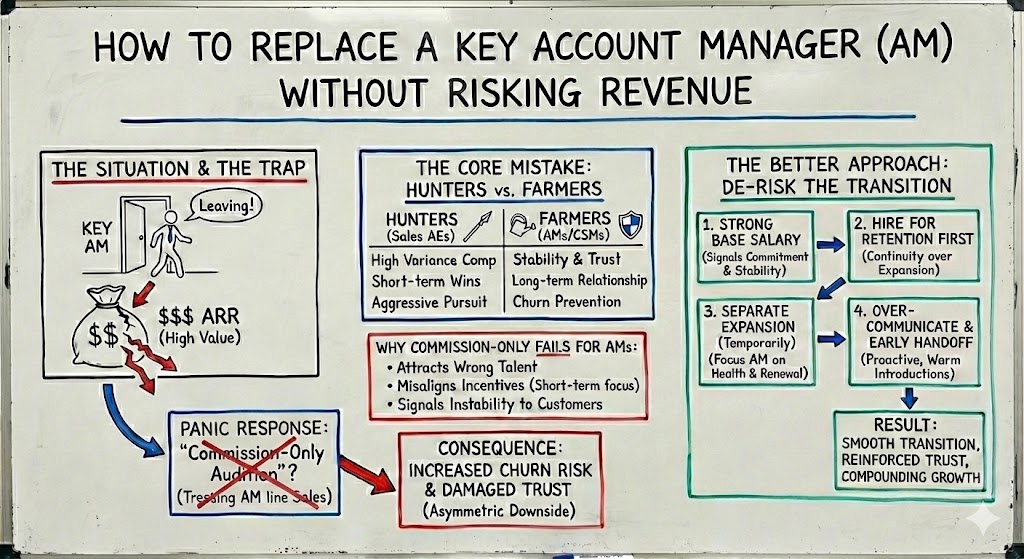
How to Replace an Account Manager Without Risking Your Revenue
There are a few moments in building a SaaS company that reliably spike a founder’s heart rate.One is when your largest customer churns unexpectedly. Another is when a core engineer quits mid-roadmap. And right up there near the top of the list is this moment:Your most important account manager or customer success manager announces they’re leaving — and they’re responsible for a massive chunk of your ARR.

If you’ve ever been there, you know the feeling. A knot in your stomach. A dozen questions firing at once. And a creeping sense that you’re now “on the clock” in a way that doesn’t feel comfortable.
This post is about how to handle that moment correctly — and how not to.
Because the wrong decision here doesn’t just create short-term turbulence. It can quietly bleed revenue for months, damage customer trust, and set your company back far more than the cost of doing things the right way from the start.
I recently participated in a B2B SaaS leadership discussion where this exact situation came up, and the instinctive reaction from the company involved was one I’ve seen many times before.
It’s understandable.
It’s logical on the surface.
And it’s dangerous.
Let’s walk through why — and what to do instead.
.jpg)
The Situation: When One Person Holds a Large Book of Business
Here’s the setup.
A B2B SaaS company had an account manager / CSM responsible for a very meaningful portion of annual recurring revenue. Think six or seven figures of ARR under management.
This wasn’t a junior “check-in once a quarter” role. This person:
- Owned relationships with key customers
- Understood renewal cycles, risk signals, and expansion opportunities
- Had trust with decision-makers
- Knew the internal history of every account
And then they gave notice.
The company had a limited runway to replace them and ensure a clean transition. Leadership immediately shifted into problem-solving mode, which is exactly what you want — but this is also where subtle mistakes get made.
One idea quickly surfaced.
“What if we hire someone on a commission-only basis for a few months as an audition? If they perform, we convert them to full compensation.”
On paper, this sounds prudent.
- It lowers risk
- It creates a performance filter
- It avoids committing to a full salary too early
In reality, it introduces far more risk than it removes.
The Core Mistake: Treating Account Management Like Sales
At the heart of this issue is a misunderstanding that’s surprisingly common in SaaS companies, especially founder-led ones.
Account managers are not salespeople in the traditional sense.
They are not hunters.
They are farmers.
And the personality, motivation, and compensation structure that works for hunters often actively repels great farmers.
.jpg)
Hunters vs. Farmers (And Why It Matters)
Sales AEs are typically wired for:
- High variance compensation
- Short-term wins
- Aggressive pursuit
- Deal-driven dopamine
That’s not a judgment — it’s a role fit.
Account managers and CSMs, on the other hand, thrive on:
- Stability
- Long-term relationship building
- Trust and consistency
- Deep understanding of customer context
They win by preventing churn, not by creating dramatic spikes.
When you introduce a commission-only or heavily variable structure into an account management role, a few things happen immediately:
1. You attract the wrong candidates.
The best account managers self-select out. They don’t want income volatility tied to accounts they didn’t close.
2. You misalign incentives.
The person becomes focused on short-term upsell behavior rather than long-term retention health.
3. You introduce risk exactly where you can least afford it.
When someone’s paycheck depends on commissions alone, subtle pressure seeps into every customer interaction.
That pressure gets felt by customers — especially your most sophisticated ones.
Why Commission-Only Is Especially Dangerous in a Transition Period
Let’s be very clear about the context here.
This isn’t a greenfield role.
This isn’t a net-new revenue experiment.
This is existing ARR that has already been sold, onboarded, and is being renewed based on trust.
That changes everything.
Existing Revenue Is Fragile in Transitions
Customers don’t like surprises.
They don’t like instability.
And they are highly sensitive to changes in account ownership.
During a transition, customers are subconsciously asking:
- “Is this company stable?”
- “Am I still important to them?”
- “Do I need to reassess my vendor stack?”
The number one job of a replacement account manager during the first 90 days is continuity.
Not growth.
Not optimization.
Not squeezing incremental expansion.
Continuity.
A commission-only structure does the opposite. It signals:
- Experimentation instead of commitment
- Transactional intent instead of partnership
- Cost-cutting instead of customer care
That signal alone can be enough to trigger re-evaluation conversations on the customer side.
The False Economy of “Saving” on Salary
One of the most dangerous traps founders fall into is optimizing for the wrong cost.
Let’s do some simple math.
If an account manager is responsible for $2M in ARR, and you’re debating whether to pay a $90k or $130k base salary, the incremental cost difference is $40k.
Now compare that to:
- Losing one $200k customer due to a shaky transition
- Seeing renewal rates dip 5–10%
- Creating internal chaos that distracts leadership
The downside risk isn’t linear. It’s asymmetric.
You’re risking dollars to save pennies.
.jpg)
.jpg)
What Strong Account Managers Expect (And Deserve)
High-quality account managers know their value.
They know that:
- They are protectors of revenue
- They are stewards of long-term trust
- Their work compounds over time
As a result, strong candidates expect:
- A solid, predictable base salary
- Clear ownership over accounts
- Reasonable, aligned incentives
- Stability during transitions
When you propose a commission-only “trial,” the best candidates hear something very different than what you intend.
They hear:
“We don’t fully understand this role.”
“We’re optimizing for cost over customer outcomes.”
“This company may not invest in retention.”
And they quietly move on.
The Better Approach: How to Actually De-Risk the Transition
So what should you do when a key account manager leaves?
Here’s the approach I consistently see work — across early-stage SaaS, growth-stage companies, and scaled businesses alike.
1. Lead With a Strong Base Salary
If revenue protection is the goal, stability must come first.
Offer a competitive base salary that:
- Reflects the size of the book of business
- Signals commitment to the role
- Attracts experienced AM / CSM talent
Variable compensation can exist — but it should be secondary, not existential.
Your message should be clear:
“Your job is to protect and strengthen relationships. We’ve got you covered.”
That psychological safety matters.
2. Hire for Retention, Not Expansion
This is another subtle but critical distinction.
Many companies want their account managers to:
- Handle renewals
- Drive expansion
- Identify upsell opportunities
- Act as pseudo-sales
In theory, this sounds efficient.
In practice, it often dilutes focus — especially during transitions.
Your first priority should be someone who excels at:
- Relationship continuity
- Risk identification
- Customer advocacy
- Deep listening
Expansion is valuable, but churn prevention is existential.
You can always add an expansion layer later. You can’t retroactively rebuild trust.
3. Separate Expansion From Retention (At Least Temporarily)
One of the best structural decisions you can make is to consciously separate these motions.
Let your account manager focus on:
- Health
- Satisfaction
- Renewal confidence
Then, once stability is restored, layer in:
- A dedicated expansion role
- A sales overlay
- A structured upsell process
This protects customers from feeling “worked” during a vulnerable period and allows your AM to act as a true advocate.
.jpg)
4. Start the Transition Earlier Than You Think You Need To
If you have notice — even a few weeks — use it aggressively.
The highest-leverage activities during a transition are:
- Joint customer calls
- Warm introductions
- Explicit knowledge transfer
- Documented account history
Customers should never feel like they’re starting from scratch.
Ideally, they should feel like:
“This company really handled that well.”
That sentiment alone can deepen loyalty.
5. Over-Communicate With Customers
Silence creates uncertainty.
Be proactive. Be confident. Be human.
A simple message goes a long way:
“We wanted to let you know about an upcoming change. We’ve planned carefully, and your success remains our top priority.”
That reassurance matters more than you think.
The Bigger Lesson: Protect What You’ve Already Earned
Founders are wired to chase growth. I get it — I am one.
But the most durable SaaS companies are built by leaders who understand that retention is a growth strategy.
Every dollar you protect compounds.
Every customer you retain becomes a reference, a case study, and a long-term partner.
Every smooth transition reinforces trust in your brand.
Replacing an account manager is not just a hiring problem.
It’s a trust problem.
A signal problem.
A leadership problem.
Solve it with the same care you’d give a major enterprise deal.
Final Thought
When significant revenue is on the line, this is not the moment to experiment with compensation models or “try before you buy” hiring strategies.
This is the moment to:
- Invest in proven talent
- Align incentives with stability
- Signal commitment to your customers
- Protect the foundation you’ve already built
Do that, and you won’t just survive the transition.
You’ll come out stronger on the other side.