
How to Raise Venture Capital Without Getting Burned
I break down when to raise venture capital, how much to take, from whom, and on what terms, plus how to protect your control and spend the money wisely once it lands.

Most founders treat venture capital as a prize to be won. It is closer to a tool with a sharp edge: used well, it compounds a working business into a category winner; used badly, it strips the founders of control and leaves them with nothing from an exit everyone else calls a success.
Last week I sat down with a founder I advise. His company went from roughly $23,000 to $100,000 in monthly recurring revenue in a single quarter, hitting the goal with two days to spare. He has never taken outside money. His next target is $250,000 MRR by December 31, and the question on his mind was the one every bootstrapped founder with real traction eventually faces: should I raise, and if so, how do I do it without getting burned?
I spent ten years building iContact to $50 million in annual recurring revenue and a $170 million exit. What follows is the advice I gave him: whether to raise, when, how much, from whom, on what terms, and what to do with the money once it lands.
Who should raise, and who shouldn't
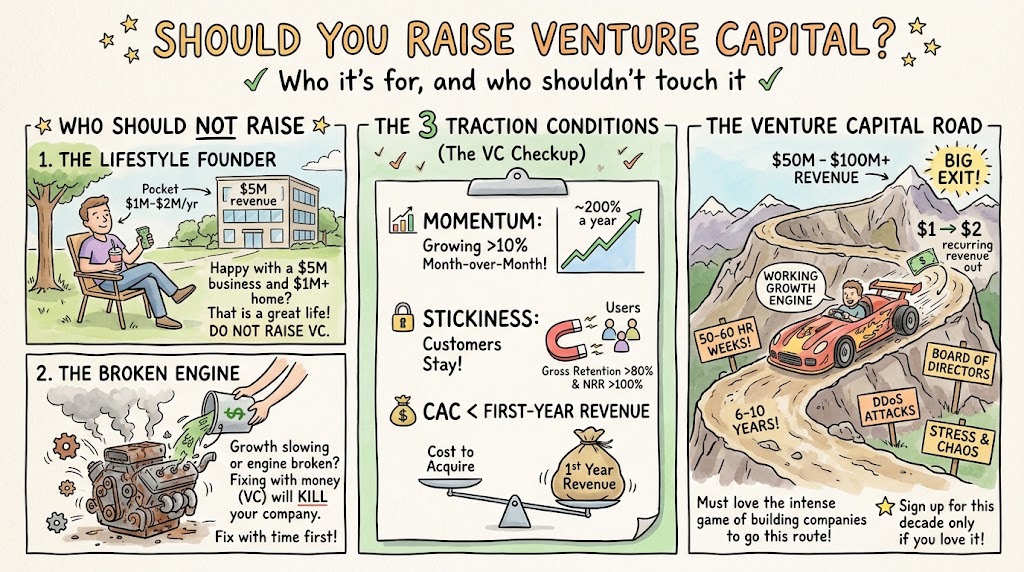
Venture capital is the right tool for one kind of company: a business whose growth engine already works and is limited mainly by how much fuel it gets. If a dollar put into sales and marketing reliably comes back as two dollars of recurring revenue, and the market is large and still relatively uncontested, then raising becomes close to a spreadsheet decision. Put in more dollars, get more revenue, and take market share before competitors arrive. Blue oceans do not stay blue for long.
Three conditions should all be true before you consider it:
- Revenue is growing more than 10% month over month. That compounds to roughly 200% a year. Investors fund momentum, and the founder I spoke with had it.
- Customers stick. You know your account churn, and you have gross annual customer retention above 80% and an NRR above 100%.
- You know what a customer costs to acquire in sales and marketing costs and that number is well under what the customer pays you in the first year. The next section covers the math.
There is also a personal condition. Raising is a commitment to six to ten more years in this business at fifty or sixty hours a week, with a board to answer to. If you enjoy the game of building a software company, including the DDoS attacks, the employees quitting and the founder disputes, and you can keep your identity and personal happiness separate from the inevitable ups and downs, go for it. If you do not actually like building companies, do not raise. You would be signing up for a decade of something you do not enjoy.
Who should not raise: a founder who would be happy building to $5 million in revenue and taking home $1 million or $2 million a year. That is a good life. But if you are 30 and thinking about the next decade, building to $50 million or $100 million in revenue and selling for several hundred million is a real-world PhD in entrepreneurship, and it buys a freedom the lifestyle business does not. I can advise founders and raise my kids on 25 hours a week at 42 because of what I learned from 18 to 28 in my ten years building and exiting a venture-backed company.
The last disqualifier is simple. If you sense growth is slowing, do not raise. Fix the engine first with time, not money. Money will kill your company if you put it in a broken growth engine.
Do the math before you do anything else
Before a single investor conversation, build a simple spreadsheet with your customer acquisition cost (CAC) by month and your sales and marketing expenses by month. This is the preparation that makes the rest of the process work, and most founders skip it.
The calculation is straightforward. Take everything you spent on sales and marketing last month: salaries, bonuses, software, advertising, trade shows, travel. Divide by the number of new paying customers that month. If you spent $50,000 and closed 50 customers, your CAC is $1,000. Then compare that to your annual contract value (ACV). You want ACV to be two or three times CAC, which by definition gives you a four- to six-month payback. Once you have retention data, calculate lifetime value: lifespan is one divided by monthly churn, and LTV is lifespan times average revenue per account.
Bootstrapped founders often object that they have no sales and marketing costs because they do the selling themselves for free. That is exactly why CAC must be calculated rather than read off the P&L. CAC is not what you spent; it is what you should have spent with costs properly allocated. If half your time goes to sales and a market-rate head of growth earns $300,000 a year, roughly $10,000 to $12,000 a month of your time belongs in that line. If customers came through a sister business or referral network, assume a 20% first-year commission. Add trade show tickets, flights and hotels. That is your real CAC.
One aside: book your unpaid founder salary, perhaps $10,000 to $15,000 a month, as debt from the company to you, payable at a milestone such as closing a round. Established before any negotiation, it surprises no one and gives you a personal buffer later.
If the ratios check out, you have a scalable business, and unless you only want two or three years of cash flow before moving on, you should raise from the right partners. If they do not check out, no amount of capital will fix that. Fix the ratios first.
Timing: de-risk first, then strike while the iron is hot
The founder I spoke with asked a good question. Should he wait until the end of the quarter, when he expects to hit $200,000 to $250,000 MRR, so he has more months on the growth curve and a stronger valuation story? Or does waiting not move the needle much, in which case he should go earlier and put the capital to work sooner?
The answer is: de-risk the one thing that could break the story, then move fast. In his case, the open question was whether pilot customers would convert to annual contracts. That answer arrives 30 to 45 days after the pilots end. Once it does, and if 80% or more convert, there is no reason to wait. At $200,000 MRR he would be at $2.4 million ARR with a credible path to $7 million to $10 million the following year. That is a fundable story today.
Two external forces argue for speed. The market for investment capital is strong right now, but no window stays open forever. And growth itself is the asset investors are buying; a founder growing 10% a month has more leverage this quarter than he may have next.
The practical sequence: close the books, calculate CAC, wait for conversion data on the trial cohort, then research which firms to approach. Plan to spend two weeks in San Francisco pitching every target firm in the same window so term sheets arrive together. Closing roughly 90 days after you begin is realistic.
Raise the right amount, not the biggest valuation
The single most common fundraising mistake is raising too much, too early, at too high a price. It feels like winning. It is usually the beginning of losing.
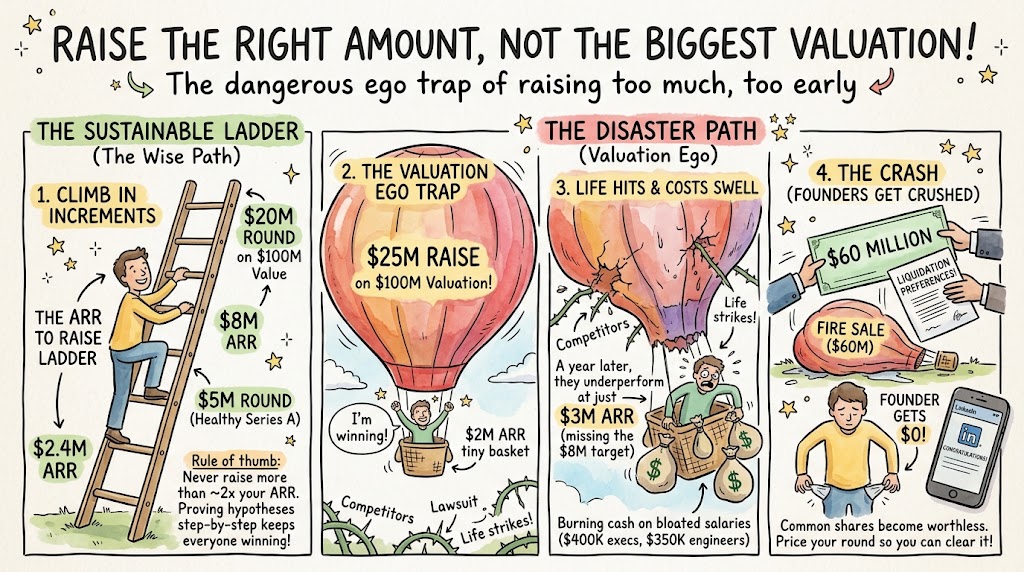
A useful rule of thumb: never raise more than about two times your ARR. If you are at $2.4 million ARR, a $5 million round is sensible. It is not so small as to be meaningless, and not so large that one missed quarter puts the company underwater. Some AI companies today raise 20 times their ARR. If they stumble once, the valuation they raised at exceeds what the company will eventually sell for, the next round is a down round, and the founders get crushed on dilution.
Raise in increments. Prove a hypothesis, raise enough to scale it, prove the next one, raise again. Five million on a $30 million to $40 million pre-money is a healthy Series A at $2.4 million ARR. Use it to go from $2 million to $8 million, then raise $20 million on $100 million. The ladder keeps going up, early investors get credit for early risk, and everyone wins along the way.
Here is why valuation ego is dangerous. Picture a founder at $2 million in revenue who raises $25 million on a $100 million pre-money. Then a competitor appears, a lawsuit lands, or life knocks him off his curve. A year later he is at $3 million instead of the $8 million he forecast, and a company that just grew from $2 million to $3 million is worth $15 million to $25 million. He has spent the money on $400,000 executives and $350,000 engineers, so he raises again at $30 million or $40 million. He loses control, his common shares become nearly worthless, and eight times out of ten the company sells in a fire sale for $60 million. Everyone congratulates him on LinkedIn. He receives nothing, because all $60 million goes to liquidation preferences.
If you ever sell for less than the valuation you raised at, you effectively get zero. Price your round so that you can clear it.
Choose the partner, not the valuation
A lot of founders lack the wisdom to go for the right firm rather than the highest number. The right firm is worth far more than the extra 20% on your pre-money.
For a Series A, the ideal structure is two investors with different jobs. The first is a brand-name, early-stage firm, usually in the Bay Area, that can help you recruit senior talent, understands how to build and launch great products, and lends credibility that opens doors. The list is short: Andreessen Horowitz, Sequoia, Founders Fund, Lightspeed, Thrive, General Catalyst, Kleiner Perkins, Accel, Index, Battery, Bessemer, NEA, and a few more such as Khosla, Menlo and Greylock. After roughly the top 20, brand value falls off quickly, and later-stage or private-equity names will not help an early company grow.
The second investor is a vertical specialist: a firm you may never have heard of with 15 or 20 portfolio companies in your exact industry. They know the channel partners you will need and the acquirers who will eventually call. They typically participate rather than lead, and a specialist who has already shown interest will almost always follow a top-tier lead. A $5 million round might be $3 million from the specialist and $2 million from the brand-name firm.
Within the firm, the partner matters as much as the name on the door, because that person will sit on your board for most of a decade. Find the companies in adjacent spaces that sold for hundreds of millions, identify who led their A and B rounds, and go find that partner. Then apply the one non-negotiable filter: do not take money from jerks. A difficult board member makes life miserable for years regardless of the firm.
Expect to be in San Francisco about once a month, and for two solid weeks during the raise itself. Being outside the Bay Area is not a problem; being unavailable is.
Keep control: 10x founder shares and a board you can win
If you take one sentence from this article, take this one: do not raise venture capital without 10x voting rights on your founder shares.
This is the structure Meta and Airbnb used, and it is now common in California. Have your lawyer put founder preferred shares with 10x voting rights in place before you negotiate a round. Investors only agree when growth is strong, which is exactly when you should be raising. Say no, politely, to anyone who insists on one-times voting rights.
Here is the failure mode it prevents. You raise $5 million and your investors encourage you to spend it faster. You lack the boundaries to say no, the money runs low, and you raise again. Eighteen months later three venture investors sit on a five-person board. They fire you, install their own operator, run the company for cash, and sell it for enough to return their capital. The founders get nothing. It happens constantly, almost always to first-time founders in their twenties with no experienced advisors.
Board composition is the second line of defense. Seat yourself and your co-founder, one venture investor, and one independent director who will generally side with the founders. Every vote then goes 3-to-1 at worst. Your investors are minority shareholders; treat them with courtesy, a three-hour board meeting each quarter, a call when you need help hiring, and a report every 90 days. If they pressure you for more, thank them for their capital and decline.
The pressure to burn is real. Venture firms benefit when your next round prices higher, because it marks up their portfolio and helps them raise their next fund. That incentive can push a founder to spend even when a dollar returns fifty cents of ARR instead of two. With the right share structure, the right board and an advisor who knows the math, you can simply decline. It is your company.
Spend the money like it isn't there
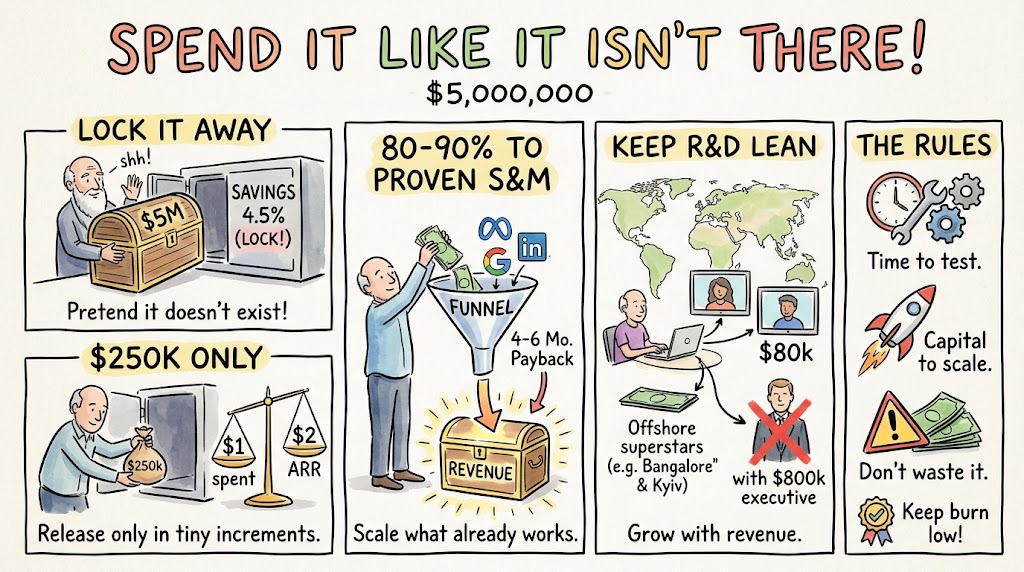
The founder I advise made an observation that showed good instincts. Five million dollars, he said, is not much in the grand scheme, because it can disappear quickly. But it is also a lot, because a lean, effective team can accomplish an enormous amount with it. Both are true, and the way to honor both is to pretend the money does not exist.
Put it in a savings account earning 4.5% and do not touch it. Act as your own CFO. Release it only in $250,000 increments, and only when you believe the experiment will return $2 of ARR for every $1 spent. Decide on the first day of the quarter how much incremental sales and marketing spend to add, track it for 90 days, then decide whether next quarter gets $500,000 or stays flat. You have the money, but you never have to raise your burn rate, and burn rate is what kills companies. Money in your account makes you stronger. Money leaving it makes you weaker unless it is bringing in customers.
Eighty to ninety percent of the capital should go into sales and marketing with a proven payback window. If it goes into Meta, Google, LinkedIn and Bing campaigns with a four-month payback already proven at smaller scale, you get the money back in four to six months and revenue climbs. Grow engineering at the pace of revenue, and keep it offshore, where an $80,000 superstar in Bangalore or Kyiv often outperforms an $800,000 hire from Netflix.
Use time to test and fix. Use capital to scale what already works. Capital is highly dilutive and very expensive; spending it to figure something out is the worst possible use of it.
The mistakes that kill venture-backed companies
Here is a statement that is illustrative rather than statistical: 100% of startups that have ever failed did so because the founders gave up or because revenue did not grow fast enough. Everything below is a way of causing the second one.
- Raising to fix instead of raising to scale. An extra $10 million will not help you figure out what is wrong with the business. Fix it first, then raise to pour fuel on it.
- Spending on things that are not accretive to revenue. The $400,000 trade show booth instead of the $40,000 one, with neither tracked. The $500,000 launch party. The $800,000 engineer who contributes less than the $100,000 one.
- Letting burn climb to $500,000 a month. The moment you go from zero burn to half a million a month, you are in trouble unless revenue is growing extremely fast. Burn, not capital, makes you beholden to others.
- Chasing revenue at any cost. Companies running 18- to 24-month payback windows cannot raise when the market wobbles. They lay off 70% of staff, take a down round, and the founders end up with nothing. Keep payback at six or seven months.
- Raising at one-times voting rights. It is how good founders lose good companies.
- Taking money from the wrong people. A misaligned board member turns a hard job into a miserable one.
- Losing contact with the customer. The founders who win stay focused on being the best in the world at solving the customer's problem and on acquiring more customers. Do that, and keeping investors happy takes care of itself.
The honest cons
I have made the case for raising when the engine works, so it is only fair to be clear about what it costs beyond dilution.
Your life becomes more regimented. There is a quarterly board meeting to prepare for, and you have to care what the board thinks. Time on the phone with lawyers and investors roughly quadruples. You become a step removed from the customers and the product, which makes it harder to keep your ear to the ground and build the best thing. And you take on a commitment: you are telling the world you are passionate about this problem and willing to spend six to ten years on it.
There is also an honest question about the edge producing today's growth. Deep industry knowledge, a strong network and a good product may carry you to $5 million or $7 million in revenue on their own. Beyond that you need a professional sales team and a marketing machine. Capital helps build both, but only if you are prepared to build them. If you would rather not, the bootstrapped path remains honorable.
Founders also worry about split attention, for example when the software grew out of a services business they still run. Investors do not care how you spend your time as long as revenue keeps growing; they only ask when it stalls. Separate the entities cleanly, with IP assigned and vesting in place, and let the growth speak for itself.
Revenue growth hides all sins
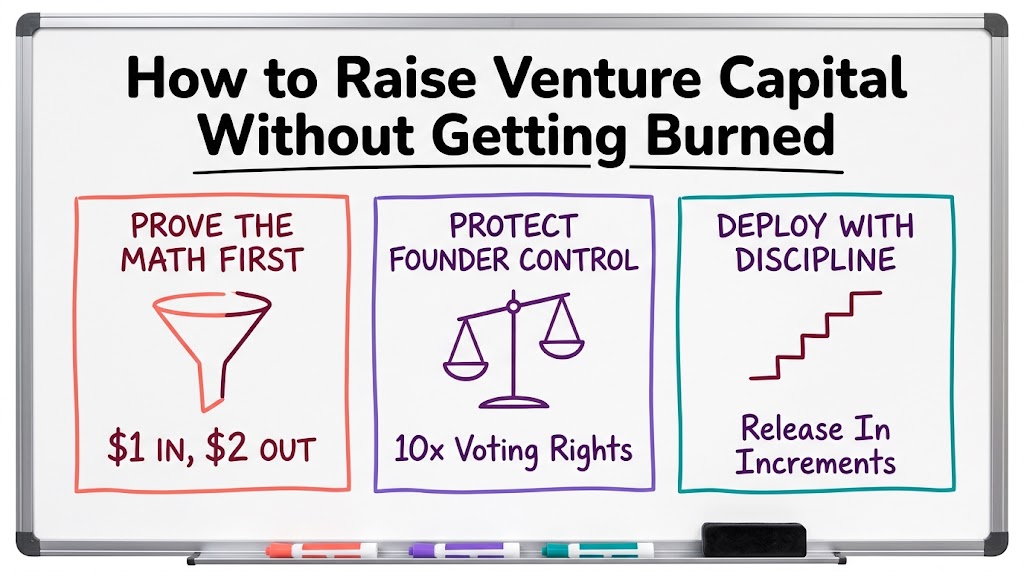
Everything here reduces to a short set of rules. Raise only when the math proves the engine works and growth exceeds 10% a month. Raise no more than twice your ARR, at a valuation you can clear. Pick a brand-name lead and a vertical specialist, and pick the partner over the number. Insist on 10x founder voting rights and a board you can win. Put the money in savings and release it in $250,000 experiments with a two-to-one return.
The founder I spoke with will have his pilot conversion data in about 30 days. If it holds, he will be at $2.4 million ARR with a credible path to $7 million to $10 million next year, and we will spend a few days in Silicon Valley in January sitting in rooms with the right firms. That is the right order of operations: data first, then the raise, then disciplined deployment.
Revenue growth hides all sins. Keep it growing, keep the payback short, and keep control, and the rest of the venture game becomes much easier to play.