
How to Make Meta Ads Work for SaaS Customer Acquisition
A B2B SaaS founder's Meta ad spend doubled his CAC the moment he scaled past small budgets. Here's the math, the ad types, and the fixes our mastermind worked through to get it back under control.

One of our members runs a subscription product for podcasters and creators, priced around $100 a month, and he brought a problem to the group that almost every SaaS founder running paid social eventually hits. His Meta ads looked great at small volumes, with customer acquisition cost as low as $166. The moment he tried to scale the budget up, CAC more than doubled, drifting to $350 or $400 within a few days. Nothing about the audience or the offer had changed. He'd just turned up the spend, and the math stopped working.
That's a familiar pattern, and it's worth walking through both the numbers behind it and what our group actually recommended, because the fixes aren't complicated. They just require knowing what you're targeting and understanding how Meta's ad system behaves once you feed it more money.
Set your target CAC before you touch the budget slider
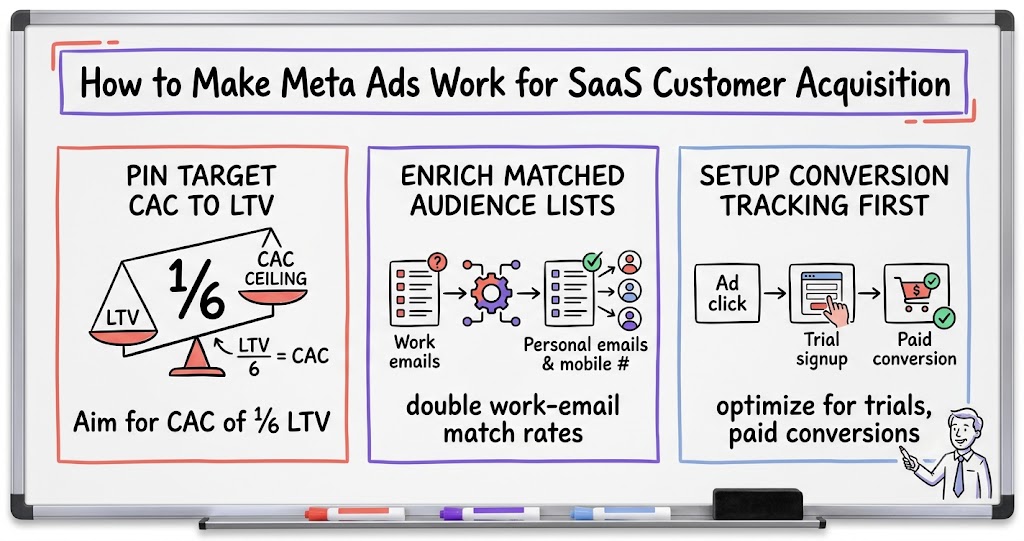
The rule of thumb I remind our members of constantly is that your target customer acquisition cost should sit at roughly one sixth of lifetime value. If a customer is worth $1,200 to you over their lifetime, you want to be paying around $200 to acquire them, not $400. That single ratio is the difference between a channel that compounds and one that quietly drains your bank account while looking fine on a top-line revenue chart.
For the founder in our group, his customers were sticking around 10 to 14 months, which put his LTV somewhere between $1,000 and $1,400 based on organic traffic. That math suggested a target CAC close to $200, which is almost exactly where he started before scaling wrecked it. The lesson here isn't that his channel was broken. It's that he'd never actually pinned down the number he was supposed to be defending, so when CAC crept up, there was no clear line telling him to stop and diagnose instead of push harder.
One nuance worth sitting with: LTV from paid traffic isn't automatically the same as LTV from organic traffic. Paid customers can churn faster or slower than the people who found you through search or word of mouth, and you won't know which until you've run a cohort long enough to watch it play out. Until then, treat your organic LTV as a working estimate, not gospel, when you're setting a CAC ceiling for paid channels.
The four ad types you're actually choosing between
A lot of the confusion around Meta ads comes from founders not knowing which lever they're pulling. There are really four distinct ways to structure a Meta campaign, and they behave very differently:
- Retargeting. Shows ads to people who already visited your website. Cheapest and most predictable, but it's a small, finite pool, so it can't carry your growth alone.
- Advantage Plus. Meta's own system for taking a seed audience and expanding it algorithmically based on who tends to convert. You give up some control in exchange for Meta's targeting engine doing the work.
- Lookalike audiences. Takes a seed list and finds roughly the top one percent of the population that most closely resembles it. Useful once you have a clean seed list of actual customers, not just website visitors.
- Matched audiences. You upload a list of known contacts, usually emails or phone numbers, and Meta matches them to real accounts so you can retarget or exclude them directly.
Our member had only been running retargeting and a matched audience built from his email list, and he hadn't touched Advantage Plus or lookalikes at all. That's a common gap. Founders get comfortable with the ad type that feels the most controllable and skip the ones that require trusting Meta's algorithm, even though those often perform better once your tracking is solid.
Fix your matched audience math before you blame the channel
Here's a detail that trips up a lot of B2B founders specifically. If you're uploading a list of work email addresses to build a matched audience, expect a weak match rate, because most people use personal emails and personal phone numbers on their Meta accounts, not their work address. Our member had done exactly this, uploading his list of signups and paying customers, and he wasn't seeing much come from it.
Say you have 10,000 people who have ever logged into your platform. Uploading just their work emails might get you a 20 to 30 percent match rate on Meta. Spend $1,000 or $2,000 running that list through an enrichment tool that appends personal emails and mobile numbers, and you can often double the match rate. That's not a huge line item for most SaaS companies, and it directly expands the pool of people your matched and lookalike campaigns can actually reach. It's one of the highest-impact, lowest-effort fixes available before you start second-guessing your creative.
Get your tracking right, then let Meta do what it's good at
Another member in the group, who's been running paid social for about a decade, made a point that's easy to underestimate: Meta's system is built to optimize for engagement first, and conversions second, unless you've set it up to know better. A video ad that racks up comments and watch time will pull budget toward itself even if it isn't converting, because from Meta's perspective, engagement looks like success. If you don't watch your metrics closely and pause the ads that are eating spend without producing signups, you can burn through budget on a campaign that looks active and healthy while quietly missing your actual goal.
The fix starts before you spend a dollar. Get your conversion tracking exactly right, all the way through to the event that matters, whether that's a trial signup or a paid conversion. Don't launch a Meta campaign without it, because everything downstream depends on Meta knowing what a real outcome looks like. Once tracking is solid, the group's advice converged on something a little counterintuitive: often the best move is to interfere less, not more. Run a clean campaign with minimal manual targeting variables, let the ad copy itself do the audience filtering (for example, calling out a specific job title or company size directly in the creative so the wrong people self-select out), and let Meta's targeting engine find your buyers.
There's also a real difference by business type here. For B2B products, a member running a lower-ticket tool found that static image ads consistently outperformed video, and that most of his conversions happened on desktop rather than mobile, which cuts against the general assumption that video always wins on Meta. He also cautioned that retargeting everyone who watched even half of a video ad can quietly push your CAC up, because you're now paying to re-engage a broad, only loosely qualified pool. Sometimes a simple, single static ad running cold performs better than a complicated funnel with three layers of retargeting stacked on top.
Creative angles worth testing
Beyond the mechanics, a few creative tactics came up that are worth adding to your testing queue if you haven't tried them. One member described partnering with a podcast host or creator whose audience overlaps with your buyers, then using Meta's partnership ad tools to run ads against that creator's actual following, choosing whether the ad shows as a joint post, the creator's post, or your own. That effectively rents you a warm, pre-qualified audience instead of building one from scratch.
- Borrow an audience. Partner with a creator or podcaster in your space and run ads against their following through Meta's partnership tools, rather than only prospecting cold.
- Seed engagement cheaply. Some experienced media buyers launch a new ad in lower-cost ad markets first to build up comments and engagement, then shift the budget-heavy version into their real target market once the ad already has social proof attached.
- Don't over-engineer the funnel. Test a single, simple static ad running cold before you assume you need a multi-step video and retargeting sequence. Simpler sometimes wins on CAC.
None of these are silver bullets, and what works varies by ticket size, audience, and how commoditized your category is. But the pattern across everyone who spoke up was the same: the founders getting the best results were the ones treating Meta ads as a system to be measured and adjusted weekly, not a channel you turn on and check monthly.
The bigger picture
Meta remains one of the strongest paid channels for B2B SaaS customer acquisition when it's set up correctly, and for several members in our group it's the single best source of qualified applications they have. But it punishes sloppy tracking and undefined targets faster than almost any other channel, because the algorithm will happily spend your budget on engagement that never turns into revenue if you let it. Pin down your target CAC using the LTV to CAC ratio first. Get your matched audiences enriched so Meta actually has enough signal to work with. Fix your tracking before you scale spend. And once those pieces are in place, trust the platform to do more of the targeting work than most founders are comfortable letting it do.