How to Make AI Outbound Work on Small Deals
AI makes it possible to generate a personalized asset for every prospect on your list, but the economics only work if you're smart about what you generate and when. Here's the two-step approach that makes AI-personalized outbound actually pencil out on low-dollar deals.

One founder in our mastermind runs a platform in a market with a clearly defined, public universe of prospects, tens of thousands of accounts whose contact information and public content are all sitting out in the open. The appeal was obvious: use AI to pre-generate a customized asset, a data summary, an analysis clip, something genuinely useful, for every single one of them, then reach out with a version of "hey, I made you this." It's a clever idea. It's also a great example of how AI personalization can go from brilliant to expensive very quickly if you don't think through the math first.
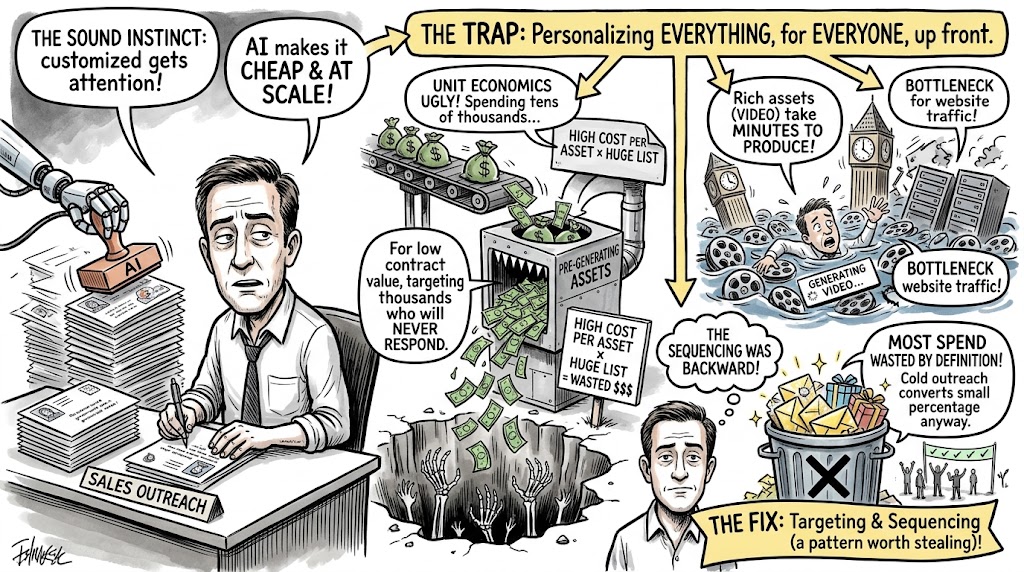
The trap: personalizing everything, for everyone, up front
The instinct behind this kind of outreach is sound. A generic cold email gets ignored. A genuinely customized one, something that shows you understand the specific prospect's situation, gets opened and remembered. AI makes that kind of customization cheap enough to attempt at scale for the first time, and that's genuinely new. The problem shows up when you try to apply it uniformly across your entire addressable market instead of targeting it.
- The unit economics get ugly fast. If generating one customized asset costs even a dollar, and you're targeting tens of thousands of prospects at a low average contract value, you can end up spending tens of thousands of dollars pre-generating content for people who were never going to respond.
- Generation time creates a bottleneck. A rich, customized asset, video, in particular, can take several minutes to produce. That's fine for one prospect. It's a serious infrastructure problem when you're trying to do it in the moment for anyone who lands on your site.
- Most of the spend is wasted by definition. Cold outreach converts at a small percentage no matter how good it is. Pre-generating your most expensive asset for one hundred percent of a list guarantees that the vast majority of that spend never gets seen by someone who converts.
None of this means the idea is bad. It means the sequencing was backward. The fix that came out of the discussion is a pattern worth stealing for almost any SaaS company thinking about AI-personalized outbound on a large prospect list.
The two-step fix: cheap first, expensive only after they engage
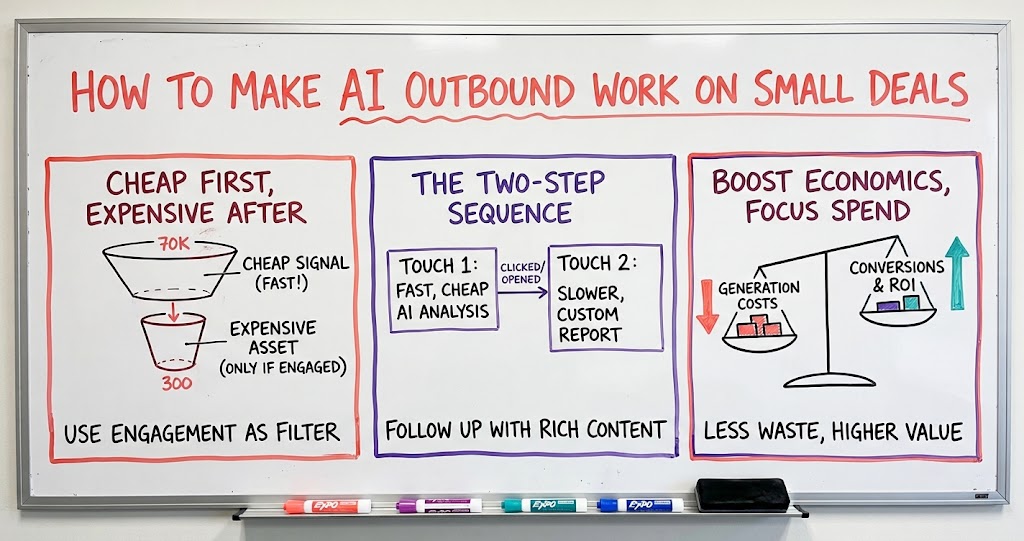
Instead of generating your most expensive, most impressive asset for every prospect before you know whether they care, split the experience into two moments. The first is cheap and fast. The second is expensive and slow, but it only fires for the people who already showed you they're paying attention.
- Step one: send something cheap and instant. A text-based analysis, a summary of something public about their business, anything that's easy to generate at scale without a six-minute render time. This is what goes out to your full list.
- Let engagement be the filter. Only after a prospect opens that first email and engages with it do you queue up the expensive asset, the video, the deep custom report, in the background.
- Deliver the expensive asset as a follow-up. By the time they've spent a couple of minutes with your first message, the second, richer asset is ready. Now your outreach looks like two separate moments of value instead of one expensive swing that might miss.
- You generate hundreds, not tens of thousands. If your list is 70,000 prospects, but only a few hundred actually engage with the first-touch email, that's the number you need to generate the expensive version for. The math suddenly works.
This reframes the entire cost structure of the campaign. You're not trying to guess up front who's worth the investment. You're letting the prospect tell you, for free, by whether they open and engage with the cheap version first. As one founder put it during the discussion, people will generally wait about sixty seconds for something that feels like a personalized report, which is roughly the length of most people's patience for anything online. That's your window to earn the right to spend more on them.
What this looks like for a real prospect
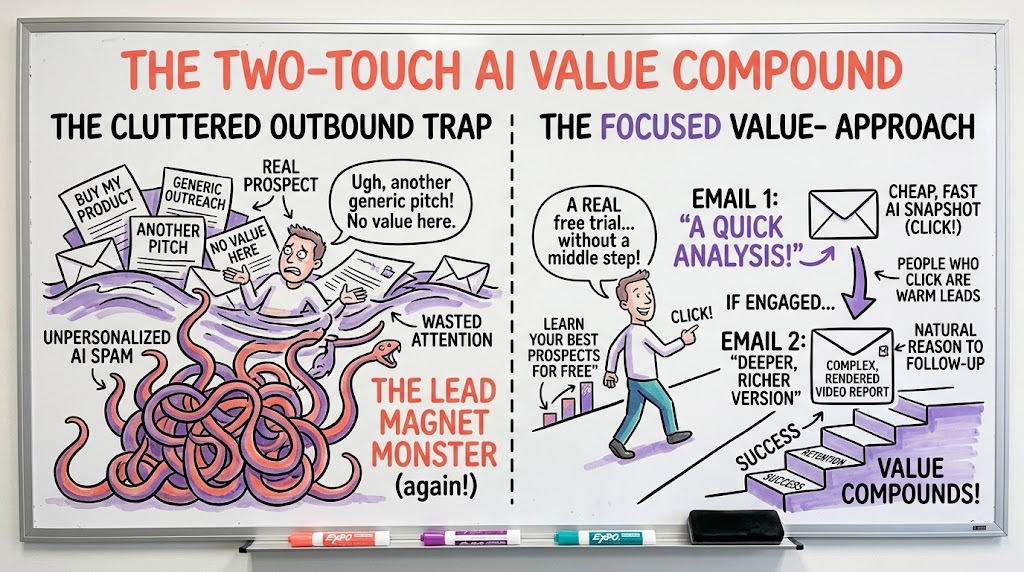
Picture a prospect who gets an email that says something like, "I pulled together a quick analysis of your recent content and how it compares to others in your space." They click. They spend a minute or two looking at something clearly built around their own public information. That's already more attention than most cold outreach earns. A few minutes later, a second email arrives: a deeper, richer version, the thing that took six minutes to render, now sitting in their inbox because they showed interest in the first one.
- The brand impression compounds. Two touches of real, specific value land very differently than one generic pitch, even if the second one only reaches a fraction of the list.
- The follow-up has a natural reason to exist. You're not just "checking in." You have something new and better to show them, which makes the second email easy to write and easy to justify sending.
- You learn who your best prospects are for free. Engagement with the first-touch email becomes a lead-scoring signal you didn't have to build separately. The people who click are self-selecting as your warmest leads.
Where this applies beyond cold outbound
The same two-step logic shows up elsewhere in B2B SaaS, and it's worth recognizing the pattern rather than treating it as a one-off outbound tactic. Any time you're tempted to use AI to generate something expensive for an entire list before you know who's interested, ask whether there's a cheaper, faster signal you could collect first.
- Sales rooms and microsites work the same way. Another founder in the discussion described building lightweight, customizable microsites for prospects, starting with a simple logo swap and curated existing content, and only investing in fully custom video or deep-dive assets once a deal is clearly progressing and the prospect has shown real intent.
- Onboarding flows can defer expensive personalization. You don't need to generate a fully custom experience for every new signup on day one. Let early behavior tell you who's worth the extra investment.
- Content and campaigns follow the same rule. Cheap, broad, and fast for the top of the funnel. Expensive, narrow, and slow only after someone has proven they're worth the spend.
AI has made it tempting to personalize everything for everyone, simply because it's now technically possible. The founders who get the most out of it aren't the ones generating the most content. They're the ones who figured out where the cheap signal belongs in the funnel, so the expensive, impressive work only gets spent on the people who already told you they're listening.
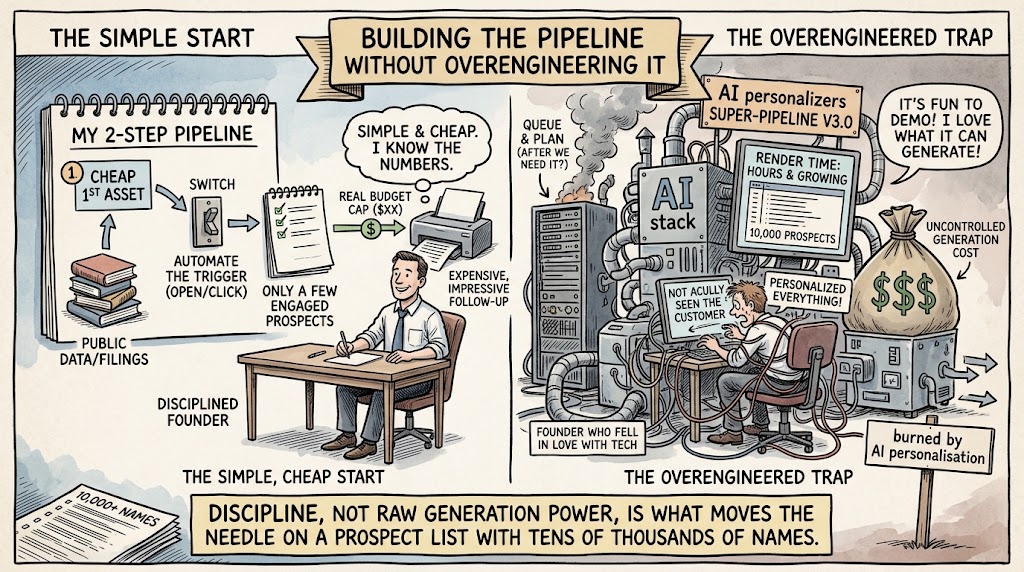
Building the pipeline without overengineering it
You don't need a sophisticated AI stack to start testing this. Most of the tooling that makes a two-step outbound sequence possible already exists in whatever email or marketing automation platform you're using, paired with a language model that can generate the first, cheap asset from public or first-party data you already have access to. The harder part is resisting the urge to build the impressive version first, because that's the version that's fun to demo and easy to get excited about.
- Start with the data you already have public access to. If your market has a defined, findable universe of prospects, like public company filings, public content libraries, or public directories, that's your source material for the cheap first-touch asset.
- Automate the trigger, not the entire pipeline. You don't need the whole system built end to end on day one. A simple rule, generate the expensive asset when someone opens and clicks the first email, is enough to start.
- Set a real budget cap while you test. Treat the expensive-asset generation cost the way you'd treat paid ad spend. Cap it, measure the response rate, and expand only once you know the numbers hold up.
- Watch the render time as your list grows. A six-minute generation process for a hundred engaged prospects is manageable. The same process for ten thousand engaged prospects needs a queue and a plan, so build for that before you need it, not after.
The founders who get burned by AI-personalized outbound are usually the ones who fell in love with what the technology could generate before they worked out who should actually receive it. Flip that order. Figure out your cheapest possible signal of real interest first, and let that signal decide who's worth the expensive, impressive follow-up. The technology is capable of a lot more than most sales processes are disciplined enough to use well, and discipline, not raw generation power, is what actually moves the needle on a prospect list with tens of thousands of names sitting on it.