
How to Integrate Agentic AI into Your SaaS Product
A founder facing a fork in the road, embed AI deep into one vertical or decouple it and go horizontal, brought the question to a room of SaaS operators. Their answers point to a clear starting principle for any founder building an agentic AI strategy.

A founder running the leading ERP platform for the cannabis industry brought a genuinely hard strategic question to the group recently. His market is small and volatile, and he was laying out three different paths for where to take AI inside his product. He could keep building AI deep into his existing platform and ride that vertical all the way, essentially building what he called an agentic operating system for his industry. He could decouple the AI layer from the core ERP and make it easier to plug into other industries, taking a lighter version of the product horizontal. Or he could go narrow and deep on one function, accounting, and build a tight AI layer that integrates hard with tools like Sage and NetSuite rather than trying to cover manufacturing, distribution, and everything else.
That's not a hypothetical question. It's the question most SaaS founders are quietly wrestling with right now, whether they've said it out loud in those terms or not. Do you build AI as a feature of what you already do, or does AI change what you should be building in the first place?
Start with your wedge, not your whole product
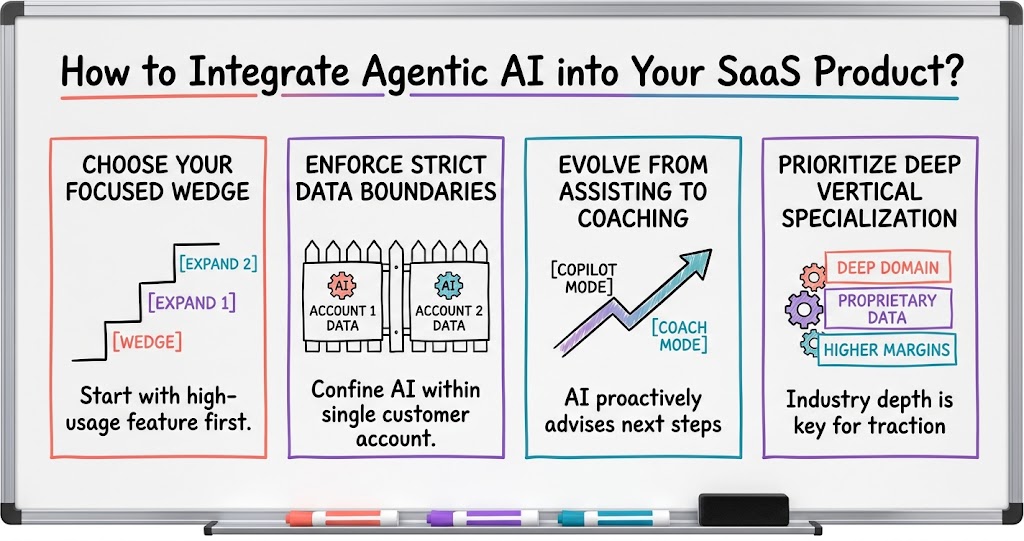
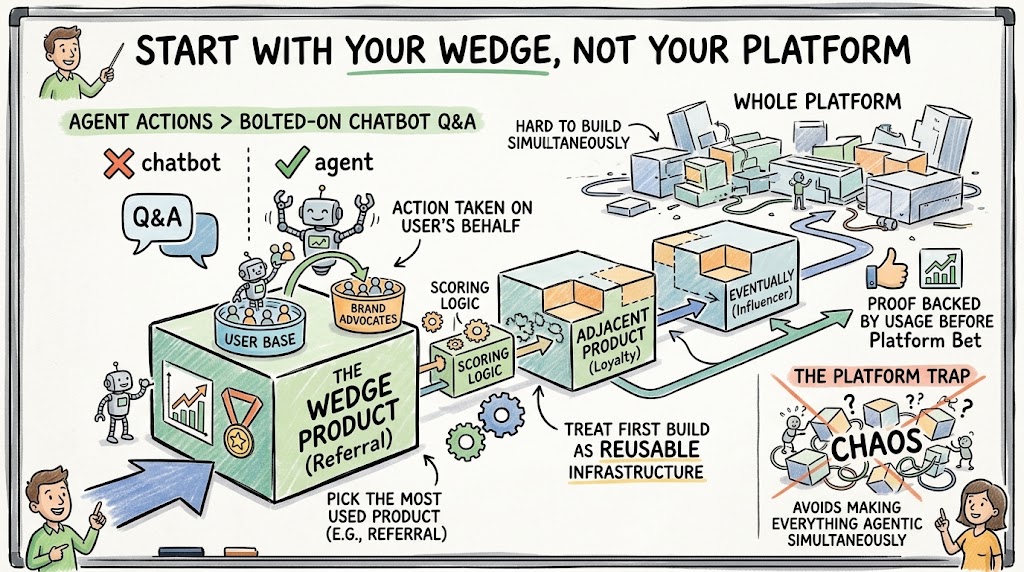
The most concrete answer in the room came from a founder who runs referral, loyalty, and influencer marketing software. Rather than trying to make his entire suite agentic at once, he picked the single product his customers use most, referral marketing, and asked a focused question: within that one product, what does a genuinely agentic solution look like? His answer was an agent that finds which of a customer's users are ready to be activated into brand advocates who'll actually refer the product. That's the wedge he's building against, and only once that infrastructure works does he plan to extend it into loyalty and, eventually, influencer.
- Pick the product your customers use most. That's where an agentic feature has the fastest path to real usage and real feedback.
- Ask what an agent would do, not what a chatbot would say. The useful framing is an action the software can take on the user's behalf, not just a Q&A layer bolted onto existing screens.
- Treat the first build as reusable infrastructure. The scoring and activation logic built for one product line can extend into adjacent product lines once it's proven.
That approach avoids the trap of trying to make everything agentic simultaneously, which usually means nothing gets built well. It also gives you a real answer, backed by usage, before you commit to a bigger platform bet.
Agentic AI on your customer's own data, safely
A second pattern that came up is using agentic AI inside the boundaries of a single customer's own data set, rather than across your whole platform. One founder described letting his enterprise clients search and report on their own imported data using an agent, with a hard constraint that the agent never reaches outside that customer's own data. For enterprise buyers, especially ones handling sensitive records, that boundary isn't a nice-to-have. It's often the difference between a security team approving the feature and blocking it outright.
Another founder described a more ambitious version of this same idea, moving from what he called a copilot model, where the user still knows what they're doing and the AI assists, toward a coach model, where the system actively advises the user on what they should be doing next. His example: a customer built a prospect list for a nonprofit's car-race fundraising event, and the system flagged that the list scored low against similar past offers, then recommended targeting automotive dealerships instead, a group with a much higher predicted response rate. That's a meaningfully different product experience than a search box. It's the software taking a point of view.
- Copilot mode: the user drives, AI assists. Good for search, summarization, and speeding up work the user already knows how to do.
- Coach mode: the AI has a point of view. It scores your input against what's worked before and recommends a different path, which requires real confidence in your own model or data.
- Data boundaries matter more as you go agentic. Enterprise buyers will ask hard questions about whether the agent can see or act outside their own account, so design that boundary early rather than retrofitting it.
Should you take a vertical product horizontal?
The cannabis ERP founder also asked a more specific follow-up that's worth its own section: has anyone actually taken a vertical product into a new industry, and what did that path really look like? He suspected the honest answer was messier than the easy version people say out loud, we'll just go sell to another industry.
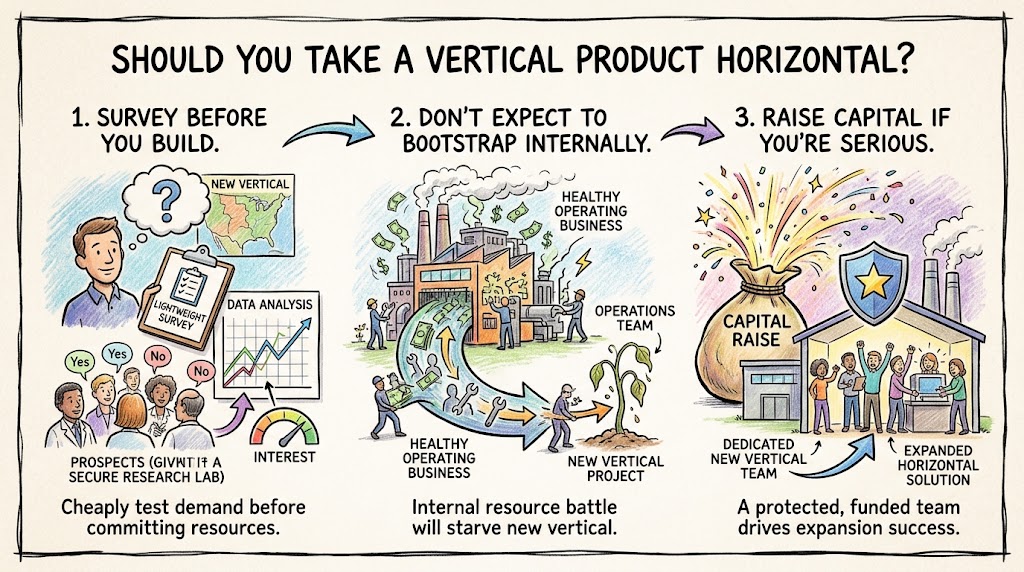
One founder described a disciplined way to test that before committing real resources. Start from your total addressable market, pull a subset of prospects in the new vertical, and run a survey to gauge real interest before building anything. He'd used that process twice to validate entry into new markets, including a move into corporate security and secure research labs handling federal grant money, where access to sensitive intellectual property has to be tightly controlled. In both cases, the survey step told him whether it was worth committing resources before he committed them.
Another founder added a financing observation that matches what I've seen across a lot of portfolio companies: it's genuinely hard to bootstrap your way into a new vertical while you're also running a healthy operating business, because the new effort keeps losing the resource fight to whatever's working today. Where he's seen vertical expansion actually succeed is right after a capital raise, when a founder can staff a dedicated team for the new vertical instead of pulling people off the business that's already paying the bills.
- Survey before you build. A lightweight survey of prospects in the target vertical is a cheap way to test demand before committing engineering time.
- Don't expect to bootstrap it internally. An existing profitable business will almost always starve a new vertical of resources unless that team is protected.
- Raise capital if you're serious about the pivot. A dedicated, funded team dramatically improves the odds of a vertical expansion actually working.
The three paths, and how to actually choose between them
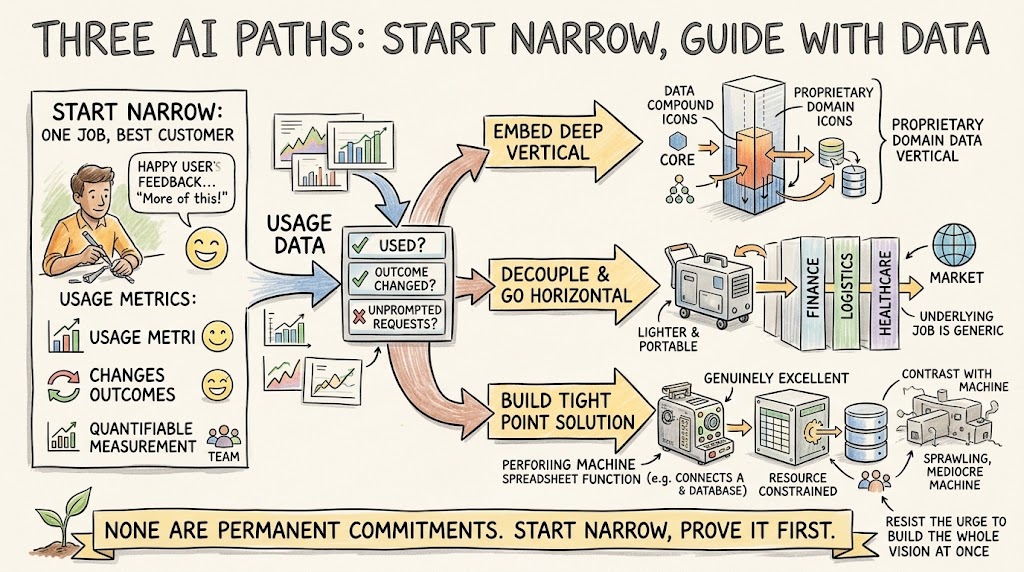
Going back to the original question, embed AI deep into one vertical, decouple it to go horizontal, or build a narrow point solution, I don't think this is a decision you make from a whiteboard. It's a decision you make from usage data, the same way the referral marketing founder approached his wedge. Build the narrowest, highest-conviction version first: one agent, on one product line, solving one specific job your best customers already have. Watch whether it gets used, whether it changes an outcome you can measure, and whether customers ask for more of it unprompted.
- Embed deep when your data moat is real. If your product sits on proprietary domain data that a horizontal competitor can't easily replicate, going deeper into your existing vertical usually compounds that advantage.
- Decouple and go horizontal when the underlying job is generic. If the workflow your AI layer automates isn't actually specific to your industry, a lighter, more portable version of it may find a bigger market outside your current vertical.
- Build the tight point solution when you're resource constrained. Going deep on one function, the way the accounting-and-ERP-integration path was framed, lets a smaller team ship something genuinely excellent instead of something mediocre across many surfaces.
None of those three paths are permanent commitments. The founders who described real traction in the room had all started with the narrowest version of their bet, and only expanded once the first version proved itself with real customers. That's the actual lesson underneath all three options: whichever path you pick, resist the urge to build the whole vision at once.
Why vertical, AI-native SaaS has the edge right now
My own view on this, and something worth sitting with if you're facing a version of this decision: twenty years ago, building horizontal software was the easier path because customer acquisition costs were low enough that you could win broad markets without deep domain expertise. That's not the environment we're in anymore. These days I've consistently seen vertical SaaS products command higher multiples and run more profitably than their horizontal counterparts, largely because depth in one industry lets you build product and go-to-market advantages a horizontal competitor simply can't match.
That's the same logic that should guide your agentic AI roadmap. The founders in the room who were seeing traction weren't the ones trying to build a general-purpose AI layer. They were the ones going deep on the one product their customers already use most, teaching the agent their specific domain, and only then asking whether that infrastructure could stretch further. If you're staring down a similar fork, start narrow, prove the agent adds real value inside your best product, and let that success tell you whether horizontal expansion is worth the resources it will take.