
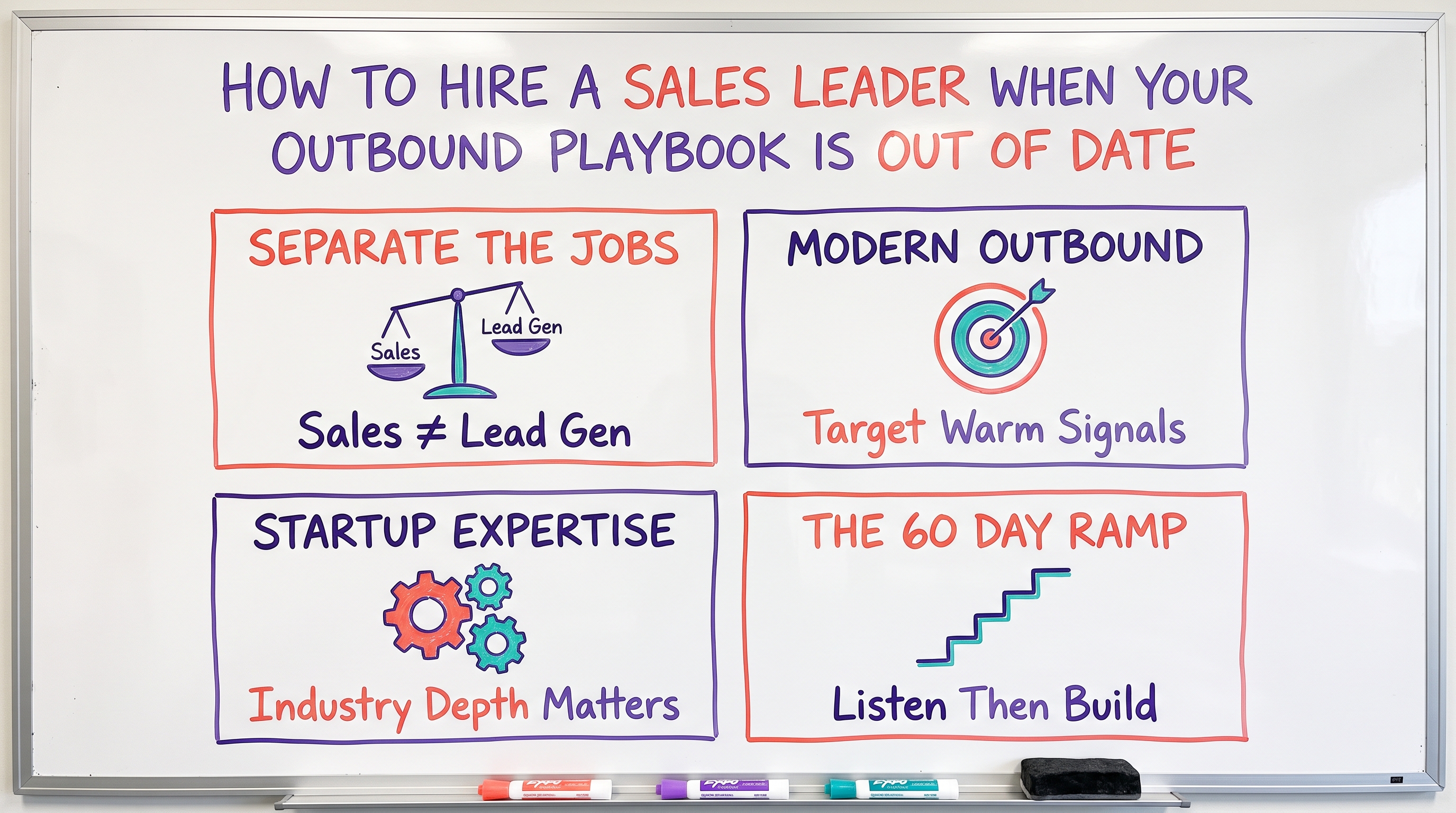
How to Hire a Sales Leader When Your Outbound Playbook Is Out of Date
Hiring a sales leader and fixing outbound lead generation are two separate jobs, and asking one person to do both is expensive. Here is how to split them, what to look for, and how to onboard in the first 60 days.

Two conversations in our mastermind this month sounded different on the surface and turned out to be the same problem. One founder has been through a string of sales leaders who each promised to build an outbound engine and then failed to deliver one. Another founder is two weeks away from bringing in a senior sales executive for the first time and wanted advice on making the hire work. Both were really asking what a sales leader is for in a market where the playbook changed within the last year and a half.
I came away with a view that I think saves a lot of money. Hiring a sales leader and fixing your outbound lead generation are two separate jobs, and most of the expensive failures happen when a company asks one person to do both.
Why sales leaders keep failing at outbound
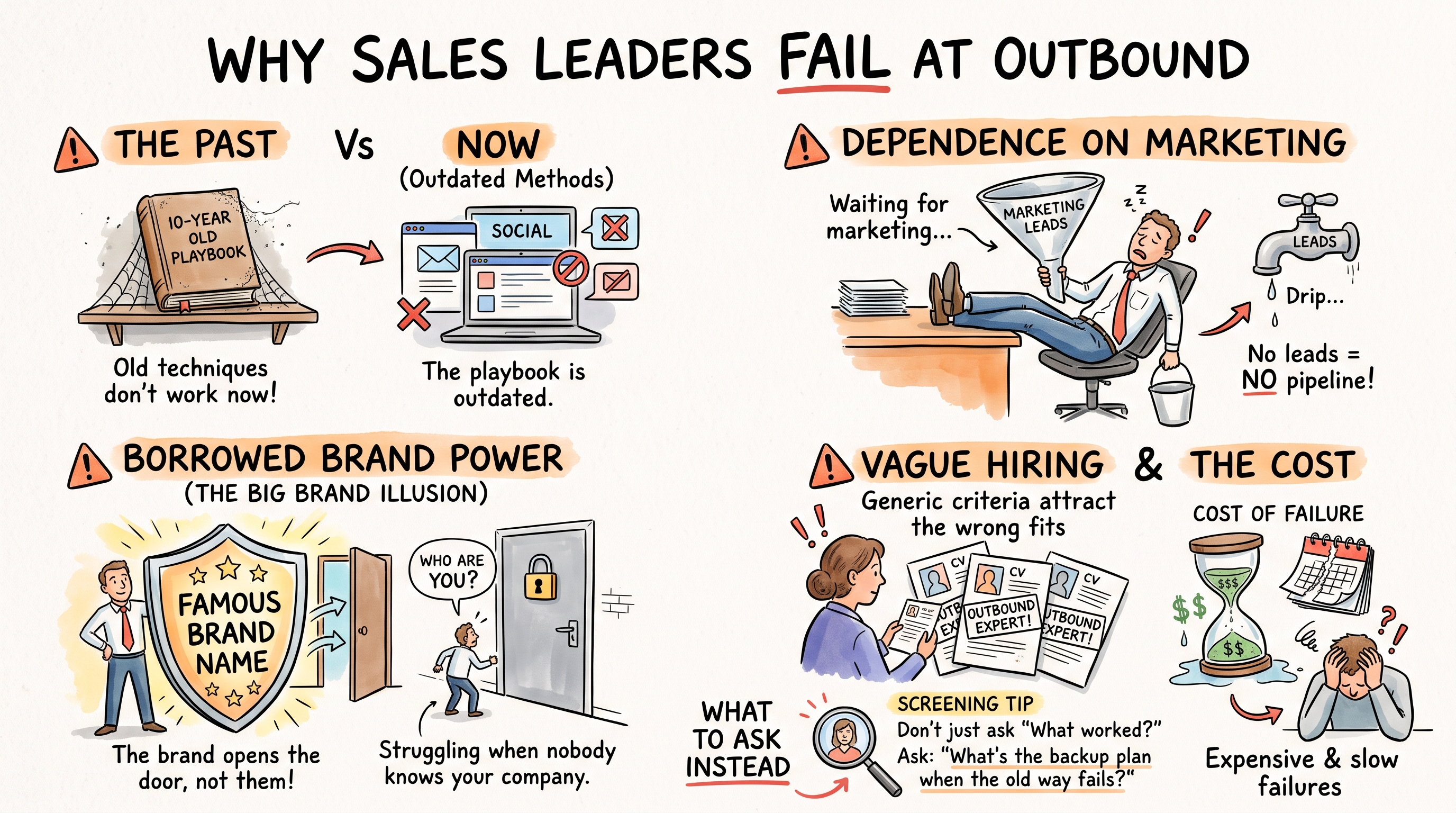
The company in question grew up on inbound. A large marketing team fed a small group of account executives and development reps, and the model worked until competitors at higher revenue levels turned out to rely heavily on outbound. The founder tried to add it by hiring sales leaders who said it was their strength, and several of them fell short. One applied techniques from ten years ago. Others had more recent experience but failed anyway, often because they were used to marketing handing them leads and could not generate pipeline when the leads slowed. The founder also noticed a pattern in the people who failed: leaders from well-known brands, where the name opens doors, find outbound easy, and then struggle badly when nobody has heard of the company. By the end of the conversation the founder suspected the criteria given to the recruiting firm had attracted exactly the candidates who claim outbound expertise.
- Outdated methods. Techniques that worked a decade ago do not carry over to the channels buyers respond to now.
- Dependence on marketing. A leader who waits for leads cannot build the engine you hired them to build.
- Borrowed brand power. People from famous companies often mistake the brand's pull for their own skill.
- Vague hiring criteria. If your brief to a recruiter says outbound expert, you will meet many people who say exactly that.
The cost of these misses is the part that hurts. The founder said each failure was expensive and slow, and that the team usually realized something was wrong long after the damage was done. That is why the screening questions matter so much, and why it helps to question how a candidate would recover when their old playbook fails, and not just what worked for them before.
Separate the two jobs
When I heard the story, my first reaction was that the founder might be asking the wrong role to solve the problem. In many companies marketing owns generating qualified leads, sales owns nurturing and closing them, and customer success owns keeping and expanding customers. Roughly half the time, all lead generation, including ads, organic, and outbound, sits inside marketing. It is not true everywhere, but the logic is sound. In my own agency, which runs ads and outbound for clients, we have had to rethink how we do outbound email and LinkedIn almost from scratch in the last six months. So I told the group, "I rarely see chief revenue officers or VPs of sales be good at outbound." A sales leader who is not working with AI tools every day is unlikely to understand how internet outbound works right now.
- A specialist owns internet outbound. Email and LinkedIn campaigns belong with a go-to-market engineer or an agency that does this work all day.
- The sales leader owns the in-person and phone motions. Calling, field sales, and trade shows fit a traditional sales leader well.
- The sales leader also owns the team. That means coaching reps, setting quota, forecasting, and keeping people motivated.
- Customer success owns retention. Keeping customers and growing their accounts is a separate skill set with its own leader.
My suggestion was to solve the outbound problem first with a strong agency or an in-house specialist, and then hire the sales manager to scale the account executive team based on the new lead volume. Another founder added a related lesson from his own company. He found he needs two kinds of development rep, one with outbound skills and one who handles inbound. The skill sets are different, so assess for each and do not treat them as interchangeable.
What modern outbound looks like in practice
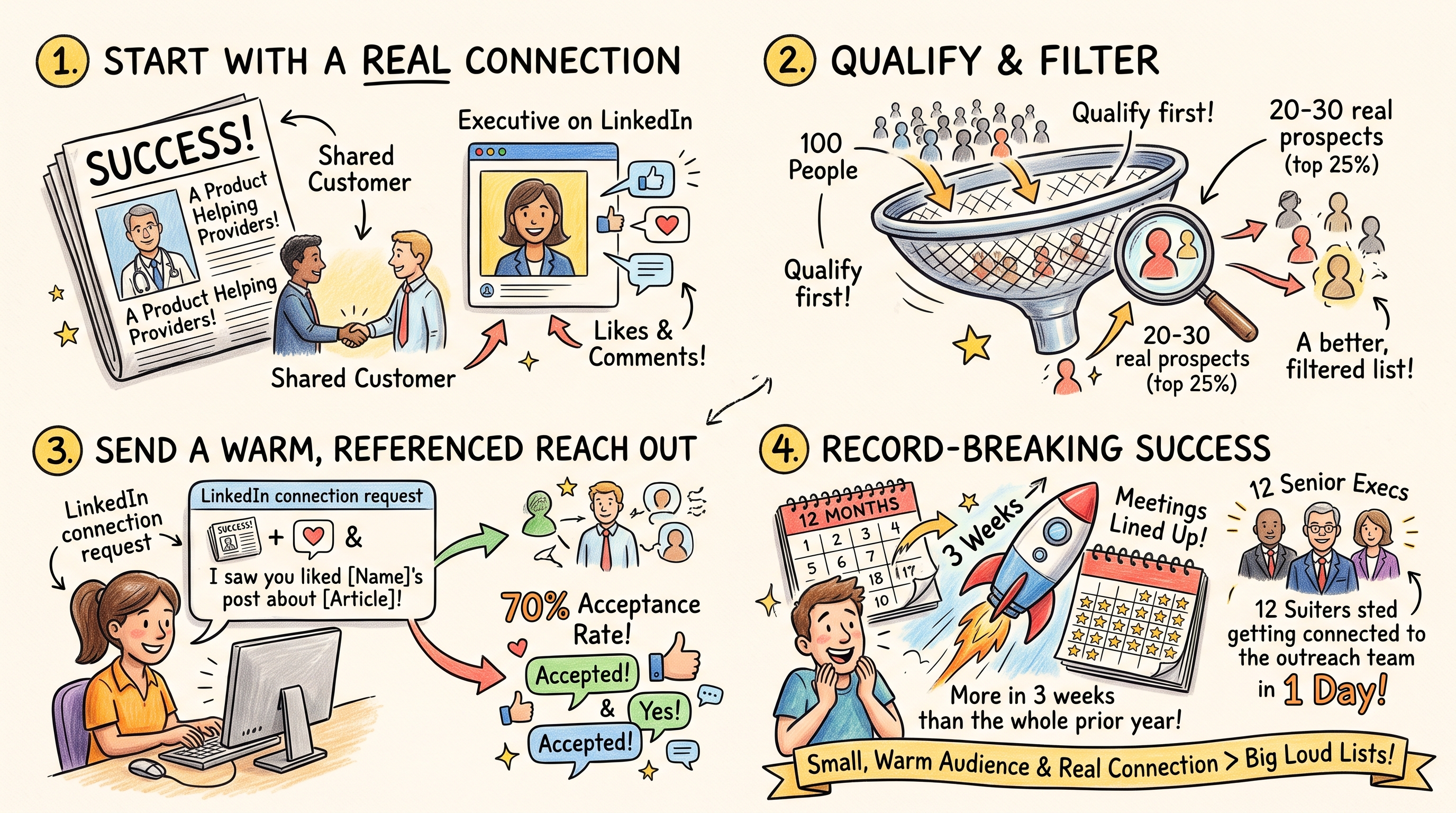
A founder selling to independent medical providers shared an example that shows the shift better than any theory. After a rough year, his outbound took off. A customer of his, a well-known company, had been featured in a public article about how his product helped them. The executives at that company post often on LinkedIn, so his team looked at everyone who had liked those posts. Working from a sample of about one hundred people, he found that twenty to thirty looked like real prospects. His team sent each of them a connection request that mentioned the post they had liked and linked the article. Around seventy percent of the eighty to one hundred people they contacted over two weeks accepted, a high share responded to messages, and meetings are now lined up. He said they accomplished more in three weeks than in the whole prior year, and that a new campaign built the same way brought in a dozen new connections from senior executives in a single day.
- Start from a real connection. A shared customer or a public article gives the other person a reason to reply.
- Find warm audiences. People who engage with a customer's executives are already interested in the topic.
- Reference the specific thing. Name the post they liked and the article that connects you.
- Qualify before you send. Only about a quarter of the original list looked like real prospects, and that screening is part of why it worked.
Nothing in that example involves a bigger list or a louder message. It is a smaller, warmer audience and a better reason to reach out. Whoever you hire, a leader or an agency, should be able to talk about this kind of work in concrete detail.
What to look for when you hire
The founder preparing to onboard a new executive said it plainly: the last sales manager was let go for lack of productivity, which is why the company set out to find a senior revenue leader who understands the mechanics of both the sales process and go-to-market. The search ran through LinkedIn, drew about twenty applicants, and ended with two finalists. The founder offered some hard-earned hiring advice along the way. Do not hire anyone whose entire experience is at a big company, because every time they have tried it, the person did not understand how a startup operates. Another founder in the group, who has been around the block, said the same about vertical depth. He hired a chief revenue officer who looked great on paper and is a good person, and after three months the executive was still struggling to get a handle on the ideal customer and the industry's connections.
- Skip big-company-only résumés. A startup is a different operating environment, and experience at scale does not transfer automatically.
- Value industry depth. Someone who knows the trade shows, the connections, and the language of your buyer saves months.
- Ask for specifics on outbound. Have them walk through a recent campaign and what they changed when it stalled.
- Check your own enthusiasm. One founder asked whether the hire was a clear yes or a hesitant one, and that gut check is worth doing honestly.
Even with all that, the hire will take a quarter to prove itself. That is why the first two months matter more than the interview.
The first 60 days
I shared how a sales leader I hired at my previous company handled his first two months, because it is the best onboarding I have seen. We had about twenty people in the sales department, and over the next few years revenue grew from around ten million dollars a year to around fifty million. He was an experienced sales executive and I was a young CEO, but he led the process and I mostly got out of the way. In his first thirty days he met every member of the sales team one on one, then every member of marketing and customer success. He split his time evenly between interviewing the team and interviewing customers. He also made sure there was a strong leader in each of three areas: the development reps, the account executives, and customer success. Where there was not, he recruited someone he already knew and trusted. In month two he built revenue forecasts and designed a new quota-based compensation system to launch at the start of the next quarter.
- Days 1 to 30. Meet every person on the revenue team one on one, and spend about half your time talking to customers.
- Build the bench. Make sure there is a leader for development reps, account executives, and customer success, and recruit where there is a gap.
- Days 31 to 60. Set revenue forecasts and design the quota and incentive system for the coming quarter.
- By the next quarter. Roll out the new system, bring in the new leaders, and package a higher-priced enterprise offering with a shared account manager.
After those sixty days it was mostly about keeping the team motivated and hitting quota. Another founder offered advice on the other side of the relationship. Define what you want, set the outcomes and targets, and then let the leader take ownership, trusting and verifying as you go. A new revenue leader may test a different go-to-market motion, and that freedom is part of the point. His own company moved from a product-led approach to a sales-led one after testing it, and it turned out to be a better fit. Give them room to try things, give honest feedback early, and cut quickly if it is not working.
