How to Get More Done as a CEO
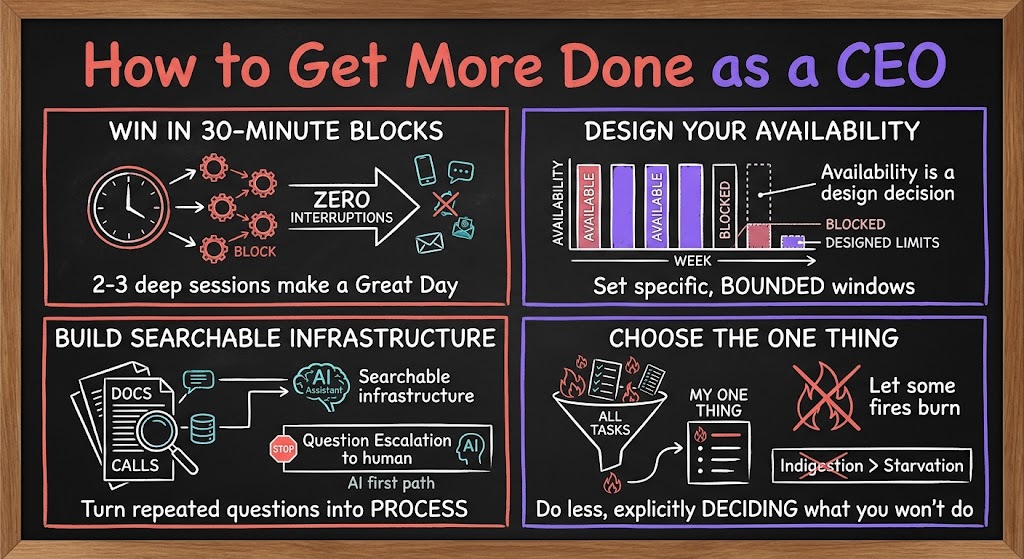
The productivity playbook that emerged from a SaaSRise mastermind call: protect short blocks of deep work, become less available on purpose, never answer the same question twice, and pick the one thing that makes everything else easier.

Every few weeks on our SaaSRise mastermind calls, a topic comes up that gets every single founder in the room nodding. This week it was the question of how a CEO actually gets meaningful work done when the whole company is set up to interrupt them. One member kicked it off by describing his days as a blur of context switching. He can be genuinely creative when he's in flow, but the moment someone pulls him into something unrelated, he loses the thread, and rebuilding it wastes more time than the interruption itself.
It's worth pausing on why this hurts as much as it does. Another member pointed out that context switching is well-studied, with estimates putting the cost of each switch at somewhere between 8 and 20 minutes of lost focus before you're fully back in the work. Multiply that by the 20 or 30 interruptions in a normal founder day and you can lose most of your productive hours without ever feeling like you stopped working. That's the real enemy here, and it's why the answers below are about structure rather than effort.
What I loved about the discussion is that nobody offered a productivity app as the answer. The advice that came back was about designing your time, your availability, and your company so that focus becomes the default instead of a daily fight. Four practices stood out, and each one came from a founder who is actually living it.
Win the day in 30-minute blocks
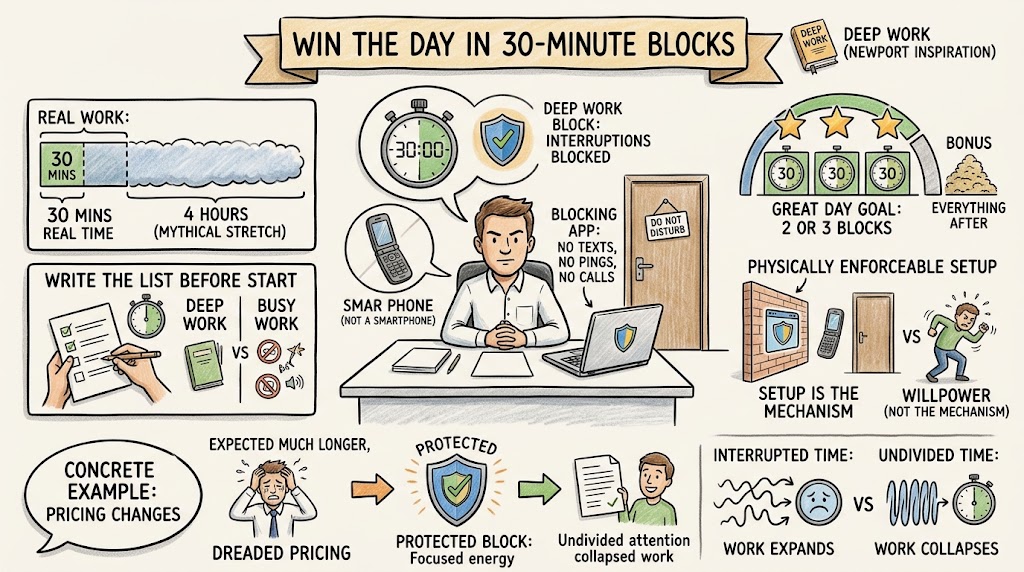
One member's whole system is built on short, absolutely protected blocks of deep work, borrowed from Cal Newport's book Deep Work, which he recommended to the group without reservation. His version is more hardcore than most. He carries a flip phone instead of a smartphone for parts of his day, and when he sits down to work, he starts a timer with an app on his laptop that blocks every distracting application, so nobody can text him, call him, or ping him until the timer runs out. Then he writes down the short list of things he's going to finish and doesn't get up until they're done.
- Thirty minutes is enough. His unit of work is a 30-minute block with zero interruptions, not a mythical four-hour stretch that never materializes.
- Two or three blocks is a great day. His only daily goal is hitting two or three of these sessions. Everything else is a bonus.
- Make the block physically enforceable. A blocking app, a flip phone, a closed door. Willpower is not the mechanism; the setup is.
- Write the list before you start. Deciding what the block is for ahead of time is what separates deep work from busy work.
He gave a concrete example: right before joining our call, he ran one 30-minute block to work through a set of pricing changes he'd been dreading. He expected it to take much longer, and with truly undivided attention it didn't. That matches my experience exactly. The work expands to fill interrupted time, and it collapses when the interruptions disappear.
Become less available, on purpose
The second theme was harder to hear, because it cuts against how most founders think about being a good leader. One member admitted that his biggest mistake was making himself too available to everyone on the team. It felt supportive, but what it actually meant was that everybody dragged him into their own problems, all day, every day. His fix was to block specific times in the day and week where he focuses on one or two tasks only, and to treat the rest of the team's access to him as something with boundaries rather than an open door.
Another founder took the same idea further than most of us would dare. He recently left every engineering channel in his own company's chat. He told one person, you're the default now, and when somebody messages him directly, his answer is that it's not his problem anymore. He was honest about how it felt, and I'll quote him because the honesty is the useful part: "It's really hard to do that. And it sucked. But I just don't exist anymore in those channels."
- Availability is a design decision. If you're reachable for everything, you'll be pulled into everything. Choose the windows where you're reachable.
- Name a default who isn't you. Someone must own the questions you used to absorb, explicitly, or they'll all find their way back.
- Expect it to feel bad. Both founders described guilt and discomfort. That's the cost of the CEO doing CEO work, and it fades.
The interesting thing is that neither of them reported disaster. The teams adapted, other people stepped up, and the founders got hours of their week back.
Never answer the same question twice
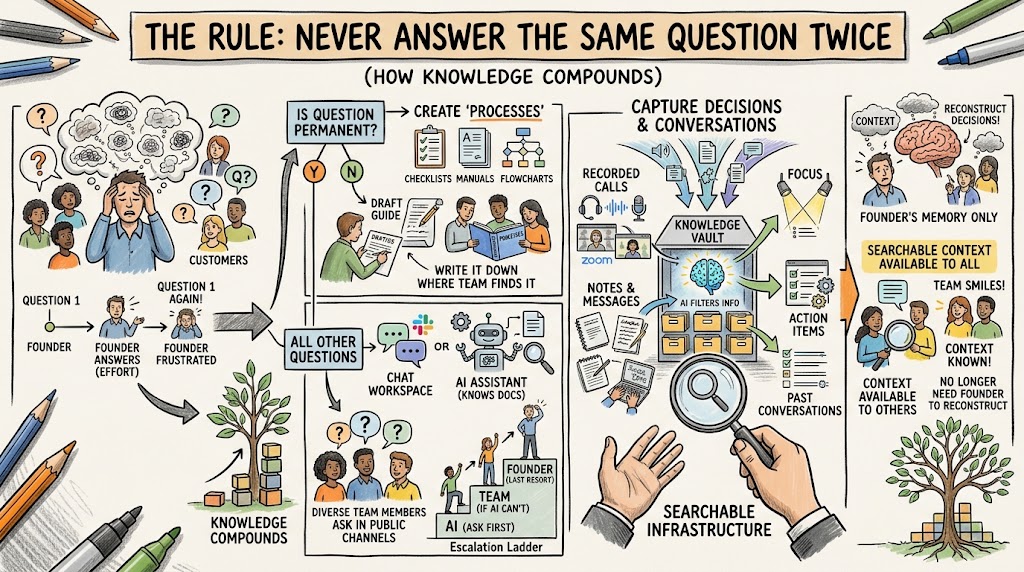
The third practice is my favorite because it compounds. The same member who limited his availability also has a rule that he tries to never get the same question twice. If a question can be resolved quickly and permanently, he sets up a process. And for everything else, his company linked their chat workspace to an AI assistant, moved questions into public channels, and made the norm that anyone who doesn't know or remember something asks the AI first. Only if the AI can't answer does the question escalate to a human, and only then to him.
A couple of other members are building the same muscle from different angles. One records all of his conversations with customers, prospects, and his team, and dumps everything into a company knowledge vault, so an AI can tell him at any point what was discussed, what the action items are, and where his focus should go. The point isn't the specific tool. The point is that every answered question and every recorded decision becomes searchable infrastructure instead of a memory that lives only in the founder's head.
- Turn repeated questions into processes. The second time you answer something, write it down where the team can find it.
- Give the team an AI-first path. A chat-connected assistant that knows your docs takes a surprising share of the daily question load off you.
- Capture decisions as you make them. Recorded calls and running notes make your context available to others, so people stop needing you to reconstruct it.
Do less, deliberately
Underneath the tactics, the call kept circling back to one uncomfortable truth: getting more done as a CEO is mostly about deciding what you won't do. One member rereads the book The One Thing every year to force the discipline. For him, the one thing is product. Everything else is explicitly allowed to be less than perfect, and as he put it, it's okay to let some fires burn. He shared a line he'd picked up that stuck with the whole group: more companies die because of indigestion than starvation. The threat at our stage is rarely doing too little. It's swallowing everything at once and doing none of it well.
Another founder echoed the same lesson from the technical side. Engineers are trained to treat every bug as their fault and every ticket as urgent, so letting a fire burn feels like negligence. Learning that a customer can wait sometimes, and that things still land well in the end, did more to give him his time back than any tool he'd tried. There's a version of this trade for every founder: name the fires you're willing to let smolder for a week, say it out loud to your team, and notice that the world doesn't end.
For anyone who doesn't know where to start cutting, one member offered a simple exercise he swears by. Sit down for 30 minutes with a notebook and a pen, no phone, no laptop, and write down everything that's bothering you. Then look at the list and ask which single item, if it disappeared, would make everything else easier. That's your one thing. Solve it before you touch anything else on the list.
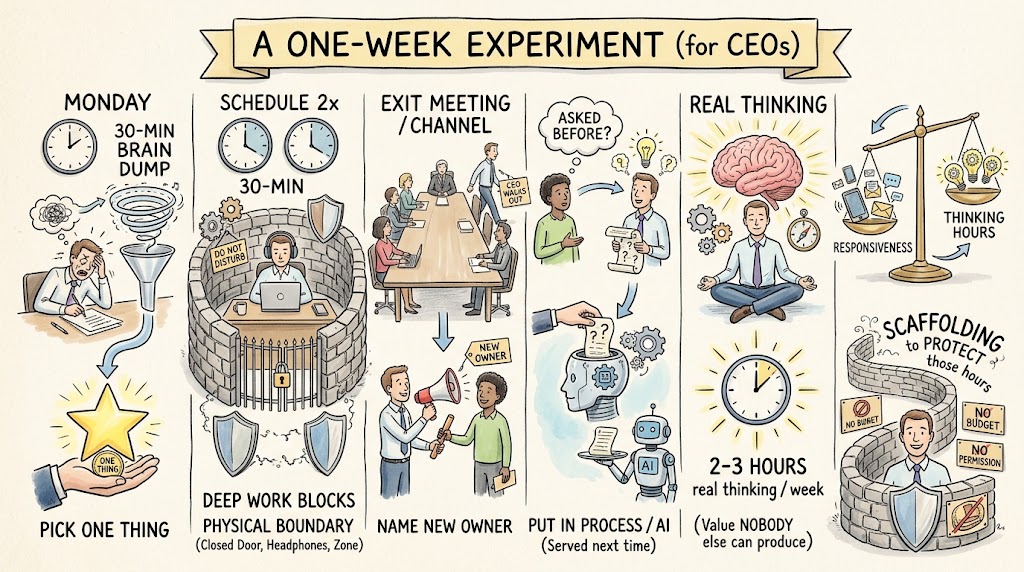
A one-week experiment
If you want to put this into practice, the call basically handed us a one-week experiment. Do the 30-minute brain dump on Monday and pick your one thing. Schedule two protected 30-minute deep work blocks a day, with something that physically enforces the boundary. Pick one channel or meeting to exit, and name the person who owns it now. And the next time you answer a question from the team, ask yourself whether you've answered it before, and if so, put the answer somewhere a process or an AI can serve it next time.
None of these steps require budget or permission. What they require is accepting that the most valuable thing you produce as a CEO is the two or three hours of real thinking a week that nobody else in the company can do, and that responsiveness is what you trade to get them. Everything above is just scaffolding to protect those hours.