
How to Get Millions in Founder Liquidity Without Giving Up Control of Your SaaS Business
Most SaaS founders think liquidity only comes from a full exit. This article breaks down how to take millions in founder liquidity through minority secondaries, revenue-based financing, or structured recaps — without giving up control of your company or sacrificing long-term upside.

If you’ve built a SaaS company with real traction — real ARR, real customers, real retention — there’s a moment that hits hard.
You realize your entire net worth is locked inside the business.
On paper, you’re wealthy.
In reality, you’re concentrated and exposed.
The good news: you do not have to wait for a full exit to create life-changing liquidity. And you do not have to give up control to do it.
But this only works if you approach it strategically.
Step One: Build a Business That Deserves Liquidity
Liquidity is not a financial trick. It’s a byproduct of strength.
Before any investor, lender, or minority buyer allows you to take money off the table, your company must demonstrate durability.
That means:
- Predictable, repeatable revenue growth
- Strong LTV to CAC with clear payback windows
- Low churn and healthy net revenue retention
- A leadership structure that reduces founder dependency
If your SaaS company still depends on founder heroics, liquidity conversations won’t go far. If it runs like a machine, you gain leverage.
And leverage is everything.
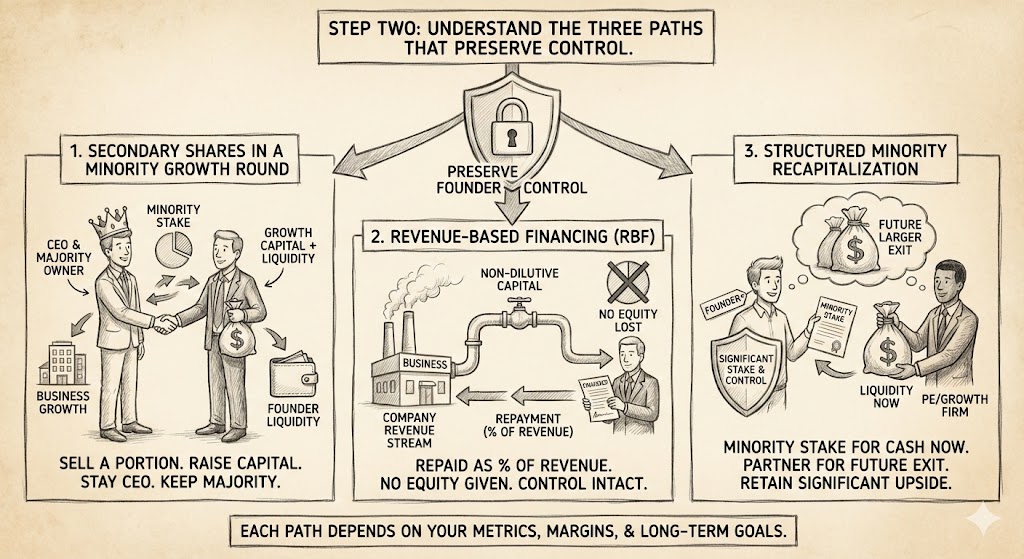
Step Two: Understand the Three Paths That Preserve Control
There are three primary structures founders use to take meaningful liquidity without losing the company.
- Secondary shares in a minority growth round
- Revenue-based financing (RBF)
- Structured minority recapitalization
A minority growth round allows you to sell a portion of your shares while raising capital for the business. You stay CEO. You maintain majority ownership.
Revenue-based financing gives you non-dilutive capital repaid as a percentage of revenue over time. No equity lost. Control stays intact.
A structured recap brings in a growth equity or private equity firm for a minority stake, allowing you to take liquidity now and still participate heavily in a later, larger exit.
Each path depends on your metrics, margins, and long-term goals.
Step Three: De-Risk Personally Without De-Risking the Business
Most founders delay liquidity because they believe it signals reduced commitment. In reality, the opposite is often true.
When you have zero liquidity:
- Every quarter feels existential
- Risk tolerance shrinks
- Short-term decisions creep in
When you take some capital off the table:
- You think in 5–10 year time horizons
- You negotiate with investors from strength
- You make bolder but more rational bets
The business doesn’t weaken. The founder stabilizes.
And a stable founder builds better companies.
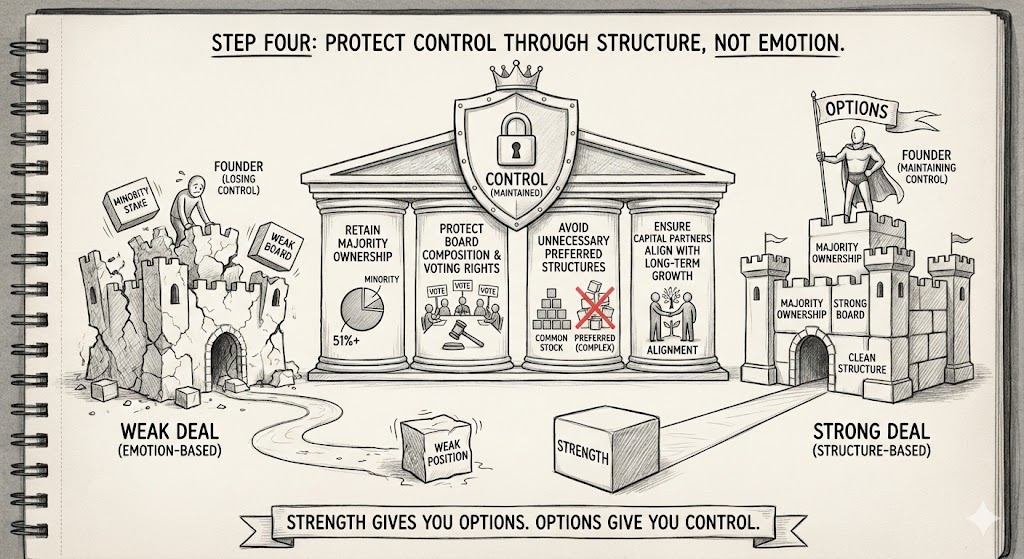
Step Four: Protect Control Through Structure, Not Emotion
Control is not about refusing capital. It’s about structuring it intelligently.
To maintain control while taking liquidity, focus on:
- Retaining majority ownership post-transaction
- Protecting board composition and voting rights
- Avoiding unnecessary preferred structures
- Ensuring capital partners align with long-term growth
The founders who lose control usually don’t lose it because they took liquidity. They lose it because they structured weak deals from weak positions.
Strength gives you options. Options give you control.
The Real Takeaway
You do not have to sell your SaaS company to change your life.
You do not have to choose between security and scale.
But you do have to earn the right to liquidity by building something durable.
Get your growth engine predictable.
Get your unit economics tight.
Reduce founder dependency.
Then structure liquidity from a position of leverage.
That’s how you take millions off the table — and still own the future.