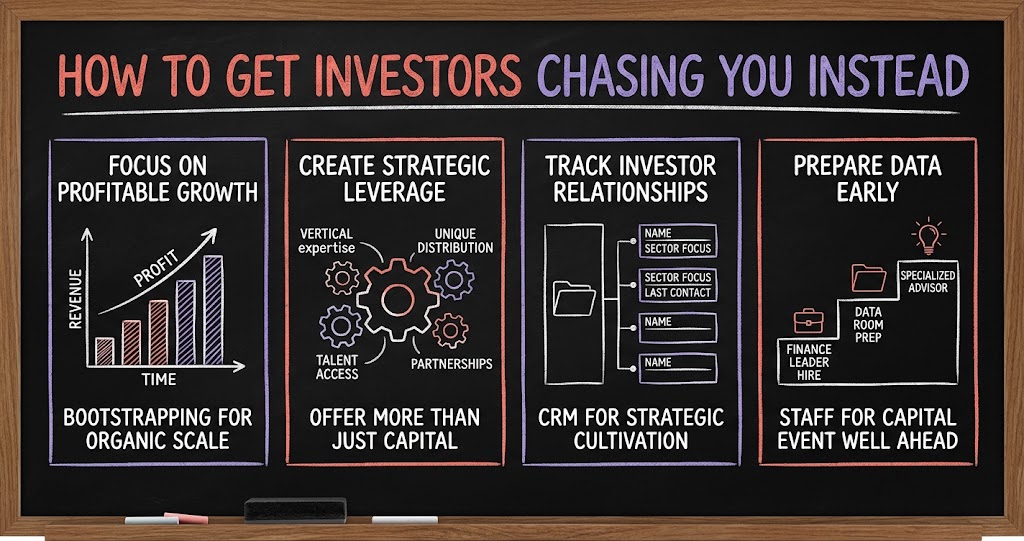
How to Get Investors Chasing You Instead
Once your company starts growing, investor outreach turns into a second job you never applied for. Here's how founders in our mastermind decide who's worth thirty minutes of their week, and who gets politely ignored.

A founder who has bootstrapped his company from day one, closing in on fourteen years of organic growth, brought a problem to our mastermind that a lot of founders would consider a nice one to have. Over the last few months, investor emails had started arriving steadily, each one asking for thirty minutes of his time to "just talk." Taken individually, each request seems reasonable. Taken together, he realized he could easily lose an entire week every month just talking about how well his company was doing, without any of it actually moving the business forward. His question to the group was direct: how do you decide who's worth talking to, and how do you say no to everyone else without feeling rude about it?
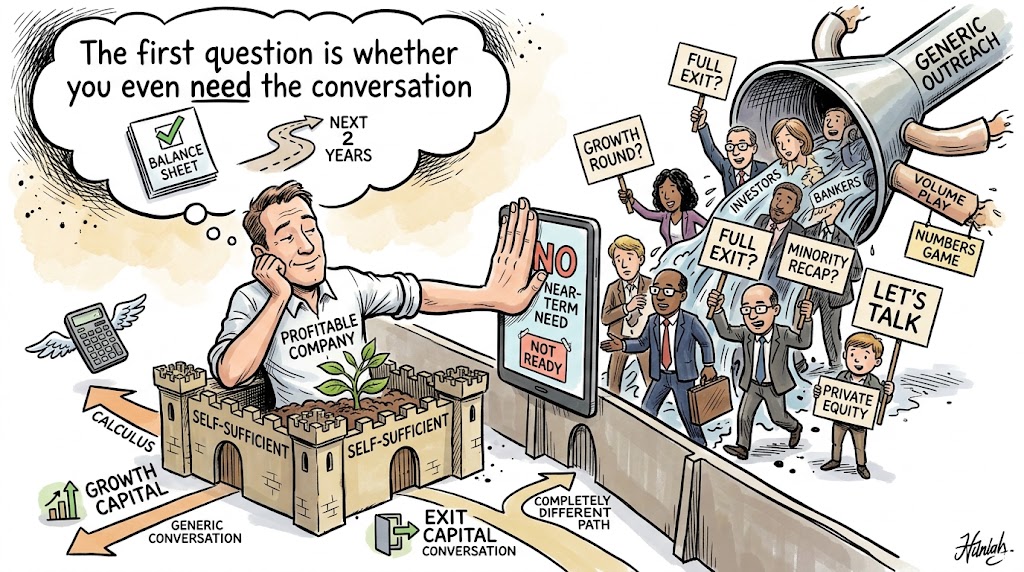
The first question is whether you even need the conversation
Before getting into how to filter investor outreach, the group pushed on a more fundamental question: does this founder actually have a near-term need for outside capital at all? The answers mattered a lot. The company was profitable, reinvesting all of its profit into growth every year, with no plans to raise money and no plans to sell or recapitalize within the next two years.
- No capital need changes the entire calculus. If you're not burning cash and you're not planning a raise or an exit in the near term, most inbound investor outreach isn't actually relevant to you yet, no matter how flattering it feels.
- Growth capital and exit capital are different conversations. A minority recapitalization, a full exit, and a growth round each call for a completely different kind of investor and a completely different kind of preparation. Don't let a generic "let's talk" email pull you into a conversation you're not actually ready to have.
- Most outreach at this stage is a numbers game on their end. It was described in the discussion as similar to outbound sales development, a volume play where investment banking and private equity associates are doing their job by reaching out broadly. That doesn't make the outreach personal or urgent. It makes it exactly what it looks like.
The filter that actually matters: strategic value, not just capital
For a founder who doesn't need money, the advice from the group converged on a single, clarifying filter. Ignore capital as the reason to take a meeting, and instead ask whether the person reaching out could bring something you can't easily get anywhere else.
- Look for real specialization in your exact space. An investor who focuses specifically on your industry, not software broadly, but your specific vertical within it, is a completely different conversation than a generalist reaching out because your name showed up on a list.
- Ask what they can actually offer beyond a check. Distribution, partnerships, access to talent, and introductions within your specific industry are worth thirty minutes. A generic pitch about capital and growth potential usually isn't, especially if you don't need the capital.
- If they can't help with anything beyond money, it's fine to pass. This is the single clearest piece of advice from the conversation: if an investor doesn't specialize in your industry and can't help with distribution, talent, or partnerships, you're allowed to simply keep ignoring them.
This reframes the whole exercise. You're not trying to be polite to everyone who reaches out, and you're not trying to find the single best offer among a pile of generic requests. You're looking for the rare message that offers something specific and useful, and treating everything else as noise you don't owe a response to. One founder's take on this, having fielded roughly a hundred of these calls a week at a much larger company, was to build internal capacity specifically for triaging inbound interest, a finance function whose job includes filtering these conversations before they ever reach the founder's calendar. Not every company needs that kind of dedicated capacity yet, but the underlying principle scales down just fine: someone, whether that's you personally or a finance hire down the line, needs to own the job of saying no on your behalf so the yes conversations get your full attention.
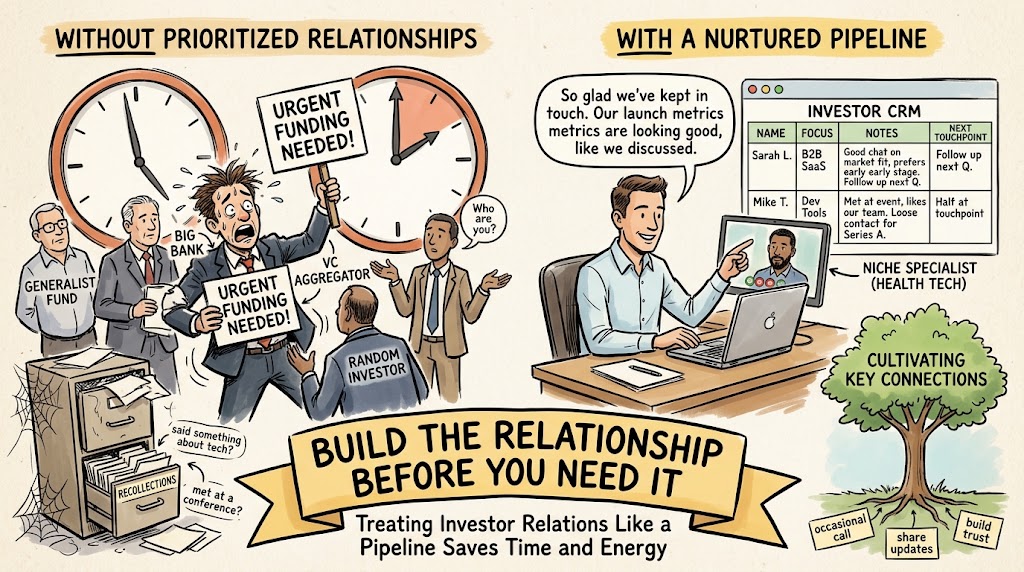
Build the relationship before you need it
Even with a strict filter for who's worth talking to, there's real value in staying organized about the handful of relationships that do pass the bar, well before you're actually raising anything. One founder in the discussion described building out a simple CRM specifically for investor relationships, tracking who he'd spoken with, what they focus on, and which conversations were worth continuing over time.
- Treat it like any other pipeline. The same discipline you'd apply to tracking sales prospects applies here. A simple spreadsheet or CRM with notes on each conversation beats trying to remember who said what eighteen months later when you're actually ready to raise.
- Prioritize investors within your specific niche. If you're in a specialized vertical, the small number of investors who genuinely focus there are worth cultivating a relationship with over time, even with no active plans, because they'll understand your business faster when the time comes.
- Let the relationship develop slowly and naturally. You don't need to commit to anything by taking an occasional call with the right person. Staying loosely in touch with a handful of strategically relevant investors costs little and can save significant time later.
When the calculation changes
The advice shifts meaningfully once a real timeline enters the picture. If you're within eighteen to twenty-four months of an actual exit or capital event, the group agreed that's when it makes sense to get serious: bring in an experienced financial leader who has personally been through a raise or a sale before, and start thinking about hiring a specialized advisor who works specifically within your industry and within software more broadly.
- Get the function staffed before you need it operating at full speed. A financial leader with real experience raising capital or navigating an exit can prepare your data room, your numbers, and your story well ahead of when you'll actually need them polished.
- Specialized advisors matter more as you get closer to a transaction. Generalist advice is fine for early exploratory conversations. Once you're seriously preparing for a minority recap, a full sale, or a growth round, an advisor who's done deals specifically in your sector becomes worth the cost.
- The type of transaction changes the entire preparation. Selling a minority stake to a private equity firm, doing a full exit, and raising a growth round each require different positioning, different numbers, and often different investors entirely. Get clear on which one you're actually preparing for before you start the process in earnest.
Until that timeline is real, the healthiest default for most growing, profitable SaaS companies is to keep ignoring most of what lands in the inbox. Every hour spent talking to someone who can't offer anything beyond generic capital is an hour not spent growing the business, which is the thing that actually determines what kind of conversation you'll be able to have with investors when you're genuinely ready for one.
A simple weekly rule that keeps this from eating your calendar
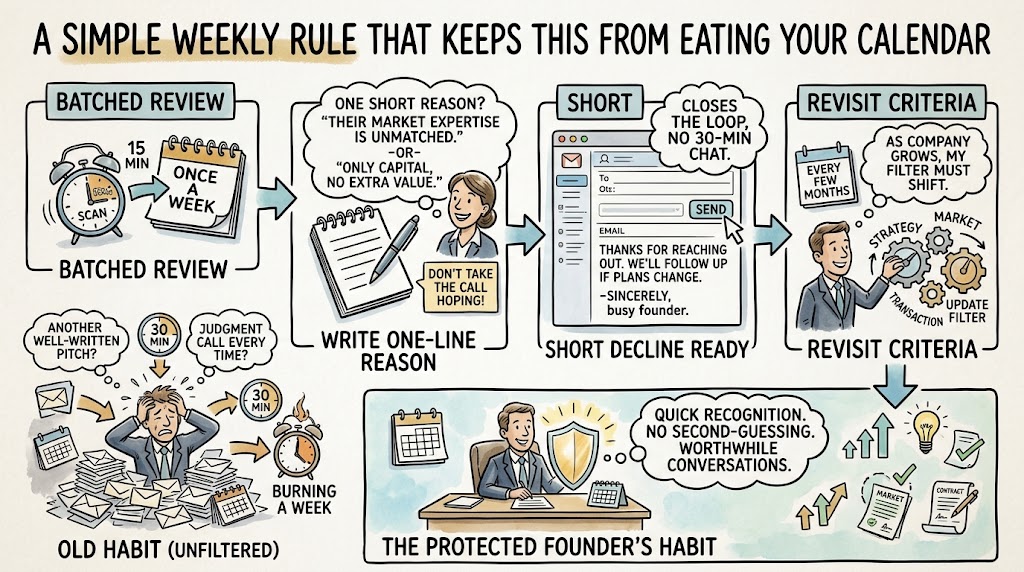
If you're getting more than a handful of these messages a week, it helps to turn the filter into an actual habit rather than a judgment call you make fresh every time an email arrives. A short, repeatable process keeps you from either burning a week on calls that go nowhere or second-guessing yourself every time a well-written pitch shows up in your inbox.
- Batch the review instead of reacting in real time. Set aside fifteen minutes once a week to scan everything that came in, rather than deciding case by case as each email lands. This alone removes most of the pressure to respond immediately.
- Write a one-line reason before you say yes to anything. If you can't articulate, in a single sentence, what this specific person or firm could bring beyond capital, that's your answer. Don't take the call hoping the reason will reveal itself once you're on it.
- Have a short, polite decline ready to go. A brief, genuine response, something like thanking them for reaching out and letting them know you'll follow up if your plans change, closes the loop without opening a thirty-minute conversation you didn't need.
- Revisit your own criteria every few months. What counts as strategically relevant can shift as your company grows, enters new markets, or gets closer to an eventual transaction. Update your filter rather than applying an old one out of habit.
None of this requires being unfriendly. Most investors reaching out cold understand that founders are busy and that a specific, relevant introduction will always get more attention than a generic one. The founders who protect their time well tend to share one habit: they've gotten disciplined about recognizing, quickly and without much second-guessing, which conversations are actually worth having right now.