
How To Get B2B Outbound Emails to the Priority Inbox
Why cold email keeps getting harder and what still works in 2026. Engagement is the currency that earns inbox placement — so tight lists, copy variation, and spreading volume across domains matter more than blasting scale. It also breaks down why your open and click rates are largely fake (bots and security gateways), and how to filter your own data so you steer by replies and meetings, not vanity metrics.

If you're doing B2B outbound in 2026, you already know the hard truth: getting a cold email into someone's priority inbox has never been more difficult. This came up in our Enterprise Mastermind this week, and it's a topic I care a lot about, because I've watched the same trend play out over the last three years. It just keeps getting harder. The sheer volume of email flowing through the system means the filters keep getting more aggressive, and the bar for actually reaching a human keeps rising.
Let me be honest about my own inbox first, because it sets the stage. Even now, I'd estimate that 95% or more of the outbound emails sent to me get filtered out of my priority inbox. Every so often Gmail will surprise me and drop a cold message into priority, almost like it's running a little test to see whether I'll engage with it. But by and large, the overwhelming majority never make it in front of me at all.
So one of our members asked the obvious follow-up, and it's the one everyone doing outbound is quietly worried about: if outbound doesn't reach the inbox, does outbound even work anymore? Here's my answer, and then the more granular playbook from a founder in our group who does this full-time.
Set your expectations correctly
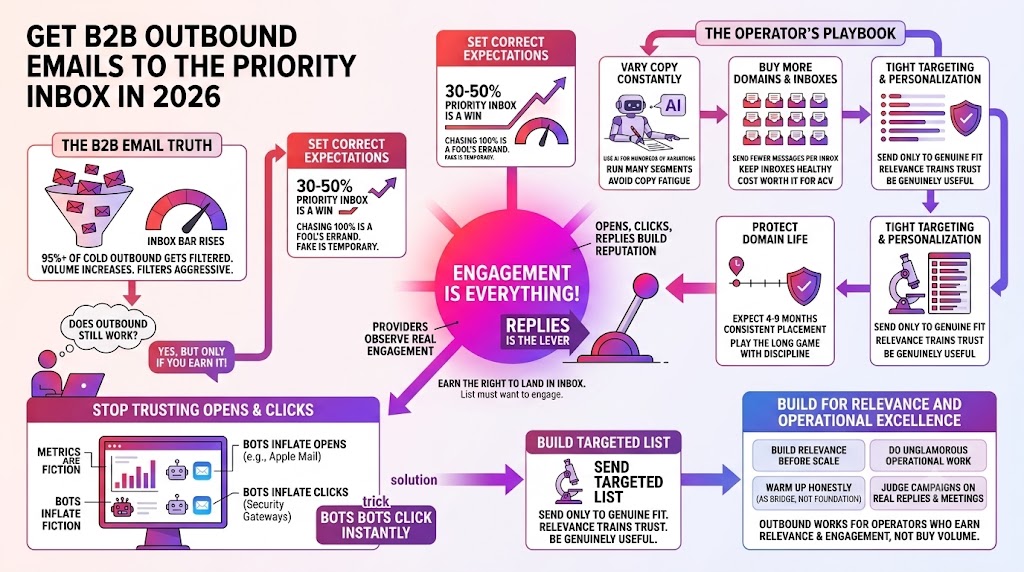
The first thing to accept is the benchmark. No matter what you do, chasing 100% inbox placement is a fool's errand. Reset your expectations around what a strong campaign actually looks like:
- 30–50% to the priority inbox is a win. If you're landing in that band, you're doing well.
- You will not get most of them there. That's normal, not a failure of your setup.
- Engagement is the lever that moves the number. Almost everything else is downstream of it.
Once you internalize that, you stop panicking about the messages that don't make it and start focusing on the things that actually move the needle. And the single biggest one is engagement.
Engagement is everything
This is the whole game. The techniques that reliably get you higher inbox placement almost all come back to one principle: the mailbox providers are watching whether the people who receive your email actually engage with it. If you can demonstrate real engagement, opens, clicks, and especially replies, you earn the right to keep landing in the inbox. If you can't, you get filtered, and no amount of clever tooling saves you for long.
That's why the first few thousand emails from any new domain or inbox matter so much. I'd say the first 5,000 or so set your reputation. To protect that window, every message should be:
- Highly targeted. Send only to people the message genuinely fits, so they're inclined to engage.
- Highly personalized. Generic blasts train the provider to filter you; relevance trains it to trust you.
- Genuinely useful. Give the recipient a reason to open, click, or reply, not just another pitch.
- Backed by real infrastructure. Solid sending setup plus real engagement is the durable, non-gaming answer.
Get the list tight enough that the people who receive your email want to engage with it, and most of the rest takes care of itself.
The ways people fake it
Now, there's a second category of technique, which is faking engagement, and it's worth understanding even if you choose not to lean on it. There are tools, warm-up services and the like, that generate artificial volume back and forth between email accounts, so it looks like your messages are being opened and replied to.
That manufactured engagement can, for a time, buy you inbox placement, essentially holding the door open until real engagement from real prospects can take over. But it's a bridge, not a foundation. If the real engagement never shows up, the fake kind won't save you.
Do more work: the operator's playbook
The most tactical part of the conversation came from a founder in our group who works in the outbound world full-time. His framing was refreshingly blunt: the thing that improved his deliverability the most was simply doing more work. Here's what that means in practice:
- Vary your copy constantly. Run many segments and many variations so no single version gets overexposed. Copy fatigue behaves like ad fatigue, a single variation starts hitting spam around the 20,000-send mark.
- Let AI carry the variation load. Producing hundreds of genuinely different, personalized messages used to be the bottleneck; it's now the part AI is best at.
- Buy more domains and inboxes. Sending fewer messages per inbox keeps each one healthier. It costs more, but if your ACV justifies it, it's worth it.
- Play the long game on domain life. Expect consistent inbox placement for about four months per domain, and up to seven to nine months if you do all the required steps. Skip the discipline and you burn domains far faster.
Stop trusting your open rates
Here's the part I think is most important, and most under-appreciated: your open and click metrics are largely fiction now, and if you're making decisions off them, you're making decisions off noise. Here's why:
- Bots inflate your opens. Apple Mail pre-opens messages, and security gateways like Barracuda and Proofpoint open every email to scan it.
- Bots inflate your clicks too. Those same security systems almost always click the links inside your emails, which registers as a click in your tool.
- The filter trick: bots click instantly, humans don't. Remove everyone who clicked within the first minute of send. You can export your CSV and ask Claude to strip them, and be ready for it to cut your reported stats roughly in half.
- Providers have mixed incentives. Honest platforms filter the bots and show ~15% open rates; permissive ones show 40–50% on the exact same send. You didn't get more real opens, you just stopped filtering the noise.
My own rule of thumb lines up with that. A real open rate, even for a great campaign, is probably more like 20–25%, maybe 35–40% if everything is firing perfectly. On aggressive cold-sending tools, assume something like half of your reported opens are fake. This has been getting worse since around 2016, when cybersecurity bots started opening every email in the world, and now plenty of us have AI assistants reading our inboxes every morning, one more non-human "open" muddying the water. The blunt conclusion one member reached is hard to argue with: there's basically no proof of human left in email metrics anymore.
Where this leaves us
So what do you actually do with all of this? A few things to take with you:
- Build for relevance before scale. A tight, well-targeted list that generates real replies beats a massive list that generates filtered-out opens, and it protects your reputation instead of torching it.
- Do the unglamorous operational work. Many copy variations, individual personalization with AI, and enough domains and inboxes to keep volume light per seat.
- Warm up honestly. Treat any artificial engagement as a temporary bridge to the real thing, never a substitute for it.
- Stop steering by opens and clicks. Filter your own data, strip the sub-one-minute bot clicks, and judge campaigns on real replies, real conversations, and real meetings booked.
Outbound still works. But it works for the operators who've accepted that the priority inbox is earned through relevance and engagement, not bought through volume, and who've stopped letting vanity metrics tell them a story that isn't true.