
.png)
How to Do AI Outbound Email the Right Way
AI can make your outbound incredible—or incredibly bad—depending on how you use it. This guide shows you the right way to blend AI with real human insight so your emails feel personal, thoughtful, and worth replying to. No spammy automation… just smart, modern outbound that actually lands.

Outbound email used to be a game of raw volume. Build a big list, push a sequence, hit send, and hope the laws of probability worked in your favor. For years this approach produced passable results—not because it was good, but because inboxes weren’t yet overrun by the tidal wave of automation, templates, and mass outreach tools that define modern go-to-market.
But the world has changed. Prospects today are flooded with cold emails. The buying journey has shifted. People expect personalization, relevance, and intentionality. And with AI becoming accessible to every sales and marketing team, the standards have risen dramatically.
Outbound hasn’t died.
Bad outbound has.
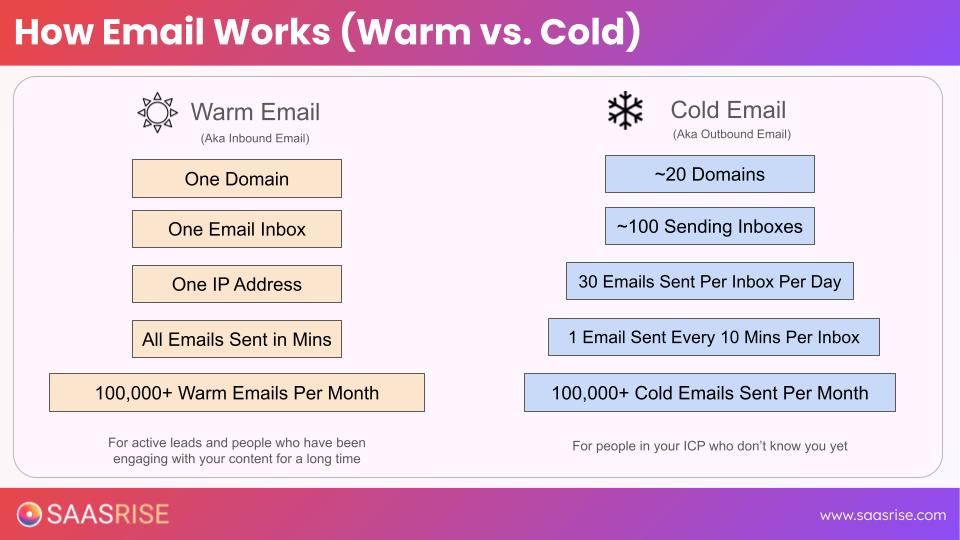
Modern outbound email—the kind that actually works in 2025—relies on AI not to automate more, but to personalize better. To make your messages feel handcrafted, thoughtful, and relevant in a way that no template ever could. AI doesn’t replace the human touch—it scales it.
But like any tool, AI can be misused. And when misused, it produces the robotic slop that buyers instantly recognize and delete. The difference between great AI outbound and terrible AI outbound comes down to strategy, psychology, and execution.
This guide is about doing it the right way.
.jpg)
The Purpose of AI in Outbound Isn’t Automation—It’s Authenticity
.jpg)
If there’s one core misunderstanding about AI in outbound, it’s this:
AI is not a shortcut. AI is an amplifier.
The best-performing outbound teams don’t use AI to blast more messages. They use AI to make each message feel unexpectedly human. AI becomes a creative assistant—researching, analyzing, extracting context, highlighting insights, and generating first drafts that you refine and direct.
The value of AI lies in its ability to pick up the small details:
- A line from a founder’s LinkedIn summary
- A hobby buried in a profile
- A career shift that hints at strategic priorities
- A niche interest shared in a post
- A brief description of the company mission
- A quirky accomplishment that would stand out to anyone who noticed
These details transform a generic cold email into a message that feels intentional. AI allows you to scale that intention across tens of thousands of prospects—something no team of human SDRs could ever do.
AI outbound, done correctly, doesn’t feel like automation.
It feels like someone actually took the time to look you up.
That is the power.
The Foundation: Your ABM List Is the Oxygen AI Needs
.jpg)
AI personalization can only be as good as the data it draws from.
You can’t generate meaningful personalization from thin air.
This is why a deeply enriched ABM list is the non-negotiable foundation of AI outbound. The quality of your inputs determines the quality of your personalization. A great AI outbound sequence begins with fields like:
- LinkedIn headline
- Role summary
- Company description
- Website
- Industry
- Location
- Team size
- Recent funding (if available)
- Context about the ICP’s world
When this data is present, AI can stitch together insights that are invisible to most outbound teams.
The result is an email that references specifics with surprising accuracy—something like:
“Loved how you turned a single surf school scheduling tool into a global watersports platform. That kind of product-market fit iteration is rare.”
Or:
“Your transition from telco data mapping to predictive farming tech is one of the most interesting career arcs I’ve seen.”
The prospect reads this and has a moment of recognition:
They actually understand who I am.
AI didn’t magically intuit this.
It simply had the right ingredients.
Feed it junk and you get junk.
Feed it context and you get connection.
The Anatomy of AI-Enhanced Outbound That Actually Works
The outbound emails that perform best today share several characteristics. They are:
- Short
- Friendly
- Non-corporate
- Personalized
- Value-forward
- Contextual
- Conversational
- Non-salesy
AI helps you achieve all of these at scale.
The magic lies not in writing the entire email with AI, but in using AI to personalize strategic moments inside the email. These moments create micro-signals of human intention.
The three most important personalization elements are:
1. The Subject Line
A personalized subject line instantly separates your message from the dozens of generic ones filling an inbox daily.
AI can reference:
- A prospect’s niche interest
- A recent accomplishment
- A micro-detail from their profile
Something like:
“From kite-surfing to SaaS—your founder story is wild”
No template can do this.
AI can.
2. The Opening Sentence
This is the most powerful personalization lever in outbound today.
Your opener must prove two things immediately:
- You did your homework
- You aren’t sending the same message to everyone
AI-generated openers can draw from real, meaningful signals:
“Saw how your team grew clinical throughput by 40% last year—that’s serious operational improvement.”
or
“Your post about using async standups to boost engineering velocity hit home—brilliant insight.”
When the recipient reads this, they instinctively treat the email differently.
They lean in.
3. The PS Line
One of the most underrated personalization locations.
It’s visually distinct.
It feels casual.
It feels like an afterthought—which makes it feel even more authentic.
Something like:
“P.S. Double valedictorian at Babson? That’s next-level dedication.”
The PS is the personality layer.
AI makes it effortless.
When all three—subject, opener, PS—are personalized, performance jumps dramatically.
And not because AI is clever.
But because the email feels unmistakably human.
AI Should Make Emails Feel More Human—Not More Robotic
The biggest mistake people make when adopting AI in outbound is letting AI write the entire message. Left unchecked, AI tends to produce generic corporate language, overly formal phrasing, and soulless structure.
This is death in outbound.
Buyers don’t want automated politeness.
They want a message that sounds like a real person wrote it at 7:45 a.m. while sipping coffee.
.jpg)
This is where human oversight is essential.
Your voice.
Your style.
Your tone.
Your intent.
AI is the researcher.
You are the editor.
AI is the engine.
You are the driver.
A correctly executed AI outbound email is one where:
- AI handles the personalized pieces
- You control the actual message
- The end result feels organic
If an AI-generated email sounds like an AI-generated email, something has gone wrong.
When you get it right, people reply with messages like:
“Okay, how did you write this? Genuinely curious.”
or
“This might be the only cold email I’ve opened all week.”
That’s when you know AI outbound is working.
Value Is Still the Centerpiece—AI Just Helps You Deliver It Better
Even with perfect personalization, outbound fails if the content itself isn’t valuable.
The job of outbound is to build awareness and interest—not to close deals.
You are not selling.
You are serving.
AI helps you deliver value in a more contextual, relevant way, but you still need to offer something worth reading.
The strongest outbound content today includes:
- A valuable industry PDF
- A meaningful report or survey
- A case study with real numbers
- A powerful template or playbook
- A webinar replay
- A helpful checklist
- A longer free trial
- A short, high-signal video
Think of cold email as your first impression.
It must be helpful.
It must be generous.
It must feel like a favor, not a pitch.
AI doesn’t change this principle—it strengthens it.
When you combine great content with great personalization, engagement skyrockets.
Clicks Matter More Than Replies—And AI Helps You Get Them
One of the most important strategic shifts in outbound today is focusing on clicks as much as replies.
A click tells you far more than a reply:
They opened your email.
They engaged with your content.
They visited your site.
They revealed intent.
.jpg)
And now they fall into your retargeting ecosystem where:
- Meta ads
- LinkedIn ads
- Google ads
- Email nurturing
- SDR follow-up
…all reinforce the impression your sequence created.
AI personalization dramatically increases click rates.
Why?
Because people only click on content that feels relevant to them personally.
When a message references something unique about them, they assume the content will be equally relevant. And this assumption drives curiosity. Curiosity drives clicks.
Outbound in 2025 isn’t about blasting and hoping.
It’s about attracting and discovering.
AI is what makes this transition possible.
AI Outbound Isn’t the Future—It’s the Present
The teams who ignore AI in outbound will find themselves rapidly outperformed by competitors who adopt it.
Not because these competitors send more emails.
But because they send better emails.
Emails that feel:
- Personal
- Accurate
- Thoughtful
- Relevant
- Useful
- Human
AI isn’t a nice-to-have anymore.
It’s the new baseline.
If you’re not using AI to personalize your outbound, you are competing at a disadvantage. Your emails will look and feel like everyone else’s—and in a crowded inbox, sameness is death.
AI outbound done right, however, gives you an edge that is almost unfair.
You’re not scaling automation.
You’re scaling connection.
You’re scaling relevance.
You’re scaling humanity.
And that is what modern outbound demands.
Final Thought: AI Outbound Wins Because It Honors the Human on the Other End
If there’s one principle that sits at the heart of great outbound—AI or not—it’s this:
Respect the reader.
Respect their time.
Respect their intelligence.
Respect their inbox.
Respect their attention.
Respect their world.
AI helps you do this at scale by ensuring each message acknowledges who that person is, what they care about, and how their experience shapes their day-to-day reality.
When outbound becomes a tool for helping rather than harvesting, people feel it.
AI is not the point.
AI is the lever.
The point is connection.
Authenticity.
Value.
Relevance.
Intent.
Do that consistently, powered by AI, and outbound becomes something entirely different:
A channel that prospects actually appreciate—and respond to.
That’s the right way to do AI outbound email.